
APULICA / FRESH PASTA, BREAD AND PASTRY
Focaccia barese
PAT · Fresh pasta, bread and pastry · Puglia
In brief
- A round focaccia about 30 cm across, topped with fresh tomatoes, crisp outside and soft inside. (Atlante dei PAT di Puglia — Focaccia barese)
- Potato goes into the dough, which rises twice before baking. (Atlante dei PAT di Puglia — Focaccia barese)
- It probably began in Altamura or Laterza, as a way to use the wood oven's first, too-fierce heat before the bread went in. (Atlante dei PAT di Puglia — Focaccia barese)
- Its stated area of origin covers the provinces of Bari, Barletta-Andria-Trani and Taranto. (Atlante dei PAT di Puglia — Focaccia barese)
History and origin
Focaccia barese is listed among Puglia's traditional products, with an area of origin covering the provinces of Bari, Barletta-Andria-Trani and Taranto. According to the regional record it was born in Altamura or Laterza, as a variant of durum wheat bread.
Its origin is practical. A wood-fired oven, freshly lit, has an initial heat too strong for baking bread; so before loading the loaves, a piece of raw dough was spread in a tin, left to rest, topped and baked, making use of that first heat.
The history of focacce is much older, though: the name comes from the Latin focus, the fire on which it was cooked, and the Romans already offered them to the gods. Since 2010 a dedicated consortium has promoted focaccia barese made according to tradition.
Sources: Atlante dei PAT di Puglia — Focaccia barese · Masaf — Elenco nazionale dei prodotti agroalimentari tradizionali, XXVI revisione (2026)
Area and method of production
The dough combines water, extra virgin olive oil and yeast with the flours, salt, a pinch of sugar and boiled potato, which makes it soft. The dough is very soft but not runny, and rises for about an hour.
It is then gently turned into an oiled tin dusted with salt and spread with oiled hands without pressing it down, so as not to lose the gas from rising. Cherry tomatoes cut in half are placed on top, skin side up and juicy side against the dough, and it is left to rise for another hour.
Before baking it is sprinkled with salt and oregano. Baking starts at a high temperature at the bottom of the oven and continues higher up at a gentler heat, until the focaccia turns a fine brown.
How to recognise it
Focaccia barese is round, about thirty centimetres across, and is recognised by the fresh tomatoes covering its surface. It is crisp outside and soft inside, made juicy by the abundance of tomatoes that release their juices into the dough as it bakes.
Two details of the recipe explain its texture: the boiled potato in the dough, which makes it soft, and the double rise, first in the bowl and then in the tin under the tomatoes. On top, after baking, the colour is brown. Salt and oregano complete a simple topping of tomato and extra virgin olive oil.
In the kitchen
According to the regional record, focaccia barese is the snack par excellence of the people of Bari. It can replace lunch or dinner, but it is eaten at any time of day, even just as a treat, and it is common to see people enjoying it on the street.
Eating it this way takes some care: with every bite a tomato threatens to fall. It is precisely this abundance of juicy tomatoes that defines it, together with the extra virgin olive oil that goes into the dough and greases the tin.
It needs no accompaniment: it is a complete meal in its simplicity, born as a home dish and now Bari's most representative street food.
Where to taste it
Bari is the city of focaccia: the regional record mentions sales through traditional retailers and specialist shops, and here it is eaten at every hour of the day. A visit to the city is a chance to taste it the way locals do, on the street.
The area of origin extends to the provinces of Barletta-Andria-Trani and Taranto. Altamura and Laterza, the towns where tradition says it was born alongside durum wheat bread, are a natural stop for anyone wanting to discover the bond between focaccia and bread baked in wood-fired ovens.
Protection
- Traditional agri-food product (PAT) — Puglia, n. 226, 26th revision (Masaf — Elenco nazionale dei prodotti agroalimentari tradizionali, XXVI revisione (2026) · Atlante dei PAT di Puglia — Focaccia barese)
When
- Production: all year round (Atlante dei PAT di Puglia — Focaccia barese)
Where

Bari
The old town as a first encounter with Puglia.
Read the guide →Photo: Berthold Werner / Wikimedia Commons — CC BY-SA 3.0 · Resized and converted to WebP.

Read more
Bari focaccia and panzerotti
Potato dough, cherry tomatoes and oregano; the fried half-moon filled with mozzarella: history, technique, local variants and how to taste them in Bari.
Read the guide →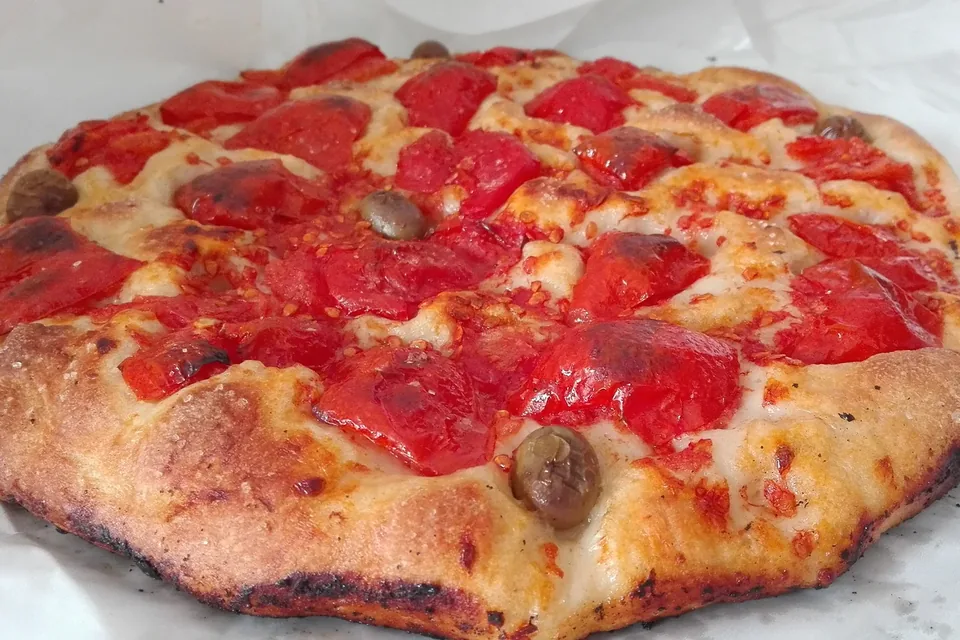
Traditional Puglian dishes
Orecchiette, focaccia, panzerotti, tiella and Salento cooking: connecting dishes with places.
Read the guide →Photo: Elfmir / Wikimedia Commons — CC BY-SA 4.0 · Resized and converted to WebP.
