APULICA / Food guides
Bari focaccia and panzerotti: the city's bakery food, eaten on the street
In Bari focaccia and panzerotti are not starters: they are the food you buy at the bakery and eat on the move, at any hour. Focaccia is round and thick, crisp underneath and soft inside, topped with halved cherry tomatoes; the panzerotto is a disc of leavened dough folded into a half-moon, filled with mozzarella and tomato and fried. Both are recognised as traditional food products of Puglia. This guide explains what the official records say, which variants exist in nearby towns and how to fit them into a day in Bari.
Fecàzze, the people of Bari's snack
The Atlas of Apulian traditional products has listed Bari focaccia, fecàzze in dialect, as a PAT since 2012, with its area of origin in the provinces of Bari, Barletta-Andria-Trani and Taranto. It describes a round focaccia about thirty centimetres across, crisp outside, soft and juicy inside, topped with fresh cherry tomatoes: the snack par excellence for the people of Bari, eaten at lunch, at dinner and at any other time. On its origins the record offers a precise hypothesis: it was born in Altamura or Laterza as a variant of durum-wheat bread, to use the first heat of the wood oven before the temperature settled for the loaves. The name comes from the Latin focus, cooked on the fire. The bibliographic reference is La checine de nononne, a 1982 collection of popular Bari recipes.
Potato in the dough and two rises
The PAT record explains the technique step by step. Water, extra virgin olive oil and yeast are mixed for a couple of minutes; then flour, salt, a pinch of sugar and potato are added and kneaded until the dough is very soft but not runny. The first rise lasts about an hour, covered; then the dough goes into an oiled pan dusted with fine salt and is spread with oiled hands without pressing, so the gas is not lost. The cherry tomatoes go on skin side up, salt and oregano are scattered over, and it rises for another hour. Baking starts at 220 degrees low in the oven for about a quarter of an hour and finishes higher up at 180, until deep golden brown. Italia.it's guide to Bari adds that the dough is made with re-milled semolina, boiled potatoes, salt, yeast and water.
Sources: Atlante dei PAT di Puglia — Focaccia barese · Italia.it — Bari: guida, storia e curiosità
Soft or crisp, with or without olives
The sources do not describe a single focaccia. Italia.it's page on Apulian flavours speaks of softer and crisper versions topped with cherry tomatoes, salt, oregano and black olives, placing it alongside spaghetti all'assassina and the panzerotto as specialities of the Bari area. The Bari guide describes it as tall and fragrant, with halved fresh cherry tomatoes and Bari olives. The PAT record, by contrast, does not mention olives: the topping is cherry tomatoes, salt and oregano. Rather than a contradiction, this reflects a family and bakery recipe that changes from shop to shop. The record also notes that since 2010 there has been a Consorzio della focaccia barese, set up to promote the product in line with tradition. Sales, it adds, go mainly through traditional and specialist shops.
Sources: Italia.it — La Puglia dei sapori made in Italy · Italia.it — Bari: guida, storia e curiosità · Atlante dei PAT di Puglia — Focaccia barese
Its sisters: Bisceglie and Sammichele
Around Bari the Atlas lists other focacce with their own story. U cùcue from Bisceglie, a PAT since 2025, is an open focaccia of flour and re-milled semolina with boiled potatoes, topped with pomodori da serta, tomatoes hung in clusters to keep, or with unpeeled garlic when there are none; the dough rests twenty-four hours in the fridge. In 1980 Mario Cosmai described it as the focaccia of Sundays and feast days, eaten on Thursday evenings with cured meats and cheese when shops were closed; it is still customary on the last day of Carnival. The focaccia a libro of Sammichele di Bari, a PAT since 2005, is instead a spiral roll: two very thin sheets brushed with oil, oregano and salt, rolled up and coiled in a circle. Tradition links the name to an open book and the short rise to the time needed for ten prayers.
Sources: Atlante dei PAT di Puglia — Focaccia di Bisceglie · Atlante dei PAT di Puglia — Focaccia a libro di Sammichele di Bari
The panzerotto: a disc, a filling, the fryer
The fried panzerotto has been a PAT since 2012 and, according to the Atlas, belongs to all of Puglia; in dialect it is also called frittella, calzone, frittue or calzengiidde. The dough is flour, yeast dissolved in warm water, oil and salt, risen for at least two hours until doubled. It is divided into pieces rolled into discs ten to fifteen centimetres across; in the centre goes a generous spoonful of chopped, well-drained mozzarella, tomato, oregano and salt. The disc is folded into a half-moon, the edges pressed firmly and the excess trimmed with a pastry wheel. It is fried in plenty of olive or seed oil, turned several times until golden; the record also allows baking. It should be served hot but not scalding, and it is eaten on the street, with the risk, the record says, of getting messy or burnt.
The belly that bursts, and home-made fillings
The PAT record places its origins probably in the 16th century, when the tomato spread through Italy, and imagines a baker or a housewife turning leftover bread dough into a small folded pizza. The name would come from panza, the belly that swells and, bursting, reveals the filling. Many variants are listed: minced meat with mozzarella, turnip tops, ricotta, provolone and mortadella, and sponzali. Among related products the Atlas also lists sweet ricotta panzerotti and sfricone. The same bibliographic source as the focaccia, La checine de nononne of 1982, records many of these fillings. As an example of promotion the record mentions the panzerotto festival in Terlizzi, in the province of Bari, which reached its thirty-fourth edition in 2021; the calendar for later years should be checked with the town.
Old Bari, the harbour and the seafront
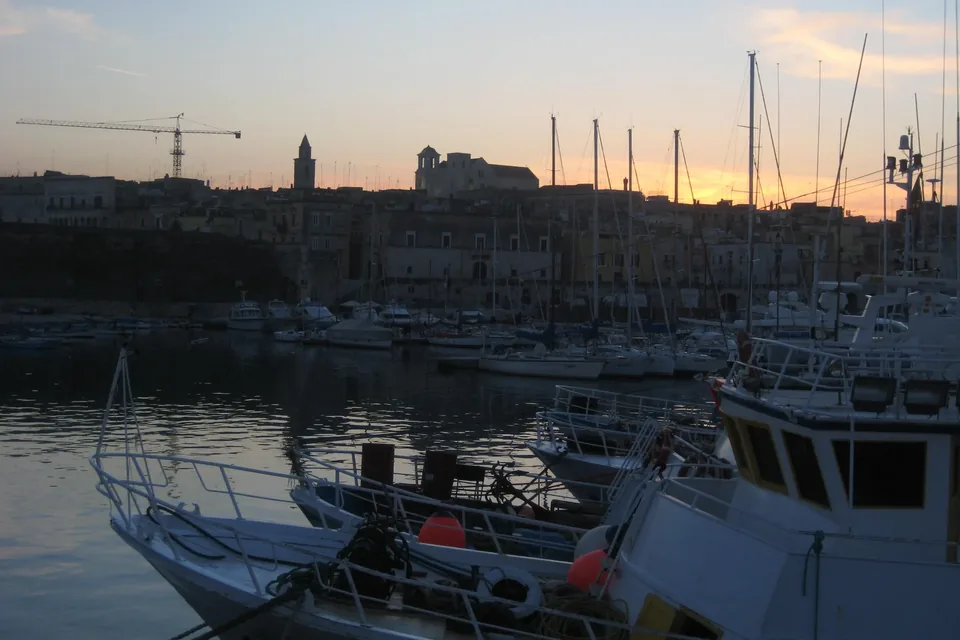
Italia.it's guide to Bari suggests eating a panzerotto while strolling and describes a street-food route through the old town's alleys, in places frequented by locals. The historic centre has a medieval core enclosed by walls and overlooked by the Norman-Swabian Castle; the San Nicola quarter stretches between the old and new harbours, facing the sea. The Basilica of San Nicola holds the relics of the saint of Myra, which arrived in 1087 and made Bari a religious centre between East and West. In the alleys the women of Old Bari still make orecchiette by hand. The seafront, the same guide says, is among the most beautiful in Italy. The general page on Bari also mentions the Teatro Petruzzelli, from 1903, rebuilt after a fire and reopened in 2009.
Sources: Italia.it — Bari: guida, storia e curiosità · Italia.it — Bari
How to taste them properly
Focaccia should be judged straight from the oven, when the base is still crisp and the tomatoes are blistered but juicy: ask for a piece from the edge and one from the centre, as they are two different experiences. Eat the panzerotto at once, but carefully: the filling stays very hot even when the dough feels warm. Compare two bakeries on the same walk, perhaps a thicker focaccia and a thinner one, and try a classic panzerotto before the variants. To drink, a cold beer or a glass of Apulian white is enough; the right way is standing, at the counter or in the street. For a longer stop, focaccia goes well with local cured meats and cheeses, just as it did in Bisceglie on Thursday evenings.
Taking them home, or making them yourself
The panzerotto does not travel: once fried it loses its point within hours, so treat it as a local experience. Focaccia survives a short journey wrapped in paper rather than plastic and revives after a few minutes in a hot oven; the next day it is already something else. Anyone wanting to make it at home will find a complete recipe in the PAT record, with potato in the dough and two rises: the decisive detail is not pressing the dough in the pan. As suitcase souvenirs, the dry products of Apulian baking work better, such as taralli and friselle, or a good extra virgin olive oil to dress it. Locally, some bakeries in the centre bake focaccia several times a day: it is worth asking when the hot batch comes out.
A thread for your journey
Journey idea: a morning in Old Bari between the Basilica of San Nicola, the castle and the orecchiette alleys, with a hot slice of focaccia halfway round and a panzerotto on the seafront at the end; in the afternoon, those with time can head to Bisceglie to discover u cùcue. Any guided street-food walk to be arranged with operators.
Talk to us