
APULICA / FRESH PASTA, BREAD AND PASTRY
Ostie ripiene (filled wafers of Monte Sant'Angelo)
PAT · Fresh pasta, bread and pastry · Puglia
In brief
- Two oval wafers enclose toasted almonds caramelised with honey and sugar and scented with cinnamon. (Atlante dei PAT di Puglia (Regione Puglia, Università di Bari) — Ostie ripiene · Ente Parco nazionale del Gargano — Ostie ripiene di Monte Sant'Angelo)
- Legend places their origin around 1600 in the Holy Trinity convent of Monte Sant'Angelo, among nuns making communion wafers. (Atlante dei PAT di Puglia (Regione Puglia, Università di Bari) — Ostie ripiene · Ente Parco nazionale del Gargano — Ostie ripiene di Monte Sant'Angelo)
- They are often decorated with sacred images and pressed in pairs between marble or wooden boards. (Ente Parco nazionale del Gargano — Ostie ripiene di Monte Sant'Angelo)
- They have been on the national list of traditional products since 2001, with their home in the province of Foggia. (Atlante dei PAT di Puglia (Regione Puglia, Università di Bari) — Ostie ripiene)
History and origin
Filled wafers, ostie ripiene, are the signature sweet of Monte Sant'Angelo, the Gargano town that keeps the sanctuary of Saint Michael the Archangel. In the local dialect they are called "ostie chjène", full wafers, and the name already tells their story: two paper-thin sheets of wafer enclosing a heart of almonds and honey.
Legend has it that the sweet was born around 1600 in the kitchens of the convent of the Holy Trinity, home to Poor Clare nuns. While the sisters were preparing the dough for Communion wafers, a few almonds fell into a bowl of freshly cooked honey; to retrieve them, one nun used two pieces of wafer, and almonds and honey stuck to the wafer, forming a single sweet.
The Gargano National Park notes that the convent origin seems confirmed by two clues: the filled wafers share the ingredients and cooking method of liturgical wafers, and they often bear sacred images. The sweet has been on the national list of traditional food products since 2001.
Sources: Atlante dei PAT di Puglia (Regione Puglia, Università di Bari) — Ostie ripiene · Ente Parco nazionale del Gargano — Ostie ripiene di Monte Sant'Angelo · Masaf — Elenco nazionale dei prodotti agroalimentari tradizionali, XXVI revisione (2026)
Area and method of production
The area of origin given by the regional record is the province of Foggia, and above all the town of Monte Sant'Angelo, where the wafers are made all year round. The method has remained a craft one and has two stages.
First come the wafers: water and flour are mixed into a batter, which is cooked pressed inside a special iron heated over the fire. Separately, in a pan, preferably a copper one, honey and sugar are melted over a low flame with toasted almonds, stirred constantly until the almonds are coated in a thick syrup and begin to crackle. Cinnamon goes in only at the end.
The still-boiling mixture is spread over wafers laid on a marble slab and covered with a second wafer. The pairs are then pressed under wooden or marble boards with weights, so that the two halves bond and stay perfectly flat as they cool. They are sold mainly directly by the people who make them.
Sources: Atlante dei PAT di Puglia (Regione Puglia, Università di Bari) — Ostie ripiene · Ente Parco nazionale del Gargano — Ostie ripiene di Monte Sant'Angelo
How to recognise it
Filled wafers are recognisable at a glance. The wafers are oval or round and come in various sizes: for the oval ones the Gargano Park gives about 7-8 centimetres in width and 16-18 in length. Outside they are cream-white, with a very delicate texture that breaks at the first bite.
Inside the colour changes completely: it is the dark brown of toasted, caramelised almonds held together by honey. The surface of the wafer often bears sacred images, a reminder of the sweet's birth in a convent.
The flavour is sweet and intense, with a strong scent of honey and cinnamon; the cinnamon leaves a slightly bitter aftertaste that balances the sweetness of the filling. The contrast between the crumbly wafer and the crunchy almond heart is the hallmark of this Gargano sweet.
Sources: Atlante dei PAT di Puglia (Regione Puglia, Università di Bari) — Ostie ripiene · Ente Parco nazionale del Gargano — Ostie ripiene di Monte Sant'Angelo
Where to taste it
The place to taste them is Monte Sant'Angelo, on the Gargano mountain. The town's tourism portal lists them among its best-known sweets, alongside the large wheels of golden-crusted bread, the olive oil of the Macchia countryside and caciocavallo podolico, a Slow Food Presidium. A walk through the old town means meeting these flavours along the way.
Tasting the sweet goes naturally with visiting the town. Monte Sant'Angelo is called the town of two UNESCO sites: since 2011 the Lombard remains of the sanctuary of Saint Michael the Archangel have been part of the serial site "The Longobards in Italy", and the sanctuary, built around a natural cave, has drawn pilgrims for fifteen centuries.
Filled wafers also appear among the typical products listed by the Gargano National Park, which calls them the most typical sweet of the town. Travellers crossing the promontory, from the inland villages to the coast, can take them along: the dry wafer and honey filling make them a sweet for the journey.
Sources: Città di Monte Sant'Angelo, portale turistico — Enogastronomia · Città di Monte Sant'Angelo, portale turistico — Santuario di San Michele Arcangelo · Ente Parco nazionale del Gargano — Ostie ripiene di Monte Sant'Angelo
Protection
- Traditional agri-food product (PAT) — Puglia, n. 250, 26th revision (Masaf — Elenco nazionale dei prodotti agroalimentari tradizionali, XXVI revisione (2026) · Atlante dei PAT di Puglia (Regione Puglia, Università di Bari) — Ostie ripiene)
When
- The sources consulted give no months.
Where
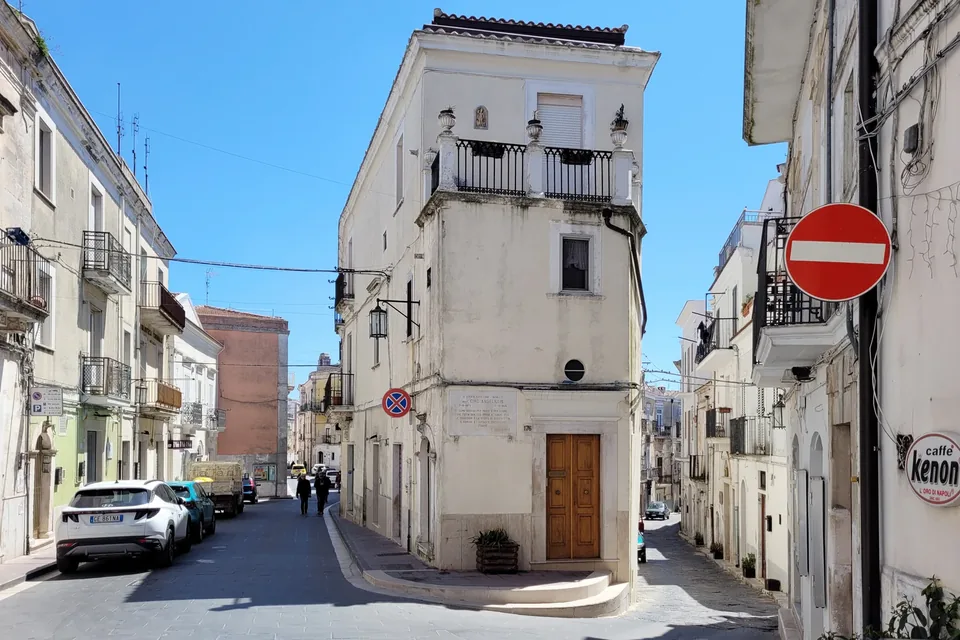
Monte Sant’Angelo
Monte Sant’Angelo: the cave and Junno quarter.
Read the guide →Photo: Bernard Gagnon / Wikimedia Commons — CC0 · Resized and converted to WebP.


Gargano
Gargano: villages, woodland and coast.
Read the guide →Photo: Bernard Gagnon / Wikimedia Commons — CC0 · Resized and converted to WebP.

Read more
Monte Sant'Angelo filled wafers
The nuns' sweet of Monte Sant'Angelo: legend, recipe, the Gargano's big bread and a day between the sanctuary, the Junno quarter and the May and September pilgrimages.
Read the guide →