
APULICA / FRESH PASTA, BREAD AND PASTRY
Pane di Monte Sant'Angelo (Gargano bread)
PAT · Fresh pasta, bread and pastry · Puglia
In brief
- A large round loaf of soft-wheat flour, water, salt and natural leaven, with a crisp almond-coloured crust. (Atlante dei PAT di Puglia (Regione Puglia, Università di Bari) — Pane di Monte Sant'Angelo)
- Traditional loaves reached 80-90 cm across, because families once bought bread only once a week. (Atlante dei PAT di Puglia (Regione Puglia, Università di Bari) — Pane di Monte Sant'Angelo)
- The Gargano National Park calls it the best-known bread of the promontory, one that keeps for several days. (Ente Parco nazionale del Gargano — Pane)
- It has been on the national list of traditional products since 2005. (Atlante dei PAT di Puglia (Regione Puglia, Università di Bari) — Pane di Monte Sant'Angelo)
History and origin
The bread of Monte Sant'Angelo is regarded as the historical memory of the Gargano's farming culture and of the promontory's mountain diet. For centuries making it was one of women's main occupations, and they spent whole nights on the dough: work accompanied by gestures, prayers and formulas that gave bread the sacred aura of the most essential food.
The size of the loaves comes from a household habit. Families once bought bread only once a week, and loaves could exceed twelve kilos, with diameters of 80-90 centimetres: they had to last until the next purchase.
The tradition is documented: the soft-wheat bread of Monte Sant'Angelo is mentioned in Tancredi's book "Folclore garganico" of 1940. It has been on the national list of traditional food products since 2005, it is part of the Slow Food Foundation's Ark of Taste, and the town belongs to the national association of Bread Towns, which promotes local breads tied to their territory.
Sources: Atlante dei PAT di Puglia (Regione Puglia, Università di Bari) — Pane di Monte Sant'Angelo · Masaf — Elenco nazionale dei prodotti agroalimentari tradizionali, XXVI revisione (2026)
Area and method of production
The area of origin is the province of Foggia and above all the town of Monte Sant'Angelo, where the bread is made all year round. The ingredients are few: type 0 soft-wheat flour, water, salt and natural leaven, called "lu crescente" in dialect. The Gargano Park notes that durum wheat semolina is also used on the promontory, and that the dough is kneaded in two stages.
According to the regional record, the flour is combined with the natural leaven and loosened with water and salt. The dough rises for about an hour, is then shaped into a loaf and left to rest for at least another hour in wooden bins; the Park also describes rising in wicker baskets, which gives an even crumb.
Baking takes place at about 200 degrees, and the traditional method calls for a wood-fired oven. No additives are used: the proof, the Park observes, is how long the bread resists going hard, which lasts several days.
Sources: Atlante dei PAT di Puglia (Regione Puglia, Università di Bari) — Pane di Monte Sant'Angelo · Ente Parco nazionale del Gargano — Pane
How to recognise it
It is a round, large and sometimes huge bread. The Gargano Park describes loaves from 20 to 100 centimetres across, weighing from half a kilo to eight kilos; today, according to the regional record, the most common loaves weigh one to four kilos, while the largest traditional ones are made to order.
The crust is crisp and fragrant, almond-coloured to dark, 2 to 5 millimetres thick and often dusted with flour, which protects the dough as it rises. The crumb, 4 to 12 centimetres deep, is soft and compact, milk-white, with an even honeycomb.
A sign to look for in town is the loaves displayed hanging or on wooden frames outside the bakers' shops, as the Park recalls. Over the days the fresh crumb and crisp crust turn into a sturdy, full-flavoured day-old bread.
Sources: Ente Parco nazionale del Gargano — Pane · Atlante dei PAT di Puglia (Regione Puglia, Università di Bari) — Pane di Monte Sant'Angelo
In the kitchen
The bread of Monte Sant'Angelo is made to last, and Gargano cooking uses it at every stage. Fresh, it goes with everyday meals; as the days pass it becomes a sturdy, tasty day-old bread which, according to the Gargano National Park, is ideal for the many dishes of the promontory's farmhouse cooking.
The same tradition knows a frugal and clever variant: potato bread, in which about 30 per cent mashed potato is mixed into the flour. Poorer families once made it to stretch the wheat, which cost more.
With the same flours the Gargano also kneads its fresh pasta: orecchiette, troccoli, fusilli and the tagliatelle called lajne. The Park tells that in the old town of Monte Sant'Angelo the tools for making these pastas at home are on display.
Sources: Ente Parco nazionale del Gargano — Pane · Parco nazionale del Gargano — Orecchiette e paste fresche
Where to taste it
Look for the bread in Monte Sant'Angelo, on the Gargano mountain. The town's tourism portal invites visitors to follow the scent of bread through the streets: large wheels with a golden, crisp crust and a soft white crumb, the fruit of a tradition handed down from generation to generation. The regional record lists direct sale by producers and sale in shops.
The same portal pairs the bread with the other local flavours: the olive oil of the Macchia countryside, caciocavallo podolico, a Slow Food Presidium, and ostie ripiene, the town's typical sweet.
The bread goes well with a visit to the town of two UNESCO sites. The Lombard remains of the sanctuary of Saint Michael the Archangel, a natural cave that has drawn pilgrims for fifteen centuries, have been part of the serial site "The Longobards in Italy" since 2011, and the town is one of the gateways to the Gargano National Park, which tells the story of its typical products.
Sources: Città di Monte Sant'Angelo, portale turistico — Enogastronomia · Città di Monte Sant'Angelo, portale turistico — Santuario di San Michele Arcangelo · Atlante dei PAT di Puglia (Regione Puglia, Università di Bari) — Pane di Monte Sant'Angelo · Ente Parco nazionale del Gargano — Pane
Protection
- Traditional agri-food product (PAT) — Puglia, n. 255, 26th revision (Masaf — Elenco nazionale dei prodotti agroalimentari tradizionali, XXVI revisione (2026) · Atlante dei PAT di Puglia (Regione Puglia, Università di Bari) — Pane di Monte Sant'Angelo)
When
- The sources consulted give no months.
Where
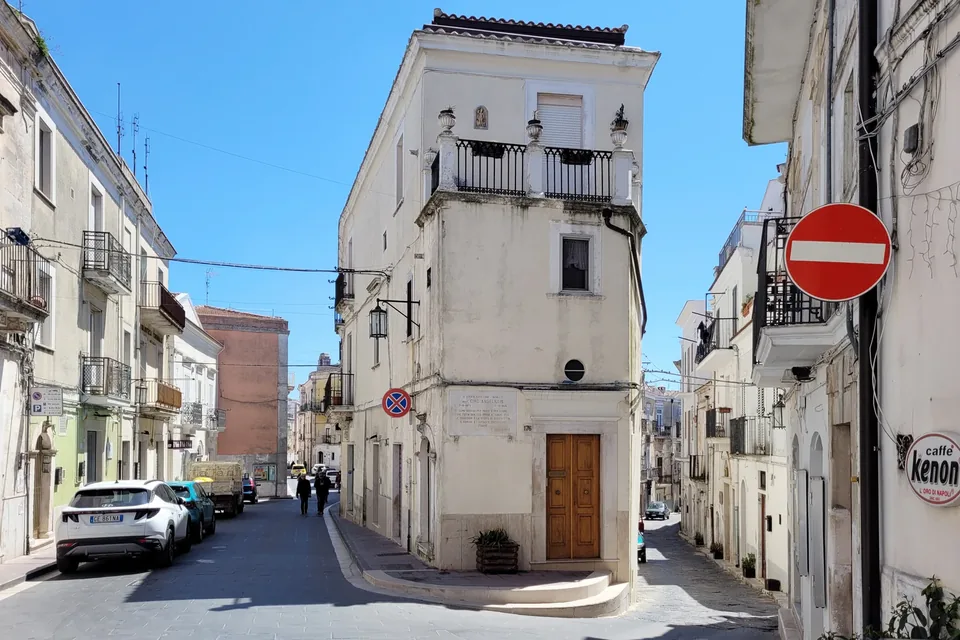
Monte Sant’Angelo
Monte Sant’Angelo: the cave and Junno quarter.
Read the guide →Photo: Bernard Gagnon / Wikimedia Commons — CC0 · Resized and converted to WebP.


Gargano
Gargano: villages, woodland and coast.
Read the guide →Photo: Bernard Gagnon / Wikimedia Commons — CC0 · Resized and converted to WebP.

Read more
Monte Sant'Angelo filled wafers
The nuns' sweet of Monte Sant'Angelo: legend, recipe, the Gargano's big bread and a day between the sanctuary, the Junno quarter and the May and September pilgrimages.
Read the guide →