
APULICA / CHEESES
Caciocavallo podolico of the Gargano
Slow Food Presidium · Cheeses · Puglia
In brief
- A stretched-curd cheese from the milk of Podolica cows grazing on the Gargano; the cows give little milk and only at certain times. (Fondazione Slow Food — Presidio Caciocavallo podolico del Gargano)
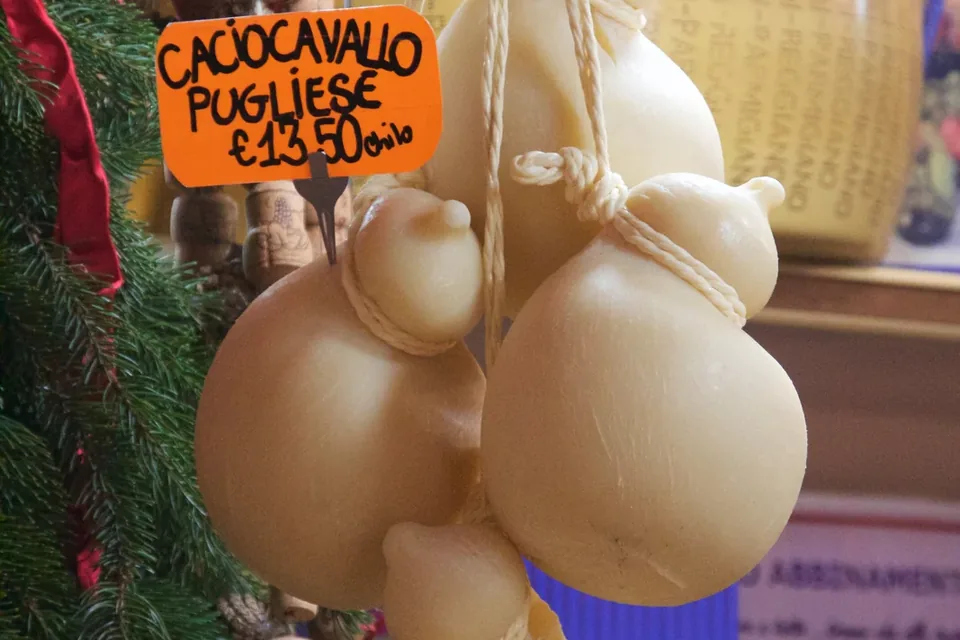
- The stretched curd is shaped like a round-bellied flask with a small head, cooled in water and brined. (Fondazione Slow Food — Presidio Caciocavallo podolico del Gargano)
- It ages from three months to three years, sometimes far longer; the Presidium aims to bring natural ageing caves back into use. (Fondazione Slow Food — Presidio Caciocavallo podolico del Gargano)
- It is made all year, but mostly from March to May. (Fondazione Slow Food — Presidio Caciocavallo podolico del Gargano)
History and origin
Caciocavallo podolico is the cheese of the Podolica cow, an ancient breed that once dominated the Italian countryside and today survives in the parts of southern Italy where pasture is meagre and water scarce. On the Gargano the Podolica became so established that it was also called the "Puglia" breed, and its milk was made into caciocavallo.
The cheese's name comes from the way it is aged: two cheeses tied together with a cord and hung "astride" (a cavallo) a horizontal pole. The small head that closes the cheese serves precisely to hold the cord during ageing.
The Gargano herd is still relatively sizeable, but for a long time the promontory's caciocavalli were made only for family use or strictly local sale. The Slow Food Presidium was set up to encourage milk and cheese production and to bring back the traditional ageing rooms, especially natural caves, which ensured the best quality.
Sources: Fondazione Slow Food — Presidio Caciocavallo podolico del Gargano · Ente Parco Nazionale del Gargano — Caciocavallo podolico · Atlante PAT Puglia (Università di Bari, Regione Puglia) — Carne podolica
Area and method of production
The milk comes only from Podolica cows grazing on the Gargano, hardy animals that do not live in barns and browse poor soils and scrub. They give very little, and only at certain times: mainly in spring and summer, at the end of suckling. So caciocavallo is made all year round, but most production falls between March and May.
The milk is curdled and the curd broken into rice-sized grains. The curd ripens in its whey in a vat, then drains on a sloping wooden table for a variable time. It is sliced, stretched with boiling water and shaped into a pot-bellied flask with a small head: a delicate task that takes practice and skilled hands.
Once the head is closed, the cheese is plunged into cold water and then brined. Finally it ages, from a minimum of three months up to three years, and in some cases even eight or ten.
Sources: Fondazione Slow Food — Presidio Caciocavallo podolico del Gargano · Ente Parco Nazionale del Gargano — Caciocavallo podolico
How to recognise it
On the Gargano caciocavallo podolico usually weighs around two kilos and is egg-shaped, like a pot-bellied flask, with the characteristic small head. It is a semi-hard stretched-curd cheese. At first it is straw-yellow, darkening as the months pass.
Its flavour changes greatly with age: sweet when young, it becomes increasingly piquant as it matures. Only after many months does it take on its most distinctive traits, becoming one of Italy's most aromatic aged cheeses.
The Podolica's milk, scarce but precious, carries the scents and fragrances of the wild vegetation of the promontory's pastures and woods, and these notes resurface in the cheese.
Sources: Ente Parco Nazionale del Gargano — Caciocavallo podolico · Fondazione Slow Food — Presidio Caciocavallo podolico del Gargano
In the kitchen
The character of caciocavallo podolico changes with age: tasted young it is a sweet cheese, while after many months of ageing it is piquant and highly aromatic.
It is also a prized ingredient in Puglia's cooking. In the richest versions of the bombetta, the small meat roll of the Itria Valley cooked at the fornello, caciocavallo podolico joins Capocollo di Martina Franca and Canestrato Pugliese, served with Altamura bread.
On the Gargano the cheese pairs with the meat of the same breed: the festivals devoted to the Podolica, in Rignano Garganico and Carpino, bring together the meat and the caciocavallo, showing how a whole table can come from a single animal.
Sources: Ente Parco Nazionale del Gargano — Caciocavallo podolico · Atlante PAT Puglia (Università di Bari, Regione Puglia) — Bombetta · Atlante PAT Puglia (Università di Bari, Regione Puglia) — Carne podolica
Where to taste it
The Presidium area is the whole Gargano, in the province of Foggia. Podolica cows graze freely on the uplands of Rignano Garganico, Monte Sant'Angelo, San Marco in Lamis, San Nicandro Garganico, Mattinata and Carpino, and on the Santa Tecla estate at Vieste: seeing them at pasture, with their great horns and grey coats, is one of the privileges of visiting the park.
Two festivals celebrate the Podolica's meat and cheese: the Sagra della mucca podolica e del caciocavallo podolico in Rignano Garganico and the Sagra della carne e del caciocavallo podolico in Carpino.
Production peaks between March and May, when the Podoliche give most milk, but caciocavallo is made all year round, and after the minimum three months of ageing it is ready for the table.
Sources: Fondazione Slow Food — Presidio Caciocavallo podolico del Gargano · Ente Parco Nazionale del Gargano — Caciocavallo podolico · Ente Parco Nazionale del Gargano — Vacca podolica · Atlante PAT Puglia (Università di Bari, Regione Puglia) — Carne podolica
Protection
- Slow Food Presidium — caciocavallo-podolico-del-gargano (Fondazione Slow Food — Presidio Caciocavallo podolico del Gargano)
When
- Production: March–May (Fondazione Slow Food — Presidio Caciocavallo podolico del Gargano)
- Spring
Where

Gargano
Gargano: villages, woodland and coast.
Read the guide →Photo: Bernard Gagnon / Wikimedia Commons — CC0 · Resized and converted to WebP.

Read more
Caciocavallo podolico
The Podolica cow, the caciocavallo of the Gargano and Basilicata, the Slow Food Presidia, ageing and documented festivals.
Read the guide →Photo: Mike Peel / Wikimedia Commons — CC BY-SA 4.0 · Resized and converted to WebP.
