
APULICA / CHEESES
Fiordilatte
PAT · Cheeses · Campania
In brief
- A fresh stretched-curd cheese of cow's milk, listed among Campania's traditional products; the most famous comes from Agerola, in the Lattari Mountains. (Regione Campania, Assessorato Agricoltura — Prodotti tradizionali: Fiordilatte · Masaf — Elenco nazionale dei prodotti agroalimentari tradizionali, XXVI revisione (2026))
- The milk, from one or more consecutive milkings, reaches the dairy raw within 24 hours of the first milking. (Regione Campania, Assessorato Agricoltura — Prodotti tradizionali: Fiordilatte · ONAF, Organizzazione Nazionale Assaggiatori di Formaggi — Scheda Fiordilatte (PAT Campania))
- The curd ripens under whey for three to twelve hours and is stretched with water at 80-90 °C. (ONAF, Organizzazione Nazionale Assaggiatori di Formaggi — Scheda Fiordilatte (PAT Campania))
- Rindless and milk white, it releases a milky liquid when cut and tastes fresh and gently tangy. (Regione Campania, Assessorato Agricoltura — Prodotti tradizionali: Fiordilatte · ONAF, Organizzazione Nazionale Assaggiatori di Formaggi — Scheda Fiordilatte (PAT Campania))
- Agerola celebrates it in summer, in the first days of August, with the FiordilatteFIORDIFESTA festival. (FiordilatteFIORDIFESTA — 42ª edizione ad Agerola, 3-5 agosto 2024 · FiordilatteFIORDIFESTA — Le aziende (caseifici partecipanti))
History and origin
Fiordilatte is a fresh stretched-curd cheese of cow's milk with old roots in Campania. The Campania Region, in the sheet that accompanies its listing among traditional agri-food products, names Agerola as the home of the best-known fiordilatte: a village in the Lattari Mountains that was already cited in the time of the physician Galen, in the second century AD, for a milk regarded as very wholesome. The association that runs the village festival recalls that Galen praised the milk together with the mild climate and the clean air of these mountains.
Agerola's milk is tied to a cow that was born here. According to the same association, the Bourbons made the first attempts at crossbreeding, importing Brown Alpine, Dutch Black Pied and Simmental bulls to improve cattle of the Podolian type; the isolation of the area fixed the new traits better than elsewhere. In 1845 General Paolo Avitabile, a native of Agerola returning from service in Afghanistan for the British government, brought back a young bull, two pregnant cows and a Jersey heifer, and from crosses with that first herd came the breed which since 1952, when its standard was presented to the Ministry of Agriculture, has been called Agerolese. Today the FAO lists it as endangered.
Finally, the ONAF sheet recalls that the names fiordilatte and mozzarella overlapped for a long time: in 1996 Mozzarella became a traditional speciality guaranteed, an attempt at an interregional PDO for fiordilatte never reached its goal, and the regions entered the product in their lists under different names. Campania, like Lazio, calls it Fiordilatte, and this is the name under which it appears in the Masaf national list.
Sources: Regione Campania, Assessorato Agricoltura — Prodotti tradizionali: Fiordilatte · FiordilatteFIORDIFESTA — Agerola, un po' di storia · FiordilatteFIORDIFESTA, Associazione Sant'Antonio Abate di Agerola — Mucca Agerolese · ONAF, Organizzazione Nazionale Assaggiatori di Formaggi — Scheda Fiordilatte (PAT Campania) · Masaf — Elenco nazionale dei prodotti agroalimentari tradizionali, XXVI revisione (2026)
Area and method of production
Fiordilatte has always been made with very high quality cow's milk from one or more consecutive milkings, which, according to the Campania Region, reaches the dairy raw within 24 hours of the first milking. The area is the whole region, with a particular mention of the municipality of Agerola. The cows are of various breeds raised locally, above all the Agerolese, kept in free or semi-free housing and at pasture; the Region notes that this breed's milk, in blends, is used both for Provolone del Monaco and for fiordilatte.
The ONAF sheet describes the process step by step. Whole, pasteurised milk receives whey starter from the previous batch and calf rennet, and curdles at 33-38 degrees in 20-40 minutes. The curd is broken with the spino into grains the size of a maize kernel or a hazelnut and ripens under whey for three to twelve hours: acidification is lactic, and organic acids or chemical correctors are forbidden. The cheesemaker checks the right moment with the provatura, dipping a piece of curd in boiling water to see whether it stretches without breaking.
When the pH reaches 5.0-5.3 the curd is cut into strips and stretched with water at 80-90 degrees; in the past a wooden vat and wooden sticks were used. Knots and braids are shaped by hand, spheres also by machine. The cheeses firm up in cold water, go into brine, dry briefly and are sold straight away. The producers at the Agerola festival describe their fiordilatte as made with raw cow's milk, so the sources record both practices.
Sources: Regione Campania, Assessorato Agricoltura — Prodotti tradizionali: Fiordilatte · Regione Campania, Assessorato Agricoltura — Provolone del Monaco DOP e razza Agerolese · ONAF, Organizzazione Nazionale Assaggiatori di Formaggi — Scheda Fiordilatte (PAT Campania) · FiordilatteFIORDIFESTA — Prodotti freschi: fiordilatte, treccia, ciliegine, provola
How to recognise it
Fiordilatte has no rind. According to the Campania Region its shape varies with the area it comes from: round, sometimes with a little head, knotted, braided or block-shaped. The colour is milk white with straw-coloured tints, the skin is tender and the surface smooth, glossy and even. The paste is soft and, when cut, releases an even, milky liquid; the taste is very fresh, of gently tangy milk.
The ONAF sheet adds the details of tasting. The very thin skin is white or porcelain white; the paste has no holes and is elastic, fibrous and moist. On the nose and palate the profile is delicate, with notes of fresh milk, cream and butter and a hint of yoghurt; the taste is tangy, sweet and properly salted. Compared with classic mozzarella the paste is more fibrous and the outer film slightly thinner. The weights given range from a few tens of grams for the knot to a quarter of a kilo for the braid.
In Agerola, according to the festival association, the sphere weighs between 350 and 500 grams, is leaner than buffalo mozzarella and has a less chalky white. After the sphere, the most common shapes are the braid and the small cherry-sized ciliegine. There is also the smoked version, provola, which is stretched for longer to give a firmer, drier ivory paste, in flattened rounds from a quarter of a kilo up to one kilo.
Sources: Regione Campania, Assessorato Agricoltura — Prodotti tradizionali: Fiordilatte · ONAF, Organizzazione Nazionale Assaggiatori di Formaggi — Scheda Fiordilatte (PAT Campania) · FiordilatteFIORDIFESTA — Prodotti freschi: fiordilatte, treccia, ciliegine, provola
In the kitchen
Fiordilatte is eaten fresh, right after salting. The ONAF sheet suggests it as a table cheese with raw vegetables, or as a starter with a drizzle of extra virgin olive oil, aromatic herbs and a grind of pepper, and notes that its most frequent use is precisely on pizza, where the cheese goes into the oven together with the tomato. The small ciliegine, according to the Agerola producers, are excellent as bite-sized morsels or in a generous salad.
The menu that the Agerola festival devoted in 2026 to the Slow Food Presidia shows how readily the cheese lends itself to everyday cooking: a bruschetta with stracciata of fiordilatte, lupin mayonnaise and crushed olives; pasta with yellow tomato and soft fiordilatte; a multigrain roll with Agerola provola and Vesuvius pappacelle peppers; and to finish, a fiordilatte ice cream with jam of Vesuvius Pellecchiella apricots.
For the glass, ONAF recommends local white wines, young and fresh, low in alcohol, with a pleasant acidity to balance the cheese's delicate aroma: for example a Penisola Sorrentina white, from Falanghina, Greco, Fiano and Biancolella, or an Asprinio di Aversa. It is a very fresh cheese, put on sale straight after it is made, in a protective wrapper or in water or light brine, usually without preservatives.
Sources: ONAF, Organizzazione Nazionale Assaggiatori di Formaggi — Scheda Fiordilatte (PAT Campania) · FiordilatteFIORDIFESTA — Prodotti freschi: fiordilatte, treccia, ciliegine, provola · FiordilatteFIORDIFESTA — Il Fiordilatte incontra i Presìdi Slow Food (4 agosto 2026)
Where to taste it
The home of the best-known fiordilatte is Agerola, in the Lattari Mountains, more than 600 metres above sea level, straddling the Amalfi and Sorrento peninsulas. The Agerolese, the cow that gives the local milk its character, today lives, according to the Campania Region, only in the municipalities of Agerola and Gragnano. The festival association recalls that many visitors, drawn by the mountain air, the woods and the sea views, stop precisely to taste the village's fiordilatte and its other dairy products.
The best time to get to know it is FiordilatteFIORDIFESTA, the festival of fiordilatte and Agerola specialities run by the Sant'Antonio Abate Association, which brings together business owners and residents devoted to the village's patron saint. It is held in the first days of August: the 42nd edition took place on 3-5 August 2024, and in the 2026 edition one evening paired fiordilatte with the Slow Food Presidia of Campania.
The local dairies take part in the festival and supply the products for its menu: the association's list counts eighteen of them, including cheese dairies, a cheesemaker's shop and a butter maker. According to the association, it is their traditional methods that give the festival dishes their flavour, and the festival makes it possible to taste the village's fiordilatte in one place alongside Agerola's other specialities: Provolone del Monaco, cured meats, dark bread and the pennata pear.
Sources: FiordilatteFIORDIFESTA — Agerola · Regione Campania, Assessorato Agricoltura — Provolone del Monaco DOP e razza Agerolese · FiordilatteFIORDIFESTA — Agerola, la vita economica · FiordilatteFIORDIFESTA — Le aziende (caseifici partecipanti) · FiordilatteFIORDIFESTA — 42ª edizione ad Agerola, 3-5 agosto 2024 · FiordilatteFIORDIFESTA — Il Fiordilatte incontra i Presìdi Slow Food (4 agosto 2026) · FiordilatteFIORDIFESTA — Il gusto tipico di Agerola
Protection
- Traditional agri-food product (PAT) — Campania, n. 115, 26th revision (Masaf — Elenco nazionale dei prodotti agroalimentari tradizionali, XXVI revisione (2026))
When
Where
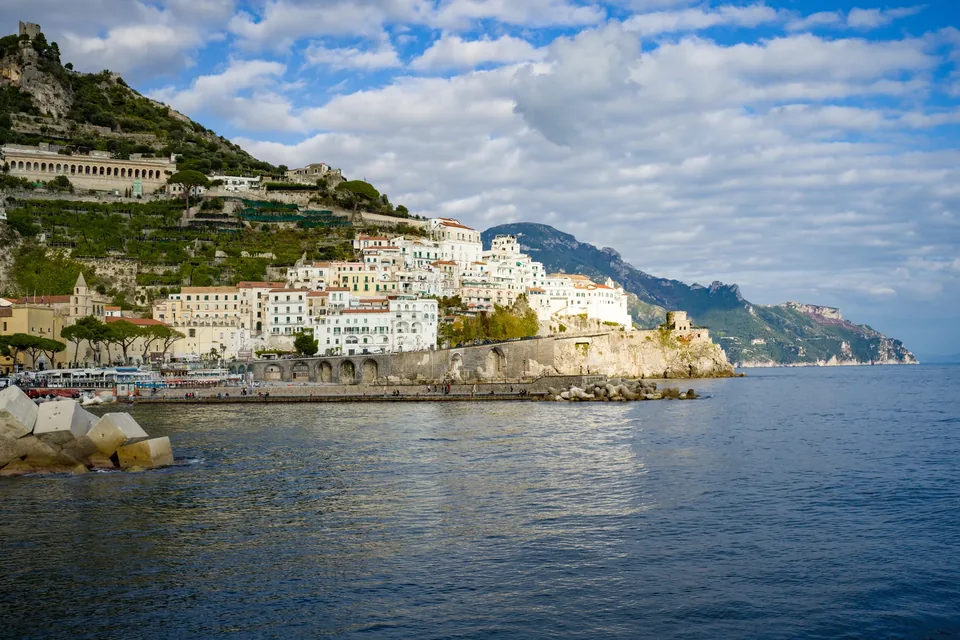
Amalfi Coast
The UNESCO cultural landscape between Positano and Vietri sul Mare: citrus terraces, footpaths, inland valleys and the history of a maritime republic.
Read the guide →Photo: Wolfgang Moroder / Wikimedia Commons — CC BY-SA 3.0 · Resized and converted to WebP.
