
APULICA / CHEESES
Mozzarella di Bufala Campana (buffalo mozzarella)
PDO · Cheeses · Campania, Molise, Puglia
In brief
- A fresh pasta filata cheese made from the fresh milk of Italian Mediterranean buffalo. (Qualigeo — Mozzarella di Bufala Campana DOP)
- The area covers the provinces of Caserta and Salerno and municipalities around Naples and Benevento, plus parts of Lazio, the municipality of Venafro in Molise and municipalities in the province of Foggia. (Qualigeo — Mozzarella di Bufala Campana DOP)
- The curd is stretched with water at 95 °C and then cut off into individual pieces. (Qualigeo — Mozzarella di Bufala Campana DOP)
- Besides the round shape it comes as bites, plaits, knots and cherry-sized pieces; the natural whey starter comes from the previous day's batch. (Qualigeo — Mozzarella di Bufala Campana DOP)
History and origin
The history of mozzarella begins with the arrival of the buffalo in Italy, about which there are several theories: some suggest a native origin, because of fossils found in the Roman countryside, others an arrival with the Lombards, and others the Norman kings around the year 1000. The first documented records date from the twelfth and thirteenth centuries, when the spread of marshland on the Tyrrhenian plains favoured buffalo farming.
The name comes from the verb «mozzare», to cut off, the gesture with which the cheesemaker separates each piece of stretched curd by hand. The word appears in a cookery text by a papal court cook in the sixteenth century, but as early as the twelfth century the monks of San Lorenzo in Capua offered a «mozza or provatura» with a piece of bread for their patron saint's feast.
The bufalare, masonry buildings where the milk was processed, are recorded from the seventeenth century; in the mid-eighteenth century the Bourbons set up a herd with a dairy on the royal estate of Carditello, at San Tammaro. From then on buffalo cheeses spread ever more widely.
Sources: Regione Campania, Assessorato Agricoltura — Mozzarella di Bufala Campana DOP · Qualigeo — Mozzarella di Bufala Campana DOP
Area and method of production
The PDO area covers the provinces of Caserta and Salerno and some towns in those of Naples and Benevento; in Lazio some towns in the provinces of Latina, Frosinone and Rome; in Molise only the town of Venafro; in Apulia some towns in the central part of the province of Foggia. Only fresh milk from Italian Mediterranean buffalo is used, rich in fat and protein.
The milk reaches the dairy filtered, is processed within 60 hours of milking and is warmed to 33-36 degrees. Before the calf rennet goes in, natural whey starter is added, the «cizza», taken from the previous day's work: its local microbial flora contributes to the flavour. The curd is broken in two stages into walnut-sized lumps and, after maturing, cut into strips.
With water at 95 degrees the curd is stretched, lifted and pulled with a wooden ladle and stick, and then «mozzata» into individual pieces, in many dairies still by hand between thumb and forefinger. The mozzarellas go into cold water and then into brine. On average 4.2 litres of milk are needed for one kilo.
Sources: Qualigeo — Mozzarella di Bufala Campana DOP · eAmbrosia — Mozzarella di Bufala Campana (PDO-IT-0014) · Regione Campania, Assessorato Agricoltura — Mozzarella di Bufala Campana DOP
How to recognise it
The classic shape is round, but the specification also allows bocconcini, plaits, perline, knots, cherries and ovoline. Weight ranges from 10 to 800 grams depending on the shape, up to 3 kilos for plaits.
The colour is porcelain white, the skin very thin and the surface smooth. The paste, without holes, has a structure of thin layers: it is slightly springy in the first 8-10 hours after production and then becomes increasingly melting. The flavour is delicate and distinctive, with a faint hint of musk, and the aroma recalls lactic ferments.
A smoked version is also allowed, following an old natural process: in this case the name is followed by the word «affumicata». PDO mozzarella is on sale all year round, packed at source.
Sources: Qualigeo — Mozzarella di Bufala Campana DOP · Regione Campania, Assessorato Agricoltura — Mozzarella di Bufala Campana DOP
In the kitchen
Buffalo mozzarella is eaten mainly fresh, just as it is. To enjoy it at its best it should be kept in a cool place, in a glass or ceramic container, always covered by its own liquid; if it is kept in the fridge, it is best taken out in advance and eaten at room temperature.
It is also an ingredient in many recipes, including Pizza Napoletana TSG. In this case the advice is to take it out of the liquid and leave it in the fridge for a few hours, so that it loses its excess liquid.
Where to taste it
The heart of production is in Campania, home to about 80% of the buffalo herd in the PDO area; the rest is in southern Lazio, Apulia and Molise. On the Volturno plain, near Caserta, and on the Sele plain, near Salerno, the old bufalare still survive: round masonry buildings with a central fireplace for working the milk and small rooms for the buffalo herders along the walls. One of the most characteristic is at the Region's experimental farm of Improsta, in Eboli.
A trip between Caserta and the Sele plain, on the edge of the Cilento, offers the chance to see the buffalo pastures and to taste freshly made mozzarella in the local towns. The royal estate of Carditello, at San Tammaro, tells instead of the link between this cheese and the Bourbon court.
Sources: Regione Campania, Assessorato Agricoltura — Mozzarella di Bufala Campana DOP · Qualigeo — Mozzarella di Bufala Campana DOP
Protection
- Protected designation of origin (PDO) — PDO-IT-0014 (eAmbrosia — Mozzarella di Bufala Campana (PDO-IT-0014))
When
- The sources consulted give no months.
Where
Read more
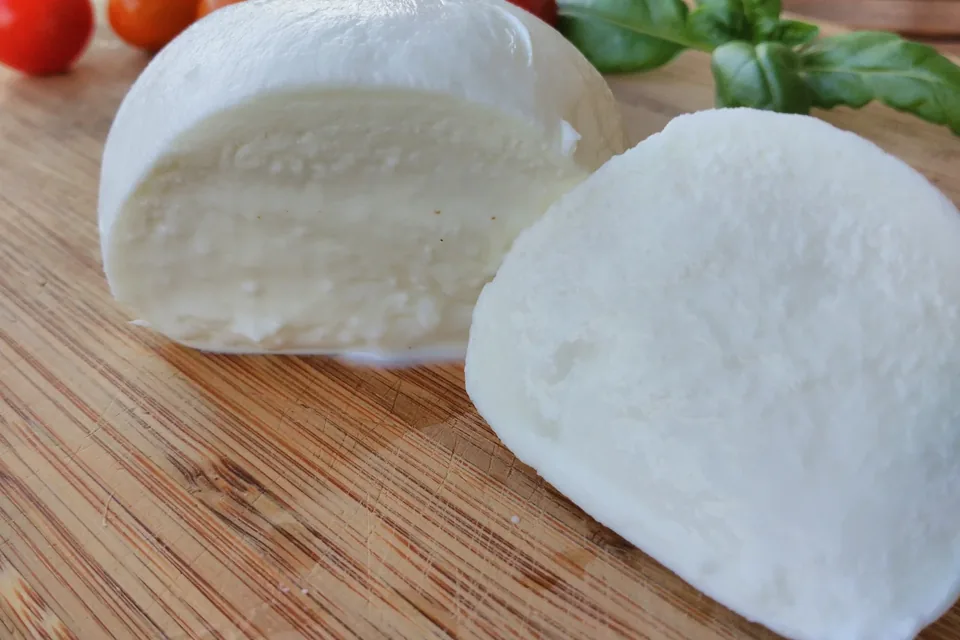
Mozzarella di Bufala Campana PDO
History, stretching and hand-cutting, PDO rules, landscapes and practical tips for recognising and enjoying buffalo-milk mozzarella.
Read the guide →Photo: Popo le Chien / Wikimedia Commons — CC BY-SA 3.0 · Resized and converted to WebP.
