
APULICA / FRUIT, VEGETABLES AND PULSES
Terra dei Messapi artichoke
Slow Food Presidium · Fruit, vegetables and pulses · Puglia
In brief
- A local landrace of the Catanese type, nicknamed the ugly artichoke for its open head, grown in Carovigno, Ostuni, San Vito dei Normanni, San Michele Salentino and Ceglie Messapica. (Fondazione Slow Food — Presidio Carciofo della Terra dei Messapi)
- The first artichoke fields date from after the Second World War and were planted with stock brought from Sicily. (Fondazione Slow Food — Presidio Carciofo della Terra dei Messapi)
- The heads are spineless; the small May ones are preserved in oil or in salted water. (Fondazione Slow Food — Presidio Carciofo della Terra dei Messapi)
- Its open shape makes it well suited to stuffing and slow cooking in a pan. (Fondazione Slow Food — Presidio Carciofo della Terra dei Messapi)
History and origin
The Terra dei Messapi is the area inhabited in classical times by the ancient Messapian people, between Leuca, Ceglie and Egnazia. According to the Slow Food Presidium the whole territory is well suited to growing artichokes, and old recipe books confirm it: Il cuoco galante, published in 1773 by abbot Vincenzo Corrado, cook and philosopher from Oria, offers some fifteen artichoke recipes.
The ecotype protected by the Presidium has a more recent history. It belongs to the Catanese type, and the first artichoke fields date from after the Second World War, when they were planted with propagation material brought from Sicily. Since then it has adapted to the countryside around Brindisi.
Growers also call it the ugly artichoke, because on market stalls it stands out for its more open head. A small group of local producers chose to safeguard this ecotype with sustainable methods that respect tradition, giving rise to the Presidium.
Sources: Fondazione Slow Food — Presidio Carciofo della Terra dei Messapi
Area and method of production
The Presidium brings together growers from Carovigno, Ostuni, San Vito dei Normanni, San Michele Salentino and Ceglie Messapica, in the province of Brindisi. In an area where intensive farming is often the norm, these producers chose to grow the local ecotype with sustainable methods that preserve its traits.
The plant is early and repeat-flowering, about one and a half metres tall on average, and bears eight or nine heads on average. Picking begins in December and continues until May, following the rhythm of the seasons: spring artichokes are the most delicate and usually go to market to be eaten fresh.
In May, at the end of the cycle, the heads are small but very tender and fleshy. This is the time for preserves: they are put in oil or kept plain, simply in water and sea salt.
Sources: Fondazione Slow Food — Presidio Carciofo della Terra dei Messapi
How to recognise it
The Terra dei Messapi artichoke is recognised straight away by its open head, which has earned it the nickname of ugly artichoke: an irregular look that, according to the Presidium, hides a vegetable of high quality.
The heads are spineless and almost cylindrical, with green bracts tinged with violet. Each plant bears eight or nine on average, and their texture changes with the season: in winter and spring they are suited to eating fresh, while the smaller May heads are tender and fleshy.
The open shape is precisely what makes it useful in the kitchen, because it leaves room for a generous filling. For anyone looking for it at the market, the telltale sign is therefore not compactness but the open crown of bracts, on a vegetable without spines.
Sources: Fondazione Slow Food — Presidio Carciofo della Terra dei Messapi
In the kitchen
The recipe that best shows off this artichoke is stuffed artichokes. The Presidium describes a filling of cheese, eggs, stale bread and breadcrumbs, parsley, lemon, a few mint leaves and a little garlic. The artichokes are stood upright in a pan, covered with tomato sauce or a little broth and cooked slowly, adding water if needed.
Stuffed artichokes are also listed among Apulia's traditional products, made across the region with egg, breadcrumbs, cheese, parsley and pepper and cooked in broth with potatoes or peas.
The small May heads become preserves: in oil or plain, in water and sea salt. In the Apulian tradition the hearts are blanched in vinegar with lemon and salt, packed into jars and covered with extra virgin olive oil with garlic, parsley or chilli.
Sources: Fondazione Slow Food — Presidio Carciofo della Terra dei Messapi · Atlante dei PAT di Puglia (Regione Puglia, Università di Bari) — Carciofi ripieni · Atlante dei PAT di Puglia (Regione Puglia, Università di Bari) — Carciofini sott'olio
Where to taste it
The Terra dei Messapi artichoke grows in the countryside of five municipalities in the province of Brindisi: Carovigno, Ostuni, San Vito dei Normanni, San Michele Salentino and Ceglie Messapica. For anyone visiting Ostuni and its old town, the Presidium's countryside is close at hand.
The right time to look for it runs from December to May. In winter and spring it is found fresh in the local markets, where it is easy to spot by its open head; in May, with the last small, tender heads, it is the season for preserves in oil and in salted water.
The very name of the artichoke invites a journey into history: the Terra dei Messapi stretches as far as Ceglie and Egnazia, the area where the ancient Messapians settled in classical times and where eighteenth-century recipe books already celebrated the artichoke.
Sources: Fondazione Slow Food — Presidio Carciofo della Terra dei Messapi
Protection
- Slow Food Presidium — carciofo-della-terra-dei-messapi (Fondazione Slow Food — Presidio Carciofo della Terra dei Messapi)
When
- Harvest: January–May, December (Fondazione Slow Food — Presidio Carciofo della Terra dei Messapi)
- Winter
- Spring
Where
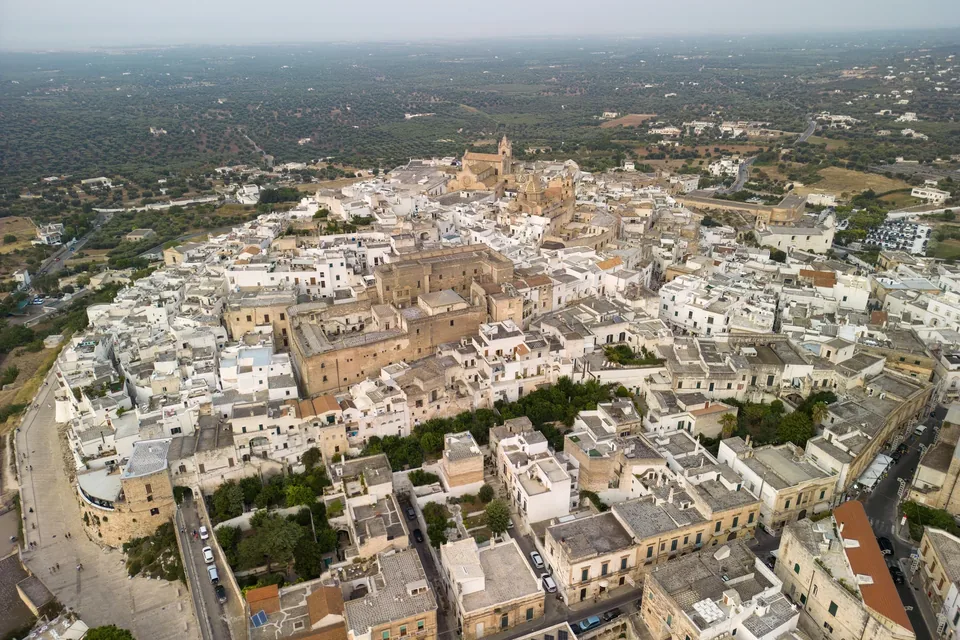
Ostuni
Houses, steps and agricultural landscape within one visit.
Read the guide →Photo: ParisTaras / Wikimedia Commons — CC BY 4.0 · Resized and converted to WebP.
