
APULICA / FRUIT, VEGETABLES AND PULSES
Smooth chickpeas of Cassano delle Murge
Slow Food Presidium · Fruit, vegetables and pulses · Puglia
In brief
- A smooth, thin-skinned chickpea landrace, from brick red to almost black, grown in Cassano delle Murge and some neighbouring towns of the Alta Murgia. (Fondazione Slow Food — Presidio Ceci lisci di Cassano delle Murge)
- It is sown by hand between December and February and needs no irrigation. (Fondazione Slow Food — Presidio Ceci lisci di Cassano delle Murge)
- Plants are pulled by hand and threshed with wooden sticks; the Presidium's rules ban chemical weedkillers. (Fondazione Slow Food — Presidio Ceci lisci di Cassano delle Murge)
- Recovery began in 2007, after it was listed among varieties at high risk of genetic erosion. (Fondazione Slow Food — Presidio Ceci lisci di Cassano delle Murge)
History and origin
In the countryside of Cassano delle Murge and neighbouring towns, an area once called terr'd cicerin, the land of chickpeas, a local chickpea ecotype adapted to harsh winters and scorching summers has been grown for generations. The hills' vocation for pulses is documented: at the end of the nineteenth century, when animal protein was scarce, chickpeas were eaten in quantity, and those grown on the hills were entrusted to dealers who took them to the markets of Bari, Modugno and Foggia. Statistical data from the early twentieth century also show that, in the province of Bari, chickpea flour was eaten only in Cassano delle Murge.
The seed has survived to this day thanks to farmers who set aside part of each harvest for the following year's sowing. In recent decades, however, the effort required by a crop that is hard to mechanise had greatly reduced its spread, to the point that it was entered in the register of varieties at high risk of genetic erosion.
Since 2007 a handful of custodian farmers have led its recovery, and today the Slow Food Presidium brings together the growers who wish to preserve this chickpea through sustainable farming.
Sources: Fondazione Slow Food — Presidio Ceci lisci di Cassano delle Murge
Area and method of production
The production area covers Cassano delle Murge and parts of the territories of Grumo Appula, Santeramo in Colle, Altamura and Sannicandro di Bari, in the province of Bari. These are the limestone soils of the Murge, partly within the Alta Murgia National Park: a plateau of rocky ridges, sinkholes, pastures and fields, where the ground holds rainwater and releases it slowly in dry spells. For this reason the crop needs no irrigation.
Sowing was once done ai nove lamb, during the nine days before Christmas; today the seeds are planted by hand in straight furrows between December and February. The plant resists disease and pests well, and the Presidium's rules require traditional techniques, low-impact crop protection and a ban on chemical weed control.
Harvest falls between June and July, when the plants have dried well in the field. They are pulled up by hand, gathered into sheaves and beaten with wooden sticks called magghjioccl; then, again by hand, the grain is separated from the debris with sieves shaken in the wind. Finally the chickpeas spend a few days in a freezer room for the cold treatment that is part of the Presidium's practice.
Sources: Fondazione Slow Food — Presidio Ceci lisci di Cassano delle Murge · Parco Nazionale dell'Alta Murgia — L'Alta Murgia
How to recognise it
The name says a lot: the Cassano chickpea has a smooth, thin skin, unlike the wrinkled one of other Murgia ecotypes. The seed is medium to large and roundish.
Its most striking feature is its colour, which is not uniform. It ranges from brick red to a very dark brown, almost black, with many shades in between: a handful of these chickpeas shows all the variability of a seed that farmers reproduce themselves every year.
It is a dried pulse, harvested in early summer and then stored. Cooking it takes patience: after soaking for about forty-eight hours, the chickpeas cook in a couple of hours in plenty of salted water, and give a full flavour that local tradition pairs with simple dressings. The plant's hardiness and its ability to grow without irrigation also make it an example of farming suited to the plateau's climate.
Sources: Fondazione Slow Food — Presidio Ceci lisci di Cassano delle Murge
In the kitchen
After forty-eight hours of soaking and about two hours of cooking in salted water, the smooth chickpeas of Cassano are prepared according to a simple tradition. Once boiled, they are tossed in a pan with pork rind and bay leaf, or with fried onion and chilli. They are also eaten puréed.
Then there is the oldest way of all: with no dressing at all, taken straight from the pignatidde, the earthenware pot left by the hearth for slow cooking. It is an image that captures the bond between this pulse and domestic life in the farmsteads and towns of the Murgia.
One curiosity concerns the cooking water: it was once used to make a thick, dark, almost jelly-like drink called the coffee of the poor, credited with energising properties. Today the Cassano chickpea is above all an ingredient for soups and traditional pulse dishes, best tasted in the towns where it grows.
Sources: Fondazione Slow Food — Presidio Ceci lisci di Cassano delle Murge
Where to taste it
The smooth chickpea is to be found in Cassano delle Murge and the neighbouring municipalities of Grumo Appula, Santeramo in Colle, Altamura and Sannicandro di Bari. It is harvested between June and July, and from then on the dried pulse accompanies home cooking throughout the year.
Much of the area lies within the Alta Murgia National Park, which supports the Presidium. It is a stone plateau where human history is plain to see: stone farmsteads, some of them fortified, sheepfolds, cisterns, snow pits, small chapels and long networks of dry-stone walls, with Castel del Monte dominating the landscape. A visit to the chickpea fields can therefore be combined with an excursion in the park or with a discovery of the Murgia towns, such as Altamura and Gravina in Puglia.
The Presidium brings together the growers who cultivate this ecotype with traditional methods; for travellers, the most direct way to meet it is the cooking of the Murgia towns, where tradition calls for the chickpeas to be tossed with pork rind and bay or with onion and chilli.
Sources: Fondazione Slow Food — Presidio Ceci lisci di Cassano delle Murge · Parco Nazionale dell'Alta Murgia — L'Alta Murgia
Protection
- Slow Food Presidium — ceci-lisci-di-cassano-delle-murge (Fondazione Slow Food — Presidio Ceci lisci di Cassano delle Murge)
When
- Harvest: June–July (Fondazione Slow Food — Presidio Ceci lisci di Cassano delle Murge)
- Summer
Where
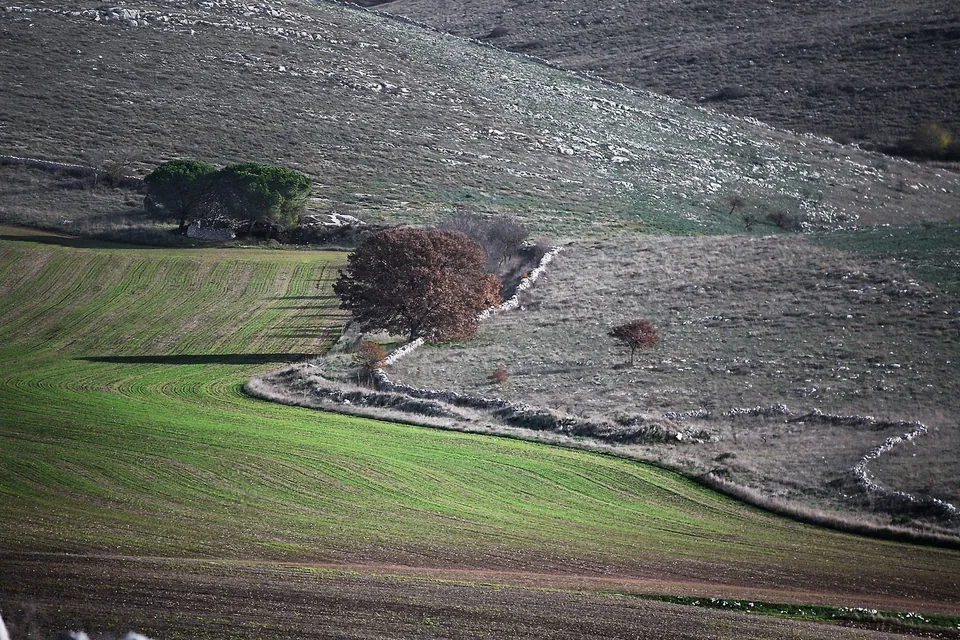
Alta Murgia
Stone, pasture and farming to explore the landscape beyond the towns.
Read the guide →Photo: Acquario51 / Wikimedia Commons — CC BY-SA 4.0 · Resized and converted to WebP.
