
APULICA / FRUIT, VEGETABLES AND PULSES
Molise white truffle
PAT · Fruit, vegetables and pulses · Molise
In brief
- Molise regional law lists Tuber magnatum Pico, commonly called white truffle, among the species that may be gathered. (Regione Molise — Legge regionale 27 maggio 2005, n. 24, disciplina dei tartufi (testo su FAOLEX, FAO))
- Since 2006 white truffles may be gathered in Molise from 15 October to 31 December. (Regione Molise — Legge regionale 10 agosto 2006, n. 18, modifiche alla L.R. 24/2005 (testo su FAOLEX, FAO))
- Free foragers may not take more than half a kilo of white truffle per day. (Regione Molise — Legge regionale 10 agosto 2006, n. 18, modifiche alla L.R. 24/2005 (testo su FAOLEX, FAO))
- San Pietro Avellana, in upper Molise, holds a market fair devoted to the white truffle. (Comune di San Pietro Avellana — 31ª Mostra mercato del tartufo bianco)
History and origin
White truffle is one of the specialities Molise brings to the table alongside its oil, cheeses and wines, and the Alto Molise uplands around Capracotta are known precisely for white truffles and chestnuts. Tuber magnatum Pico, to give it its scientific name, is also on the national list of traditional food products for Molise.
The bond with the region has also become law. With Regional Law no. 24 of 2005 Molise gave itself its own rules for gathering, cultivating and trading truffles, within the framework of the 1985 national law, with the stated aim of protecting and promoting truffle growing. The same law provides support for truffle fairs, shows and conferences and for an identity mark for truffles gathered in the region.
A year later Regional Law no. 18 of 2006 rewrote the harvest calendar and the rules on truffle grounds, a sign of continued close attention to this woodland resource.
Sources: Italia.it — Molise, prodotti e piatti tipici · Masaf — Elenco nazionale dei prodotti agroalimentari tradizionali, XXVI revisione (2026) · Regione Molise — Legge regionale 27 maggio 2005, n. 24, disciplina dei tartufi (testo su FAOLEX, FAO) · Regione Molise — Legge regionale 10 agosto 2006, n. 18, modifiche alla L.R. 24/2005 (testo su FAOLEX, FAO)
Area and method of production
In Molise white truffles may be gathered from 15 October to 31 December. Gathering is free in woods, uncultivated land and along the banks of public watercourses; in controlled or cultivated truffle grounds, marked by signs, it is reserved to whoever manages them. Searching is forbidden at night, from an hour after sunset to an hour before dawn, and on Saturdays, except in managed grounds.
Hunting truffles requires a permit issued by the Province after an exam on the species, their biology and the gathering rules. Hunters may use at most two dogs and dig with the vanghetto, a small tool of set dimensions, only where the dog has found the truffle; the hole must be refilled at once with the same soil.
Picking unripe or damaged truffles and digging the ground at random are forbidden. Free gatherers may take home at most half a kilo of white truffle a day, with a tolerance of just one more specimen.
Sources: Regione Molise — Legge regionale 10 agosto 2006, n. 18, modifiche alla L.R. 24/2005 (testo su FAOLEX, FAO) · Regione Molise — Legge regionale 27 maggio 2005, n. 24, disciplina dei tartufi (testo su FAOLEX, FAO)
How to recognise it
Molise's law adopts the official description of the commercial species. The white truffle has a smooth, unwarted skin, called the peridium, pale yellow or greenish in colour. The flesh, or gleba, ranges from brown to a more or less pale hazel, sometimes tinged with bright red, and is crossed by fine, numerous light veins that disappear when cooked.
It gives off a strong, pleasant scent and ripens between October and the end of December, when the gathering season is open. Under the microscope its spores are elliptical or rounded, with a broad network pattern, up to four to each ascus.
Identification is usually by eye, from these features; in case of doubt or dispute the species is confirmed by microscopic analysis of spores and skin, carried out by specialised centres that issue a written certificate. Fresh truffles may not be sold outside the gathering season.
Sources: Regione Molise — Legge regionale 27 maggio 2005, n. 24, disciplina dei tartufi (testo su FAOLEX, FAO) · Regione Molise — Legge regionale 10 agosto 2006, n. 18, modifiche alla L.R. 24/2005 (testo su FAOLEX, FAO)
Where to taste it
Alto Molise is the heartland of white truffle. In San Pietro Avellana, in the province of Isernia, the municipality holds the White Truffle Show and Market, now in its thirty-first edition: an event devoted entirely to this product, which the village has built up over the years. Not far away, Capracotta pairs white truffle with chestnuts and a mountain cooking tied to transhumance.
Other parts of the region have their truffles too. In the Isernia area the land around Fornelli, a village known for its oil, is rich in truffles and in old pulses grown along the river Vandra. In lower Molise, at Larino, the historic agricultural fair has a food section where truffles are sold alongside cheeses, sausages and olives.
For those travelling along the droving tracks, autumn is the time when Molise's woods and villages show this product in its own setting.
Sources: Comune di San Pietro Avellana — 31ª Mostra mercato del tartufo bianco · Italia.it — Molise, prodotti e piatti tipici · Italia.it — Fornelli, il borgo delle Torri e dell'Olio · Italia.it — Un viaggio nel Molise di Larino e Guglionesi
Protection
- Traditional agri-food product (PAT) — Molise, n. 79, 26th revision (Masaf — Elenco nazionale dei prodotti agroalimentari tradizionali, XXVI revisione (2026))
When
Where
Read more
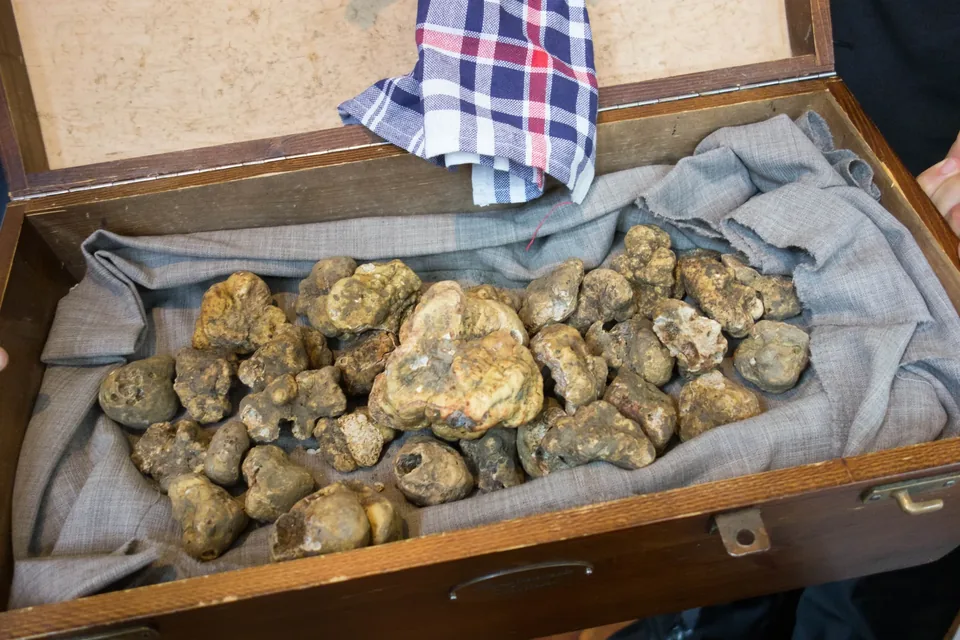
Molise truffles
White truffle and the other Molise species: regional harvesting rules, truffle hunting as UNESCO heritage, the museum and fair at San Pietro Avellana, the summer festivals and how to enjoy it at the table.
Read the guide →Photo: Kent Wang from London, United Kingdom / Wikimedia Commons — CC BY-SA 2.0 · Resized and converted to WebP.
