
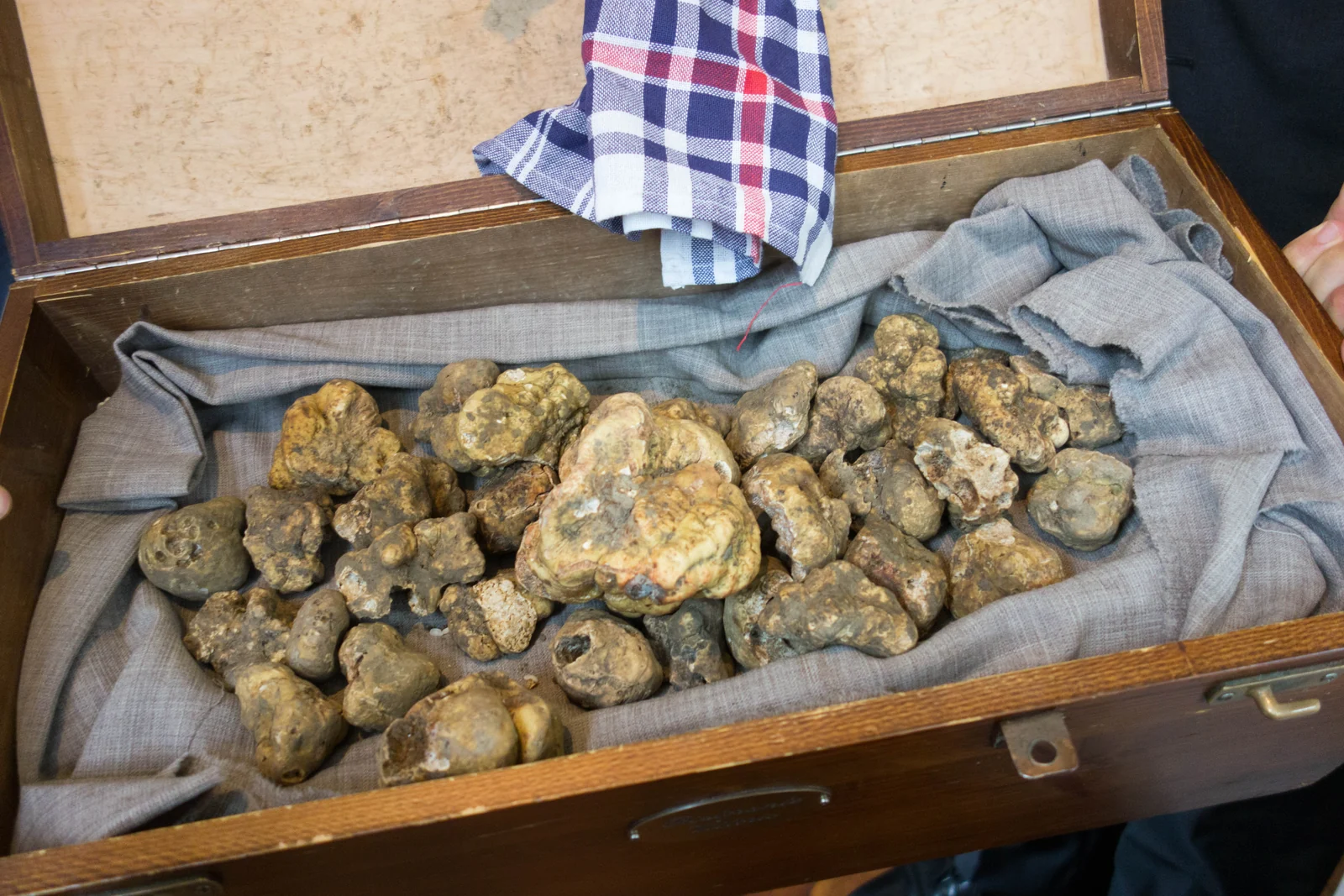
The species recognised by law
Molise Regional Law no. 24 of 27 May 2005 governs the gathering, cultivation and sale of truffles and refers to national framework law 752 of 1985. It allows only certain species to be sold as fresh truffles: Tuber magnatum Pico, the white truffle; Tuber melanosporum, the prized black truffle; the moscato truffle; Tuber aestivum, the summer truffle or scorzone, and its uncinatum variety; the winter black truffle; the bianchetto or marzuolo; the smooth black and the ordinary black. Any other type is excluded from sale. For travellers this list is useful because it explains why markets and restaurants offer different truffles in different months: there is no single Molise truffle, but a calendar of species with very different aromas, looks and prices.
The harvesting calendar
With the changes made by Regional Law 18 of 2006, the Molise calendar sets different periods for each species. White truffle may be sought from 15 October to 31 December; prized black from 15 November to 15 March; summer scorzone from 1 June to 30 August; bianchetto from 15 January to 31 March; winter black from 1 January to 15 March; uncinatum and smooth black from 15 October to 31 December. Searching is banned in April, May and September and, even in permitted periods, from one hour after sunset to one hour before dawn. The law lets provincial authorities adjust the calendar by area, according to soil and climate: actual dates for each year must always be checked with the relevant bodies.
The dog, the spade and the rules of the woods
The regional law describes the search precisely. Hunting is done with the help of at most two dogs; to extract the truffle only the vanghetto may be used, a rectangular tool no larger than 15 by 6 centimetres. A hole may be dug only after the dog has located the truffle, and only where the dog began digging; it must be refilled at once with the same soil and levelled. Picking unripe or spoiled truffles and broadly working the soil to search are banned. For free gathering there is a daily limit of half a kilo of white truffle. Anyone wishing to gather needs a permit, issued to those aged at least 16 who pass an exam on species, truffle biology and the rules. In practice a visitor cannot simply go hunting: they must rely on an authorised truffle hunter.
Knowledge recognised as world heritage
In 2021 UNESCO inscribed truffle hunting and extraction in Italy, traditional knowledge and practice, on the Representative List of the Intangible Cultural Heritage of Humanity. The UNESCO page explains that it is a body of knowledge passed on orally for centuries, which still shapes rural life in whole communities. There are two stages: the hunt, identifying areas where the plants the truffle is linked to grow, with a trained dog; and the extraction, digging with a special spade that does not disturb the soil. It requires knowledge of climate, environment and vegetation, and a close bond between dog and hunter. This knowledge is handed down through stories, anecdotes and local expressions, and the season is often marked by popular festivals at its start and end.
Sources: UNESCO — Truffle hunting and extraction in Italy, traditional knowledge and practice
San Pietro Avellana: museum and fair
The reference village for Molise white truffles is San Pietro Avellana, in the province of Isernia. The town council presents the Truffle Museum as a route that guides you through the ritual of the hunt in the village woods, listening to and watching truffle hunters' stories, with visits also possible by booking, subject to guide availability. The same village has the Museum of Upper Molise, a civic museum of crafts, costume and archaeology recreating a kitchen, a bedroom, a classroom and old workshops. The council has published applications for the 31st White Truffle Fair. The National Association of Truffle Towns lists in San Pietro Avellana a white truffle fair in November and one devoted to the summer black truffle or scorzone in August.
Sources: Comune di San Pietro Avellana — Museo del Tartufo · Comune di San Pietro Avellana — Museo dell'Alto Molise · Comune di San Pietro Avellana — 31ª Mostra mercato del tartufo bianco · Associazione nazionale Città del Tartufo — Regione Molise
Other festivals and green places
The National Association of Truffle Towns, in its Molise page, lists other summer events: the Tartufata in Miranda, province of Isernia, in August, and the truffle festival at Vandra, a hamlet of Forlì del Sannio, in July. The same page suggests natural places not necessarily linked to truffles but useful for planning: the Molise side of the Abruzzo, Lazio and Molise National Park, on the Mainarde and Monti della Meta; the Montedimezzo and Collemeluccio MAB reserve in Upper Molise; the Campochiaro and Guardiaregia reserve; and the Apennine flora garden in Capracotta. Italia.it notes that the area around Capracotta is rich in white truffles and chestnuts. Festival dates change every year and should be checked with towns and pro loco before travelling.
Sources: Associazione nazionale Città del Tartufo — Regione Molise · Italia.it — Molise, piccolo e gustoso scrigno di pietanze e prodotti identitari
At the table: few rules, much care
White truffle is never cooked: it is shaved raw, at the last moment, over simple hot dishes that release its aroma without covering it. Fried eggs, egg pasta with butter, a plain risotto or a light fondue are the best bases. Prized black truffle and scorzone, on the other hand, tolerate brief cooking and suit sauces, fillings and dressings. In Molise truffles pair happily with mountain cheeses and local wines: a risotto creamed with young caciocavallo is a good testing ground. Avoid preparations with synthetic flavourings: a real truffle is recognised by the intense scent of the whole piece, not by a flavoured oil. If a restaurant weighs or shaves the truffle at the table, always ask the species: white and scorzone differ greatly in value.
Going out with a truffle hunter and taking truffles home
A walk in the woods with a truffle hunter and their dog is the best way to understand truffles, but it must be arranged with someone authorised and within the species calendar: visits must be agreed with operators and results are never guaranteed. Outdoor clothes, closed shoes and silence help the dog work. A fresh truffle keeps only a few days: wrapped in absorbent paper changed daily, in a closed container in the least cold part of the fridge. White loses its scent quickly, black lasts a little longer. Always ask the species and origin, and be wary of very low prices for white. Alternatively, preserved truffle products are more practical, but read the label carefully to see how much real truffle they contain.
A thread for your journey
Journey idea: an autumn weekend in Upper Molise, based in Agnone. One day in San Pietro Avellana between the Truffle Museum and the Museum of Upper Molise, with a woodland outing with an authorised truffle hunter arranged with operators; the next day Capracotta and the Montedimezzo reserve, with a lunch where white truffle is shaved raw over a simple dish.
Talk to us

.jpg)

