
Why go
Pietrabbondante is a small village in Upper Molise, in the province of Isernia, perched at over a thousand metres among rocky spurs. The municipality calls itself “the capital of ancient Samnium”, and not out of vanity: a short distance from the houses lies the Italic Sanctuary, which the Regional Directorate of National Museums of Molise describes as the most important architectural record of the religion of the Pentrian Samnites.
The site enjoys a theatrical position on the southern slope of Monte Saraceno, also called Caraceno, at about a thousand metres. From the cavea of the theatre the view opens over the Trigno valley and the villages clinging along its course: it is one of those places where the landscape explains the architecture better than any panel.
Coming here means meeting the Italic world before Rome at close range, in a sanctuary that was at once temple, assembly place and symbol of a people. But it is also worth climbing to the village, which over the centuries reused many stones from the ancient site and keeps panoramic rocks, churches and the monument to the Samnite warrior. Half a day is enough for the sanctuary; a full day lets you add the village and the surrounding landscape.
Sources: Direzione regionale Musei nazionali Molise — Santuario italico di Pietrabbondante · Italia.it — Pietrabbondante · Comune di Pietrabbondante — Il teatro e tempio italico · Visit Agnone (portale turistico collegato dal Comune di Agnone) — Città di Pietrabbondante
History
On Monte Saraceno stretches of fourth-century BC Samnite fortifications survive, dismantled by the Romans at the end of the last of the wars fought between the two peoples. Already in the fourth century BC an Ionic temple and a small sacred building stood on the slope; they were destroyed during the Second Punic War, and in their destruction layers many weapons taken from enemies and dedicated as trophies have been found.
After Hannibal’s war Temple A was built on an artificial terrace, and in the last years of the third century BC a treasury and a small stoa were added to hold offerings. Between the late second and early first century BC the Samnite state and its magistrates, based at Bovianum, built the great complex of the theatre and Temple B. The sanctuary was not only a place of worship: it hosted the assemblies of the senate and administrative functions such as the census, military levy and taxation, and abstract deities such as Victory were venerated there.
Official excavations began in 1857 under the Bourbon government, which sent the finds to the collections of today’s National Archaeological Museum of Naples; from 1959 research was led by Adriano La Regina and it continues today. A roof tile from the temple has yielded the first known Latin-Oscan bilingual inscription.
Sources: Italia.it — Santuario italico di Pietrabbondante · Direzione regionale Musei nazionali Molise — Santuario italico di Pietrabbondante · Comune di Pietrabbondante — Il teatro e tempio italico
What to see
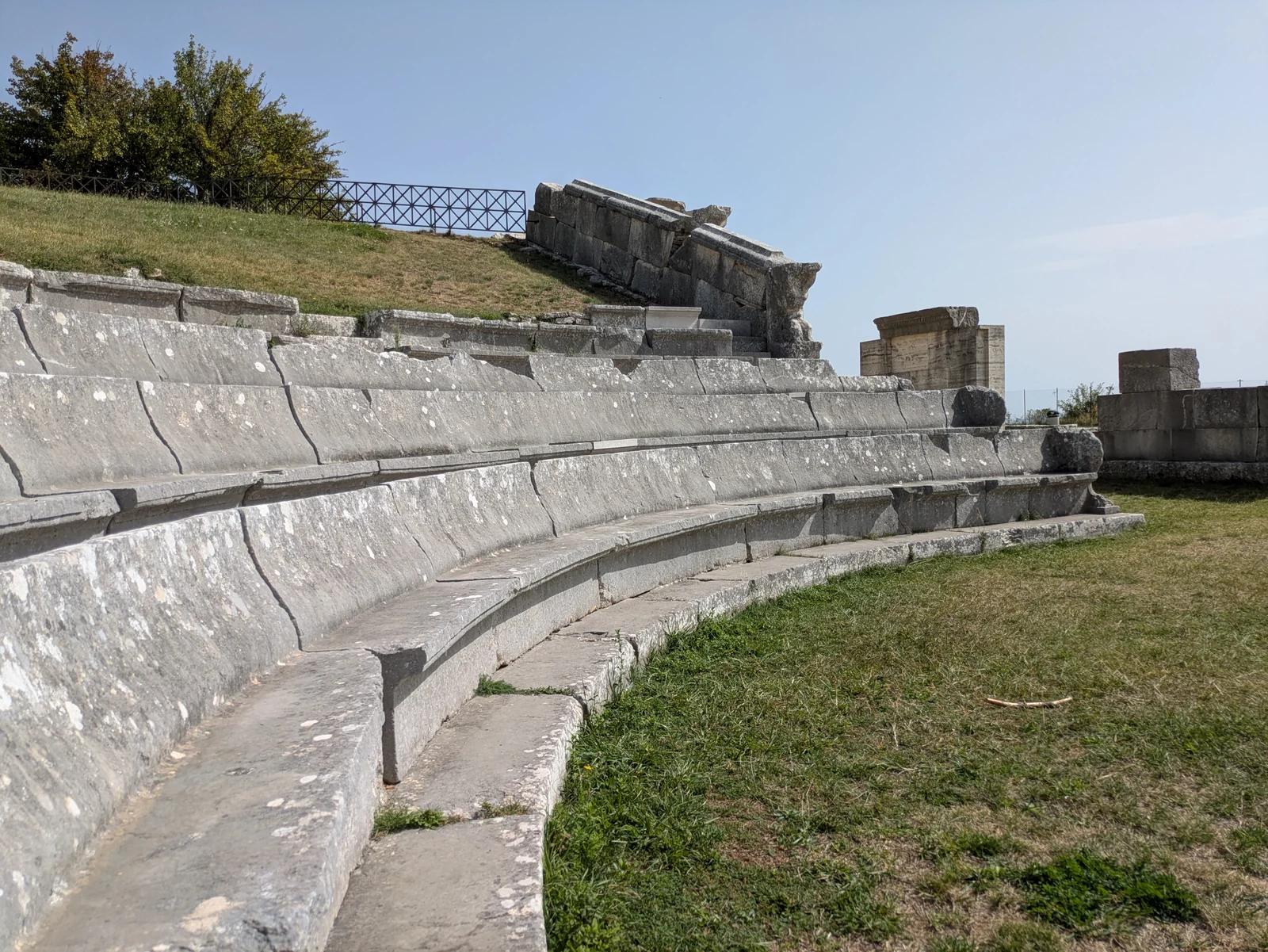
The heart of the site is the complex of the theatre and Temple B, laid out on an axis of symmetry that faces a vast horizon. The theatre, built above ground and supported by a mighty wall of polygonal masonry, keeps its first three rows of stone seats with shaped backrests and armrests carved as winged lion’s paws: one of the most refined solutions of the ancient world. The cavea is thought to have served for assemblies.
Behind the theatre rises the main temple, completed in the early first century BC, of which the imposing podium and part of the spaces before the stairway to the pronaos remain. Of the smaller temple, built in the early second century BC, the podium survives. Nearby are the tabernae, Roman-period shops opening onto a long colonnaded portico.
On the south-western terrace stands the Domus publica, discovered in 2002: the residence of the priests and highest magistrates, who stayed there during religious and political meetings, and the oldest known example of this kind of building. In the eastern sector recent research has identified the treasury, where a stone table with an Oscan inscription names the chief magistrate Gaius Ennius, of the family of the poet Quintus Ennius.
Sources: Direzione regionale Musei nazionali Molise — Santuario italico di Pietrabbondante · Italia.it — Santuario italico di Pietrabbondante
Food and wine
Pietrabbondante’s cooking belongs to that of Upper Molise, born of pastures, woods and long, cold seasons. The dish the official guide links to this area, together with Torella del Sannio, Poggio Sannita and Bagnoli del Trigno, is scattone: fresh pasta served with its cooking water and red wine, a humble and warming dish. Not far away, in Pescolanciano, polenta is cut with a thread.
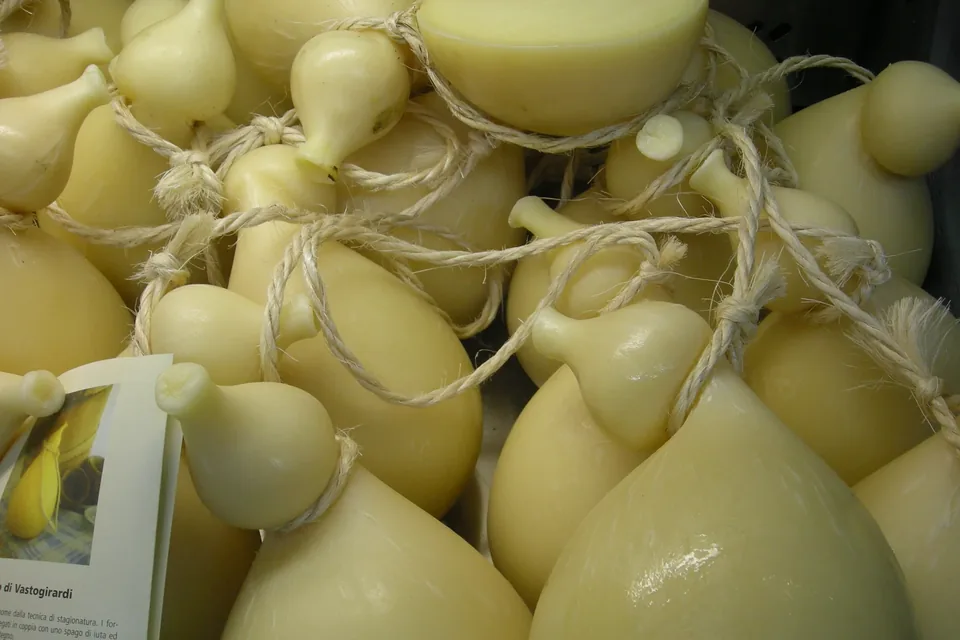
Cheese is the area’s great heritage. Caciocavallo di Agnone, with its hard rind and straw-yellow colour, goes alongside Capracotta pecorino, stracciata and Molise scamorza; among the region’s cured meats are the Signora di Conca Casale, capofreddo and guanciale. In Agnone, a few kilometres away, you also find filled wafers and curly sugared almonds.
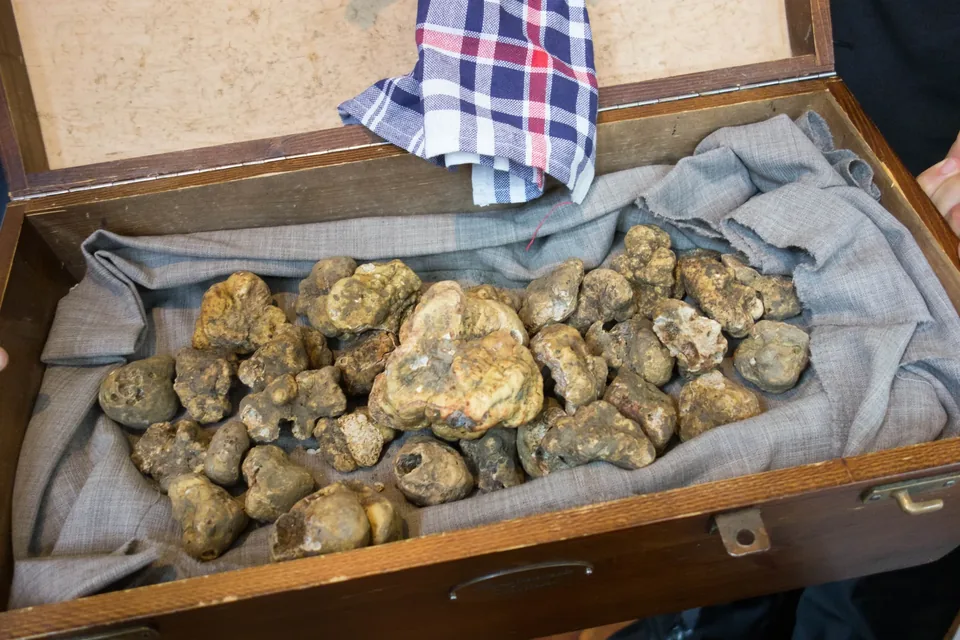
Upper Molise, especially around Capracotta, is rich in white truffles, among them the Tartufo bianco del Molise, and chestnuts, and at the table you can choose Molise wines, among them Tintilia del Molise, and Molise PDO extra virgin olive oil. After a morning at the sanctuary, a lunch built on these products is the simplest way to understand the land of the Samnites through taste as well.
Sources: Italia.it — Molise, prodotti e piatti tipici · Italia.it — Agnone
Things to do
After the sanctuary, the village deserves a stroll. In the square visitors are greeted by the 1922 war memorial by Giuseppe Guastalla: a bronze Samnite warrior about three metres tall, with breastplate, helmet and shield, on a base bearing the names of the village’s twenty-three dead of the Great War and an epigraph by the philologist Francesco D’Ovidio, who was born here. The statue in the square is a 1963 copy; the original is kept indoors.
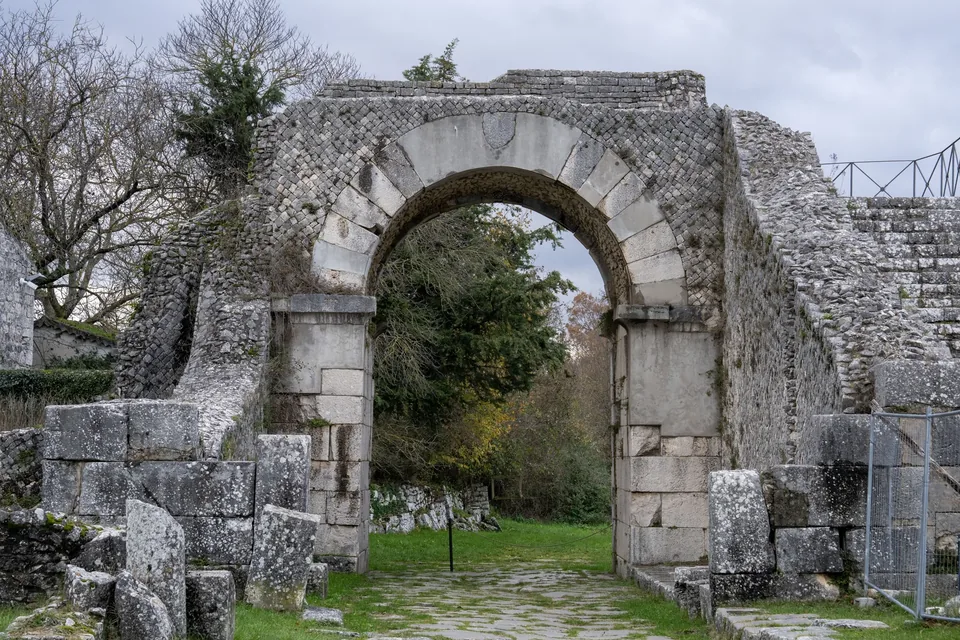
The village is marked by three morge, the rocky spurs typical of the Trigno and Biferno valleys. The morgia known as the Castle can be climbed on foot, with care, for the view; at its foot the seventeenth-century church of Santa Maria Assunta bears fragments of Oscan inscriptions on its rear wall. The Marchesani morgia stands by the baronial palace, while on the Crows’ morgia a short stretch of ancient walls has been identified.
For walkers, the area is crossed by the Celano-Foggia droving track, which passes the archaeological areas of Vastogirardi and Pietrabbondante. Pietrabbondante is also a member of the consortium of municipalities of the Collemeluccio-Montedimezzo MAB Biosphere Reserve, with trails through woods of silver fir, Turkey oak and beech.
Sources: Italia.it — Pietrabbondante · Comune di Pietrabbondante — La statua del guerriero sannita · Italia.it — I tratturi del Molise · Visit Agnone — Riserva MAB Collemeluccio-Montedimezzo Alto Molise · Comune di Pietrabbondante — Riserva MAB Collemeluccio-Montedimezzo Alto Molise
When to go
The sanctuary is a state cultural site open throughout the year, with a ticketed entrance, and the village can be visited in every season. Opening days and hours should be checked on the website of the Regional Directorate of National Museums of Molise before setting off, as they may change.
The village lies at over a thousand metres, and the climate reflects it. In spring and summer the long days let you combine the archaeological site, the climb up the morge and a walk in the nearby woods. Autumn is perhaps the finest moment: the regional museum directorate points out how the Molise woods take on foliage colours between gold and red, and Pietrabbondante is among the sites it suggests for discovering the region’s heritage in this season. In early October the village also holds the traditional fair of Our Lady of the Rosary, which in 2026 took place on Sunday 4 October.
Winter brings cold and possible snow: the landscape is striking, but it is wise to check road conditions before driving up and plan the visit to the site in daylight hours, with clothing suited to the altitude.
Sources: Direzione regionale Musei nazionali Molise — Santuario italico di Pietrabbondante · Direzione regionale Musei nazionali Molise — La prima domenica al museo nei luoghi della cultura statali del Molise · Comune di Pietrabbondante — Fiera della Madonna del Rosario 2026 · Visit Agnone (portale turistico collegato dal Comune di Agnone) — Città di Pietrabbondante
Getting there and around
Molise is reached by train or by car; it has no airports of its own and the Region lists Rome Fiumicino, Rome Ciampino, Naples, Pescara and Foggia as the nearest airports, linked by road. For Upper Molise the reference station is Isernia, on the Rome-Campobasso line, with direct links to Rome and Naples.
Regional bus lines connect Molise with Rome Tiburtina, Naples and Pescara railway station; for internal routes and timetables the Region and Agnone’s tourism portal refer to the ATM and SATI companies, to be consulted before travelling. The official guide notes that from Pescolanciano, regarded as the gateway to Upper Molise, about 11 kilometres bring you into the territory of Pietrabbondante.
By car, from Rome or Naples take the A1 to San Vittore or Caianello and continue via Venafro and Isernia; from Pescara and Bari leave the A14 at Vasto Sud towards Isernia. The sanctuary lies about a kilometre from the village, on the slopes of Monte Saraceno: the village is explored on foot, while your own transport is handy for reaching the site and the nearby villages.
Sources: Regione Molise, Assessorato al turismo (visitmolise.eu) — Come arrivare in Molise · Visit Agnone — Come raggiungerci · Italia.it — Molise, prodotti e piatti tipici · Italia.it — Santuario italico di Pietrabbondante
Where to stay
Pietrabbondante is a village of a few hundred inhabitants and its hospitality is small-scale and family-run: the area’s tourism portal lists bed-and-breakfast accommodation in the village, suited to those who want to sleep close to the sanctuary and enjoy the evening silence at altitude.
For a wider choice the natural base is Agnone, a short distance away, which between hotels, bed and breakfasts and holiday homes can host more than four hundred people, often in old palazzi, village houses or restored farmhouses overlooking the valleys. In the countryside around Agnone there are also agriturismi serving home cooking with local produce.
Staying in one of these villages lets you reach the sanctuary early in the morning or late in the afternoon, at a calmer pace and without hurrying back. For a trip of two or three days it makes sense to combine a night in Pietrabbondante with one or two in Agnone, alternating archaeology, crafts and walks in the woods.
Sources: Visit Agnone (portale turistico collegato dal Comune di Agnone) — Città di Pietrabbondante · Visit Agnone — La città di Agnone
Nearby
The closest and most complementary destination is Agnone, the town of bells: the Pontifical Marinelli Foundry has worked there for about a thousand years and, together with the Historical Bell Museum, the copper and wrought-iron workshops and the sixteen churches of the old centre, it offers a completely different afternoon after a morning among the Samnites.
The Collemeluccio-Montedimezzo MAB Biosphere Reserve, split into two sections in the municipalities of Pescolanciano and Vastogirardi, preserves relict silver fir stands, beech and Turkey oak woods, with a network of trails, one of them accessible to people with reduced mobility, and a visitor centre at Montedimezzo devoted to geology, timber and wildlife. In Capracotta people come for mutton pezzata and lentil soup.
Those following the thread of the Samnites and the droving tracks can continue to Sepino, whose Roman-period archaeological area lies along the Pescasseroli-Candela track, or to Isernia with its historic centre. Pietrabbondante thus becomes one stage of a wider itinerary through inland Molise, among archaeology, villages and the old routes of transhumance.
Sources: Italia.it — Agnone · Visit Agnone — Riserva MAB Collemeluccio-Montedimezzo Alto Molise · Italia.it — I tratturi del Molise · Italia.it — Molise, prodotti e piatti tipici
Where to stay
In the municipality of Pietrabbondante the national database of the Ministry of Tourism lists 5 accommodation businesses with a verified CIN code: 0 hotels, 0 other licensed accommodation and 5 other types such as B&Bs and private rentals.
Sources: Ministero del Turismo – Banca Dati Strutture Ricettive (dashboard pubblica), 2026-10-12
YOUR JOURNEY
How to shape a journey here
A morning at the sanctuary and an afternoon in Agnone, among bells and workshops. Visits to be arranged with local operators.
Talk to us about it

.jpg)
outside.jpg)

