
APULICA / Food guides
Pisticci and its amaro: herbs, an 1894 pastry shop and the pacchiana costume
Pisticci, a Lucanian town between the hills and the Ionian Sea, is known throughout Italy for an amaro. In 1894 the pastry maker Pasquale Vena developed, in the back room of his biscuit shop, a blend of more than thirty herbs that would become Amaro Lucano, now listed as a historic trademark of national interest. This guide is not an advertisement: it sets out what the company, its museum, Museimpresa and public sources say about the liqueur's origins, the traditional costume on its label and Basilicata's herbal liqueurs, and suggests how to fit Pisticci into a journey between Matera, the badlands and Metaponto.
A biscuit shop and more than thirty herbs
Museimpresa, the Italian network of company museums and archives, dates Amaro Lucano to 1894 and to the herbal passion of Pasquale Vena, a pastry maker from Pisticci. The company's own site names the place: the back room of the biscuit shop Vena had opened in town, where he developed a blend with a firm taste and notes of citrus and flowers. There are more than thirty herbs, and the full recipe remains a Vena family secret handed down from one generation to the next. Worth keeping in mind: visitors to Pisticci will not find a formula to copy, but the story of a shop that became an industry. The liqueur's name points to the region, Lucania, rather than to a single ingredient.
Sources: Museimpresa (Associazione italiana musei e archivi d'impresa) — Amaro Lucano, museo Essenza Lucano · Lucano 1894 (sito dell'azienda, fonte primaria) — La storia · Lucano 1894 (sito dell'azienda, fonte primaria) — Amaro Lucano
From the shop to the Pisticci Scalo plant
The timeline published by the company marks a few precise steps. Some years after its creation the amaro travelled beyond Lucania, and the Vena family became official supplier to the Royal House of Savoy. The Second World War halted production for lack of raw materials. In the second half of the 1950s the founder's sons, Leonardo and Giuseppe, turned the workshop into a business, reaching three thousand bottles a year. In 1965 production left the hilltop town for a new plant at Pisticci Scalo, on the plain, and that same year rose to 117,000 litres. National advertising campaigns followed and, in the 1980s, the television slogan that still accompanies the brand. Today the founder's grandson and namesake, Pasquale Vena, works in the company with his wife and children.
Sources: Lucano 1894 (sito dell'azienda, fonte primaria) — La storia
The pacchiana on the label
Italia.it, the Ministry of Tourism portal, notes in its page on Pisticci that the town's traditions survive even in products that became known worldwide: the label of the amaro made here shows the traditional women's costume. That figure has a name, the pacchiana, and both Museimpresa and the Essenza Lucano museum devote one of the five areas of the visit to it, alongside Lucania, Lucano, Amaro and History. For travellers this is a tangible link: an image many people know from a bottle refers to a real costume, worn by the women of a specific community. Looking at the town after seeing the label helps explain why a company chose that face to tell its story.
Sources: Italia.it (Ministero del Turismo) — Pisticci · Museimpresa (Associazione italiana musei e archivi d'impresa) — Amaro Lucano, museo Essenza Lucano · Essenza Lucano — Museo d'impresa dell'Amaro Lucano, Pisticci Scalo
Essenza Lucano, the company museum
The Essenza Lucano museum opened in December 2019 inside the historic Pisticci Scalo plant. According to the museum's site and the Museimpresa profile, the visit begins in the garden of medicinal herbs, the same ones used in the recipe, which visitors can see, touch and smell. It continues in the exhibition space called the Fabbrica, among historic advertising campaigns, the brand's characters and old walnut presses in motion, before reaching the section devoted to the essences. The guided visit lasts about an hour and a quarter; on request it can include a street-art work linked to the project. The site lists specific opening hours for October to June: check them before setting off. Apulica has no agreement with the company and mentions the museum as a place of local history.
Sources: Essenza Lucano — Museo d'impresa dell'Amaro Lucano, Pisticci Scalo · Museimpresa (Associazione italiana musei e archivi d'impresa) — Amaro Lucano, museo Essenza Lucano · Lucano 1894 (sito dell'azienda, fonte primaria) — Lucano's world
What a historic trademark is
In 2021, the company reports, Amaro Lucano was recognised as a Historic Trademark of National Interest. The Italian Patent and Trademark Office explains what this means: article 31 of decree-law 34 of 2019 allows owners of trademarks registered, or used without interruption, for at least fifty years, for products of an excellent national company tied to its territory, to apply for entry in a special register. A decree of 10 January 2020 created the logo, and in March 2025 the English version, Italian Historical Trademark, was presented. Do not confuse the two: this recognises a company trademark, not a designation of origin such as a PDO or PGI, and it carries no specification setting ingredients or production area.
Sources: Lucano 1894 (sito dell'azienda, fonte primaria) — La storia · Ufficio Italiano Brevetti e Marchi (MIMIT) — Registro speciale dei marchi storici di interesse nazionale
In the glass: strength, ageing, serving
The company's pages describe an amaro at 28 per cent alcohol, made from herbs dried naturally and then broken up, with a long ageing phase in which the infusion rests and the taste rounds out towards citrus and floral notes. The same pages suggest several ways to serve it: neat, chilled, on ice or with a strip of orange peel, and as a cocktail base. For a traveller this means the same liqueur can change a great deal with temperature and pairing: chilled it feels tighter, while orange peel brings the citrus side forward. As with any spirit, moderation matters, and Basilicata's hill roads rule out any tasting before driving.
Sources: Lucano 1894 (sito dell'azienda, fonte primaria) — Amaro Lucano · Lucano 1894 (sito dell'azienda, fonte primaria) — Il segreto
Basilicata's traditional liqueurs
Pisticci's amaro is a company product; Basilicata, however, also lists drinks among its traditional food products. In the national list updated by the Ministry of Agriculture with the decree of 6 February 2026, the region's drinks and liqueurs include elderflower liqueur from Chiaromonte and mir' cutt'. Among plant products is anes, the coriander of Carbone, which returns in a biscuit and a sausage from the same village; among sweets, cicerata and mostaccioli. Inclusion is not a designation of origin and gives no recipes. Anyone curious about herbs can therefore look beyond the industrial amaro to the preparations of small inland villages, where names and versions change from valley to valley.
Upper Pisticci: the Casale abbey and the castle
The Comune of Pisticci points to two places that round off a visit. The abbey of Santa Maria La Sanità del Casale was built around 1087 on Monte Corno, then outside the town, and entrusted to the Benedictines of Taranto; the church, in Apulian Romanesque style and local stone, has a thirteenth-century portal carved with acanthus leaves. The wooden statue of the Virgin was crowned by John Paul II in 1991, and the feast of the Madonna del Casale falls on the last Sunday of April. On the town's highest point, at 394 metres, stands the tower of the Norman castle: in the 1930s its central part was demolished for an aqueduct reservoir, and for now the site cannot be visited.
Sources: Comune di Pisticci — Abbazia Santa Maria La Sanità del Casale · Comune di Pisticci — Castello Normanno
Between hills and the Ionian, towards Metaponto
Italia.it describes Pisticci as a town looking out to the Ionian Sea from a landscape of gentle hills, linked to the Pisticci Painter, regarded as the founder of Lucanian red-figure pottery, and birthplace of Ernesto Bruno Lapadula, architect of the Palazzo della Civiltà Italiana in Rome. Close by lies Metaponto, founded according to the same source around the eighth century BC by Greek settlers from the Peloponnese between the mouths of the Bradano and Basento, with temples, a theatre, streets and houses of Magna Graecia. Hills, archaeology and sea make Pisticci a natural stop between Matera and the coast. In spring and autumn the inland clay hills are easier going than in the summer months.
Sources: Italia.it (Ministero del Turismo) — Pisticci · Italia.it (Ministero del Turismo) — Metaponto
Fitting it into the journey
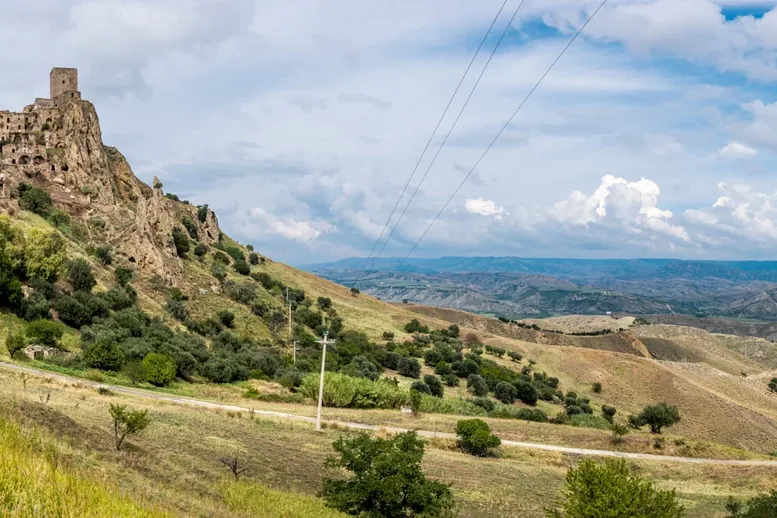
I would not make the amaro the centre of the day, but the thread that ties it together: a morning in Metaponto among temples and museum, a Lucanian lunch inland and, in the afternoon, a stop in Pisticci to walk up to the Casale abbey and look at the town with the label and the pacchiana costume in mind. Anyone curious about company history can book the museum at Pisticci Scalo, on the plain and easy to reach; those who prefer landscape can spend the time on the badlands and Craco. Tasting makes sense after dinner, not mid-day. To take home, more than a bottle, I would suggest the traditional Lucanian sweets found in village bakeries. There are no partner companies in this proposal.
A thread for your journey
Journey idea: a morning at Metaponto's archaeological park and museum, a Lucanian lunch inland, an afternoon in Pisticci between the Casale abbey and the upper town, then the badlands towards Craco; anyone interested can book the company museum at Pisticci Scalo in advance. Tasting the amaro, neat or with orange peel, ends dinner, with no driving afterwards.
Talk to us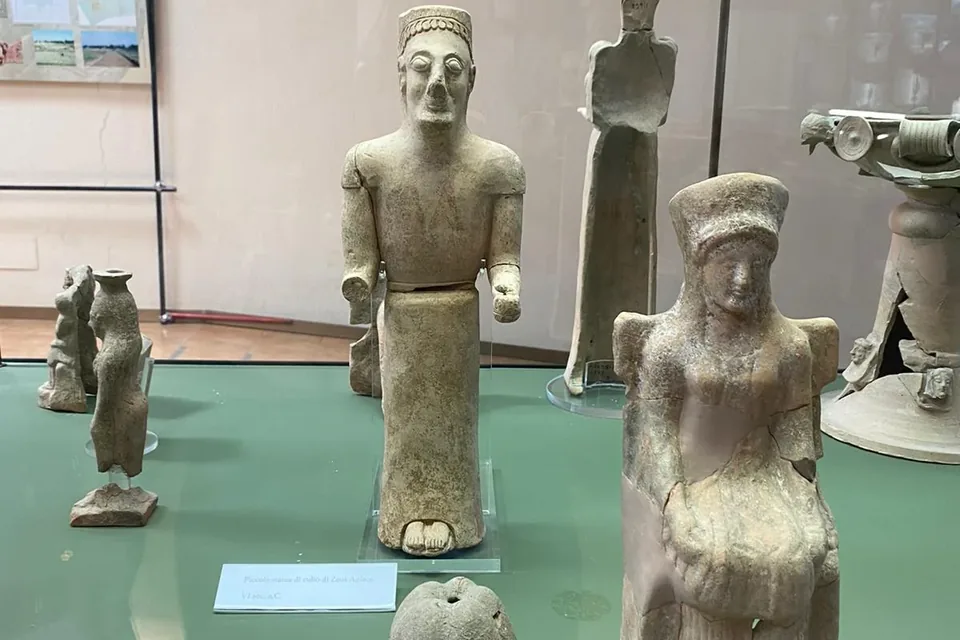


.jpeg)
