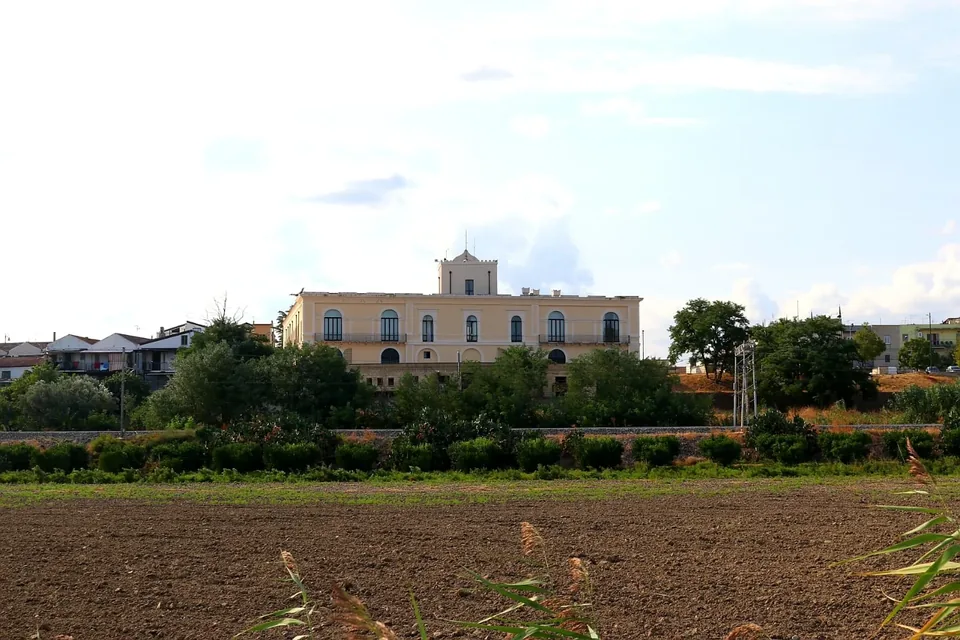
Why go
Metaponto is one of the places where Magna Graecia can best be read. On the alluvial plain between the mouths of the Bradano and Basento rivers, a few minutes from the beaches of the Lucanian Ionian coast, settlers from the Peloponnese founded one of the most important cities of Greek Italy, with temples, an agora, a theatre, craft quarters and a port open to the Mediterranean.
Today those remains are gathered in the archaeological park of the urban area and, just outside, in the sanctuary of the Tavole Palatine, where fifteen Doric columns of the temple of Hera still rise among the fields. The national archaeological museum, in the modern village, holds finds from the city and from the indigenous centres inland, and is the key to understanding how Greeks and local peoples lived side by side and changed one another.
Metaponto's charm also lies in contrast: ancient Greece amid intensively farmed countryside, with citrus groves, orchards and strawberry greenhouses, and a long sandy shore close by. It is an ideal stop on a trip combining archaeology and sea, or for linking the Ionian coast with Matera and inland Basilicata.
Sources: Italia.it — Metaponto · Museo archeologico nazionale di Metaponto — Il parco archeologico · Ministero della Cultura — Tempio delle Tavole Palatine · Museo archeologico nazionale di Metaponto — Il museo · Italia.it — Prodotti e piatti tipici lucani · Qualigeo — Fragola della Basilicata IGP
History
Ancient sources, starting with the geographer Strabo, credit Metaponto with a mythical foundation linked to Nestor and a historical one by the Achaeans, called in by Sybaris to halt Taranto's southward expansion. Excavation dates the colony's birth to the last quarter of the 7th century BC, preceded by a period when groups of Greeks from various parts of the Aegean lived alongside the indigenous Oenotrian communities of the inland plateaus, as on the Incoronata hill. The city's name may derive from a local hero, Metabos.
In the 6th century BC the city took monumental shape: an orthogonal street grid, the first Doric temples and the ekklesiasterion for political assemblies. Aristocratic rule gave way to the tyranny of Archelaus and then, in the 5th century, to a democracy that brought Metaponto its greatest prosperity in the 4th century, thanks to its grain harvests, so rich that it offered a «golden harvest» at Delphi, and to its potters, whose vases reached the elites of all southern Italy.
The Roman conquest and the fall of Taranto in 272 BC began a slow decline, hastened by Hannibal's defeat, to whom the city had surrendered in 212 BC. The settlement shrank to the port at the mouth of the Basento. Modern exploration, launched by the archaeologist Dinu Adamesteanu, has recovered the city's plan.
Sources: Museo archeologico nazionale di Metaponto — Il museo · Museo archeologico nazionale di Metaponto — Il parco archeologico
What to see
In the archaeological park of the urban area you can make out the street grid, the great sanctuary, the agora with the ekklesiasterion later turned into a theatre, the potters' quarter near the north gate and, across the road leading to the park, next to the railway, the Roman castrum, probably built for the 3rd-century BC garrison. The Greek and Roman city had a perimeter of about seven kilometres and covered 150 hectares.
The Tavole Palatine, on the right bank of the Bradano, are the colony's emblem: the Doric temple of Hera, built in the 6th century BC, marked the border with Taranto's territory. Of its original 32 columns, 15 survive with capitals and architraves; in the Middle Ages the site was also called «Mensae Imperatoris», recalling Emperor Otto II, who camped here in the 10th century. Along the road between city and sanctuary lies the Crucinia necropolis.
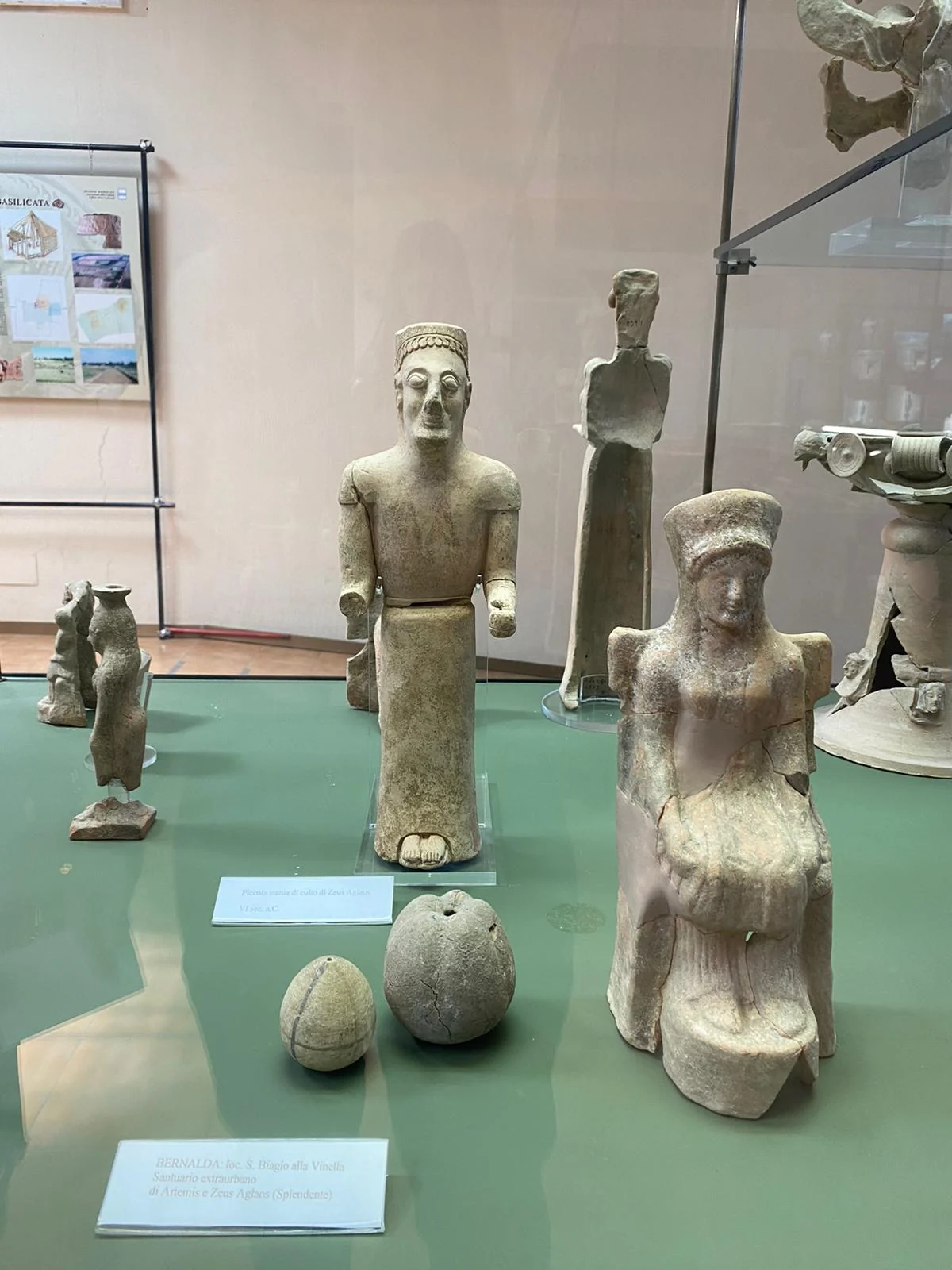
The national archaeological museum, opened in 1991, tells the area's story from the Bronze Age to the Roman conquest: Italo-Mycenaean vases, rich indigenous grave goods from San Teodoro and Incoronata, pottery with mythological scenes and works by the Proto-Lucanian and Lucanian painters. The museum is temporarily closed for works, while an exhibition can be visited by booking in its storerooms: check the current status before visiting.
Sources: Museo archeologico nazionale di Metaponto — Il parco archeologico · Museo archeologico nazionale di Metaponto — Il museo · Ministero della Cultura — Tempio delle Tavole Palatine
Flavours
The Metaponto plain is one of Basilicata's great farmlands. Italy's national tourism portal describes it as the kingdom of fruit, with oranges, mandarins, clementines and strawberries, the latter called Metaponto's red gold. Fragola della Basilicata PGI is grown in nine towns of the province of Matera, including Bernalda, to which Metaponto belongs, Pisticci, Policoro and Scanzano Jonico: the conical, elongated fruit are hand-picked from November to June.
Local cooking shares the same rural simplicity. Dishes recorded for the area include acquasale, made with stale bread, eggs and onion, and baccalà a «ciauredda», with fresh spring onions and chilli. Heading inland you reach Pisticci, home of Amaro Lucano, with its handmade pasta and burrino cheese, and Ferrandina, the kingdom of the Maiatica olive, also eaten baked.
It is a table that changes with the seasons: citrus in winter, strawberries in spring, vegetables and fruit in summer. The food trail the portal suggests from Metaponto to Matera, about 48 kilometres long, crosses this variety all the way to the PGI bread of Matera.
Sources: Italia.it — Prodotti e piatti tipici lucani · Qualigeo — Fragola della Basilicata IGP
When to go
The archaeological area and the plain's landscape can be visited all year, and the best months for walking among the ruins are spring and autumn, when the sun is gentler: the park and the Tavole Palatine are outdoors with little shade. In spring the countryside is at the height of the strawberry season, while in winter the orchards glow with citrus.
Summer is the beach season. The Ionian beaches are minutes from the archaeological area, and the sandy shore running from Metaponto to Scanzano Jonico and beyond suits seaside stays to alternate with cultural visits. In these months plan archaeological visits for early morning or late afternoon.
The museum publishes initiatives, exhibitions and events on its website; as the building is temporarily closed for works, check the museum website before setting out for how to visit the storerooms and the park.
Sources: Museo archeologico nazionale di Metaponto — Il parco archeologico · Qualigeo — Fragola della Basilicata IGP · Italia.it — Prodotti e piatti tipici lucani · Italia.it — Metaponto · Italia.it — Scanzano Jonico · Museo archeologico nazionale di Metaponto — Il museo
Getting there and around
Metaponto is well connected. On the RFI rail network there is Metaponto station, and the museum notes that the area is served by the Taranto-Sibari line; the station is also a reference point for travelling on to inland Basilicata and Matera.
By car, the museum lists from Campania the great valley roads crossing the region to the Ionian Sea: the Basentana (SS407), the Sinnica (SS653) and the Agrina (SS598). Along the coast runs the SS106 Jonica, linking Metaponto with Taranto to the north and with Calabria to the south.
The sites are spread across the plain, so a car or bicycle is useful: the museum is in the modern village, the urban archaeological park is close by, while the Tavole Palatine stand outside the ancient city, on the right bank of the Bradano. The beaches are a few minutes' drive from the archaeological sites.
Sources: RFI — Stazione di Metaponto · Museo archeologico nazionale di Metaponto — Contatti e come arrivare · Museo archeologico nazionale di Metaponto — Il museo · Ministero della Cultura — Tempio delle Tavole Palatine · Italia.it — Metaponto
Nearby
The museum itself suggests extending the visit to nearby towns. Bernalda, the municipality Metaponto belongs to, has a castle, the mother church of San Bernardino da Siena and Palazzo Margherita; on the coast is Torre Mare with the church of San Leone Magno. In Metaponto you can also visit the Metaponto Nature Reserve.
Inland, Pisticci offers the mother church of Saints Peter and Paul, the Dirupo and Terravecchia quarters, the castle of San Basilio and the aqueduct tower; on its Incoronata hill the oldest imported Greek vases in the area were found. To the south, Policoro holds the Museo della Siritide and the archaeological park of Herakleia, the coast's other great Greek city, plus a baronial castle.
A little further lies Scanzano Jonico, with its baronial palace, Basilicata's only lighthouse and long sandy beaches. Matera and its Sassi, a UNESCO site, are about 48 kilometres away according to the national portal's food trail: the route from the coast to the city of the Sassi is a classic way to cross Basilicata from the sea to the plateau.
Sources: Museo archeologico nazionale di Metaponto — Il parco archeologico · Museo archeologico nazionale di Metaponto — Il museo · Italia.it — Scanzano Jonico · Italia.it — Matera · Italia.it — Prodotti e piatti tipici lucani
Where to stay
In the municipality of Bernalda the national database of the Ministry of Tourism lists 215 accommodation businesses with a verified CIN code: 12 hotels, 82 other licensed accommodation and 121 other types such as B&Bs and private rentals.
Sources: Ministero del Turismo – Banca Dati Strutture Ricettive (dashboard pubblica), 2026-10-12
YOUR JOURNEY
How to shape a journey here
Pair the museum with the archaeological area: objects help give meaning to structures. Time on the coast completes the day without replacing its cultural focus.
Talk to us about it