
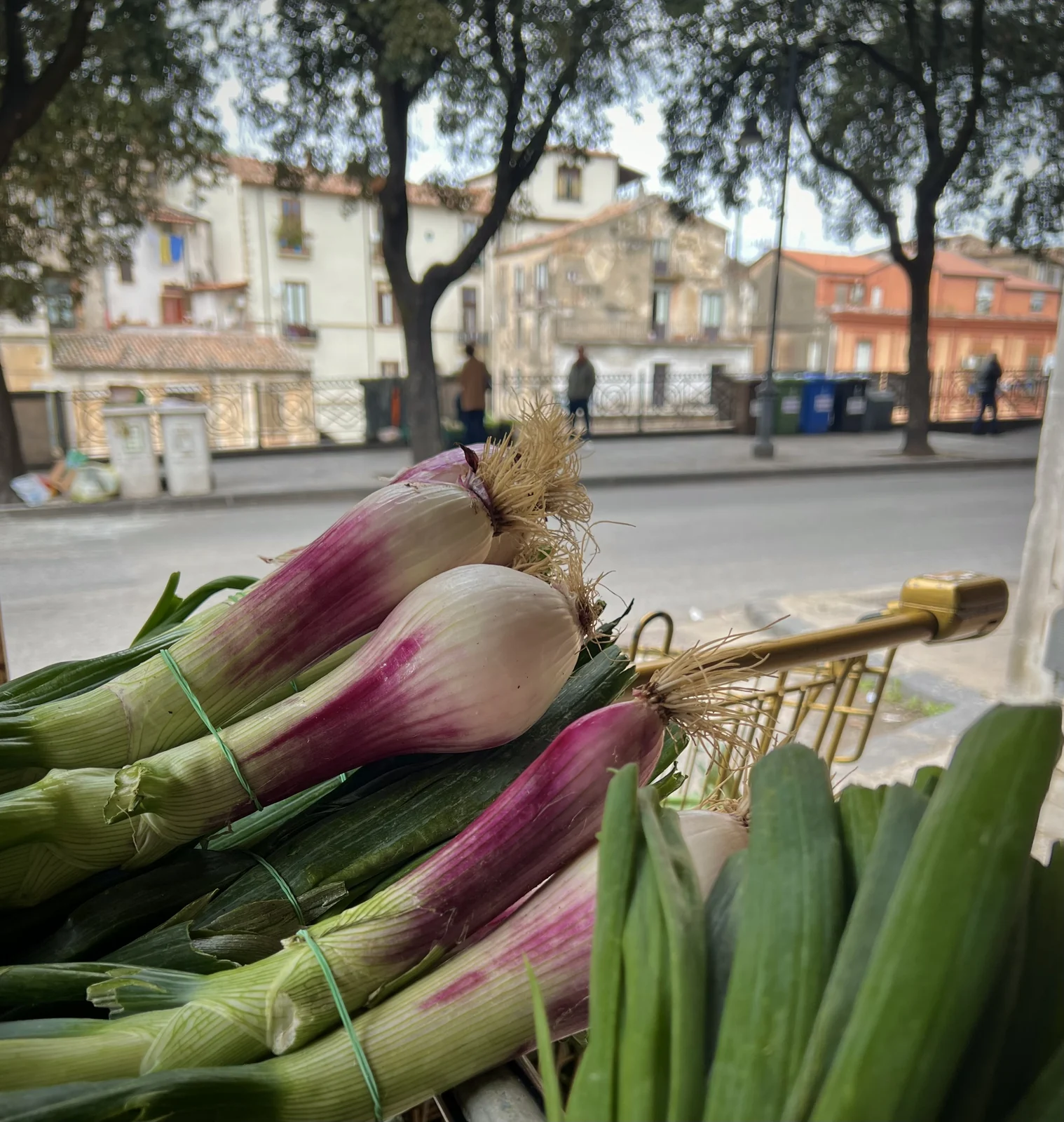
The Garden of the Hesperides project
FIRAB documents the “Garden of the Hesperides” project, devoted to safeguarding Calabria’s herbaceous and fruit biodiversity from the Pollino to the Aspromonte. It was developed by AIAB Calabria together with ARSAC, the regional agricultural development agency, the Department of Agriculture of the Mediterranea University of Reggio Calabria and FIRAB itself, with the aim of preventing the extinction of old fruit tree varieties and herbaceous plants typical of the region.
The page explains why these plants are at risk. Grown for centuries for food, remedies and flavourings, they became ill-suited to modern markets, often having small or perishable fruit; yet they carry genetic traits that make them disease-resistant and adaptable to different environments. So the habit of growing them was lost, except for some varieties kept in family gardens as ingredients in traditional recipes.
The project chose organic farming methods, involving farms that preserved endangered species and an organic nursery for seedlings and rootstocks.
Sources: FIRAB — Giardino delle Esperidi
Conserving in different ways
FIRAB distinguishes three forms of conservation in the project. In “in situ” fields, farmers provided not only their old varieties, trees and seeds, but also their own land, which became genuine research laboratories. In purpose-built “ex situ” fields, rootstocks were planted to be grafted with material from endangered varieties, away from their original setting. In “on farm” fields, crops were followed throughout their cycle to assess health, productivity and adaptation.
The observations were gathered in a database, designed so that this body of knowledge would not be lost. The project also included pruning and grafting courses, seminars on protecting old varieties, meetings on participatory plant breeding, outreach days and publications.
The page notes that the project was promoted by the Calabria Region through the 2007-2013 Rural Development Programme, within the framework of the law by which Italy ratified the Rio Convention on biodiversity in 1994. It is a heritage of varieties and knowledge, not the current programme of a park open to visitors.
Sources: FIRAB — Giardino delle Esperidi
A register of local names
ARSAC publishes the list of genetic resources entered in Calabria’s Regional Register of Agricultural Biodiversity, set up to protect varieties, breeds and strains of agricultural and food interest. Each entry gives the botanical name, common name, dialect name, place of conservation and risk of genetic erosion.
Reading it is a small journey through names. There is the Aubergine Fig, locally called “Milangiana”; Calabrian purple potato; the wheats Rosia, Mazzancollo and Secrìa; the jasmine of the Reggio coast; the orange of Villa San Giuseppe; the “zafarana” pepper of Tortora; the friars’ plum; the “cuacciu” apple. Among the most recent entries are the Pappaluni bean, the white Poverello bean of the Pollino, the Mormanno lentil, the Belmonte Calabro tomato and the violet aubergine of Longobardi.
For every variety listed the register gives a high risk of erosion, and conservation takes place in ARSAC’s experimental centres, such as those at San Marco Argentano, in the Sila and at Gioia Tauro. These are names to remember when you meet them on a menu or at a market.
Sources: ARSAC (Regione Calabria) — Registro regionale della biodiversità agraria
The case of pulses
An ARSAC article uses pulses to explain the value of agricultural biodiversity. It starts from a 2019 FAO report on the decline in the diversity of cultivated species and recalls that in 2015 Italy adopted a law protecting biodiversity of agricultural and food interest, which also recognises the role of guardian farmers.
Grain legumes, beans, chickpeas and lentils, are rich in protein and also have environmental value: thanks to bacteria living on their roots they fix nitrogen from the air and leave it in the soil for the following crops. ARSAC, with several research institutes, has worked on Calabrian ecotypes such as the local chickpea, the Mormanno lentil and the white Poverello bean.
The article stresses that these crops, often grown on unirrigated land, help counter the abandonment of the countryside, and that they are found in areas rich in nature, landscape and archaeology, where food tourism combines well with nature and cultural tourism. Small producers grow them with low-impact techniques.
Sources: ARSAC (Regione Calabria) — La biodiversità agricola in Calabria: il caso dei legumi
The white onion of Castrovillari
Another example documented by ARSAC is the white onion of Castrovillari, to which the municipality has granted a municipal designation, with the agency’s support in drafting the production rules and in meetings between administrators and growers.
Cultivation once covered a few dozen hectares, from the districts near town along the Coscile valley to part of the Sibari plain, now given over to specialised fruit growing. Today it is concentrated mainly in the Giardini area, where about twenty growers cultivate it on small plots with low-impact methods, selecting their own bulbs for seed.
ARSAC measured very variable pungency across samples, depending on soil, climate and individual growers’ choices; some bulbs are very sweet. According to the agency, the recognition strengthens the onion’s identity for the whole area between the Sibaritide and the Pollino, rich in nature, landscape and archaeology, and can support local restaurants and nearby food tourism.
Sources: ARSAC (Regione Calabria) — La Cipolla bianca di Castrovillari conquista la De.Co.
The flavours of the Pollino
The Pollino National Park devotes a page to the flavours of its territory, mountains, forests and streams at whose feet lie historic centres, craft workshops and taverns. It explains that the park’s communities hand down customs, languages, songs and dances, and that the landscape has been shaped by farming, grazing, livestock and the processing of milk, meat and plant products.
The park authority states that it has supported these products through projects on quality, good practice and organising producers into supply chains, linking them with tourism businesses. Among local specialities it lists Senise peppers, Rotonda red aubergine, Cerchiara bread, miskiglio, soppressata, ricotta, honey, wild fruit liqueurs and Saracena moscato.
For cheeses, the page mentions hard pecorino from sheep’s and goat’s milk, paddaccio, fresh and unsalted, made at the foot of the Pollino, and baked ricotta, which in some dairies on the Calabrian side is baked in ceramic or earthenware containers and matured from a few weeks to six months.
Sources: Parco nazionale del Pollino — Sapori
Civita and the Arbëreshë communities
The Pollino park also tells the story of the Arbëreshë communities. Between 1470 and 1540, after the death of George Castriot Skanderbeg, groups from Albania settled in the territory between Calabria and Basilicata to escape the Ottoman forces, founding villages such as Acquaformosa, Civita, San Basile, Lungro, Plataci and Frascineto.
These communities have preserved their language, costumes and traditions. In Civita, the park notes, there is a museum of Arbëreshë culture with objects, tools and traditional dress; in some villages fabrics are still woven from broom fibre using methods handed down from mother to daughter, and at festivals people dance the “vallje”, linked by handkerchiefs.
Parishes follow the Byzantine-Greek rite and belong to the Eparchy of Lungro, established in 1919; Easter is the most important feast. A visit to Civita combines landscape, language and food: the biodiversity of these lands concerns not only plants but also the knowledge of the communities that grew them.
The questions that change a visit
When faced with an ingredient, ask what it is called, who passed that name down and how it is used in cooking. These are three different questions: the first identifies, the second opens a memory, the third leads to tasting. Note a concrete detail, such as shape or texture, beside the dialect name.
There is no need to count hundreds of varieties to appreciate biodiversity: two well-explained examples can stay with you longer than a list. Then compare simple preparations with a precise question: how does the chosen product change this dish? A complex sauce can make it hard to pick out the ingredient that interests you.
A first taste on its own, followed by one in the recipe, lets you follow the passage from raw material to kitchen. The useful outcome is remembering a use as well as a name: that is how a rare product becomes something to look for again, and how its growers find one more reason to keep going.
Harvest time and travel rhythm
No single month reveals every variety. ARSAC explains that many Calabrian pulses have a spring-summer cycle: they are sown in spring and harvested by the end of summer, sometimes in autumn. If your curiosity concerns a fresh vegetable, build the stop around that crop; if it concerns seeds and memory, around the story of the people who keep them.
In our northern Calabria itinerary, pair the theme with three places. The Pollino, with the villages and products described by the park; Civita, with its Arbëreshë community; and the Ionian coast of Corigliano-Rossano, towards the Sibari plain that ARSAC recalls as the onion’s old growing area, now given over to fruit.
Choose one farming chapter per day, leaving room for landscape, historic centres and food. Festivals and events change every year and should be checked before leaving; the story of a guardian farmer, on the other hand, can be sought in any season.
Sources: ARSAC (Regione Calabria) — La biodiversità agricola in Calabria: il caso dei legumi · Parco nazionale del Pollino — Sapori · Parco nazionale del Pollino — Comunità arbëreshë · ARSAC (Regione Calabria) — La Cipolla bianca di Castrovillari conquista la De.Co.
A thread for your journey
Journey idea: follow one chosen ingredient from countryside to table in northern Calabria. The historical project documents a context; the editorial idea seeks recognisable varieties and practical uses without assigning services to unidentified farms.
Talk to us


_luglio_2021_f01.jpg)