APULICA / Food guides
Ceglie biscuit: almonds, jam and a town of flavour
In Ceglie Messapica, between the Itria Valley and the Salento, the town's emblematic sweet is a small, irregular cube of almond paste with a jam centre: the Ceglie biscuit, piscquett'l in dialect. It has been made at home for centuries, for feasts and weddings, and is now a Slow Food Presidium requiring raw materials from the Ceglie countryside, from almonds to cherries. This guide follows the official records on ingredients, technique and history, and suggests how to taste it during a day in Ceglie.
The piscquett'l, symbol of a town
The Slow Food Foundation describes the Ceglie biscuit as a small sweet shaped like an irregular cube, made in Ceglie Messapica for hundreds of years and known locally as piscquett'l. The Atlas of Apulian traditional products added it to the PAT list in 2001, with the town of Ceglie as area of origin and year-round production; it describes it as dark, with a jam filling, rooted in peasant tradition. In the commonest variants the filling may be sour cherry, cherry or fig; some versions are flavoured with coffee or covered with a sugar and cocoa glaze. The Puglia Region's profile of Ceglie for the Interreg AI-SMART project presents the town as a city of art and a land of gastronomy, naming the Ceglie biscuit as its signature product.
Sources: Fondazione Slow Food — Presidio Biscotto di Ceglie · Atlante dei PAT di Puglia — Biscotto di Ceglie Messapica · Regione Puglia, Interreg AI-SMART — Ceglie Messapica città del gusto
Blanched and toasted almonds, honey and rosolio
The heart of the biscuit is almond paste. According to the Presidium, some almonds are blanched in water and some toasted, then all are ground finely but keeping some texture. They are mixed with sugar, honey, lemon zest and citrus rosolio liqueur, bound with about four eggs per kilo of almond paste, until the dough is firm and resilient. The PAT record specifies that the almonds should preferably be of the Cegliese variety, which the Presidium also calls du riviézz, and that the dough is worked by hand. Slow Food adds that many local almond varieties have almost disappeared, largely replaced by industrially grown almonds, and that a consortium and then the Presidium were created precisely to defend the original biscuit. As early as 1792, the Foundation recalls, Vincenzo Corrado praised the excellence of Brindisi's almond groves.
Sources: Fondazione Slow Food — Presidio Biscotto di Ceglie · Atlante dei PAT di Puglia — Biscotto di Ceglie Messapica
Strips, jam and little squares
The PAT record describes the shaping. The paste is rolled into strips twelve to fourteen centimetres wide, thirty-five to forty long and about one and a half centimetres thick. Jam is spread along the edge, then the strip is folded and rolled to enclose the filling in the centre; the log is cut into squares of about five centimetres, which go on a lightly floured tray and bake in a preheated oven at 160 to 180 degrees for fifteen to twenty minutes. A light sugar and cocoa glaze is optional and helps it keep; Slow Food calls it gileppatura. The Presidium rules specify fillings of cherry jam from the capa di seta, mascialora and cirasona varieties, or of grapes from native Brindisi vines, and require all raw materials to come from the Ceglie countryside.
Sources: Atlante dei PAT di Puglia — Biscotto di Ceglie Messapica · Fondazione Slow Food — Presidio Biscotto di Ceglie · Slow Food Foundation — Ceglie Biscuit Presidium
Feasts, weddings and favours
The Ceglie biscuit is a festive sweet. For Slow Food, in its many variants it is a key part of the town women's culinary tradition: it is always in the house, above all on feast days, and never missing from wedding favours. The PAT record confirms that it was, and still is, made at home for important feasts and wedding banquets. Today, the Atlas adds, it is found in the town's bakeries, cafés and pastry shops and is also served in restaurants, often in freer versions than the original; the English Presidium page notes that in many cases the authenticity of ingredients has been lost and a simplified method is used, which is why the Presidium aims to promote the original tradition. The Atlas also notes it is protected by a consortium of raw-material producers, artisans and restaurateurs.
Sources: Fondazione Slow Food — Presidio Biscotto di Ceglie · Slow Food Foundation — Ceglie Biscuit Presidium · Atlante dei PAT di Puglia — Biscotto di Ceglie Messapica
Almonds around Brindisi: another sweet
The Ceglie biscuit belongs to an almond province. In the same province, the Apulian Atlas lists the mandorla riccia of Francavilla Fontana, a PAT since 2004: almonds toasted in a single layer in a wood oven, coated in sugar in a copper pan over glowing coals with a rocking motion for about seventy minutes, then curled over a low flame for about two and a half hours while glaze drips from above, and finally scented with lemon, citron and vanilla. The record mentions a family firm active since 1931, a medal at a Paris food fair in 1912 and inclusion in the Slow Food Ark of Taste; it is linked to Carnival, when on the two Thursdays before Shrove Tuesday men and women exchange almonds, and to the feast of the Madonna della Fontana on 14 September. Comparing the two sweets shows well how almonds are used around Brindisi.
Sources: Atlante dei PAT di Puglia — Mandorla riccia di Francavilla Fontana
Ceglie: from the Messapians to the castle
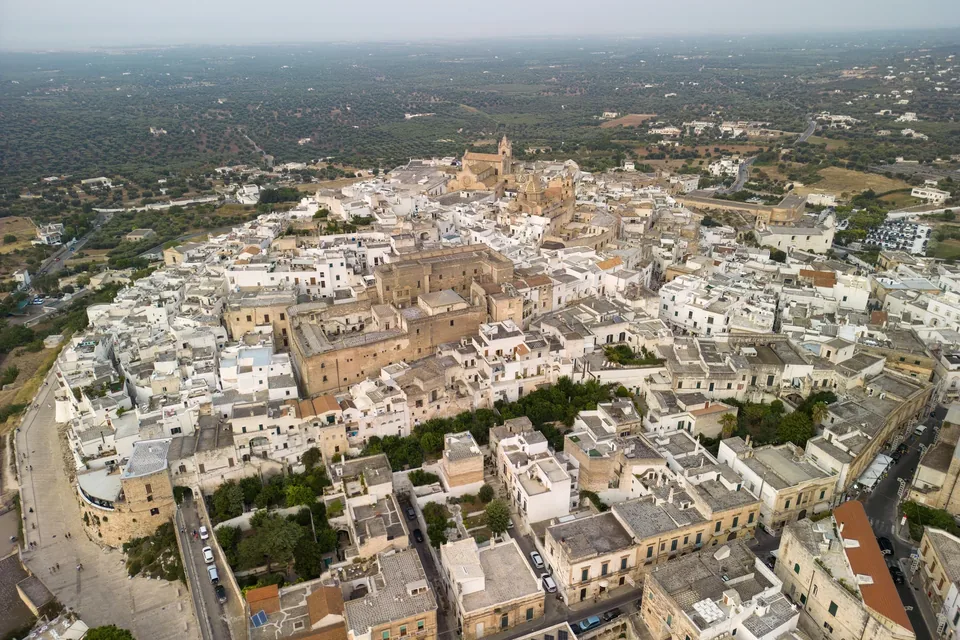
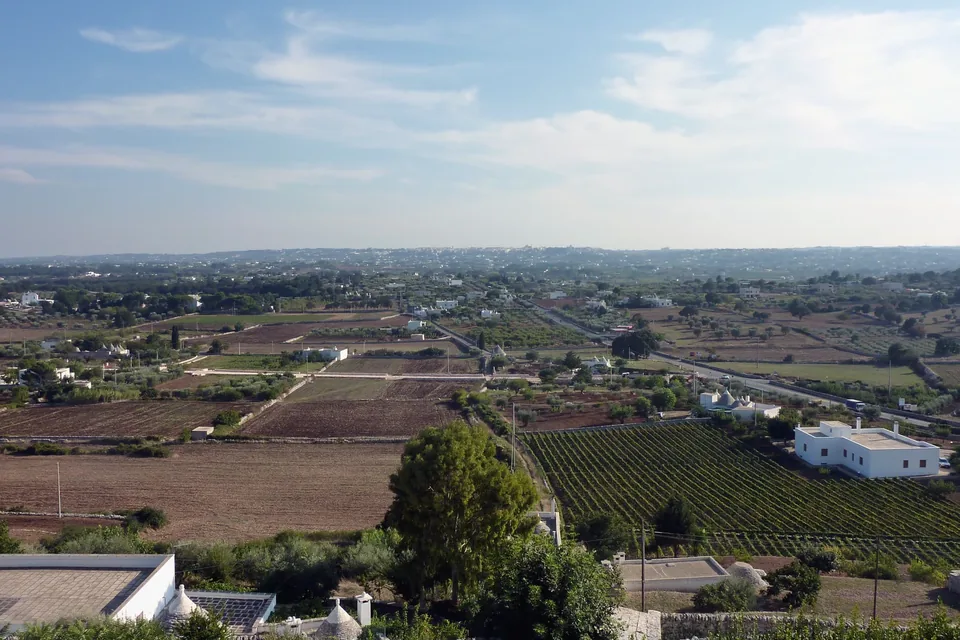
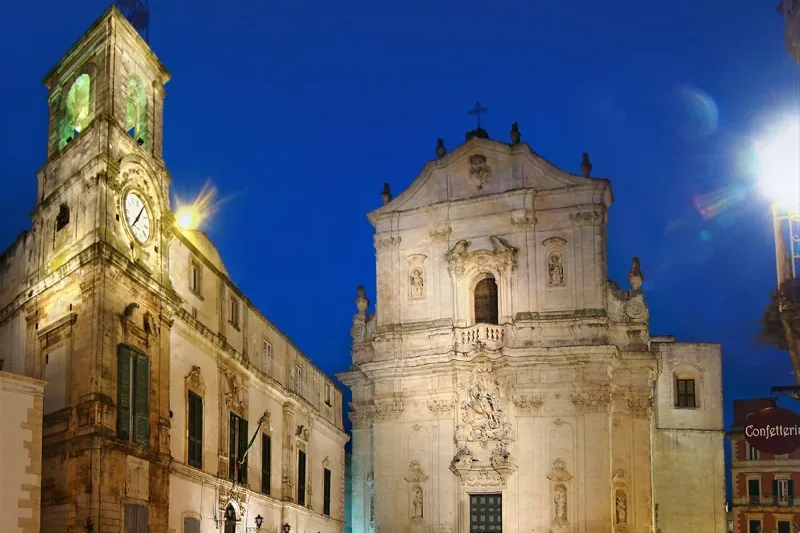
Italia.it notes that Ceglie was an important military, political and religious centre of the Messapians, identified with the Caelium mentioned by Pliny, at its height in the 4th and 3rd centuries BC; after Goths, Visigoths and Lombards it became a fief of the Brindisi archdiocese and, around the mid-14th century, of the Sanseverino family. The castle, with parts possibly from the 11th century, overlooks the medieval town. The little church of the Madonna della Grotta has a Basilian crypt with 13th-century frescoes; at the Montedoro farm, the Museum of Trullo Civilisation tells of peasant life in a complex from 1792, and the countryside keeps the specchie, ancient Messapian watchtowers. The regional profile adds Palazzo Allegretti, home to the Emilio Notte art gallery, the Collegiate Church of the Assumption on the ancient acropolis and the Montevicoli caves, about a kilometre from the centre, in a landscape of terraces with trulli and dry-stone walls.
Sources: Italia.it — Ceglie Messapica · Regione Puglia, Interreg AI-SMART — Ceglie Messapica città del gusto
What with, and when
The PAT record suggests pairing the biscuit with home-made rosolio or local sweet wines such as Aleatico and Primitivo dolce naturale. For our part, taste it mid-afternoon in a café in the centre, with a coffee, comparing two fillings, cherry and grape, to sense how the balance between almond and fruit changes. A good biscuit shows the texture of the almond, which should remain perceptible, and is not overly sweet: if it tastes only of sugar, it is probably a simplified version. Always ask whether the product belongs to the Presidium. We give no dates for dedicated festivals: on the official pages we consulted we found no up-to-date calendar of events devoted to the biscuit.
The souvenir for your suitcase
The Ceglie biscuit is one of the Apulian sweets best suited to travel: compact, not very moist and, in glazed versions, designed to keep longer. Buy it in a rigid box, choosing an assortment of fillings, and keep it away from heat. If you bring it as a gift, it is worth telling its story as a wedding-favour sweet: a way of describing Ceglie to someone who has not been there. If you have time, complete the basket with a pack of mandorle ricce from Francavilla Fontana, to have two different ways of working the same province's almonds. For cooks, a local cherry or grape jam is the starting point for trying the PAT recipe at home.
A thread for your journey
Journey idea: half a day in Ceglie Messapica between the castle, the Collegiate Church and Palazzo Allegretti, with a stop at a café or bakery to taste the biscuit with different fillings, then the afternoon towards Ostuni or the Itria Valley; visits to a workshop or the Museum of Trullo Civilisation to be arranged with operators.
Talk to us