
APULICA / Food guides
Zungoli: caciocavallo podolico aged in the caves beneath the village
Zungoli is a village in the upper Ufita valley, on the border between Campania and Apulia, crossed by the royal Pescasseroli-Candela drove road. Beneath its lanes lies a network of tuff caves on several levels, first used as shelters and today also for ripening cheeses, including caciocavallo podolico, made from the milk of Podolica cows grazing between Irpinia and Daunia. This guide connects the cheese with the landscape of transhumance: the breed, the technique, cave ageing, the castle, the festivals and the best way to taste it.
The Podolica cow
The Slow Food Foundation, presenting its Gargano caciocavallo podolico Presidium, describes Podolica cows as having a straight profile, a lively gaze, large horns and a grey coat. They give excellent milk for cheese, but in very small quantities and only at certain times of year; that is why the breed, once dominant, is now confined to a few areas of southern Italy where grazing is poor and water scarce. The 'Most Beautiful Villages in Italy' page on Zungoli explains that genuine caciocavallo podolico comes from cows grazing the meadows between Irpinia and Daunia along the royal drove road, eating only grass and giving milk only from March to June, like the village's herds. The Campania Region notes that the Podolica is among the local breeds, often at risk, that give little milk but of high quality.
Sources: Fondazione Slow Food — Presidio Caciocavallo podolico del Gargano · I Borghi più belli d'Italia — Zungoli · Regione Campania — Prodotti agroalimentari tradizionali: formaggi
From curd to a flask with a little head
The technique for caciocavallo podolico, as Slow Food describes it for the Gargano Presidium, is that of stretched curd. The milk is curdled and the curd broken into rice-sized grains; the paste matures in whey in a tub, then drains on a sloping wooden table. When ready it is sliced, stretched with boiling water and shaped into a pot-bellied flask with a small head: a delicate task that takes practice. Once the head is closed, the cheese goes into cold water and then brine. Ageing ranges from three months to three years, sometimes eight or ten, and only after many months does the cheese gain its aromatic character. Peak production, again according to Slow Food, falls between March and May. The Campania Region lists caciocavallo podolico among its traditional products.
Sources: Fondazione Slow Food — Presidio Caciocavallo podolico del Gargano · Regione Campania — Prodotti agroalimentari tradizionali: formaggi
The caves beneath the village
Beneath Zungoli's old centre, explains the Province's Sistema Irpinia portal, caves extend over several interconnected levels, attributed to the Byzantine period between the 9th and 10th centuries, with entrances facing east, although their origin is probably older. Over time they have served as shelter, dwelling, cellar, storehouse, granary, olive mill and stable. Italia.it and the Touring Club Italiano add the most recent use: ripening rooms for local cheeses, caciocavallo podolico above all. According to the Touring Club, the caciocavallo ages in the caves for more than two years; by then it is covered in moulds under which the rind is hard and shiny and the paste compact, with a strong, lingering aroma and a full flavour. The Municipality runs guided tours of the village and the caves at weekends and on public holidays.
Sources: Provincia di Avellino, Sistema Irpinia — Grotte bizantine di Zungoli · Italia.it — Zungoli · Touring Club Italiano — Zungoli, Bandiera Arancione
Why it is called caciocavallo, and the Irpinian cave
The Campania Region explains that the name caciocavallo comes from the old habit of hanging the cheese in pairs, tied with a raffia loop, 'astride' wooden poles near the hearth, to help the rind form and the cheese mature. Podolico is made from the milk of Podolica cows, still found in the provinces of Avellino, Caserta and Salerno; in inland areas around Avellino and Salerno they are raised with the ancient practice of transhumance. The aroma changes with the pasture: in spring and summer mountain grazing is rich in aromatic herbs, while in autumn and winter lowland grazing gives a stronger taste. The Region also recognises the Irpinian cave caciocavallo, made in areas including the Ufita valley: after an initial drying of 45-60 days it ages in tuff caves, hung in pairs on wooden beams, at 80-90% humidity and almost constant temperatures of 10-15 degrees, for up to two years.
Sources: Regione Campania — Prodotto tradizionale: caciocavallo podolico · Regione Campania — Prodotto tradizionale: caciocavallo irpino di grotta
The Pescasseroli-Candela drove road
Zungoli, write Italia.it and the Touring Club, is surrounded by the Molara, Monticelli and Toppo dell'Anno mountains and crossed by a stretch of the royal Pescasseroli-Candela drove road, which is becoming a tourist and sports route for horse riding and trekking. The 'Most Beautiful Villages in Italy' site notes that the village was also linked to the Roman Appia and Traiana roads, joined by the Erculea and Herdonetana, and that since 2002 the itinerary 'Settembre, andiamo, è tempo di migrare' has followed the original drove road on horseback and mountain bike in seven stages through the provinces of L'Aquila, Isernia, Campobasso, Benevento, Avellino and Foggia. Sistema Irpinia has documented several guided hikes on the drove road: the latest we found, 'Lungo la via della transumanza' on Sunday 23 February 2025, was a 15-kilometre loop along the Cervaro river up to the 940 metres of Monte Molara. It is not a fixed event: we found no published dates for 2026.
Sources: Italia.it — Zungoli · Touring Club Italiano — Zungoli, Bandiera Arancione · I Borghi più belli d'Italia — Zungoli · Provincia di Avellino, Sistema Irpinia — Zungoli, Lungo la via della transumanza (2025)
The castle and the convent
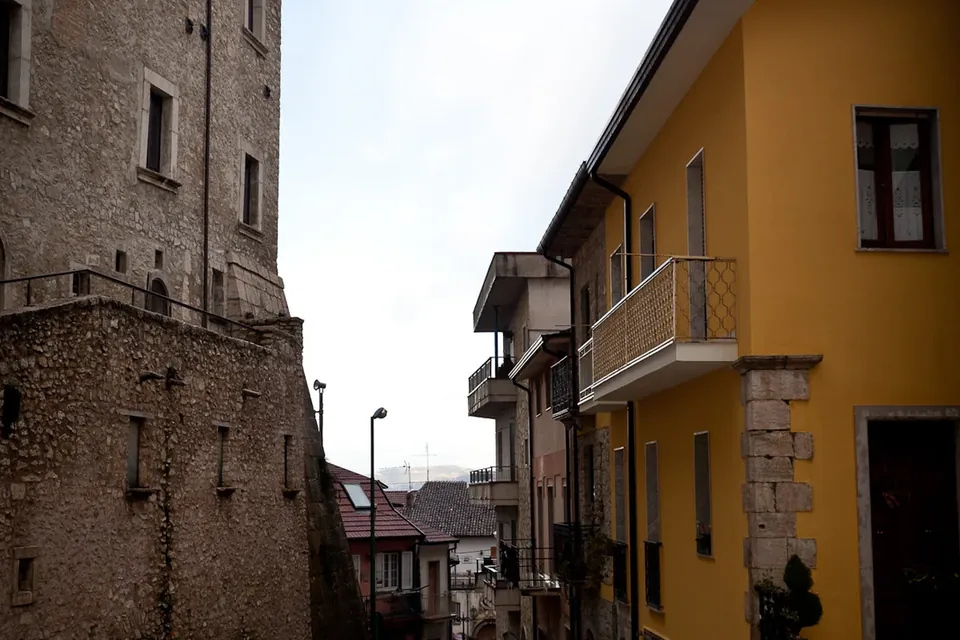
The Norman castle, explains Sistema Irpinia, dates from the 11th century, when it was built to defend the area from Byzantine raids; its façade is about 30 metres long and 14 high, and today it is a private residence of the Marquises Susanna di Sant'Eligio. The Touring Club notes that it keeps three of its four towers and an access ramp bearing the town's arms in porphyry. According to the Most Beautiful Villages site, the Loffredo family turned it into a noble residence in the 16th century and the Susanna family bought it in 1825; the same site records that in 1618 the writer Giambattista Basile, author of 'Lo cunto de li cunti', was governor of Zungoli. In the lower part of the village stands the convent of San Francesco, damaged several times by the earthquakes of 1456, 1703 and 1930 and rebuilt; its church has a walnut choir and a painting attributed to Titian.
Sources: Provincia di Avellino, Sistema Irpinia — Zungoli · Touring Club Italiano — Zungoli, Bandiera Arancione · I Borghi più belli d'Italia — Zungoli
Festivals and Zungoli's table
The village calendar, according to Sistema Irpinia, includes the Incoronata festival on the last Saturday of April, the Hunter's festival on 1 May and Saint Anne on 26 July, plus summer events. Italia.it and the Touring Club list the Transhumance festival on the first Sunday of September, with local products to taste and buy; the Most Beautiful Villages site instead describes it as a festival held for years in September, with animals and cheeses for sale: check before travelling whether and when it takes place. Among local dishes the sources mention fusilli, polenta with mushrooms, cavatelli with broccoli, pizza baked in a terracotta pan and cianfotta, and the Touring Club notes the handmade fresh pasta called 'past accattat'. The village also produces extra virgin olive oil, including oil from Ravece olives, which Italia.it presents as PDO.
Sources: Provincia di Avellino, Sistema Irpinia — Zungoli · Italia.it — Zungoli · Touring Club Italiano — Zungoli, Bandiera Arancione · I Borghi più belli d'Italia — Zungoli
How to taste it
Caciocavallo podolico changes a lot with time, and the best way to understand it is a small comparison: a cheese a few months old, still soft and milky, and one aged in a cave, harder and sharper. I would cut it into thin shavings at room temperature, removing the rind only where there is mould. The young cheese goes well with rustic bread and seasonal vegetables; the aged one with chestnut honey, pears or a little preserve, and a structured Irpinian red such as Taurasi or Aglianico. In cooking, aged podolico is grated over homemade pasta, for example cavatelli with broccoli. Since Podolica cows give milk only a few months a year, quantities are limited: purchases and visits to the caves or producers should be arranged in advance with operators.
A day on the border
Zungoli is a small, compact village that suits an unhurried day. In the morning I would choose the guided tour of the caves and the centre, when the village is quiet; then a short walk along the drove road, even just a few kilometres, to understand what moving herds between mountain and plain meant. Lunch is the moment for caciocavallo and handmade pasta. In the afternoon you can walk down to the convent of San Francesco. If you are travelling between Irpinia and Apulia, Zungoli makes a good intermediate stop towards the Tavoliere and the Gargano, ideally following the same transhumance route. In spring the pastures are green and the cows give milk; in autumn the aged cheese takes centre stage.
A thread for your journey
Journey idea: a morning in Zungoli with the Municipality's guided tour of the Byzantine caves and the old centre, a short walk on the Pescasseroli-Candela drove road and a lunch comparing young and aged caciocavallo podolico; in the afternoon the convent of San Francesco. From here you can continue towards Apulia, ideally following the transhumance route.
Talk to us


.jpg)
