
APULICA / Food guides
Colatura di alici di Cetara: the sea's amber dripping from the terzigni
Colatura di alici is an amber, almost mahogany liquid produced by the slow maturing of anchovies under salt. In Cetara, a fishing village at the start of the Amalfi Coast coming from Salerno, it is a household seasoning that since 2020 has also carried a protected designation of origin. This guide explains where it comes from, how it is made in the small wooden containers called terzigni, what the specification requires and how to use it sparingly, because a few drops are enough to change a dish.
From garum to the monks of Amalfi
The Campania Region presents colatura as the heir of garum, the Roman fish sauce described by Pliny and Horace. Qualigeo recalls how garum was made: in an earthenware jar with chopped herbs such as dill, rocket, mint, thyme and oregano, small whole fish and pieces of larger fish, covered with a two-finger layer of coarse salt. Colatura proper probably appeared in the second half of the 13th century, thanks to the Cistercian monks of the old Canonica di San Pietro a Toczolo near Amalfi. Storing anchovies in barrels with loose staves, they noticed a fragrant liquid seeping out when the fish were fully matured; the brother cook immediately tried it on boiled vegetables. A humble use that tradition kept alive for centuries.
Sources: Regione Campania, Assessorato Agricoltura — Colatura di alici di Cetara DOP · Qualigeo (Fondazione Qualivita) — Colatura di Alici di Cetara DOP · Regione Campania — Prodotti tradizionali: preparazioni di pesci, molluschi e crostacei
The fishermen's traditional method
The regional profile describes the process handed down by Cetara's fishermen. Anchovies freshly caught in spring are headed and gutted, covered with plenty of sea salt for 24 hours and then arranged in the terzigno, a small barrel, head-to-tail in alternating layers with salt. The container is closed with a wooden disc topped with weights. Under pressure and as the fish mature, a liquid rises; it is collected little by little in large glass bottles left in the sun for four or five months so that the water evaporates. Between late October and early November the liquid is poured back into the terzigno, trickles slowly through the layers of fish and gathers their aromas; it comes out of a hole in the bottom and is filtered through linen cloths called 'cappucci'.
Sources: Regione Campania, Assessorato Agricoltura — Colatura di alici di Cetara DOP
What the specification requires
The PDO specification, updated by decree on 4 November 2024 and summarised by Qualigeo, sets precise rules. The anchovies, only of the species Engraulis encrasicolus, are caught by purse seine, the 'cianciolo', in the sea off the province of Salerno, within 12 miles of the coast and at depths between 50 and 200 metres, and are landed in the province's ports. They are headed and gutted by hand; 'incruscatura', up to 24 hours in brine, is allowed. Salting must take place within eight hours of delivery to the workshop, by hand, in 20-kilo terzigni or barrels of up to 200 kilos. Maturing lasts nine months in cool, airy rooms. Further ageing may follow, in workshops or in restaurants based in Cetara; the label may then say 'invecchiata' with the duration.
Sources: Regione Campania — Disciplinare di produzione Colatura di alici di Cetara DOP (DM 4 novembre 2024, GU n. 276 del 25.11.2024) · Qualigeo (Fondazione Qualivita) — Colatura di Alici di Cetara DOP · Regione Campania, Assessorato Agricoltura — Colatura di alici di Cetara DOP
Colour, aroma and the 2020 PDO
Colatura must be clear and bright, amber shading to mahogany brown. Its aroma, persistent and intense, recalls salted anchovies, fresh anchovies and sea air; the taste is 'umami', strong and very savoury. The specification adds a clear parameter: at least 20 grams of salt per 100 grams of product. The name was entered in the European register by Commission Implementing Regulation (EU) 2020/1529 of 14 October 2020, published on 21 October 2020, in the class of fresh fish, molluscs, crustaceans and derived products. It may only be sold in clear, transparent glass containers from 50 millilitres to one litre: a useful detail for spotting the certified product on the shelf.
Sources: Regione Campania, Assessorato Agricoltura — Colatura di alici di Cetara DOP · Regione Campania — Disciplinare di produzione Colatura di alici di Cetara DOP (DM 4 novembre 2024, GU n. 276 del 25.11.2024) · Regolamento di esecuzione (UE) 2020/1529 della Commissione (copia Regione Campania)
Cetara, a village of tuna nets and terraces
The visit notes of the Touring Club Italiano's Salerno club trace the village's history. The settlement grew in the second half of the 9th century; by about 988 the church of San Pietro Apostolo was already active, and the village grew around it; in the 16th century coastal defence was strengthened with a viceregal tower. The land, divided in the Middle Ages between the Lombard principality of Salerno and the duchy of Amalfi, was steep: people built terraces held by dry-stone walls, the 'macerine', with vines, lemons and orchards. Cetara's people were renowned fishermen, worked tuna nets and salted anchovies and sardines. In 1834 Cetara became an independent municipality. The church of San Pietro has a ceramic-tiled dome typical of the Amalfi Coast.
The Christmas Eve dish and other uses
In Cetara, writes the Campania Region, colatura is the traditional seasoning for the spaghetti of the vigils before feast days, but it is also used on bruschetta, on Christmas broccoli and on other vegetables. It was once seen as poor food, a substitute for fresh fish; today it is a sought-after condiment. Qualigeo confirms that spaghetti with colatura is the signature dish and that, being so savoury, colatura often replaces salt on fresh or boiled vegetables and some fish dishes. Italia.it, among the products to try on the coast, also describes it as an amber liquid sauce with an intense flavour, made by macerating layers of anchovies with salt and used for spaghetti. Its link with Christmas explains why the new colatura is awaited in winter.
Sources: Regione Campania, Assessorato Agricoltura — Colatura di alici di Cetara DOP · Qualigeo (Fondazione Qualivita) — Colatura di Alici di Cetara DOP · Italia.it — Costiera Amalfitana
How to store it and take it home
According to Qualigeo, an unopened bottle keeps at room temperature; once opened it should go in the least cold part of the fridge or in a cool place away from light. The clear glass format, from 50 millilitres to one litre, makes colatura one of the easiest products to bring home from the Amalfi Coast, as long as the bottle is well protected in the luggage. On the label, look for the full name 'Colatura di Alici di Cetara DOP'; the word 'invecchiata', followed by months or years, means that it was aged further after maturing. The Campania Region also notes that all stages of processing, transformation, ageing and drawing off must take place in municipalities of the province of Salerno.
Sources: Qualigeo (Fondazione Qualivita) — Colatura di Alici di Cetara DOP · Regione Campania, Assessorato Agricoltura — Colatura di alici di Cetara DOP
Using it sparingly
Colatura is not a sauce but a concentrated seasoning: the practical rule is to add it at the end, off the heat, a few drops at a time, tasting before adding salt. For spaghetti the Cetara way, drain the pasta very al dente from barely salted water, toss it with oil, garlic, parsley and a little chilli, and only at the end add the colatura. The same principle works with sautéed escarole, boiled potatoes or toast with butter. With such a savoury dish I would choose a white from the Costa d'Amalfi or another fresh Campanian white that refreshes the palate. For a first taste, dipping a piece of bread may be enough: you immediately sense how much depth it adds, beyond simple saltiness.
When to go to Cetara
In the institutional sources we consulted we found no official, up-to-date calendar of events devoted to colatura, so we give no dates: before travelling, check announcements from the Municipality of Cetara. The rhythm of production, though, suggests two different moments. In spring and early summer the village lives the fishing and salting season, and a visit can combine the harbour with the terraced lemon groves. In winter, when the new colatura is awaited for Christmas dishes, Cetara is quieter and free of summer crowds. Either way, a visit to a salting workshop must be arranged with the operators. The village can also be reached by sea from Salerno: arriving at the harbour helps you understand how much it looks to the water.
A thread for your journey
Journey idea: arrive in Cetara by sea from Salerno, walk from the harbour to the church of San Pietro and the viceregal tower, arrange a visit with a salting workshop to see the terzigni, then lunch on spaghetti with colatura and an afternoon among the terraced lemon groves above the village.
Talk to us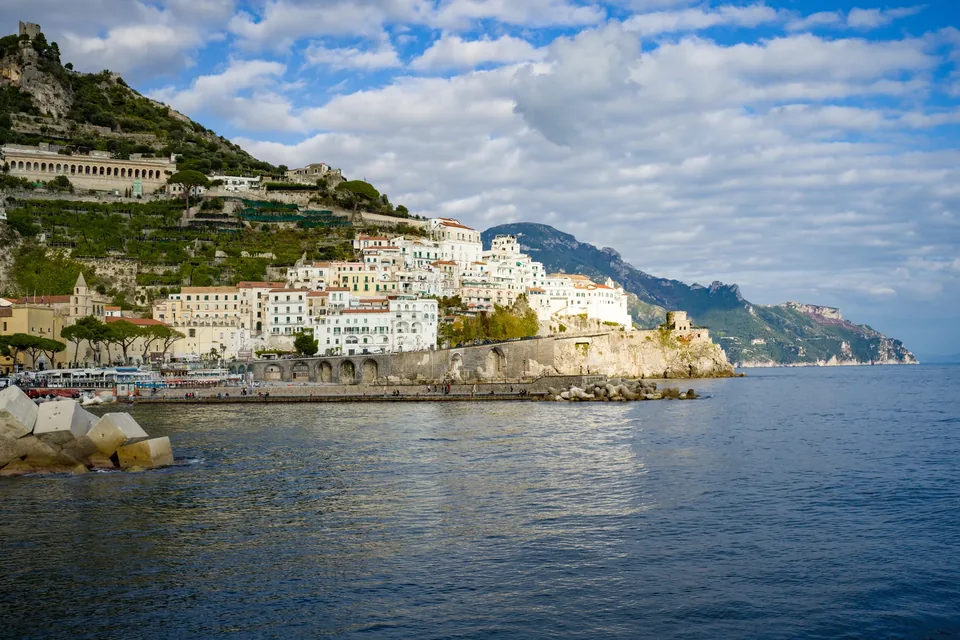


,_East_view.jpg)