
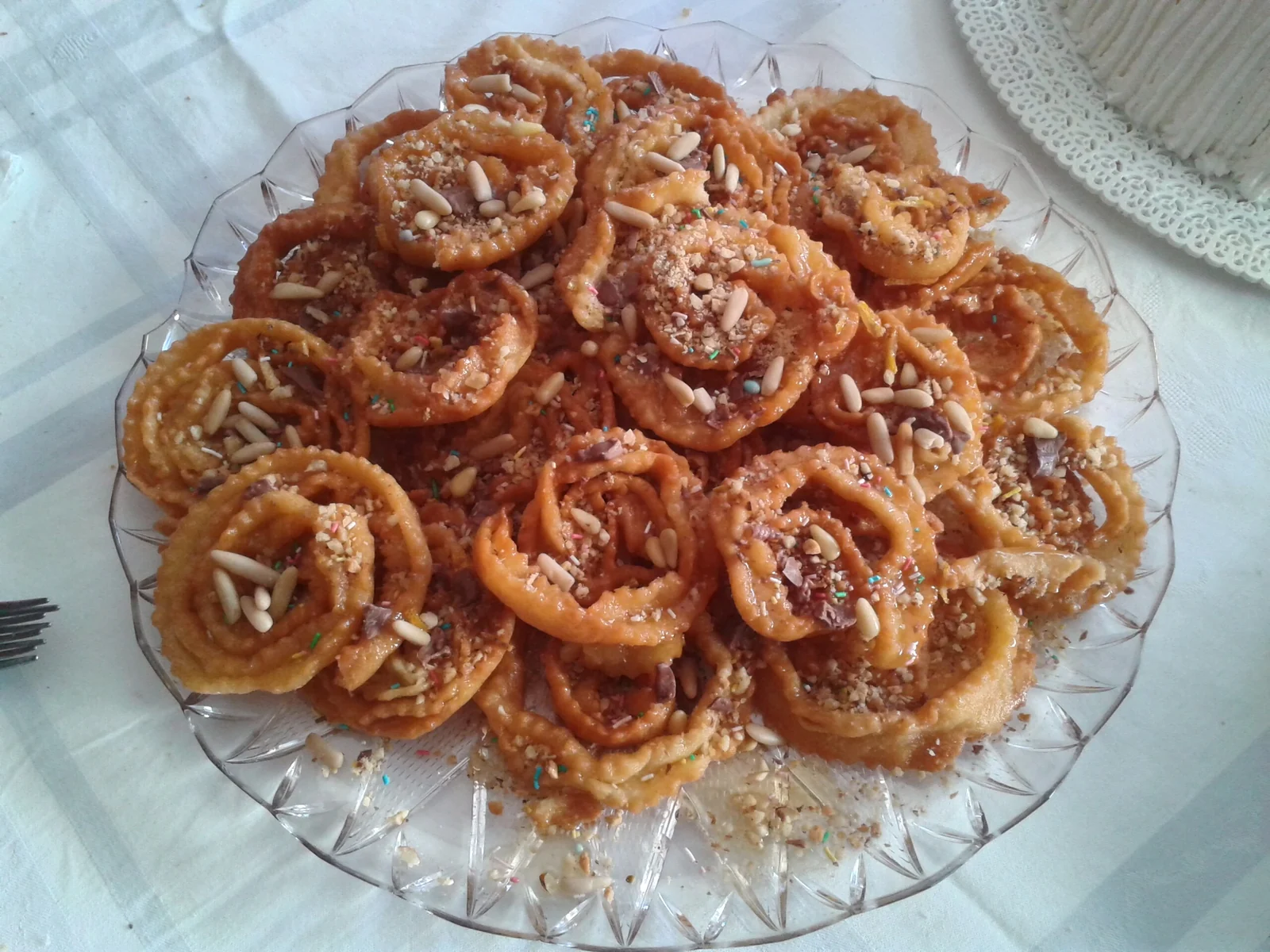
Christmas: cartellate
Cartellate are the Christmas sweet par excellence throughout the region. The PAT atlas describes a dough of flour, white wine and extra virgin olive oil, rolled into very thin sheets and cut into strips a few centimetres wide. The strips are folded, pinched at intervals and coiled into a spiral, forming a kind of rose full of small hollows; after a few hours of drying they are fried until golden.
Once cool, they are dusted with icing sugar and cinnamon or coated with honey, vincotto or fig syrup, which gathers in the hollows. The result is crumbly and crisp, with frying bubbles and a scent of wine.
On their origin the profile suggests a Byzantine theory: the name may come from the Greek “kartelas”, basket. In Puglian tradition the strips recall the swaddling bands of the Infant Jesus. The link with Christmas is already documented in a Foggia periodical of 1906, and today there are festivals devoted to them in Trinitapoli and Trani.
Sources: PAT Puglia — Cartellate
Easter: scarcelle
Scarcelle belong to the Puglian Easter. The PAT atlas describes them as sweet biscuits in various shapes, rings, baskets, doves, bunnies or plaits, with a hard-boiled egg set into the dough and decorations of sugared almonds, coloured sprinkles or icing. The dough combines flour, sugar, oil, eggs and raising agent, and bakes slowly in the oven.
The original shape, the profile explains, was a wheel, and the name itself means ring cake. The symbolic meanings are many: the egg represents the birth of a life, the round shape good fortune, and to eat the sweet you must “free” the egg from the dough that holds it, an allusion to liberation from sin.
Scarcelle are made in Holy Week or the week before, and the profile quotes a dialect nursery rhyme in which children call on Easter to come, asking precisely for scarcelle with eggs. A tradition distinct from Christmas cartellate, best sought in pastry shops and bakeries in the days before the feast.
Sources: PAT Puglia — Scarcelle
November: grano dei morti
Grano dei morti is linked to the commemoration of the dead on 2 November, especially in the province of Foggia. The PAT atlas describes it as a dish of intense flavour, combining cooked wheat grains, pomegranate seeds, fig syrup or vincotto, chocolate shavings, toasted almonds and walnuts, candied fruit, cinnamon and cloves.
Preparation is long: the wheat soaks for about three days, with the water changed daily, then cooks until the grains split. Only shortly before serving is it mixed with all the other ingredients. It is a home preparation, eaten within the family and not sold.
The profile explains that the dish descends from the custom of Greek-rite Christians of eating, on the day of the dead, boiled wheat blessed in church; the name recalls the Greek “kollyba”. The ingredients added over time carry symbolic value: pomegranate, once placed in tombs beside the wheat, stands for rebirth. The profile mentions a cooked wheat festival in Margherita di Savoia.
Sources: PAT Puglia — Grano dei morti
The topping is part of the sweet
The PAT profile of vincotto describes a brown product with red glints, very sweet and dense. It is made by boiling the must of late-harvested grapes for many hours in large copper or steel cauldrons, until it loses much of its water and acquires a caramel note; it then rests for about ten days in clay jars before bottling.
The profile explicitly links it to cartellate and recalls that it was once so precious that it was the only sweet condiment used by farming families during winter festivities, sometimes even as a remedy. Today it is made all year round.
The name should not automatically be confused with fig syrup, which many recipes cite as an alternative: for a comparison, ask which base was used, grape must or figs. On a cartellata or in a spoonful of grano dei morti, the difference shows: the former has a tangier, winey note, the latter a rounder sweetness.
Sources: PAT Puglia — Vincotto
March: Saint Joseph’s zeppole
On 19 March, Saint Joseph’s day, zeppole are made in the provinces of Lecce and Brindisi. The PAT atlas describes a ring of choux pastry, made with flour, water, eggs and lard or butter, piped with a star nozzle and fried in two stages: first in warm oil, so that it puffs up and sets, then in hotter oil to finish cooking and colour. Once cool it is topped with custard and chocolate cream.
The profile traces an interesting history. A very similar sweet already appears, as “tortanetti di pasta bignè”, in the Cuoco Galante by Vincenzo Corrado, born in Oria; its link with Saint Joseph, symbol of the carpenter saint, is said to have taken hold at the end of the eighteenth century. According to the food historian Luigi Sada, the name and custom of modern zeppole date from the late nineteenth century.
The atlas mentions festivals in Cutrofiano and Nardò held on the saint’s day itself: a good reason to place a Salento trip in mid-March.
Sources: Atlante dei PAT di Puglia (Regione Puglia, Università di Bari) — Zeppula salentina
Pasticciotto, a sweet for every season
Outside the festive calendar, Salento’s most recognisable sweet is the pasticciotto. The PAT atlas describes it as an oval shortcrust pastry filled with custard, firm outside and soft within. The pastry is pressed into moulds, filled with custard, covered with a second layer and sealed with the thumbs into a small dome before baking.
On its origin the profile separates legend from history. Tradition places its birth in Galatina in 1745, in the Ascalone family’s shop during the feast of Saint Paul: a leftover of pastry and custard supposedly became a small “pasticcio”. Documents suggest instead that the custard recipe spread through Salento probably at the end of the nineteenth century, reaching its greatest popularity in the second half of the twentieth.
Galatina has recognised it as a product with a municipal designation, and a collective brand of Salento pastry makers includes it among typical sweets. The atlas gives year-round production, sold in pastry shops and stores across the province of Lecce.
Sources: Atlante dei PAT di Puglia (Regione Puglia, Università di Bari) — Pasticciotto
The sospiro of Bisceglie
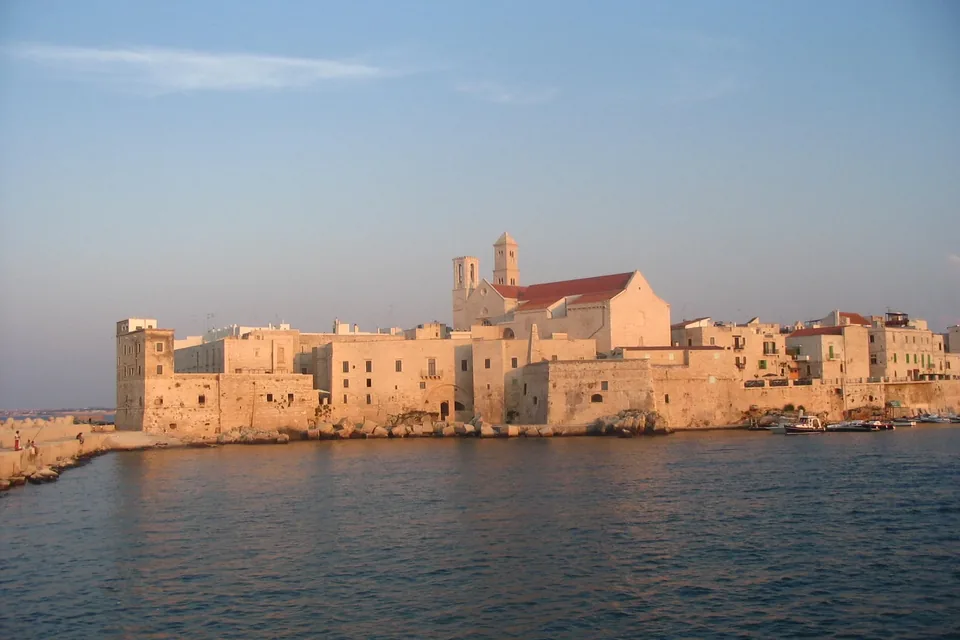
To the north, Bisceglie has its own emblematic sweet: the sospiro. The PAT atlas describes it as a small dome of sponge cake filled with custard and covered with a sugar glaze called “giulebbe”. The shape is made by piping the batter downwards and easing the pressure while lifting, to form a peak.
The profile recounts that as early as the fifteenth century the Poor Clare nuns of Bisceglie made the “nuns’ little sighs”, with pink icing. A legend links them to the wedding that never happened between Lucrezia Borgia and Alfonso of Aragon, who had received the duchy of Bisceglie as a gift: the guests, sighing as they waited, were consoled with these sweets. The word giulebbe comes from the Persian “gul-ab”, rosewater, passed down through Arabic.
The atlas also mentions a handwritten twentieth-century recipe kept in a family archive and an association of the town’s historic pastry shops that promotes the tradition; Bisceglie calls itself the “town of the sospiro”. It is made all year, and a walk through the old quarter is the ideal setting for tasting it.
Sources: Atlante dei PAT di Puglia (Regione Puglia, Università di Bari) — Sospiro di Bisceglie
Choosing the moment through a recipe
For a first reading, choose a single occasion: Christmas to see the shape of cartellate, Easter for scarcelle, early November for grano dei morti or mid-March for zeppole. Do not rank sweets with such different structures: each answers a feast and a way of being together.
When tasting, separate what breaks or is chewed from what binds the ingredients: a crisp surface, a soft dough, wheat in the spoon, custard inside pastry. Then ask which topping was used, vincotto, fig syrup or honey, because it changes the result considerably.
If the trip does not coincide with a feast, year-round sweets such as pasticciotto or sospiro still let you enter this tradition. In that case, taste them during a mid-morning or afternoon break with a coffee, and note the dialect name: it is the detail that most often opens a conversation with the people who make them.
An identified Lecce stop
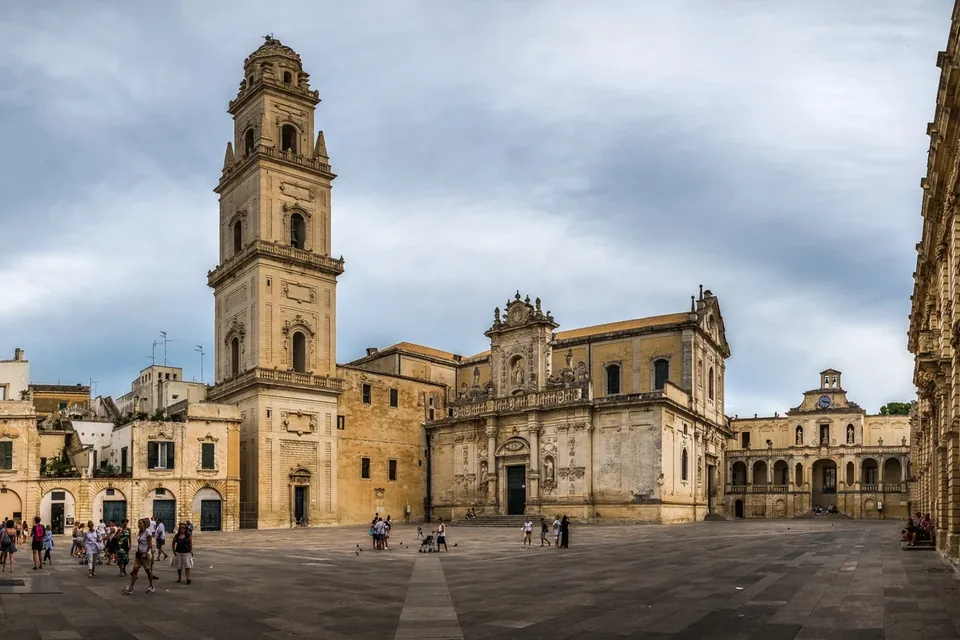
For a Salento pause, Natale Pasticceria’s official menu at Via Salvatore Trinchese 7, Lecce, lists custard pasticciotto at €2.20 and fruttone at €3.00, observed on 2026-10-06. These are individual-sweet prices, not meal costs: a comparison with other products rather than a replacement for festive recipes.
Sources: Natale Pasticceria — Menu Lecce
A thread for your journey
Journey idea: make a festive recipe the reason for a trip, alongside towns and a pastry stop. Christmas, Easter and 2 November are the traditions’ culinary markers, without implying a public event or bookable class.
Talk to us


.jpeg)