
APULICA / Food guides
Santo Stefano di Sessanio lentils: a high-altitude pulse beneath the Gran Sasso
On the L'Aquila slopes of the Gran Sasso, above a thousand metres, farmers grow a tiny dark lentil that has become the emblem of Santo Stefano di Sessanio, one of the best-known villages in the Apennines. It is a Slow Food Presidium and a traditional Abruzzo food product, grown on small plots with harvesting work that has barely changed in centuries. This guide explains what makes it different, how it is grown and harvested, how to cook it without spoiling it and how to plan a slow trip between the medieval village, the high plateaus and the transhumance towns.
Small, dark, high-altitude
Slow Food describes the Santo Stefano di Sessanio lentil as a tiny pulse, a few millimetres across, round and dark, between brown and violet. It grows above a thousand metres only on the slopes of the Gran Sasso, inside the National Park; some fields reach 1,600 metres, but the best results come at around 1,200. This is no ordinary lentil, the Foundation stresses, but a specific biotype selected in this area over a very long time. Italia.it adds that it has been grown for centuries on the clay plots around the village, ideal for pulses. Its small size and high permeability mean it can be cooked without soaking, a trait the Abruzzo wine consortium also mentions in its overview of regional products.
Sources: Fondazione Slow Food — Presidio Lenticchia di Santo Stefano di Sessanio · Italia.it — Santo Stefano di Sessanio · Consorzio Tutela Vini d'Abruzzo — Territorio e prodotti
A thousand years of records
The growing of pulses, especially lentils, in this part of the L'Aquila area is mentioned in monastic records from the year 998: both Slow Food and italia.it report it. The village that now gives the pulse its name has a history tied above all to wool. Italia.it recalls that from the late 16th century Santo Stefano di Sessanio was ruled by the Medici and that the local economy prospered on wool sent to Florence. The crenellated tower called the Medici Tower actually dates from the 14th century; destroyed by the 2009 earthquake, it was restored by 2021, preserving the original elements. The Medici Gate still bears the family coat of arms. In the second half of the 20th century the village suffered heavy depopulation, followed by a revival based on high-quality tourism.
Sources: Fondazione Slow Food — Presidio Lenticchia di Santo Stefano di Sessanio · Italia.it — Santo Stefano di Sessanio · Italia.it — Prodotti e piatti tipici abruzzesi
Sown in March, harvested by hand in summer
The mountain climate is part of the product. According to Slow Food, long, harsh winters end with sowing in late March, followed by short, cool springs. Poor limestone soils suit the lentil, which needs little fertiliser. The hard part is the harvest, between late July and late August: plants ripen gradually and at different times depending on the field's altitude. Cutting is almost always by hand; the plants are gathered into small stooks, then piled under a sheet, and up to fifteen days may pass before threshing while the seeds finish ripening. A combine harvester often cannot be used, because the fields are steep and the pods grow close to the ground: mechanical harvesting could lose 30 to 40 per cent of the crop.
Sources: Fondazione Slow Food — Presidio Lenticchia di Santo Stefano di Sessanio
Slow Food Presidium and traditional product
The lentil has no EU designation but two different forms of recognition. It is a Slow Food Presidium, covering the municipality of Santo Stefano di Sessanio and parts of neighbouring towns in the province of L'Aquila. And it is listed, as lenticchie di Santo Stefano di Sessanio, among the traditional food products published by the Abruzzo Region. Slow Food is open about the difficulties: output is limited, mostly in the hands of elderly growers and largely for family use; it has to contend with fake Santo Stefano lentils and, increasingly, with wild boar that damage the fields every year. The Gran Sasso National Park, in its Baronia itinerary, urges visitors to beware of imitations and to look for pulses from the producers' association.
Sources: Fondazione Slow Food — Presidio Lenticchia di Santo Stefano di Sessanio · Regione Abruzzo — Elenco dei prodotti agroalimentari tradizionali dell'Abruzzo · Parco nazionale del Gran Sasso e Monti della Laga — Su e giù per la Baronia, tra pascoli e coltivi
The soup, without soaking
The best way to appreciate it, according to Slow Food, is also the simplest: a soup. Cover the lentils with water, add unpeeled garlic cloves, a few bay leaves, salt and extra virgin olive oil, and bring to a gentle simmer with the lid on. Italia.it confirms that no soaking is needed and that they are harvested in August but, being eaten dried, are available all year. Many mountain variations follow from this: with toasted stale bread, with short pasta or with a drizzle of new oil in autumn. It is best to start with the essential version, to taste the full flavour of the pulse, and only then add other ingredients. In the same area italia.it mentions the cicerchia of Castelvecchio Calvisio, a pulse halfway between chickpea and lentil.
Sources: Fondazione Slow Food — Presidio Lenticchia di Santo Stefano di Sessanio · Italia.it — Prodotti e piatti tipici abruzzesi
The Baronia loop
The Gran Sasso National Park suggests a food loop starting in Barisciano, where you find cereals, pulses, L'Aquila saffron and Turchesa potatoes, and climbing to Santo Stefano di Sessanio. Here the narrow lanes recall the village that once traded wool with the Medici, and several shops sell lentils and other local produce. The loop continues to Campo Imperatore and Lake Racollo, through lunar landscapes, then descends to Castel del Monte, which the Park calls the home of transhumance, with canestrato pecorino, caciocavallo, black-pig cured meats and marcetto. From there you can climb to Rocca Calascio to look over valleys still under cultivation, before returning to Barisciano. It is a compact route, suited to a full, unhurried day.
Sources: Parco nazionale del Gran Sasso e Monti della Laga — Su e giù per la Baronia, tra pascoli e coltivi
The village and its museum
Santo Stefano di Sessanio can be seen on foot in a few hours, but deserves to be enjoyed slowly, ideally staying overnight. Italia.it mentions the Terre della Baronia Museum, which preserves the memory of the village and surrounding lands, and on Piazza Medicea the small church of the Anime Sante, or del Suffragio, with its high altar dedicated to Our Lady of Mount Carmel. Just below the village a small lake marks the way up to Campo Imperatore, as the Park's itinerary shows. Italia.it describes Campo Imperatore as a 27-kilometre plateau between 1,600 and 2,100 metres, the little Tibet, with Lake Pietranzoni, the botanical garden and the astronomical observatory. The link between lentils, pastures and fortified villages becomes clear as you climb.
Sources: Italia.it — Santo Stefano di Sessanio · Parco nazionale del Gran Sasso e Monti della Laga — Su e giù per la Baronia, tra pascoli e coltivi · Italia.it — Campo Imperatore
When to go and what to buy
To see the fields, go in summer: between late July and August, during cutting and threshing, the landscape around the village tells the story of the work better than any museum. Remember, though, that this is hard farm work and field visits must be arranged with operators, not improvised. In winter the village is often under snow and the roads to Campo Imperatore may be closed: always check road conditions. Lentils can be bought all year. To avoid imitations, buy in the village and ask who grew them, where and in which year; a small, dark pulse sold in limited quantities is more credible than plentiful anonymous packs. They keep for a long time in a closed jar, away from light and moisture, and make a light gift to take home.
A thread for your journey
Journey idea: a night in Santo Stefano di Sessanio in August. Morning among the lanes, the Medici Tower and the Terre della Baronia Museum; lunch with lentil soup in its simplest form; afternoon on the Park's loop towards Campo Imperatore and Castel del Monte, stopping at Rocca Calascio. Field visits during the harvest arranged with operators.
Talk to us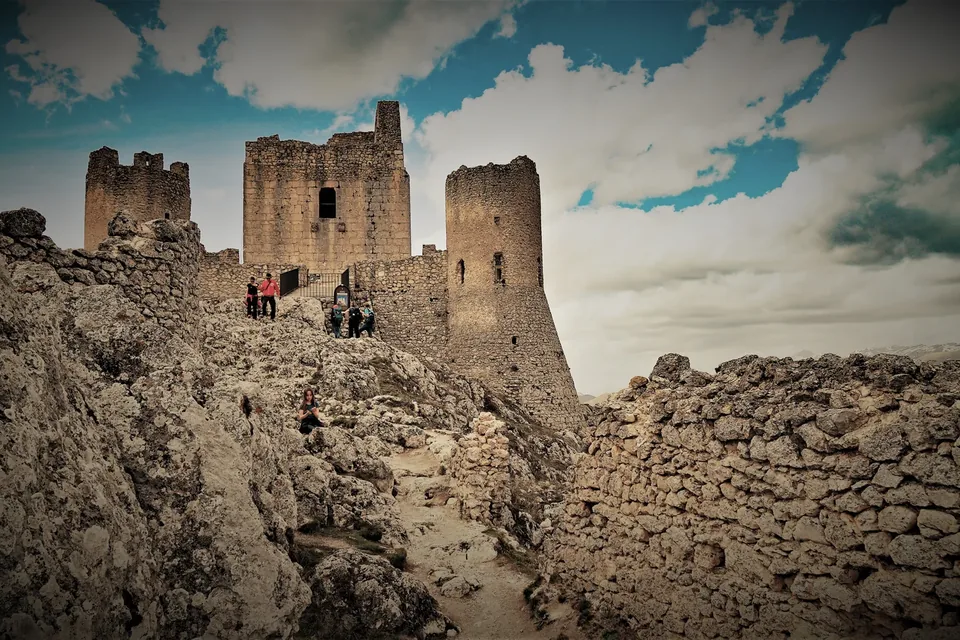
.jpg)
