
Why go
Santo Stefano di Sessanio is a small stone village on the L’Aquila side of the Gran Sasso, inside the Gran Sasso and Monti della Laga National Park. Houses pressed against one another, arches, stairways and a tower overlooking the roofs: the village keeps the layout of a mountain centre that for centuries lived on sheep farming and wool.
The park regards it as the heart of the Terre della Baronia district, the southern part of the Gran Sasso that in the late Middle Ages belonged to the Barony of Carapelle. All around stretches a landscape of grassland and cultivated fields, with fortified villages such as Calascio, Castelvecchio Calvisio and Castel del Monte and, not far away, the Campo Imperatore plateau.
People come for the quality of the silence and the light, for a lentil soup that has become a symbol, and for the story of a village that managed to come back to life. Twentieth-century depopulation had almost emptied it; more recently high-quality hospitality has revived it, and even after the 2009 earthquake the village found the strength to rebuild its monuments.
Sources: Italia.it — Santo Stefano di Sessanio, borgo in Abruzzo · Italia.it — Il Gran Sasso e la Baronia di Carapelle · Parco Nazionale del Gran Sasso e Monti della Laga — Distretto Terre della Baronia
History
Human presence on the mountains of Santo Stefano is very ancient. Research collected by the municipality records a camp of Middle Palaeolithic hunters, between a hundred thousand and fifty thousand years ago, at the place called Il Prato, above 1,500 metres, beside a small karst pond. In the Iron Age the area belonged to the Vestini, who built fortified hilltop settlements; in Roman times Santo Stefano was a pagus tied to sheep farming.
The period that shaped the village was that of the Barony of Carapelle, which from the thirteenth century brought together Carapelle Calvisio, Calascio, Santo Stefano and Castelvecchio Calvisio. The territory became a major pastoral basin, strategically placed on the Via degli Abruzzi, the route that linked Florence with Naples.
From the late sixteenth century the village passed to the Medici, and its economy flourished on wool sent to Florence. The family’s coat of arms is still on the machicolation of the Porta Medicea. The twentieth century brought depopulation, shared by many villages of inland Abruzzo; revival came through tourism, and the 2009 earthquake, which also damaged the tower, has been met with careful restoration.
Sources: Comune di Santo Stefano di Sessanio — Storia e territorio · Italia.it — Santo Stefano di Sessanio, borgo in Abruzzo · Italia.it — Il Gran Sasso e la Baronia di Carapelle
What to see
The village’s symbol is the crenellated tower rising among the houses. It is called the Medici Tower, but it dates from the fourteenth century: the name recalls how much the Florentine presence weighed on village life. Brought down by the 2009 earthquake, it was restored while keeping its original elements, with work completed in 2021; from the top there is a wide view over the roofs and the cultivated fields.
You enter the village through the Porta Medicea, bearing the Medici arms, and reach Piazza Medicea. Facing it stands the small church of the Anime Sante, also called the Suffragio, whose high altar is dedicated to Our Lady of Mount Carmel. A few steps away, the Terre della Baronia Museum keeps the memory of the village and the surrounding lands, bound up with sheep farming and transhumance.
The historic centre also holds the park’s Terre della Baronia Visitor Centre, in a municipal building: panels in Italian and English describe the nature, landscape, villages and produce of the district, and the staff help to organise excursions. The rest of the visit is the village itself, to be walked unhurriedly among lanes, arches and limestone stairways.
Sources: Italia.it — Santo Stefano di Sessanio, borgo in Abruzzo · Italia.it — Il Gran Sasso e la Baronia di Carapelle · Parco Nazionale del Gran Sasso e Monti della Laga — Centro Visite Terre della Baronia
Food and wine
The Santo Stefano di Sessanio lentil is a Slow Food Presidium. It is tiny, roundish and purplish brown, and grows above a thousand metres on the slopes of the Gran Sasso: some fields climb to 1,600 metres, but the best results come at around 1,200. It is sown at the end of March, after long, harsh winters, and harvested between late July and late August; cutting is almost always done by hand, because the fields are steep and the plant grows close to the ground. Pulse growing in this area already appears in monastic documents from the year 998.
Thanks to its small size it needs no soaking, and the best way to enjoy it is the simplest: a soup with garlic, bay leaf, salt and extra virgin olive oil, served with crusty bread. As it is eaten dried, it can be found all year round. The Presidium also points out the difficulties of production: largely elderly growers, damage from wild boar and imitations on the market.
The rest of the table speaks of shepherds. A few kilometres away, Castel del Monte makes Canestrato, a raw-milk sheep’s cheese shaped in baskets; the area also offers caciocavallo, black-pig cured meats and marcetto, a creamy, strong-flavoured cheese, while Castelvecchio Calvisio grows the cicerchia, or grass pea.
Sources: Fondazione Slow Food — Presidio Lenticchia di Santo Stefano di Sessanio · Italia.it — Abruzzo, prodotti e piatti tipici · Fondazione Slow Food — Presidio Canestrato di Castel del Monte
Things to do
The classic experience is the climb from Santo Stefano to Rocca Calascio, the highest fortification in Abruzzo, continuing on to Castelvecchio Calvisio and Castel del Monte: a route of fortified villages that follows the memory of transhumance and the wool road.
From the village you can easily reach the Campo Imperatore plateau and the glacial lake of Pietranzoni. Campo Imperatore is the largest plateau in the Apennines: in summer the trails lead towards Corno Grande, Monte Aquila or the little church of the Madonna della Neve, and near Fonte Vetica stands the monument to the shepherd. There are also a botanical garden and the Abruzzo Astronomical Observatory.
The Gran Sasso and Monti della Laga National Park offers routes for every level, mountain-bike itineraries and the Ippovia del Gran Sasso for those travelling on horseback. The Terre della Baronia Visitor Centre in the village is the right place to ask for information and arrange guided excursions in the villages and the countryside. In the mountains the weather changes fast: set out well prepared and ask before tackling high-altitude trails.
Sources: Italia.it — Il Gran Sasso e la Baronia di Carapelle · Italia.it — Campo Imperatore · Italia.it — Parco Nazionale del Gran Sasso e Monti della Laga · Parco Nazionale del Gran Sasso e Monti della Laga · Parco Nazionale del Gran Sasso e Monti della Laga — Centro Visite Terre della Baronia
When to go
The best season runs from spring to autumn. In spring Campo Imperatore is covered in wild flowers, and in May the flocks still climb to the high pastures, following a transhumance practice that has lasted for at least two thousand years. It is the time when the landscape around the village is greenest.
Summer is the season of trails and pastures: on the plateau you see herds and flocks and sometimes free-roaming horses. Between late July and late August the lentils are harvested, in many fields still by hand, and the countryside around Santo Stefano shows its farming side.
Autumn brings warm colours, clear air and the calm of the villages after summer; it is also the right moment to taste lentils from the harvest just completed. Winter has a different charm, with snow on the roofs and skiing at Campo Imperatore, but at these altitudes it calls for flexible plans and attention to road and weather conditions.
Sources: Fondazione Slow Food — Presidio Lenticchia di Santo Stefano di Sessanio · Italia.it — Campo Imperatore · Fondazione Slow Food — Presidio Canestrato di Castel del Monte · Italia.it — Parco Nazionale del Gran Sasso e Monti della Laga
Getting there and around
Santo Stefano di Sessanio lies on the L’Aquila side of the Gran Sasso, in the province of L’Aquila. The provincial capital is the reference point for anyone arriving by public transport: L’Aquila railway station, on the RFI network, has four tracks for passenger trains, a ticket office and assistance for people with disabilities and reduced mobility, to be booked through the Sale Blu.
From L’Aquila you continue by road. The village is reached on a paved road, and from here you can easily go on towards Calascio, Castelvecchio Calvisio, Castel del Monte and the Campo Imperatore plateau: to move between the villages of the Barony and the trailheads a car is the most practical choice.
The village, made of lanes, arches and stone steps, is explored on foot. For bus connections with the villages of the province, check the official regional transport channels, as services vary with the season.
Sources: Italia.it — Santo Stefano di Sessanio, borgo in Abruzzo · RFI — Stazione di L’Aquila · Comune di Santo Stefano di Sessanio — Storia e territorio · Italia.it — Il Gran Sasso e la Baronia di Carapelle
Where to stay
Santo Stefano di Sessanio came back to life precisely through hospitality: italia.it notes that its revival, after twentieth-century depopulation, is tied to an excellent hotel and tourism offer. Sleeping in the village means living for a few nights in its stone houses, with the tower and the square a few steps away.
Within the Gran Sasso park the choice is wide. The Park Authority lists hotels, agriturismi, bed and breakfasts, rooms in private homes, scattered hotels and flats in historic centres; there are also hostels, mountain huts and campsites. Some facilities are run under concession from the park, such as the one in the convent of San Colombo at nearby Barisciano, which also houses the Botanical Garden.
For a trip of several days it works well to choose a base in one of the Barony villages and move by day towards Rocca Calascio, Castel del Monte and Campo Imperatore. Apulica selects accommodation case by case, without promising availability in advance.
Sources: Italia.it — Santo Stefano di Sessanio, borgo in Abruzzo · Parco Nazionale del Gran Sasso e Monti della Laga — Ricettività e strutture di visita · Italia.it — Parco Nazionale del Gran Sasso e Monti della Laga
Nearby
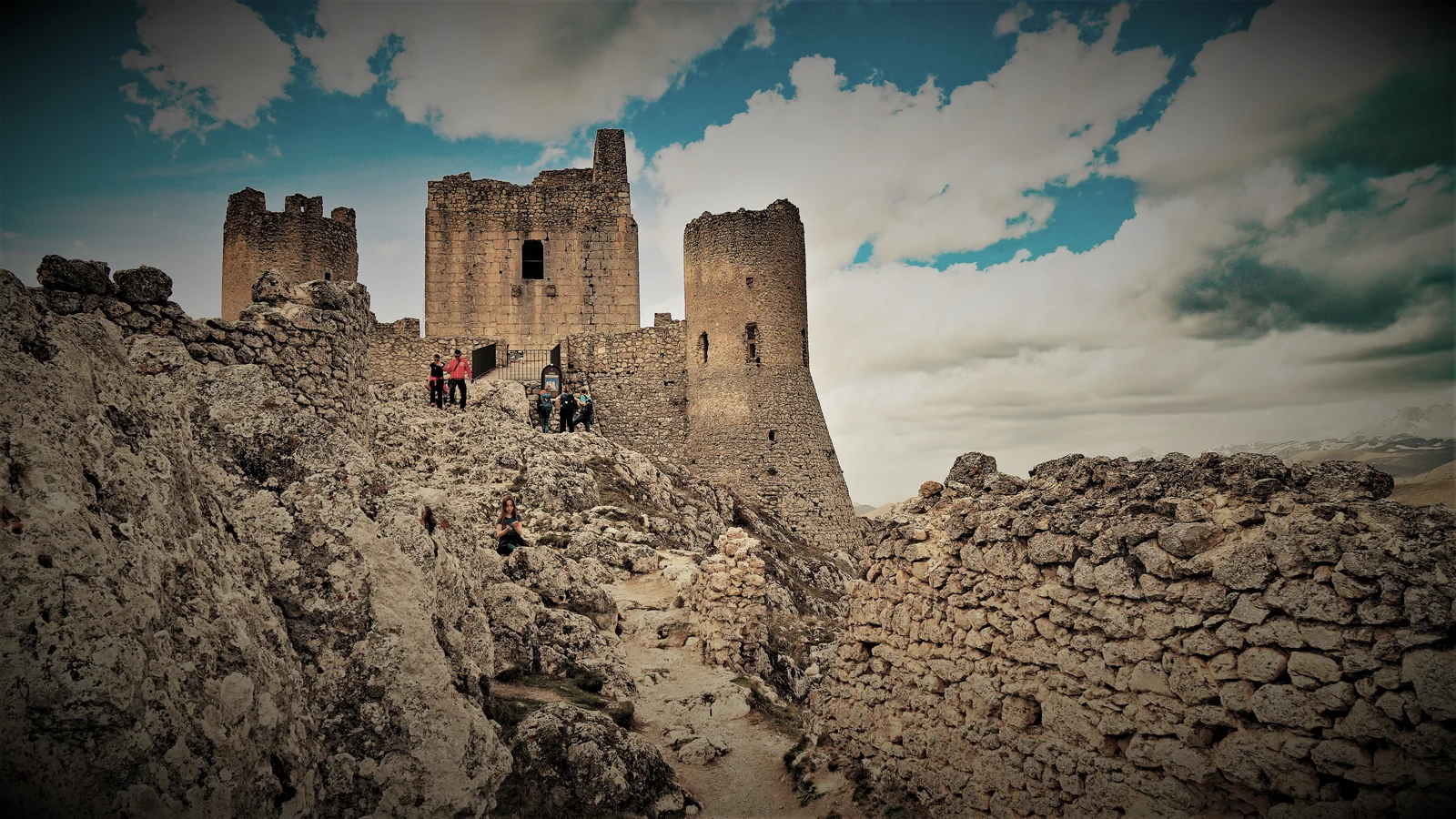
A few kilometres away stands Rocca Calascio, built around the year 1000 on a spur at about 1,460 metres to control the transhumance lands. The walls and cylindrical towers date from the late fifteenth century; it belonged to the Acclozamora and the Piccolomini and in 1579 passed to the Medici. It has a square plan, round towers at the corners and a central keep, and it watched over the L’Aquila droving track, overlooking the Tirino valley and the Navelli plain. Below the fortress stand the houses of the old village and the octagonal church of the Madonna della Pietà, from 1451. After the 1703 earthquake everything was abandoned until the twentieth century. The site was also a set for Ladyhawke, and the village of Calascio is home to the Museum of Fortifications.
Castelvecchio Calvisio keeps its old elliptical layout, cobbled lanes and the church of San Giovanni Battista with its Renaissance portal. Carapelle Calvisio gives its name to the Barony. Castel del Monte, at 1,345 metres below Monte Bolza, has an old core called the Ricetto and is the home of Canestrato.
Further down, Capestrano keeps a reproduction of the Warrior of Capestrano in its Piccolomini Castle, while at Barisciano the old convent of San Colombo houses the Apennine Floristic Research Centre, with the Flower Museum and the Botanical Garden.
Sources: Italia.it — Castello di Rocca Calascio · Parco Nazionale del Gran Sasso e Monti della Laga — Museo delle Fortificazioni, Rocca Calascio · Italia.it — Il Gran Sasso e la Baronia di Carapelle · Parco Nazionale del Gran Sasso e Monti della Laga — Distretto Terre della Baronia
Local tourist information
Local tourist offices help with opening times, events and transport on the day.
- Centro Visite Terre della Baronia (Parco Nazionale del Gran Sasso e Monti della Laga) · Via del Municipio, 67020 Santo Stefano di Sessanio (AQ) · +39 340 7100218 · viaggiatorinelparco@gmail.com · Official website
Source: Parco Nazionale del Gran Sasso e Monti della Laga — Centro Visite Terre della Baronia · checked on
Where to stay
In the municipality of Santo Stefano di Sessanio the national database of the Ministry of Tourism lists 49 accommodation businesses with a verified CIN code: 1 hotels, 16 other licensed accommodation and 32 other types such as B&Bs and private rentals.
Sources: Ministero del Turismo – Banca Dati Strutture Ricettive (dashboard pubblica), 2026-10-12
YOUR JOURNEY
How to shape a journey here
A day between the village, a bowl of lentil soup and the climb to Rocca Calascio. Accommodation and visits to be arranged with local operators.
Talk to us about it
.jpg)


