
APULICA / FRUIT, VEGETABLES AND PULSES
Santo Stefano di Sessanio lentil
Slow Food Presidium · PAT · Fruit, vegetables and pulses · Abruzzo
In brief
- A tiny purple-brown lentil grown above 1000 m on the slopes of the Gran Sasso, around Santo Stefano di Sessanio. (Fondazione Slow Food — Presidio Lenticchia di Santo Stefano di Sessanio)
- Pulse growing in the area is mentioned in monastic documents of the year 998. (Fondazione Slow Food — Presidio Lenticchia di Santo Stefano di Sessanio)
- It needs no soaking; it is sown in late March and mostly cut by hand. (Fondazione Slow Food — Presidio Lenticchia di Santo Stefano di Sessanio)
- It is on Abruzzo's list of traditional products. (Masaf — Elenco nazionale dei prodotti agroalimentari tradizionali, XXVI revisione (2026))
History and origin
The lentil of Santo Stefano di Sessanio is no ordinary lentil: it is a distinct biotype, selected in this part of the L'Aquila area over centuries. The growing of legumes, and of lentils in particular, in the area is already recorded in monastic documents from the year 998.
Here the plant found a suitable environment of long, harsh winters and short, cool springs, on poor limestone mountain soils that need little fertiliser.
Production is small, carried on largely by older growers and meant mostly for family use. It has to contend with lentils sold under this name that are not the real thing, and with wild boar, which damage many fields every year. The Slow Food Presidium supports the producers, and the lentil is on the list of traditional food products of Abruzzo.
Sources: Fondazione Slow Food — Presidio Lenticchia di Santo Stefano di Sessanio · Masaf — Elenco nazionale dei prodotti agroalimentari tradizionali, XXVI revisione (2026)
Area and method of production
The lentil grows above a thousand metres on the slopes of the Gran Sasso, in the territory of Santo Stefano di Sessanio and in parts of the neighbouring municipalities, inside the National Park. Some fields reach 1,600 metres, but the best results come at around 1,200.
It is sown at the end of March, as winter ends. The harvest, between late July and late August, is the hardest stage: the lentils ripen unevenly and at different times depending on the altitude of the field.
The plants are almost always cut by hand. Sometimes two weeks pass between cutting and threshing: the plants are gathered into small stooks and then piled under a sheet, and during that time they go on feeding the seeds until they ripen. Combine harvesters are little used, because the fields are often steep and because the pods grow close to the ground, with losses by machine that could reach 30 to 40 per cent.
Sources: Fondazione Slow Food — Presidio Lenticchia di Santo Stefano di Sessanio
How to recognise it
It is a tiny lentil, a few millimetres across, roundish and dark, between brown and violet in colour.
Because it is so small and its skin so permeable, it needs no soaking before cooking: this is one of its defining traits. The flavour is intense, surprising for such a small seed.
It is harvested in August but eaten dried, so it is available all year. Buyers should pay attention to origin, because lentils are sold under this name that do not come from the area.
It grows between a thousand and 1,600 metres, but the best lentils come from fields at around 1,200.
Sources: Fondazione Slow Food — Presidio Lenticchia di Santo Stefano di Sessanio
In the kitchen
The best way to enjoy it is a very simple soup. Cover the lentils with water, add a few unpeeled garlic cloves, some bay leaves, salt and extra virgin olive oil, and simmer gently with the lid on.
No soaking is needed, so the preparation is quick for a dried legume, and the lentil holds its shape.
The Presidium has helped bring this legume back into local restaurants, so much so that it is now cited as an example for other legumes of the L'Aquila area, such as the Navelli chickpea.
As a dried legume it keeps for a long time and is available all year, although it is harvested only in summer.
Sources: Fondazione Slow Food — Presidio Lenticchia di Santo Stefano di Sessanio · Fondazione Slow Food — Presìdi, Cece di Navelli
Where to taste it
The heart of production is Santo Stefano di Sessanio, a Gran Sasso village above a thousand metres, together with parts of the neighbouring municipalities, in the Gran Sasso and Monti della Laga National Park.
Between July and August the fields can be seen at harvest time, with the plants cut by hand and gathered into stooks; the dried lentil, on the other hand, is available all year.
A visit to Santo Stefano di Sessanio lets you taste it in the village it is named after, and continue to the Navelli plain, where another Presidium protects the chickpea.
Production is small and largely family-run, and wild boar damage many fields every year: choosing the genuine lentil helps those who still grow it.
Sources: Fondazione Slow Food — Presidio Lenticchia di Santo Stefano di Sessanio · Fondazione Slow Food — Presìdi, Cece di Navelli
Protection
- Slow Food Presidium — lenticchia-di-santo-stefano-di-sessanio (Fondazione Slow Food — Presidio Lenticchia di Santo Stefano di Sessanio)
- Traditional agri-food product (PAT) — Abruzzo, n. 61, 26th revision (Masaf — Elenco nazionale dei prodotti agroalimentari tradizionali, XXVI revisione (2026))
When
Where
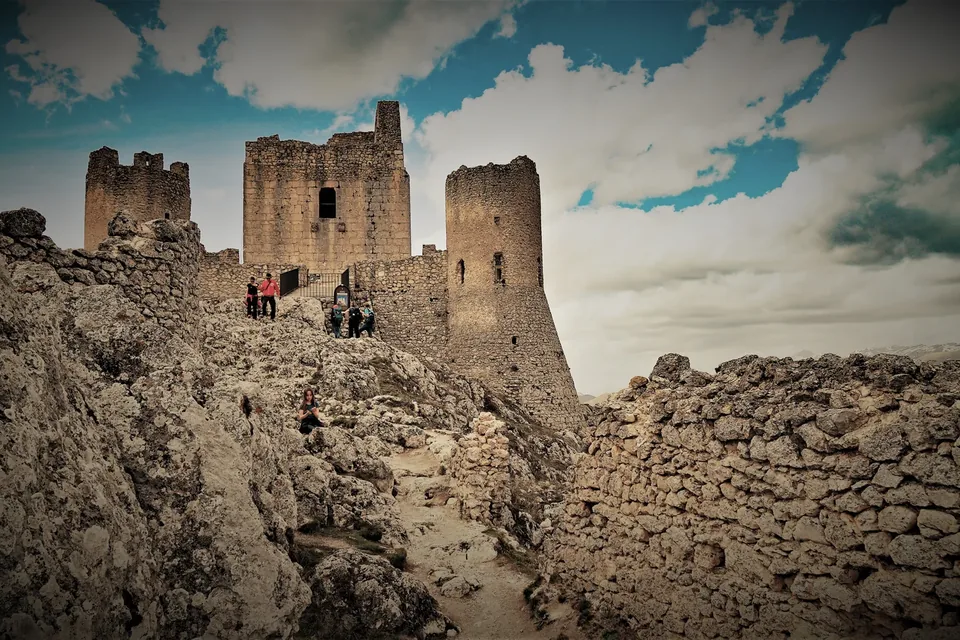
Santo Stefano di Sessanio and Rocca Calascio
A stone village on the L’Aquila side of the Gran Sasso, with a Slow Food Presidium lentil and the transhumance fortress nearby.
Read the guide →Photo: Vincedelbenàco / Wikimedia Commons — CC BY-SA 4.0 · Resized and converted to WebP.
.jpg)
Read more
Santo Stefano di Sessanio lentil
The Slow Food Presidium from fields above a thousand metres: sowing, hand harvesting, the soup that needs no soaking, the Medici village and a route through the Baronia, Campo Imperatore and Castel del Monte.
Read the guide →