
APULICA / Food guides
L'Aquila saffron: the red gold of the Navelli plateau
Zafferano dell'Aquila is one of Italy's most precious spices and one of the few you only truly understand on the spot, in autumn, when the fields of the Navelli plateau turn purple. Behind a pinch of red powder lie months of work on the land, a harvest done by hand before sunrise and a toasting over embers that sets this saffron apart from many others. Since 2005 the name has been protected as a Protected Designation of Origin. This guide covers the history, the method, the PDO rules and the landscape between L'Aquila, the old transhumance villages and the parks that surround the production area.
A spice that came from afar
Zafferano dell'Aquila is obtained by toasting the stigmas of the Crocus sativus flower, a plant of the Iridaceae family. The Qualigeo record notes that saffron growing began in Asia and that, according to historical sources, the spice was brought to Italy by a Benedictine monk from Navelli, between the 13th and 14th centuries. The conditional matters: it is a tradition reported by the sources, not a documented deed.
What followed is clearer. In Abruzzo the plant found a favourable environment and saffron became fundamental to the local market, earning the nickname of vermilion gold. It contributed above all to the growth of the city of L'Aquila, at the centre of important trade with the peoples of central and northern Europe.
Today the same land remains the heart of production. Italia.it describes the saffron plateaus, in the province of L'Aquila, as an area of villages and fields that turn purple in autumn, in the flowering season: the Navelli plateau, at about 760 metres, is the emblematic place.
Sources: Qualigeo — Zafferano dell'Aquila DOP · Italia.it — Gli altopiani dello zafferano
A year of work for a few grams
According to the Qualigeo record the growing ground is carefully worked and then left to rest from November to August. The plant reproduces by corms: in spring the corm that sprouted the year before produces new ones, and in August the best are planted very close together, in single or double rows. Suitable soil has a good share of active lime, organic matter and potassium, qualities that the record says contribute to the product's character.
The flower is small, with six pinkish-violet petals. Inside the corolla the style divides into three scarlet filaments, the stigmas, which are the saffron proper. They contain crocins, which colour things yellow, and safranal and picrocrocin, which give dishes their distinctive taste and aroma.
One figure explains the spice's value, and both Qualigeo and Italia.it report it: a kilogram of saffron takes about 200,000 flowers. Qualigeo adds that it takes about 500 hours of work, and it is this effort that justifies its high price.
Sources: Qualigeo — Zafferano dell'Aquila DOP · Italia.it — Prodotti e piatti tipici abruzzesi
Dawn harvest and toasting over embers
Harvesting is by hand during flowering, which Qualigeo places between mid-October and the first week of November: every morning at dawn, before the sun opens the flowers. Italia.it adds that in the last hours of the night the flower releases its scent at its strongest, and that growers pick the flowers one by one, gently.
Then comes the sfioritura, the most painstaking task: the stigmas are separated from the rest of the flower by hand. On the same day as the harvest they are dried, which here is a true toasting over embers of oak or almond wood. It is this step, described in the Qualigeo record, that gives Zafferano dell'Aquila its character: a purple-red colour, a very intense aroma and a decisive taste.
The result is sold in two forms, as stigmas or as powder. For visitors in autumn, a saffron day therefore has a precise rhythm: fields at dawn, sfioritura tables in the morning and embers lit in the afternoon, always on the same day.
Sources: Qualigeo — Zafferano dell'Aquila DOP · Italia.it — Gli altopiani dello zafferano
The PDO: regulation, towns and controls
The Protection Consortium notes that Zafferano dell'Aquila was entered in the PDO register by Commission Regulation (EC) No 205/2005 of 4 February 2005. The production area covers thirteen municipalities in the province of L'Aquila, especially on the Navelli plateau, and the consortium is based in Civitaretenga, a hamlet of Navelli. The product is sold all year as stigmas or powder, in paper sachets, glass jars or other fine materials; plastic is excluded.
Controls are public. The Consortium explains that a ministerial decree of 15 February 2005 designated the L'Aquila Chamber of Commerce, now the Gran Sasso d'Italia Chamber of Commerce, as the authority responsible for checks on the PDO, with its own laboratory for characterising the spice. Qualigeo names the same Chamber as control body.
For buyers, traceability matters most: according to the Consortium, producers using the name are entered in lists kept by the control body, together with the land parcels they cultivate, and the label makes it possible to trace the origin.
Sources: Lo zafferano dell'Aquila DOP — Consorzio per la tutela Zafferano dell'Aquila DOP · Qualigeo — Zafferano dell'Aquila DOP · L'Autorità di Certificazione — Consorzio per la tutela Zafferano dell'Aquila DOP
A plateau between three parks
Italia.it describes the saffron plateaus as one of Italy's most unspoilt natural areas: the growing area, in the province of L'Aquila, is crossed by the Sirente-Velino Regional Park and bounded to the north by the Gran Sasso and Monti della Laga National Park and to the south by the Majella National Park. The suggested route starts in L'Aquila, with the Spanish Fort, Collemaggio, San Bernardino and the Fountain of the 99 Spouts, and heads south to San Pio delle Camere, a transhumance village where pajare, small stone shepherds' shelters, can still be seen. Then the Navelli plateau opens up, at about 760 metres, turning purple in autumn. Italia.it mentions Cocullo, above the Sagittario gorges beyond Sulmona, as another growing area. The Gran Sasso National Park, in its food loop from Barisciano to Santo Stefano di Sessanio and Castel del Monte, also lists L'Aquila saffron among the specialities of these mountains, alongside cereals, pulses and the Turchesa potato.
Sources: Italia.it — Gli altopiani dello zafferano · Parco nazionale del Gran Sasso e Monti della Laga — Su e giù per la Baronia, tra pascoli e coltivi
L'Aquila as a starting point
The regional capital is the natural base for a saffron trip. Italia.it recalls that L'Aquila was founded in 1254, in a basin between the Gran Sasso and the Monti della Laga, and that the historic centre still bears the marks of the 2009 earthquake and the reconstruction. The basilica of Santa Maria di Collemaggio, with its Romanesque facade and the Holy Door opened every year for the Perdonanza Celestiniana, and the Spanish Fort, which houses MuNDA, the National Museum of Abruzzo, are the two main landmarks. In front stands the Fountain of the 99 Spouts, linked to the castles that helped found the city. For slow travellers it is worth sleeping in town or in nearby villages and heading out to the plateau early in the morning, when picking happens.
Sources: Italia.it — L'Aquila
In the kitchen, from sea to mountains
Italia.it links Zafferano dell'Aquila to the twin soul of Abruzzo cooking, mountain and seaside, and mentions mussels with saffron as a dish to pair with a Cerasuolo d'Abruzzo. Qualigeo notes that in Italian cooking the spice enhances many preparations: first courses such as risotto alla milanese, mains such as saffron lamb ribs, and desserts.
The same record gives practical advice. Whole stigmas should be revived first by soaking them for a few hours in a little hot stock or cooking water; powder, quicker to use, goes in almost at the end of cooking. About ten centigrams are enough for four people.
At home, treat it with respect. It keeps in glass containers, away from light and moisture, and in this way retains its qualities for several years, according to Qualigeo. A simple risotto or pasta with fish stock is the best test: avoid burning it in the pan or masking it with too many other flavours, because its strength lies in the warm note that lingers on the palate.
Sources: Italia.it — Prodotti e piatti tipici abruzzesi · Qualigeo — Zafferano dell'Aquila DOP
When to go and how to plan
To see flowering and harvest the window is narrow: the last two weeks of October and the first days of November, varying from year to year with the weather. Do not pin the trip on a single day: two or three nights are better, with a free morning for the fields when conditions are right. Harvesting is farm work, not a show: visits must always be arranged with operators and follow their rhythms. Out of season the plateau is still beautiful and the spice is available all year, but the story changes: you look at the farmed landscape, taste it in dishes and buy at leisure. We found no official source for a dedicated festival with confirmed 2026 dates, so we do not list one.
Taking it home
Saffron is one of the lightest and most durable food souvenirs. To recognise the protected product, look on the label for the name Zafferano dell'Aquila and the PDO reference, and remember that the specification excludes plastic packaging: paper and glass are the right signal. Whole stigmas let you see what you are buying and keep well in the dark, away from heat and moisture; powder is handier but harder to judge. Buying in the production area also helps you understand the price: every gram stands for thousands of hand-picked flowers. A small amount goes a long way, so buy little and good, and use it within a reasonable time.
A thread for your journey
Journey idea: two nights in L'Aquila or a nearby village in late October. Early morning on the Navelli plateau for the flowering fields, with harvest and toasting to be watched only if arranged with operators; afternoon in San Pio delle Camere among the pajare; the next day central L'Aquila with Collemaggio, the Spanish Fort and the Fountain of the 99 Spouts, and a lunch where saffron stars in a single dish.
Talk to us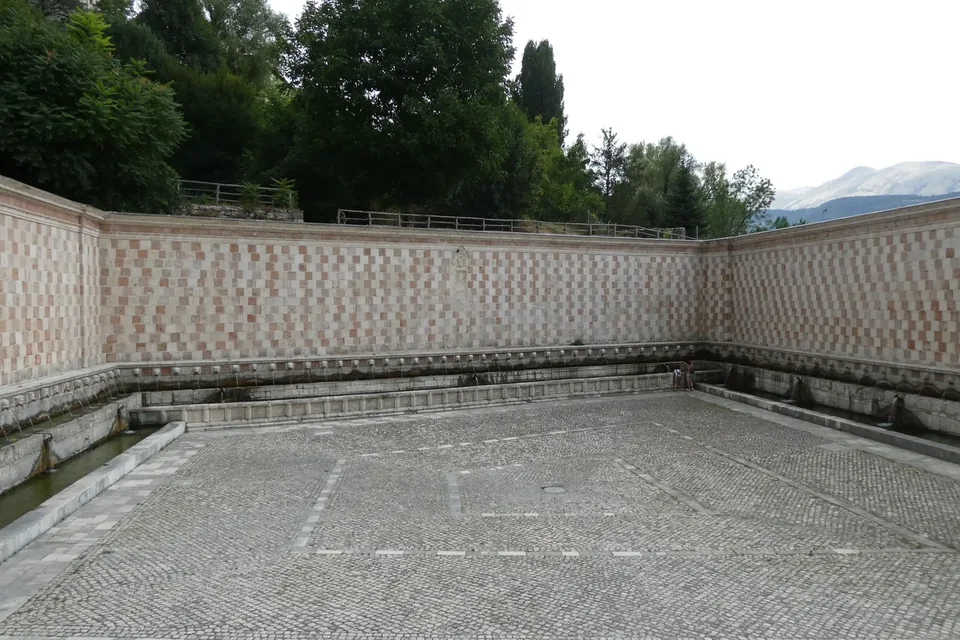

.jpg)
