
APULICA / FRUIT, VEGETABLES AND PULSES
Zafferano dell'Aquila saffron
PDO · Fruit, vegetables and pulses · Abruzzo
In brief
- A spice made by toasting the stigmas of the Crocus sativus flower, purple-red with an intense aroma. (Qualigeo (Fondazione Qualivita) — Zafferano dell'Aquila DOP)
- It is grown in thirteen towns in the province of L'Aquila, mainly on the Navelli plateau. (Qualigeo (Fondazione Qualivita) — Zafferano dell'Aquila DOP)
- The flowers are picked by hand at dawn, from mid-October to the first week of November. (Qualigeo (Fondazione Qualivita) — Zafferano dell'Aquila DOP)
- According to the sources a Benedictine monk from Navelli brought it to Italy in the thirteenth or fourteenth century, and its trade helped L'Aquila grow. (Qualigeo (Fondazione Qualivita) — Zafferano dell'Aquila DOP)
History and origin
Saffron comes from Asia, but in the basin around L'Aquila it found a second home. According to the historical sources gathered by the Qualivita Foundation, a Benedictine monk from Navelli brought it to Italy between the thirteenth and fourteenth centuries, tying the story of the spice to that of the town from the start.
The climate and soils of the plateau proved well suited, and the spice became a source of wealth, earning the name of vermilion gold. Its trade put L'Aquila at the centre of exchanges with cities in central and northern Europe and helped the city grow. In Navelli saffron supported the village economy for centuries: the Municipality records that in 1751 the town's entire saffron and silk "industries" were leased to a local notable.
Once also used in medicine and cosmetics, the spice is now protected as a Protected Designation of Origin, entered in the European register of geographical indications.
Sources: Qualigeo (Fondazione Qualivita) — Zafferano dell'Aquila DOP · Comune di Navelli — Storia del Comune · Italia.it (Ministero del Turismo) — Navelli · eAmbrosia — Zafferano dell'Aquila (PDO-IT-0266)
Area and method of production
The production area covers thirteen municipalities in the province of L'Aquila and is centred on the Navelli plateau, with fields that the Abruzzo wine consortium places between 400 and 1,100 metres above sea level. The soils are rich in active lime, organic matter and potassium, conditions that the specification links to the character of the product.
The cycle follows the farming year. The field is carefully worked and then rested from November to August; in spring the corm that flowered the year before produces new corms, and in August the best ones are planted very close together, in single or double rows. Flowering comes between mid-October and the first week of November: the flowers are picked by hand every morning at dawn, before the sun opens them.
Then comes the separating, also by hand: the red stigmas are pulled away from the stamens. The same day the stigmas are dried over embers of oak or almond wood. About 200,000 flowers and 500 hours of work go into one kilo of spice.
Sources: Qualigeo (Fondazione Qualivita) — Zafferano dell'Aquila DOP · Consorzio Tutela Vini d'Abruzzo — Il territorio e i prodotti tipici
How to recognise it
The plant is Crocus sativus, a small six-petalled flower of pinkish violet. Inside the corolla the style splits into three scarlet threads, the stigmas, which are the saffron itself.
Once toasted, Zafferano dell'Aquila PDO is purple-red, with a very intense scent and a bold flavour. The threads contain crocins, which colour food yellow, and safranal and picrocrocin, which give taste and aroma.
It is sold all year round as whole threads or as powder, in paper sachets or jars of glass or another fine material; plastic packs are not allowed. Kept in a glass container away from light and moisture, it holds its qualities for several years.
Sources: Qualigeo (Fondazione Qualivita) — Zafferano dell'Aquila DOP
In the kitchen
In Italian cooking saffron adds colour and fragrance to many dishes: the Qualivita Foundation mentions risotto alla milanese, lamb cutlets with saffron and various desserts. Very little is needed: about ten centigrams for four people.
The threads should first be softened for a few hours in a little hot stock or cooking water, then added to the dish with their liquid. The powder is quicker and can be used near the end of cooking.
On the plateau saffron meets the other products of the plain: at the Navelli festival it features, together with the Navelli chickpeas, a Slow Food Presidium, in traditional dishes and local specialities.
Sources: Qualigeo (Fondazione Qualivita) — Zafferano dell'Aquila DOP · Comune di Navelli — 48ª Sagra dei Ceci e dello Zafferano
Where to taste it
Saffron's home is the Navelli plateau, in the province of L'Aquila. Navelli stands on a hill, with an old village of grey stone houses and narrow, winding lanes, in places with steps cut into the rock. In October the flowering turns the plain purple and draws many visitors: at dawn the hand picking can still be seen, with gestures that have not changed over time.
In summer the Municipality holds the Sagra dei Ceci e dello Zafferano, a chickpea and saffron festival in Piazza San Pelino, with traditional dishes, music and an exhibition of local crafts; in 2026 it reached its forty-eighth edition.
Visitors to L'Aquila can spend a day among the thirteen municipalities of the designation and the Navelli plain, combining stone villages with the landscape of crocus fields.
Sources: Italia.it (Ministero del Turismo) — Navelli · Comune di Navelli — 48ª Sagra dei Ceci e dello Zafferano · Qualigeo (Fondazione Qualivita) — Zafferano dell'Aquila DOP
Protection
- Protected designation of origin (PDO) — PDO-IT-0266 (eAmbrosia — Zafferano dell'Aquila (PDO-IT-0266))
When
- Harvest: October–November (Qualigeo (Fondazione Qualivita) — Zafferano dell'Aquila DOP)
- Autumn
Where
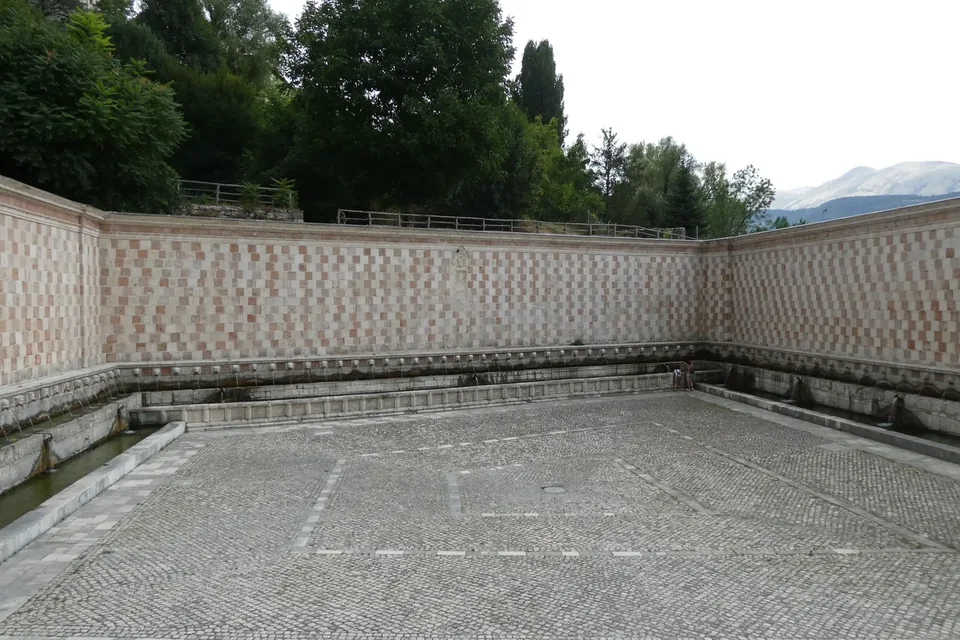
L’Aquila
A capital between the Gran Sasso and the Monti della Laga, with the UNESCO-listed Celestinian Forgiveness and reconstruction still under way.
Read the guide →Photo: Syrio / Wikimedia Commons — CC BY-SA 4.0 · Resized and converted to WebP.

Read more
Zafferano dell'Aquila PDO
Flowers picked at dawn, stigmas toasted over embers, thirteen towns around L'Aquila: the Abruzzo PDO explained from field to kitchen, with an autumn day on the plateau.
Read the guide →