
APULICA / FISH AND SEAFOOD
Tuna bottarga
PAT · Fish and seafood · Calabria
In brief
- It is salted, pressed tuna roe, a preserve that Calabria associates with the province of Vibo Valentia. (Regione Calabria — Schede PAT: preparazioni di pesci, molluschi e crostacei (scheda Bottarga di tonno))
- It is made by hand in May and June, in terracotta containers weighed down with stones. (Regione Calabria — Schede PAT: preparazioni di pesci, molluschi e crostacei (scheda Bottarga di tonno))
- It is dark pink, sweet in taste, with a delicate smell of the sea. (Regione Calabria — Schede PAT: preparazioni di pesci, molluschi e crostacei (scheda Bottarga di tonno))
- The coast between Tropea and Pizzo was lined with tuna traps, recorded as early as the eleventh century. (Soprintendenza ABAP per Reggio Calabria e Vibo Valentia (Ministero della Cultura) — Le tonnare)
- It is on Calabria's list of traditional food products. (Masaf — Elenco nazionale dei prodotti agroalimentari tradizionali, XXVI revisione (2026))
History and origin
The Calabria Region's record notes that, according to historians, bottarga was invented by the Phoenicians and then spread by the Arabs throughout the Mediterranean; the name is traced to the Arabic botarikh, meaning salted fish roe. Among the species used, connoisseurs prize most Mediterranean tuna caught in the tonnare, the fixed tuna traps.
In the province of Vibo Valentia tuna fishing has very old roots. The Soprintendenza for Reggio Calabria and Vibo Valentia points to tuna traps as early as the eleventh century, among the properties Count Roger gave to the abbey of Mileto: in 1081 Bivona appears "with its harbour and tuna trap". From Tropea to Pizzo, by way of Parghelia, Briatico, Bivona, Vibo Marina and Mezza Praja, ran the stages of a coast that waited for the tuna to pass, caught them, processed them and sold them.
Whole communities worked around the traps, supported by an inland area that supplied salt, oil, ice, fibres for nets and timber for boats. Bottarga is one of the products of this tuna economy, and in Calabria today only a few artisan firms make it.
Sources: Regione Calabria — Schede PAT: preparazioni di pesci, molluschi e crostacei (scheda Bottarga di tonno) · Soprintendenza ABAP per Reggio Calabria e Vibo Valentia (Ministero della Cultura) — Le tonnare
Area and method of production
The production area given by the Region is the province of Vibo Valentia, on the Tyrrhenian coast. There are only two ingredients: the sac holding the tuna roe, and salt. The product is worked fresh, and the working season runs from May to June.
Techniques are entirely manual. The roe first rests in brine for a time that depends on its size. It then goes under salt in terracotta containers, closed and pressed with weights, usually stones, and the product is turned every day. After fifteen to twenty days it comes out of the press, is rinsed in fresh water and left to dry in the sun and wind for one or two days.
A short maturing follows: the bottarga rests in a cool room for about two weeks before it is packed. Making it requires terracotta and glass containers and the weights; the rooms must be clean, well ventilated and fitted with cold stores.
How to recognise it
The regional record describes Calabrian tuna bottarga in a few precise strokes: creamy texture, dark pink colour, sweet taste and a delicate smell of fish. These traits come from the raw material, since trap-caught tuna has dark pink flesh, firm, rather fatty and therefore very tasty.
The process explains the rest. Brine and salt draw out the water, the weights compact the roe, sun and wind dry its surface, and resting in a cool room completes the maturing. Everything is done by hand, with terracotta and glass containers and the weights that act as a press.
It is a niche product: the Region stresses that in Calabria bottarga is made by only a few artisan firms, and the record notes that production in the province of Vibo Valentia goes back more than twenty-five years.
Where to taste it
Tuna bottarga belongs to the Vibo Valentia coast, the coast of the old tuna traps. In Pizzo, on the beach, stand the logge of the old tonnara, masonry buildings where tuna was once processed: the original structure of the Tonnara Antica, also called Grande, dates from 1475 and included spaces for weighing, cutting and salting the catch.
A little further on, at Vibo Marina, the Bivona tuna-trap complex keeps its 1881 loggia for boats and nets and a chapel dedicated to Saint Anthony of Padua. The regional tourism portal points to restaurants here serving tuna dishes, from spaghetti with bottarga to tuna tagliata with Tropea red onion, and to a canning plant open by appointment as a company museum.
In Tropea, which the Soprintendenza lists among the historic stages of tuna fishing, tasting goes together with the memory of a coast that for centuries lived on the passage of the tuna.
Sources: Soprintendenza ABAP per Reggio Calabria e Vibo Valentia (Ministero della Cultura) — Le tonnare · Calabria Straordinaria (Regione Calabria) — Tonnare in Calabria, sulle tracce dell'antica pesca del tonno
Protection
- Traditional agri-food product (PAT) — Calabria, n. 245, 26th revision (Masaf — Elenco nazionale dei prodotti agroalimentari tradizionali, XXVI revisione (2026))
When
Where
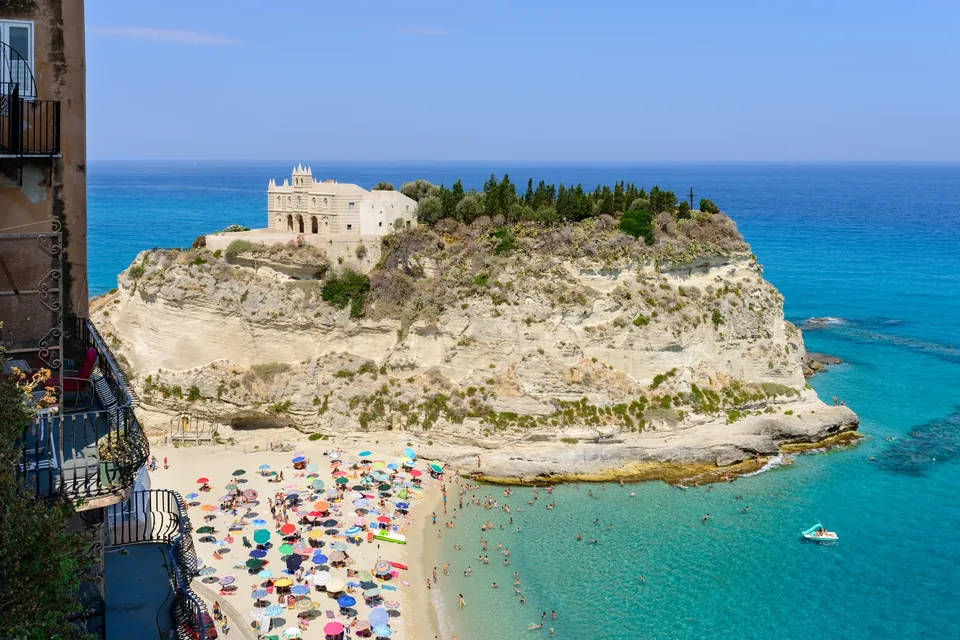
Tropea and Capo Vaticano
The clifftop town, the Tropea onion and the Capo Vaticano headland along the Costa degli Dei, on Calabria’s Tyrrhenian coast.
Read the guide →Photo: Norbert Nagel / Wikimedia Commons — CC BY-SA 3.0 · Resized and converted to WebP.
