
Why go
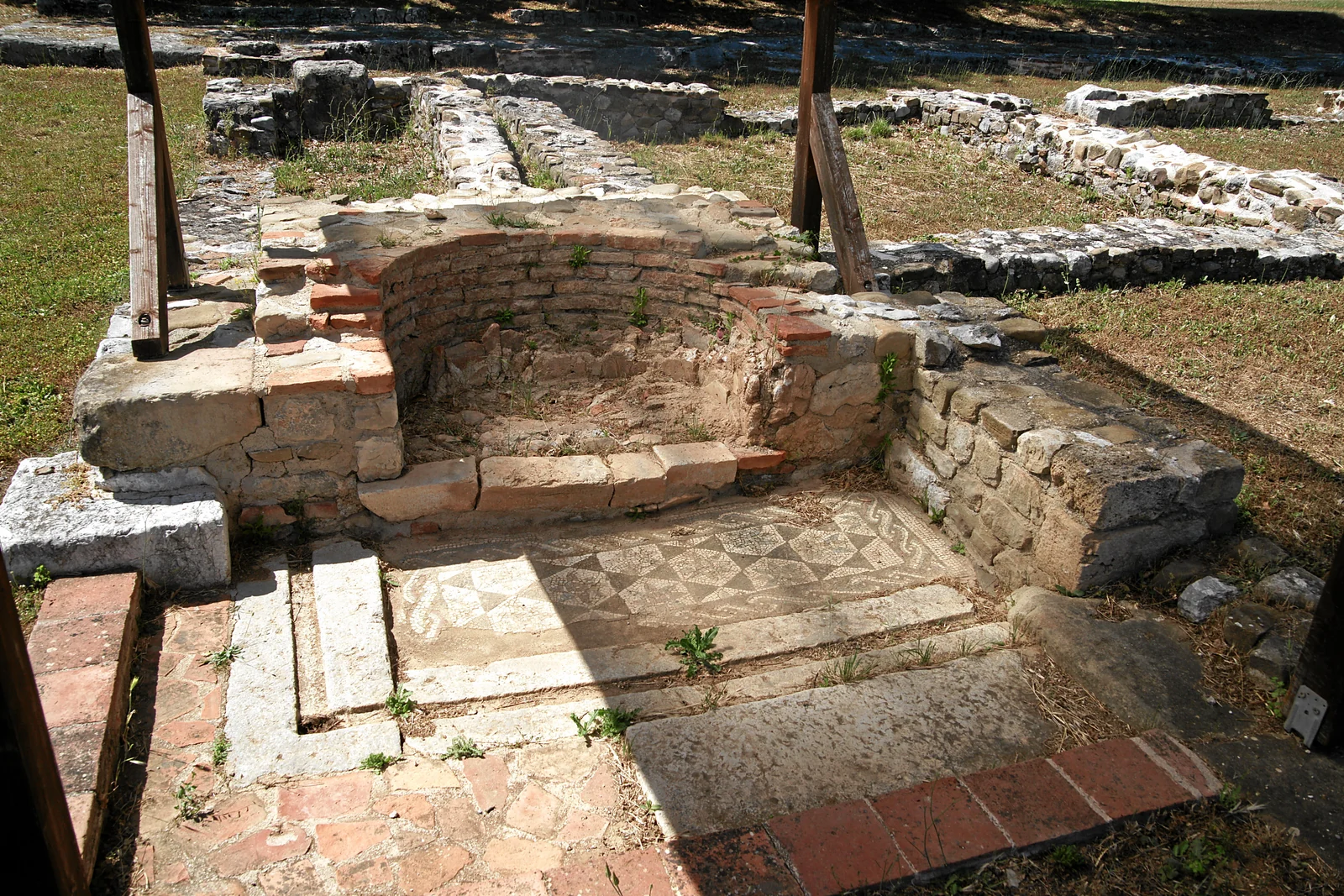
Grumento Nova is the town that keeps Grumentum, one of the largest Roman cities of Lucania and the site in Basilicata where a Roman urban layout can best be read as a whole. The Appennino Lucano National Park calls it «the little Pompeii of Basilicata»: on the plain below the town you walk along ancient streets, from the theatre to the forum, from the baths to the amphitheatre, in a landscape open onto the Val d'Agri and Lake Pertusillo.
The second reason is the National Archaeological Museum of the Upper Val d'Agri, close to the park, which tells the valley's story from the Pleistocene, when it was filled by a great lake, to the early Middle Ages. Visiting museum and site together gives faces to the spaces: statues from the baths, portraits from the forum and mosaics from the houses return in your mind to the places they came from.
The town above, once called Saponara, born when the inhabitants left the Roman city, has churches, palaces and the remains of its castle, with views over the valley. It suits travellers who love archaeology without crowds, Apennine nature and a table of Val d'Agri wine, cheese and beans.
Sources: Ministero della Cultura — Parco archeologico di Grumentum · Parco nazionale dell’Appennino Lucano — Grumento Nova · Ministero della Cultura — Museo archeologico nazionale dell’Alta Val d’Agri · Comune di Grumento Nova — Castello
History
Grumentum began in the early 3rd century BC as a small Lucanian settlement allied with Rome. During the Second Punic War Hannibal passed through it and it sided with Carthage; on its plain was fought a battle recorded by Livy, which the park remembers as a hard defeat for Hannibal and his elephants. A long process of Romanisation followed, with land divided by centuriation.
From the mid-1st century BC, refounded as a colony, the city received all the buildings typical of Roman towns: forum, temples, theatre, baths, amphitheatre and aqueduct. Under the Empire it became the largest Roman centre in the region and later a bishopric, with the basilica of Santa Maria Assunta as its first cathedral. The museum's early medieval finds tell of Christianisation and slow abandonment.
With the Saracen raids the city was left and its people moved to the nearby heights, where the medieval town of Saponara grew, protected by an 11th-century Norman castle. Tradition also links the Madonna of Viggiano to the end of Grumentum, saying she was hidden on the mountain to save her from destruction. The earthquake of December 1857 levelled the town, which was rebuilt; its present name, Grumento Nova, recalls the ancient city.
Sources: Ministero della Cultura — Parco archeologico di Grumentum · Parco nazionale dell’Appennino Lucano — Grumento Nova · Ministero della Cultura — Museo archeologico nazionale dell’Alta Val d’Agri · Comune di Grumento Nova — Castello · Comune di Viggiano — Il santuario: la storia · Comune di Grumento Nova — Chiesa Madre di Sant’Antonino Martire
What to see
The route through the archaeological park follows the ancient streets, still regular in plan. From the theatre, built at the end of the 1st century BC, you reach the Italic temple on its high podium and the domus with mosaics, whose summer dining room is decorated with geometric and floral motifs. Along the paved main street opens the forum with its public, civic and religious buildings: Capitolium, Augusteum, porticoes, curia, basilica and forum baths. Further on are the Great Baths, with a hypocaust-heated calidarium and rich mosaics and marbles, and the basilica of Santa Maria Assunta. The walk ends at the amphitheatre, one of the oldest in masonry, high above the lake.
The museum, opened in 1995 over the southern necropolis with a stretch of the Roman aqueduct in its garden, displays remains of straight-tusked elephants some 120,000 years old, Bronze Age material, Lucanian grave goods with red-figure pottery and votive offerings from the San Marco sanctuary, perhaps dedicated to the goddess Mefitis. From the Roman city stand out the marble head of Livia, wife of Augustus, an ivory pyxis and the statues from the baths; museum and park share a combined ticket.
In town, stop at the Chiesa Madre of Sant'Antonino, the church of the Rosary, the chapel of Santa Caterina with its sacred art museum, the Basilian church of Saints Cosmas and Damian and the castle hall with 18th-century painted angels and cherubs.
Sources: Ministero della Cultura — Parco archeologico di Grumentum · Parco nazionale dell’Appennino Lucano — Grumento Nova · Comune di Grumento Nova — Museo archeologico nazionale e Parco Grumentum · Ministero della Cultura — Museo archeologico nazionale dell’Alta Val d’Agri · MiBACT — Carta dei servizi del Museo e Parco archeologico di Grumento Nova · Comune di Grumento Nova — Chiesa Madre di Sant’Antonino Martire · Comune di Grumento Nova — Chiesa del Rosario · Comune di Grumento Nova — Cappella di Santa Caterina d’Alessandria · Comune di Grumento Nova — Chiesa dei Santi Cosma e Damiano · Comune di Grumento Nova — Castello
Flavours
Grumento Nova is, with Viggiano and Moliterno, one of the three towns of the Terre dell'Alta Val d'Agri PDO. The red, made mainly from Merlot and Cabernet Sauvignon, is ruby turning to garnet, with aromas of blackberry and plum jam and lively tannins; with longer ageing it can be labelled Riserva. The rosé, with Malvasia di Basilicata, is floral and fresh. The appellation is young, but bound to hilly country where vines share the land with pastures and woods.
Other recognised products come from the valley. Canestrato di Moliterno PGI is a hard pecorino with some goat's milk, shaped in baskets that mark the rind and matured in the fondaci of Moliterno, above 700 metres. Fagiolo di Sarconi PGI, grown above 600 metres in the Cannellino and Borlotto varieties and twenty local ecotypes, has tender flesh and cooks quickly.
Home cooking combines these ingredients with handmade pasta, pulses and local meat: lunch in the valley with a glass of local wine is the natural complement to a day among the ruins.
Sources: Qualigeo — Terre dell’Alta Val d’Agri DOP · Qualigeo — Canestrato di Moliterno IGP · Qualigeo — Fagiolo di Sarconi IGP
Things to do
The archaeological visit is the heart of the experience: allow at least half a day for park and museum, starting at the museum to get your bearings and then walking among the ruins, which spread over a wide plain. The route is outdoors and partly exposed to the sun, so in summer the cooler hours are best.
The site lies at the heart of the Appennino Lucano National Park, and the amphitheatre overlooks Lake Pietra del Pertusillo. On the lake shore, at Masseria Crisci in the Montemurro area, the park has opened an info point with details on excursions and official guides; a lakeside path leads to a permanent land art exhibition.
In town you can climb to the library in Palazzo Giliberti, heir to the collection of the jurist Amato Danio, with a small panoramic terrace over the valley and the lake. For lovers of small churches, the chapel of San Laverio, where the Agri and Sciaura rivers meet, keeps traces of a very old place of worship: during works in 2004 the saint's tomb and the remains of the first Christian church were found there.
Sources: Ministero della Cultura — Museo archeologico nazionale dell’Alta Val d’Agri · Ministero della Cultura — Parco archeologico di Grumentum · Parco nazionale dell’Appennino Lucano — Info point di Masseria Crisci · Comune di Grumento Nova — Biblioteca Danio a Palazzo Giliberti · Comune di Grumento Nova — Chiesetta di San Laverio
Getting there and around
Grumento Nova lies in the upper Val d'Agri, in the province of Potenza. The Appennino Lucano National Park lists as road access the SS598 «Val d'Agri», reached from the Atena Lucana exit of the Mediterranean motorway or, from Matera, Taranto and Sibari, after the Basentana or the SS106 Jonica; from Potenza you come via the Basentana and the Tito-Brienza link.
By train, the nearest stations listed by the park are Potenza, Sapri, Maratea and Policoro, from which regional buses continue. The airports named are Pontecagnano, Naples, Bari and Lamezia Terme; Grumento Nova also has an airstrip for light aircraft. Public transport to the valley is sparse, so a car makes it easier to combine park, museum and nearby villages.
The museum is about 300 metres south of the archaeological park entrance, and the two can be visited on foot one after the other. The upper town, with its churches and library, is reached by car from the plain; its streets are best explored on foot.
Sources: Parco nazionale dell’Appennino Lucano — Come arrivare · Ministero della Cultura — Parco archeologico di Grumentum
Where to stay
The Appennino Lucano National Park website lists accommodation in the protected area's towns, including Grumento Nova, Viggiano, Moliterno and Sarconi, and lets you filter by type: hotels, agriturismi, bed and breakfasts, guest rooms, apartments, holiday houses, hostels and mountain huts. It is the easiest way to find your way in a valley where places to stay are spread between villages and countryside.
For a trip focused on archaeology, a base in the valley near the park and the lake lets you visit the ruins in the morning or late-afternoon light. Countryside agriturismi suit those who want to combine the visit with good food and walks; staying in Viggiano or the other hill towns is convenient if you also plan to climb to the Sacro Monte or hike in the Apennines.
At the park's info point at Masseria Crisci, on the lake, and from the official guides you can ask about accommodation and organised activities in the area.
Sources: Parco nazionale dell’Appennino Lucano — Dove dormire · Ministero della Cultura — Parco archeologico di Grumentum · Parco nazionale dell’Appennino Lucano — Info point di Masseria Crisci
Nearby
Up the valley lies Viggiano, town of the harp and of the Black Madonna of the Sacro Monte, with its sanctuary at 1,725 metres and the places of its musical tradition; the story of its Madonna is tied to the end of Grumentum, and the Grumento Nova museum displays mosaics from a Roman villa in Viggiano's territory.
Moliterno overlooks the valley with its Norman castle and keeps the fondaci where Canestrato PGI matures; Sarconi is the bean village, cultivated on the valley's high ground. On Lake Pertusillo, the Masseria Crisci info point is the starting place for discovering the national park's nature, between Monte Sirino and Monte Volturino.
The Upper Val d'Agri museum, with finds from Marsico Nuovo, Montemurro, San Martino d'Agri, Paterno and Moliterno, is also an invitation to explore these villages: each keeps a piece of the valley's history, from Bronze Age sites to medieval churches.
Sources: Italia.it — Viggiano · Comune di Viggiano — Il santuario: la storia · Ministero della Cultura — Museo archeologico nazionale dell’Alta Val d’Agri · Qualigeo — Canestrato di Moliterno IGP · Qualigeo — Fagiolo di Sarconi IGP · Parco nazionale dell’Appennino Lucano — Info point di Masseria Crisci
Where to stay
In the municipality of Grumento Nova the national database of the Ministry of Tourism lists 14 accommodation businesses with a verified CIN code: 3 hotels, 3 other licensed accommodation and 8 other types such as B&Bs and private rentals.
Sources: Ministero del Turismo – Banca Dati Strutture Ricettive (dashboard pubblica), 2026-10-12
YOUR JOURNEY
How to shape a journey here
Try reconstructing a daily route from a house to the square and baths. This question makes the remains easier to read than a simple sequence of ruins.
Talk to us about it



_(2).jpg)