
APULICA / FRUIT, VEGETABLES AND PULSES
Polignano carrot
PAT · Slow Food Presidium · Fruit, vegetables and pulses · Puglia
In brief
- Carrots in many colours, from pale yellow to deep purple, because farmers select seed without regard to colour. (Fondazione Slow Food — Presidio Carote di Polignano · Atlante dei PAT di Puglia (Regione Puglia, Università di Bari) — Carota di Polignano)
- The sandy fields near the sea are irrigated with brackish water from stone wells, which gives the roots a savoury taste. (Fondazione Slow Food — Presidio Carote di Polignano · Atlante dei PAT di Puglia (Regione Puglia, Università di Bari) — Carota di Polignano)
- Growing them around Polignano a Mare is documented since at least 1940. (Atlante dei PAT di Puglia (Regione Puglia, Università di Bari) — Carota di Polignano)
- They are sown from mid-August to September and lifted by hand with a fork from November to May. (Fondazione Slow Food — Presidio Carote di Polignano · Atlante dei PAT di Puglia (Regione Puglia, Università di Bari) — Carota di Polignano)
History and origin
In the countryside of Polignano a Mare, a few kilometres south of Bari, the carrot never turned uniformly orange at the command of seed companies. Local families went on choosing the healthiest plants each year and saving their seed, without discarding those of a different colour, and so a local population in countless shades between yellow and purple survived in the fields. In dialect the carrot is called bastinaca or pastinaca, and one of its local names, carota di San Vito, comes from the abbey around which most of the plots lie.
Cultivation in the Polignano countryside is documented at least since 1940, according to the testimony of a horticulture professor at the University of Bari quoted in a scientific paper; the same scholar had already published photographs of these carrots in a 1990 university textbook.
In 2015 the Polignano carrot entered the national list of traditional food products; it is also a Slow Food Presidium, supported by the Puglia Region. The Presidium's aim is to keep alive a century-old tradition and the seed saved by families over generations, and to reward the work of a small number of growers.
Sources: Atlante dei PAT di Puglia (Regione Puglia, Università di Bari) — Carota di Polignano · Fondazione Slow Food — Presidio Carote di Polignano
Area and method of production
The Presidium covers only the municipal territory of Polignano a Mare. The fields, about ten hectares in all, are sandy and close to the sea, with fairly high salinity that irrigation accentuates: the water comes from hand-dug stone wells built in the nineteenth century, which reach seawater seepage at a depth of about twelve metres. The water is therefore brackish and follows the rhythm of the tides; at low tide growers rely on small underground reserve basins. A donkey once turned the pulley device known as lu gegnu, now replaced by electric motors.
Sowing is staggered from mid-August to the end of September, using seed saved by the growers themselves, who deliberately select plants with roots of different colours. Fields are rotated so that the same plot is not cropped for several years in a row, and mineral fertiliser is normally not used.
The harvest, also staggered, runs from November to May and is the hardest stage: it is done by hand, loosening the soil with a fork and lifting one root at a time. The carrots are then washed in the same brackish water and packed in crates.
Sources: Fondazione Slow Food — Presidio Carote di Polignano · Atlante dei PAT di Puglia (Regione Puglia, Università di Bari) — Carota di Polignano
How to recognise it
The Polignano carrot is recognised first of all by its colour. On the outside the root ranges from pale yellow to deep purple, through bright yellow and orange; inside, the colour goes from light yellow to light orange. In the purple roots the colour lies in the outer layer, while the central core stays pale. The roots are of medium length, between 15 and 25 centimetres, with a diameter of up to 5 centimetres.
Flavour is the second distinctive sign. Analyses by researchers at the University of Bari describe a carrot sweeter than ordinary ones, thanks to a high content of glucose and fructose, and credit the purple roots with an antioxidant activity far higher than that of yellow and orange carrots, concentrated precisely in the coloured layer.
To this sweetness is added the salty note given by the sandy soil and the brackish water: anyone tasting one freshly pulled notices its savouriness and freshness. The PAT atlas also stresses its fragrance, which makes it much sought after by those who know it.
Sources: Atlante dei PAT di Puglia (Regione Puglia, Università di Bari) — Carota di Polignano · Fondazione Slow Food — Presidio Carote di Polignano · BiodiverSO (Università di Bari, PSR Puglia) — Caratterizzazione qualitativa e nutrizionale della carota giallo-viola di Polignano
In the kitchen
The sources that describe this carrot point to a simple use: the best way to understand it is to eat it raw, freshly pulled, when the first bite immediately gives back the savouriness and freshness that come from a field by the sea. Its natural sweetness, linked to the simple sugars measured in the analyses, is best appreciated without dressings that would mask its flavour.
In the purple roots both the colour and much of the antioxidant content lie in the outer layer, while the core stays pale: cut across, they show a coloured ring around a light centre. The different colours, placed side by side on the same plate, give a salad or a tray of raw vegetables the multicoloured look that is the hallmark of this product.
The season runs from late autumn to mid-spring, and it is during these months that the fresh carrot can be found in Polignano a Mare, where many local farms distribute it.
Sources: Fondazione Slow Food — Presidio Carote di Polignano · BiodiverSO (Università di Bari, PSR Puglia) — Caratterizzazione qualitativa e nutrizionale della carota giallo-viola di Polignano · Atlante dei PAT di Puglia (Regione Puglia, Università di Bari) — Carota di Polignano
Where to taste it
The Polignano carrot is to be found in Polignano a Mare and its countryside, among farmhouses, wells, drove roads and dry-stone walls, where the fields cluster around the abbey of San Vito. It is harvested from mid-November to early May, which makes it a good reason to visit the town outside the summer, when the farming landscape inland is in full swing.
The carrots are sold retail and wholesale through local farms and also reach the local market, which many visitors attend. Raising awareness of the product and rewarding the growers' work is precisely the aim of the Presidium.
A day in Polignano can combine the two sides of the place: the white old town perched on the cliff, the Arco Marchesale, Lama Monachile with its Bourbon bridge and the viewpoints over the Adriatic, and then the countryside where the sea seeps into the wells and flavours the carrots.
Sources: Fondazione Slow Food — Presidio Carote di Polignano · Atlante dei PAT di Puglia (Regione Puglia, Università di Bari) — Carota di Polignano · Italia.it (Ministero del Turismo) — Polignano a Mare: cosa vedere in un giorno
Protection
- Traditional agri-food product (PAT) — Puglia, n. 86, 26th revision (Masaf — Elenco nazionale dei prodotti agroalimentari tradizionali, XXVI revisione (2026))
- Slow Food Presidium — carote-di-polignano (Fondazione Slow Food — Presidio Carote di Polignano)
When
- Harvest: January–May, November–December (Fondazione Slow Food — Presidio Carote di Polignano · Atlante dei PAT di Puglia (Regione Puglia, Università di Bari) — Carota di Polignano)
- Winter
- Spring
- Autumn
Where
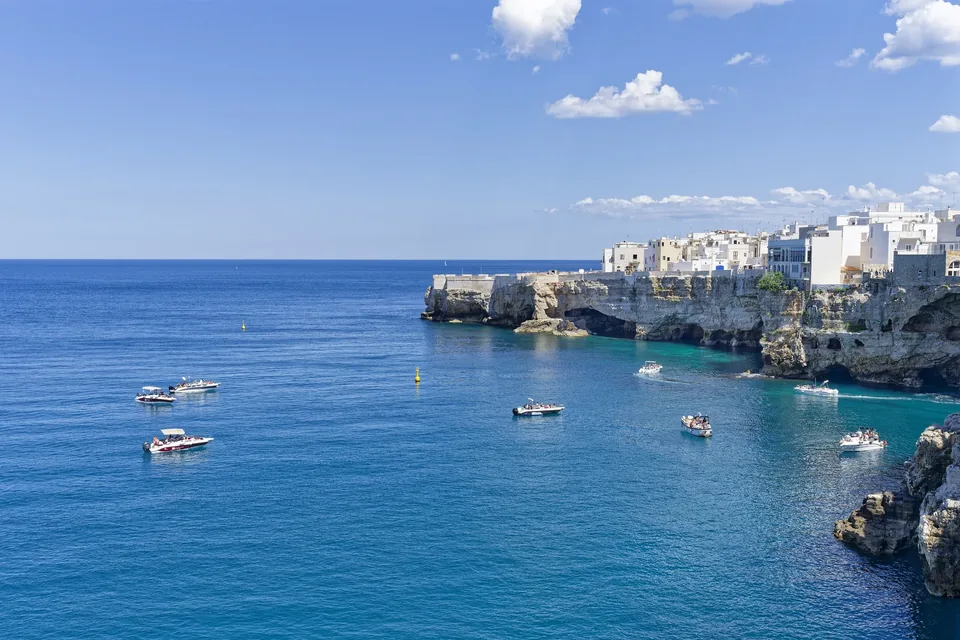
Polignano a Mare
Old town, viewpoints and a coffee as a travel pause.
Read the guide →Photo: Maksimsokolov / Wikimedia Commons — CC BY-SA 4.0 · Resized and converted to WebP.
