
APULICA / FRUIT, VEGETABLES AND PULSES
Bagno onion
Slow Food Presidium · Fruit, vegetables and pulses · Abruzzo
In brief
- An ecotype from the L'Aquila basin, grown in Bagno, Civita di Bagno and Monticchio, hamlets of L'Aquila, and partly in Ocre. (Fondazione Slow Food — Presidio Cipolla di Bagno)
- It is flattened, with golden skin and almost translucent white flesh, sweet; it weighs from 400 g to over a kilo. (Fondazione Slow Food — Presidio Cipolla di Bagno)
- The sets are planted out around the feast of San Raniero, the last Sunday of June; typical dishes are onion with salt cod and baked onion. (Fondazione Slow Food — Presidio Cipolla di Bagno)
History and origin
The Bagno onion is a local ecotype from the L'Aquila basin, tied to the hamlets of Bagno, Civita di Bagno and Monticchio in the municipality of L'Aquila, and to part of the neighbouring municipality of Ocre. Until about sixty years ago it was also grown higher up, at around a thousand metres, on Monte Ocre.
Until the 1960s it was an important source of income for growers: part of the crop went to a merchant in Terni, together with beans sown on the stubble, to be processed. Locals have always credited the onion with special qualities, which they link to the water of the small lakes of San Raniero and San Giovanni used for irrigation.
The ecotype has survived thanks to a few farmers and many family gardens. In Bagno nobody lets other onions flower, to avoid cross-pollination, and one Presidium producer grows the seed and hands out sets to anyone who asks.
Area and method of production
It is grown on flat, irrigated land. The cycle starts with the seed: between January and February the largest bulbs from the previous year are planted, and between late June and early July the small black seeds are gathered and dried in the sun. The seed is sown in small plots set aside for sets, which are trimmed to about twenty centimetres before transplanting.
The field is prepared in autumn with ploughing to 30-35 centimetres and light harrowing, and fertilised with well-rotted manure, preferably sheep manure. The crop is rotated every year with wheat or barley.
The sets are planted out between late May and late June, around the patron feast of San Raniero on the last Sunday of June. Generous flood irrigation follows, and the crust of the soil is broken up. The onion grows half above ground; in rainy spells near maturity the stem is bent over. It is harvested between late August and late September.
How to recognise it
It is a slightly flattened onion with a golden skin and white, almost translucent flesh. The taste is sugary; the smell is pungent but leans towards sweet, and the texture is firm.
It is a big onion: each bulb weighs on average between 400 and 1,100 grams, with a diameter usually of 10 to 15 centimetres and up to 20-25.
It is mostly eaten fresh, but it also keeps: families tie it in braids and store it somewhere cool in the cellar, or put it in upturned crates.
Its bond with the place is strong: to protect the ecotype, nobody in Bagno lets other onions flower, so as to avoid cross-pollination.
In the kitchen
Traditional dishes are onion with salt cod, served on feast days, onion baked with breadcrumbs and onion baked with potatoes.
Many families turn it into compote, jam and sweet-and-sour preserves following household recipes. The compote and preserves go well with fresh and aged cheeses and with boiled meats.
In Bagno people still remember a snack grandparents made for children: an onion cooked whole under the embers of the fireplace, then cleaned, opened and sprinkled with sugar. A simple way to bring out its natural sweetness.
Compote and preserves mean it can be enjoyed well beyond the harvest season.
Where to taste it
The onion is found in the hamlets of Bagno, Civita di Bagno and Monticchio, in the municipality of L'Aquila, and in part of the municipality of Ocre. The best time is late summer, when it is harvested between late August and late September.
The farming calendar follows the village's religious one: planting takes place around the feast of San Raniero on the last Sunday of June, and the small lakes named after the same saint and Saint John are those that supplied the irrigation water.
A visit to L'Aquila, with its hamlets and the basin ringed by mountains, is the chance to discover this product in its own landscape.
Protection
- Slow Food Presidium — cipolla-di-bagno (Fondazione Slow Food — Presidio Cipolla di Bagno)
When
- Harvest: August–September (Fondazione Slow Food — Presidio Cipolla di Bagno)
- Summer
- Autumn
Where
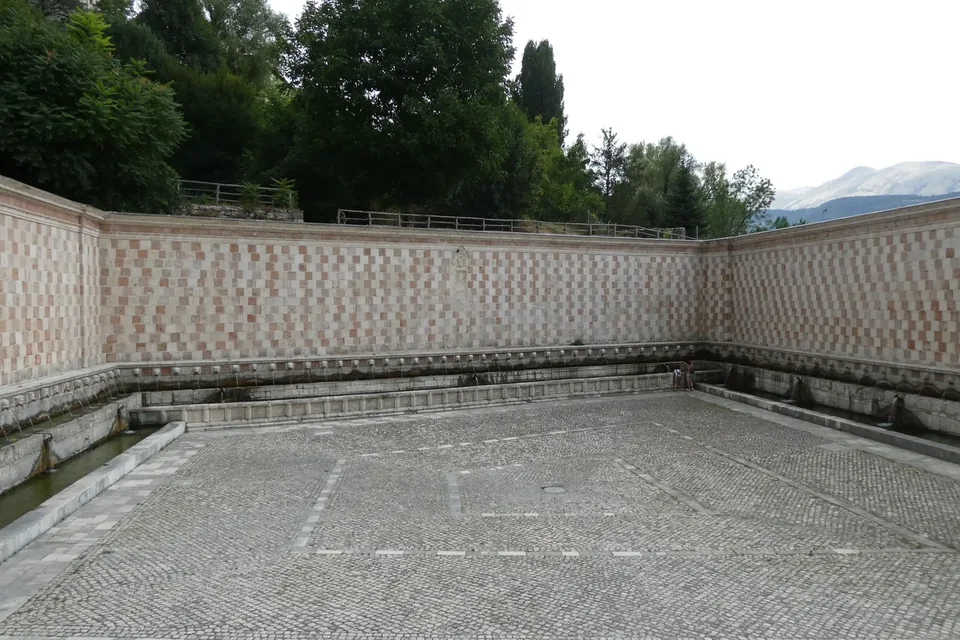
L’Aquila
A capital between the Gran Sasso and the Monti della Laga, with the UNESCO-listed Celestinian Forgiveness and reconstruction still under way.
Read the guide →Photo: Syrio / Wikimedia Commons — CC BY-SA 4.0 · Resized and converted to WebP.
