
APULICA / FRUIT, VEGETABLES AND PULSES
Prickly pear
PAT · Fruit, vegetables and pulses · Puglia
In brief
- It is the fruit of Opuntia ficus-indica, a cactus from Central America now naturalised all around the Mediterranean. (Atlante dei PAT di Puglia — Fico d'India)
- Nineteenth- and early twentieth-century texts describe it grown in Capitanata, around Manfredonia, and in the Lecce area. (Atlante dei PAT di Puglia — Fico d'India)
- Its stated area of origin is the whole region; the entry joined the national list in 2024. (Atlante dei PAT di Puglia — Fico d'India · Masaf — Elenco nazionale dei prodotti agroalimentari tradizionali, XXVI revisione (2026))
History and origin
The prickly pear is the fruit of Opuntia ficus-indica, a succulent of the cactus family that came from Central America and is now naturalised throughout the Mediterranean, especially in Sicily, Calabria, Puglia and Sardinia. In Salento its dialect name is ficarigna.
Its presence in Puglia has long been documented. In 1846 a book on the Capitanata and its industries lists it among the fruit trees of the plain, with small but fragrant and very tasty fruit. In 1898 a San Severo periodical describes the plantations around Manfredonia, lovely to see and laden with fruit that keeps fresh for months in the open air and is also preserved. In 1928 the book Oro di Puglia names the prickly pear as one of Manfredonia's main sources of wealth and describes large-scale cultivation in the province of Lecce as well, together with the making of jams and syrups.
The fruit also appears in regional imagery, from Salento's craft ceramics to the 2006 Atlas of typical Apulian products. Since 2024 it has been on the national list of traditional food products, with the whole region as its area of origin.
Sources: Atlante dei PAT di Puglia — Fico d'India · Masaf — Elenco nazionale dei prodotti agroalimentari tradizionali, XXVI revisione (2026)
Area and method of production
The plant withstands drought well and adapts to very different soils, provided they are light or coarse, free of standing water, 20 to 40 centimetres deep, and range from acid to slightly alkaline. Plantations lie between 150 and 750 metres above sea level. It needs temperatures above freezing and grows best above six degrees; long winters below zero do not kill wild plants but curb the productivity of cultivated ones.
It is propagated by cuttings: one- or two-year-old cladodes, the pads, are cut lengthwise in two, left to dry for a few days and planted, where they root easily. Pruning, in spring or at the end of summer, keeps the pads from touching and removes misshapen or damaged ones; phosphorus-potassium fertilising, preferably organic, is recommended to improve yields.
Production runs from August to October. The fruits are picked with a special tool that detaches them without touching them by hand, because of the spines. Besides cultivated fields, in Puglia fruit is also gathered from wild plants.
How to recognise it
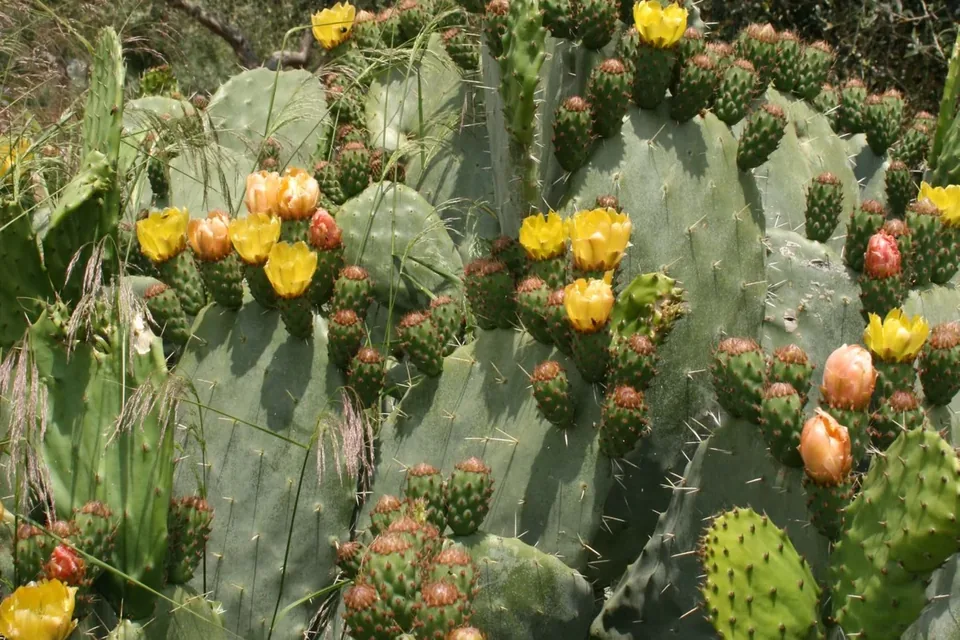
The prickly pear is a fleshy berry with a single cavity and many seeds, formed from the ovary fused with the flower's receptacle. A fruit's weight varies widely, between 150 and 400 grams. The skin is covered with tufts of fine spines, which is the feature that distinguishes it at first sight and shapes the way it is harvested and prepared.
The plant itself is unmistakable: a shrub of fleshy pads, the cladodes, on which flowers and fruit form, able to live for more than half a century and to grow in dry, stony places. Nineteenth-century sources mention another quality: in the open air the fruit keeps fresh for a long time.
Nutritionally it is a light fruit, providing about 41 kilocalories per hundred grams of edible part. Old sources describe the fruit of the Capitanata as small but very fragrant and tasty.
In the kitchen
Before it can be enjoyed, the prickly pear must be freed of its spines. The PAT atlas describes the method: the fruits are soaked for at least half an hour in room-temperature water, then, wearing gloves, brushed with a bottle brush or scrubbing brush to remove most of the fuzz, and rinsed under running water.
To peel it, the skin is cut lengthwise with a knife, both ends are sliced off and, holding the fruit still, the peel is removed by rolling the fruit over on itself, always taking care with any remaining spines. The flesh is then eaten fresh, just as it is.
Apulian tradition also knows preserved forms: already in the nineteenth century the fruit was used in preserves, and the 1928 book Oro di Puglia mentions the making of jams and syrups. Prickly pear jam and liqueur are still traditional preparations, listed among Puglia's traditional products since 2001.
Where to taste it
Prickly pears can be found all over Puglia between August and October: at festivals and fairs, through direct sale on farms or by gathering fruit from wild plants. The PAT atlas mentions in particular the prickly pear festival in Barletta and the one in Marina di Ginosa, on the Ionian coast of Taranto, as well as promotional initiatives on farms in the Brindisi area.
For the fruit's history, the emblematic place is Manfredonia, which in the early twentieth century counted the prickly pear among its main sources of wealth. The town, gateway to the Gargano on the gulf that bears its name, offers the Swabian-Angevin-Aragonese castle with its museum of Daunian stelae, the cathedral and, just outside, the Romanesque churches of San Leonardo and Santa Maria di Siponto.
Salento too has an old bond with this plant, once grown on a large scale in the province of Lecce and now reproduced in the ceramics of local craftsmen. Late summer and early autumn are the right time to taste the fresh fruit while travelling through the region.
Sources: Atlante dei PAT di Puglia — Fico d'India · Italia.it (Ministero del Turismo) — Gargano
Protection
- Traditional agri-food product (PAT) — Puglia, n. 123, 26th revision (Masaf — Elenco nazionale dei prodotti agroalimentari tradizionali, XXVI revisione (2026) · Atlante dei PAT di Puglia — Fico d'India)
When
- Production: August–October (Atlante dei PAT di Puglia — Fico d'India)
- Summer
- Autumn
Where
Read more
Prickly pear
From fresh fruit to preserves, an ingredient linking countryside and table.
Read the guide →Photo: Franz Xaver / Wikimedia Commons — CC BY-SA 3.0 · Resized and converted to WebP.
