
APULICA / FRUIT, VEGETABLES AND PULSES
Lampascioni (tassel hyacinth bulbs)
PAT · Fruit, vegetables and pulses · Puglia, Basilicata
In brief
- They are the bulbs of Muscari comosum, a wild perennial herb. (Atlante dei PAT di Puglia — Lampascione (Lambascione) o Cipollaccio)
- The fresh bulbs are dug by hand with a small hoe from December to April. (Atlante dei PAT di Puglia — Lampascione (Lambascione) o Cipollaccio)
- Much of what is sold is imported, mostly from Morocco, and stored underground. (Atlante dei PAT di Puglia — Lampascione (Lambascione) o Cipollaccio)
- They appear on the national list for both Puglia and Basilicata. (Masaf — Elenco nazionale dei prodotti agroalimentari tradizionali, XXVI revisione (2026))
History and origin
The lampascione, or lambascione, is the bulb of Muscari comosum, a perennial herbaceous plant that grows wild in uncultivated land and on the hills of Puglia. Its use as food and remedy is very old: the peoples of the ancient Mediterranean already knew it, and the Byzantine physician Oribasius of Pergamon, in the fourth century, called it very nourishing while warning of its effects on digestion. The name probably comes from medieval Latin lampadio, lampadionis; in Apulian dialects it has dozens of variants, from bambasciùle to pampasciune.
Local evidence is plentiful. In 1756 the seminary of Otranto served it several times in March, and in 1857 a Barletta botanist described three ways of eating it: boiled with oil and vinegar, fried, and roasted under the ashes. In the early twentieth century it was exported to America, and in 1924 about 1,200 tonnes were traded in the Capitanata, starting from Ascoli Satriano.
The lampascione also lives on in proverbs: to get one you have to dig deep, and so work hard. It has been on the national list of traditional products for Puglia since 2019, and the Masaf list also includes it among the traditional products of Basilicata.
Sources: Atlante dei PAT di Puglia — Lampascione (Lambascione) o Cipollaccio · Atlante PAT Puglia (Università di Bari, Regione Puglia) — Nella terra dei lampascioni: storia, tradizione e ricette · Masaf — Elenco nazionale dei prodotti agroalimentari tradizionali, XXVI revisione (2026)
Area and method of production
The lampascione is not grown like an ordinary vegetable: it is a wild plant, common throughout Puglia, especially in hilly areas and on uncultivated land. The food historian Luigi Sada described it as particularly widespread in the red limestone soils of the Daunian Subapennines. Attempts to cultivate it in Puglia were made in the mid-twentieth century, but without the hoped-for success.
Fresh bulbs are gathered from December to April, by hand. It is hard work, because the bulb lies twenty to thirty centimetres deep: in the past a longer-than-usual hoe was used, and in Salento a squat pointed pick, the zappuddru, is still used today. Those who, owning no land, lived by gathering greens, mushrooms and lampascioni were called pampasciunaru.
For several years it has been common practice to import the bulbs, and a very large share of the product on sale comes from abroad, mainly from Morocco, and stored underground; this is why it can be found all year. Anyone looking for fresh local bulbs should therefore aim for the winter and spring months.
Sources: Atlante dei PAT di Puglia — Lampascione (Lambascione) o Cipollaccio · Atlante PAT Puglia (Università di Bari, Regione Puglia) — Lambascioni sott'olio · Atlante PAT Puglia (Università di Bari, Regione Puglia) — Nella terra dei lampascioni: storia, tradizione e ricette
How to recognise it
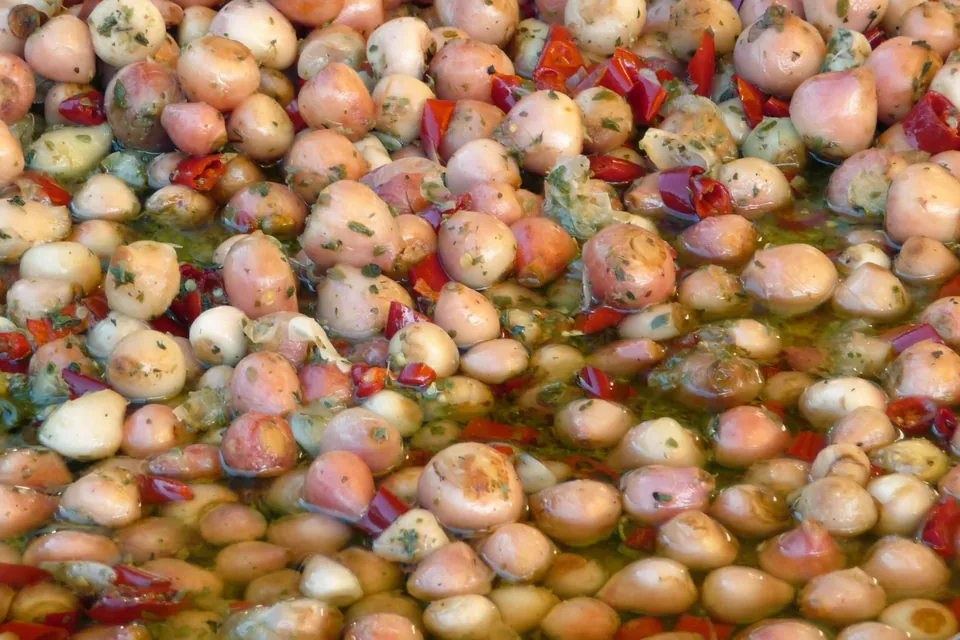
The lampascione is a small bulb with an average marketable weight of about 16 grams, ranging from 5 to 45, and a diameter of two to five centimetres. Its shape recalls a small spinning top. The outer skins range from pale apricot to salmon pink and old rose, while Sada described the bulb as reddish-violet; the edible part is around 85 per cent and increases with size.
Its flavour is its defining trait: strong and somewhat bitter, due to an active compound credited since antiquity with medicinal virtues. For this reason the bulbs are kept in water for a long time, changing it several times, before cooking.
Sada warned buyers about a look-alike bulb, sometimes sold as genuine but belonging to another, cultivated species: it can be recognised by its off-white colour and rather sweetish taste. The true lampascione, he advised, should be eaten whole, leaving only the outer skin, and crushed with a fork before dressing so that the seasoning gets inside.
Sources: Atlante PAT Puglia (Università di Bari, Regione Puglia) — Lambascioni sott'olio · Atlante PAT Puglia (Università di Bari, Regione Puglia) — Nella terra dei lampascioni: storia, tradizione e ricette · Atlante PAT Puglia (Università di Bari, Regione Puglia) — Lambascioni in agro
In the kitchen
The lampascione has given rise to many dishes, four of which are themselves Apulian traditional products. Lampascioni in agro are the classic way: they are cleaned, soaked for a day or two with frequent changes of water to reduce the bitterness, boiled in salted water and dressed with oil, vinegar, salt and pepper, sometimes with mint, parsley, chilli or garlic. They are served cold, as a starter or side dish.
Fried lampascioni are cut deeply and dropped into hot oil, where they open like flowers; alternatively they are boiled, floured, dipped in egg and fried. Some finish them with vincotto. Lampascioni under the ashes are the oldest recipe: they are cooked covered with hot ashes, then stripped of their outer skins and dressed with oil, salt and vinegar, excellent with roast meats.
Finally, lampascioni in oil are cooked for a quarter of an hour in water and vinegar and packed into jars with garlic, parsley, mint or chilli, covered with extra virgin olive oil. Sada also recalled a delicious pairing: with broad bean purée.
Sources: Atlante PAT Puglia (Università di Bari, Regione Puglia) — Lambascioni in agro · Atlante PAT Puglia (Università di Bari, Regione Puglia) — Lambascioni fritti · Atlante PAT Puglia (Università di Bari, Regione Puglia) — Lambascioni sotto la cenere · Atlante PAT Puglia (Università di Bari, Regione Puglia) — Lambascioni sott'olio · Atlante PAT Puglia (Università di Bari, Regione Puglia) — Nella terra dei lampascioni: storia, tradizione e ricette
Where to taste it
The lampascione belongs to the cooking of all Puglia and appears in dishes at trattorias, restaurants and agriturismi; fresh local bulbs are in season from December to April. Some popular festivals are especially linked to it.
In Acaya, a hamlet of Vernole near Lecce, the sagra del pampasciulu is held on the first Friday of March, and the statue of Our Lady of Sorrows in the mother church becomes for the occasion the Madonna dei pampasciuni: tradition calls for the bulbs to be offered prepared in a hundred different ways. Acaya is also one of the few fortified villages left in Puglia, with its restored sixteenth-century castle, and lies close to the coast of Roca Vecchia and Torre dell'Orso.
In Bitritto, on the outskirts of Bari, the feast of the Madonna di Costantinopoli, on the first Tuesday of March, is also known as the feast of the Madonna dei lampascioni: large quantities are sold during the celebrations, and they used to be eaten at home, crushed with oil, salt and pepper, before mass. San Donato di Lecce also holds a pampasciuni festival, and in Salento lampascioni appear on the St Joseph's tables of 19 March.
Sources: Atlante dei PAT di Puglia — Lampascione (Lambascione) o Cipollaccio · Atlante PAT Puglia (Università di Bari, Regione Puglia) — Nella terra dei lampascioni: storia, tradizione e ricette · BiodiverSO (Università di Bari, PSR Puglia) — La Madonna dei lampascioni di Bitritto · Italia.it (Ministero del Turismo) — Gite di un giorno da Lecce: Acaya e Roca Vecchia
Protection
- Traditional agri-food product (PAT) — Puglia, n. 134, 26th revision (Masaf — Elenco nazionale dei prodotti agroalimentari tradizionali, XXVI revisione (2026) · Atlante dei PAT di Puglia — Lampascione (Lambascione) o Cipollaccio)
- Traditional agri-food product (PAT) — Basilicata, n. 94, 26th revision (Masaf — Elenco nazionale dei prodotti agroalimentari tradizionali, XXVI revisione (2026))
When
- Harvest: January–April, December (Atlante dei PAT di Puglia — Lampascione (Lambascione) o Cipollaccio)
- Winter
- Spring
Where
Read more
Lampascioni and turnip greens
Lampascioni, turnip greens and broad beans: simple ingredients worth tasting thoughtfully.
Read the guide →Photo: Lucarelli / Wikimedia Commons — CC BY-SA 3.0 · Resized and converted to WebP.
