
APULICA / FRUIT, VEGETABLES AND PULSES
Limone Costa d'Amalfi (Amalfi Coast lemon)
PGI · Fruit, vegetables and pulses · Campania
In brief
- It is the fresh lemon of the Sfusato Amalfitano variety, elliptical and tapering. (Qualigeo — Limone Costa d'Amalfi IGP)
- It is grown in Atrani and in parts of the coast's other municipalities, from Positano to Vietri sul Mare. (Qualigeo — Limone Costa d'Amalfi IGP)
- The groves sit on terraces held by dry walls, the macere, under chestnut-wood frames. (Qualigeo — Limone Costa d'Amalfi IGP)
- It is hand-picked, usually from February to October. (Qualigeo — Limone Costa d'Amalfi IGP)
History and origin
Records show lemon groves on the Amalfi Coast since ancient times. According to the Campania Region it was the Arabs who brought the lemon to Spain and Sicily, and from there to Campania; its real spread around Amalfi, however, was driven by the sea. The people of Amalfi were seafarers, and the lemon, rich in vitamin C, was the remedy against scurvy: as early as the eleventh century the Republic of Amalfi ruled that ships should always carry a supply of the fruit.
From the fifteenth to the nineteenth century demand also came from other European countries. In the seventeenth century the historian Matteo Camera described lemons shipped from Minori to other markets, together with bitter oranges, and a text from the same century mentions a «limon amalphitanus» very similar to today's sfusato. In the twentieth century shipments reached the Americas.
So, century after century, the «lemon gardens», as the groves are called here, multiplied through immense labour that reclaimed steep slopes. The PGI was recognised in 2001 and the protection consortium was founded in 2002.
Sources: Regione Campania — Limone Costa d'Amalfi IGP · Qualigeo — Limone Costa d'Amalfi IGP · Consorzio di Tutela Limone Costa d'Amalfi IGP
Area and method of production
The production area covers the whole municipality of Atrani and parts of Amalfi, Cetara, Conca dei Marini, Furore, Maiori, Minori, Positano, Praiano, Ravello, Scala, Tramonti and Vietri sul Mare, in the province of Salerno. The lemons grow on terraces carved into the steepest slopes and held up by dry-stone walls called «macere», which need constant upkeep to let water drain properly.
The trees are trained under frames of chestnut poles at least 180 centimetres high, which can be covered to shelter the fruit from bad weather and delay ripening: once with straw mats called «pagliarelle», today often with shade netting. In the first two years the trees are not pruned; the branches are tied to the crossbars instead.
Picking is by hand only and the fruit must never touch the ground. The lemon flowers and fruits several times a year: it is usually harvested from February to October, and the Region names the March to late July crop as the finest. On the most inaccessible terraces carrying the fruit down remains difficult, a problem farmers have always faced.
Sources: Qualigeo — Limone Costa d'Amalfi IGP · Regione Campania — Limone Costa d'Amalfi IGP
How to recognise it
The Sfusato Amalfitano owes its name to two traits: the tapering shape of the fruit, hence «sfusato», and the coast where it developed over time. It is an elliptical, elongated lemon, medium to large, at least 100 grams per fruit.
The skin is of medium thickness and pale yellow, separated from the flesh by a white, spongy layer; rich in essential oils, it gives off an intense, aromatic scent, a quality prized for lemon liqueur. The straw-yellow flesh is juicy, with very few seeds or none, and has a marked acidity yet, according to the regional sheet, an almost sweet taste.
Studies by the University of Naples Federico II cited by the Region place it among the varieties richest in vitamin C.
Sources: Qualigeo — Limone Costa d'Amalfi IGP · Regione Campania — Limone Costa d'Amalfi IGP
In the kitchen
On the coast the lemon is everywhere at the table. The most traditional way to enjoy it is plain, sliced or as a salad, with a pinch of salt or sugar, a few mint leaves and a dash of vinegar. Its juice, flesh and grated zest flavour seafood starters, pasta dishes, fish and meat.
Peel steeped in alcohol gives limoncello, which here, as in Sorrento and on Capri, has found its home; there is also a protected Liquore di Limone della Costa d'Amalfi. The lemon is also the base for preserves, marmalades, biscuits and drinks.
Its role in pastry is large: its aroma goes into lemon «delizie», limoncello babà, cakes, profiteroles and chocolates.
Sources: Qualigeo — Limone Costa d'Amalfi IGP · Regione Campania — Limone Costa d'Amalfi IGP
Where to taste it
The lemon gardens accompany anyone travelling along the Amalfi Coast through all its villages: from Positano to Vietri sul Mare, by way of Praiano, Furore, Conca dei Marini, Amalfi, Atrani, Minori, Maiori and Cetara, up to Ravello, Scala and Tramonti in the hills. The yellow and green terraces above the sea are part of the charm of this landscape, which the Region also describes as a safeguard against slope erosion.
The protection consortium, based in Maiori, promotes the «Lemon Tour», a thirteen-stop route through the coast's municipalities, with visits to gardens and historic lemon groves and tastings prepared by pastry chefs and cooks.
Fresh lemons are available from February to October; limoncello and lemon desserts can be found all year.
Sources: Consorzio di Tutela Limone Costa d'Amalfi IGP · Regione Campania — Limone Costa d'Amalfi IGP · Qualigeo — Limone Costa d'Amalfi IGP
Protection
- Protected geographical indication (PGI) — PGI-IT-0116 (eAmbrosia — Limone Costa d'Amalfi (PGI-IT-0116))
When
- Harvest: February–October (Qualigeo — Limone Costa d'Amalfi IGP)
Where
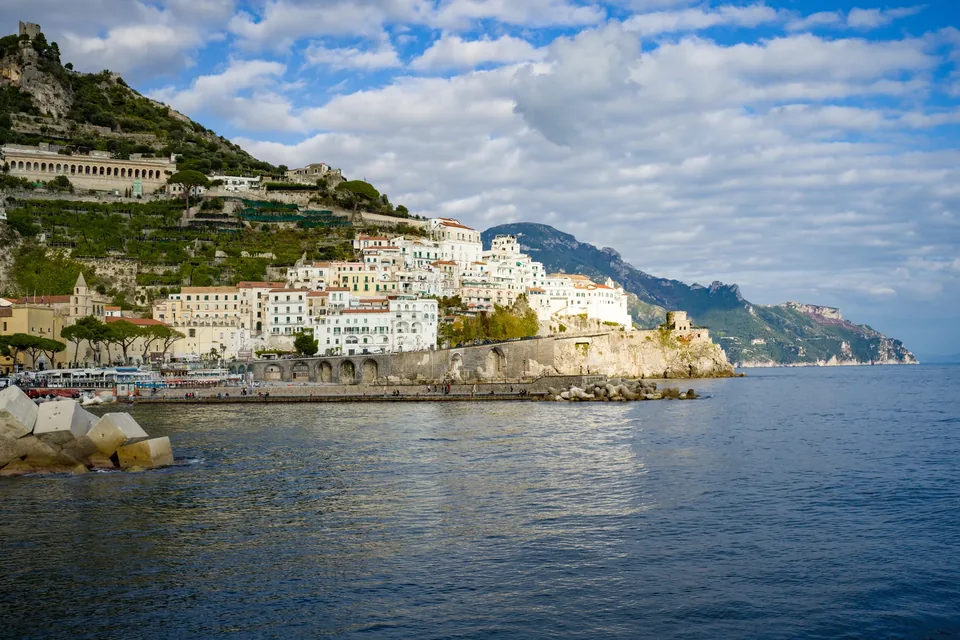
Amalfi Coast
The UNESCO cultural landscape between Positano and Vietri sul Mare: citrus terraces, footpaths, inland valleys and the history of a maritime republic.
Read the guide →Photo: Wolfgang Moroder / Wikimedia Commons — CC BY-SA 3.0 · Resized and converted to WebP.

Read more
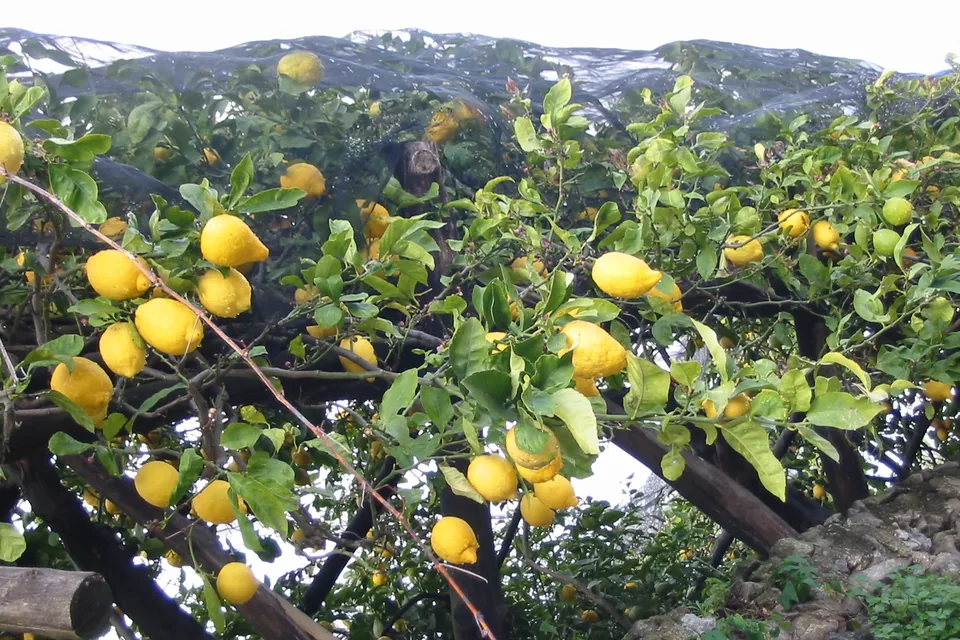
Limone Costa d'Amalfi PGI
The Amalfi Coast PGI lemon: shape and scent, seafaring history, terraces and straw covers, twelve towns, the Lemon Path and its uses in the kitchen.
Read the guide →Photo: donarreiskoffer / Wikimedia Commons — CC BY-SA 3.0 · Resized and converted to WebP.

Southern citrus rosolios: limoncello, arancello, mandarinello
Limoncello is a generic name, but the lemon liqueurs of Amalfi and Sorrento are geographical indications. PGI citrus, traditional products and family customs across the Amalfi Coast, the Sorrento peninsula and the Gargano.
Read the guide →