What it is, according to the Region
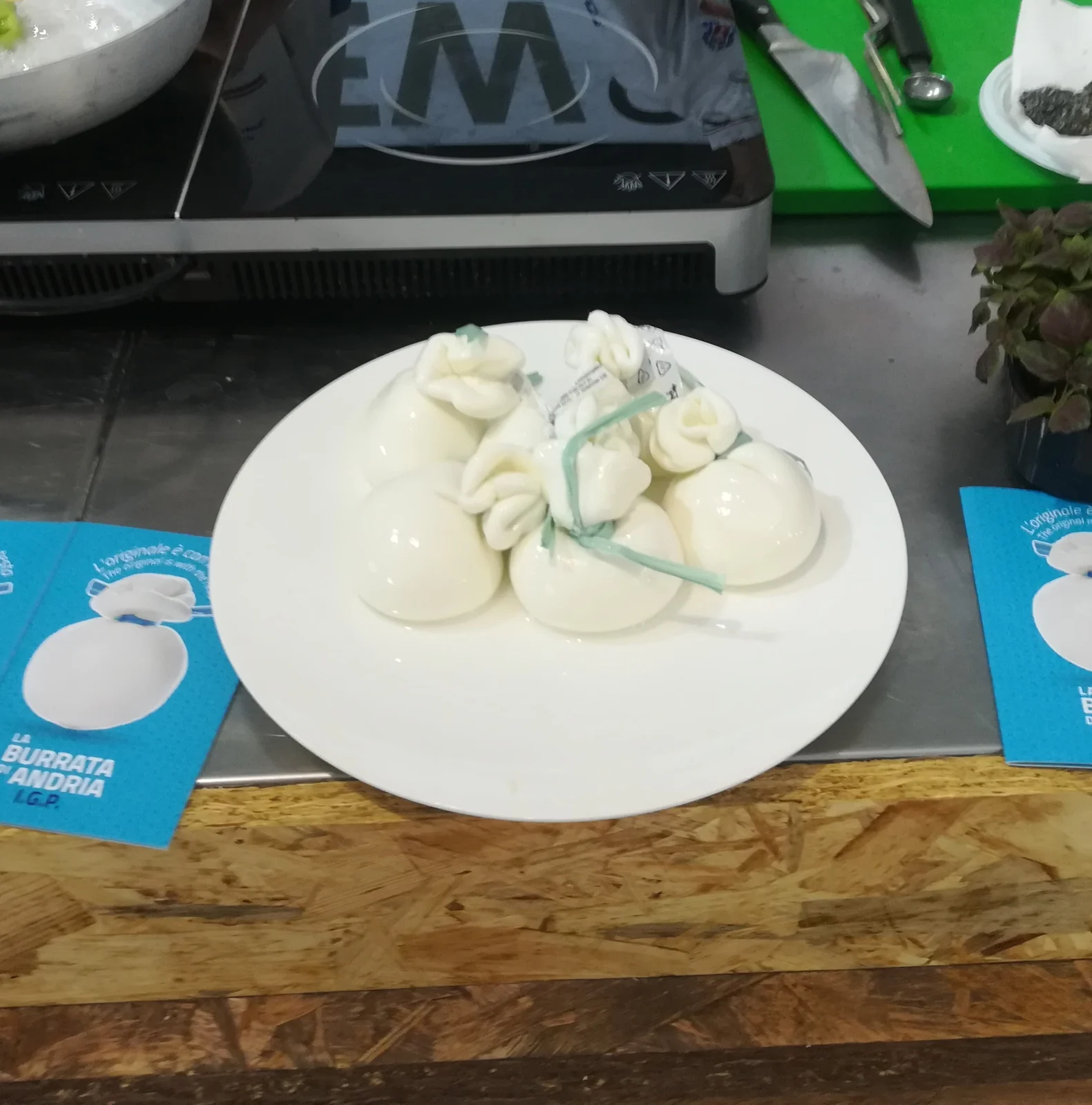
The Puglia Region's profile presents Burrata di Andria PGI as a stretched-curd cheese that stands apart for its making technique and its qualities on the palate. It is recognised by its shape: a pouch of stretched curd moulded by hand, roundish, white and glossy, closed at the top by a characteristic little knot.
Inside the pouch is the stracciatella, a mix of cream and shreds of the same stretched curd. The name comes from how the filling is prepared: the curd is torn by hand into irregular pieces, called lucini. The cream, obtained by centrifuging milk or fresh whey, may be fresh pasteurised, UHT or a blend of the two.
Only cow's milk is allowed. The Region specifies that processing, transformation and packaging may take place anywhere in Puglia, while the name remains tied to Andria, the town where burrata was born. It must be eaten fresh, because it keeps only for a short time.
Sources: Regione Puglia — Produzioni di qualità, Burrata di Andria IGP
The story Andria tells
The Burrata di Andria Consortium places the invention in the early decades of the twentieth century. During a heavy snowfall it was impossible to bring the farms' milk into town and, so as not to waste it, the Andria cheesemaker Lorenzo Bianchino came up with a pouch of stretched curd to fill with shreds of the same curd soaked in the cream that had risen from the milk. He closed it and shaped the top: so the first burrata was born.
The Region and the Qualigeo profile add a detail: Bianchino drew on the manteche, pouches of aged stretched curd in which butter was kept, and made a fresh version of them. The story is handed down orally and the Consortium gives no precise year.
The Puglia traditional food products sheet instead gives 1956 and the name Lorenzo Bianchino Chieppa, yet cites the 1931 Touring Club guide as one of the first mentions: the two dates do not fit together, so we report them as different versions of the same tradition. Qualigeo recalls its immediate success, with the Shah of Persia among its admirers.
Sources: Consorzio Burrata di Andria IGP — Storia · Regione Puglia — Produzioni di qualità, Burrata di Andria IGP · Atlante PAT Puglia — Burrata · Qualigeo — Burrata di Andria IGP
How it is made, step by step
The Puglia traditional food products sheet describes a precise process. Filtered cow's milk is acidified with whey from the previous day's work, heated to 35-36 degrees and curdled with liquid calf rennet so that it sets in about twenty minutes. The curd is broken with a curd knife to the size of a chickpea or a hazelnut.
Taken out by hand, the curd ripens for a few hours on steel tables, sometimes until the next day, and is tested until it stretches and forms a cord. It is then cut into strips and stretched at 85-90 degrees, with plunging-arm machines or by hand. The cheesemaker shapes a hollow sphere, fills it with a knob of cream and torn curd and closes it, giving it its knotted shape.
Freshly formed burrata firms up for 20-30 minutes in running water. The Consortium adds that the curd may be salted and that the top is sealed with boiling water or tied at the neck, after which the cheese cools in water for a time that depends on its size.
Sources: Atlante PAT Puglia — Burrata · Consorzio Burrata di Andria IGP — Storia
What the specification requires
The Qualigeo profile summarises the PGI rules. Cow's milk may be raw or pasteurised and is heated to 35-37 degrees; curdling, with natural calf rennet, is preceded by fermentation using citric or lactic acid, milk starter or whey starter. The curd, broken into lumps the size of a hazelnut, rests until ripening is complete and is then stretched with boiling water.
What sets burrata apart is the filling. Part of the stretched curd is torn by hand into shredded strips, cooled in water until they form a spongy mass to be mixed with cream. The specification states that hand shredding must not turn into mincing: the pieces must stay irregular, and this is what gives stracciatella its texture.
The remaining curd forms the pouches, which are filled, carefully closed and firmed in cold water; brine salting may follow. Permitted packs range from 100 grams to one kilo: bags tied at the top, green leaves of approved material, tubs, jars or cups, also with preserving liquid.
Sources: Qualigeo — Burrata di Andria IGP
Protection and the Consortium
According to the Puglia traditional food products sheet, in 2016 Burrata di Andria obtained Protected Geographical Indication status from the European Union, with production allowed throughout the region. The Consortium recalls that a PGI is granted to products whose quality, reputation or other characteristic depends on their geographical origin.
After recognition, the Consortium for the protection and promotion of Burrata di Andria PGI was set up in Andria to protect, enhance and promote the product. The Consortium states that every production stage is monitored and documented to guarantee traceability and compliance with the specification. The member dairies listed on its website are based mostly in Andria, and also in Barletta, Corato, Putignano, Noci and Gioia del Colle.
The same PAT sheet recalls milestones in its fame: a 1977 Corriere della Sera report described it as a dairy excellence of Puglia, and a 1999 article in Repubblica named it among the food heritage worth protecting. Today, Qualigeo notes, it appears on restaurant menus around the world with its Andria origin highlighted.
Sources: Atlante PAT Puglia — Burrata · Consorzio Burrata di Andria IGP — La Burrata di Andria IGP · Qualigeo — Burrata di Andria IGP
Shape, taste and storage
According to the Qualigeo profile, burrata is a small round pouch, white and glossy, with a top closure that may be very small. It weighs between 100 grams and one kilo and the casing is at least 2 millimetres thick. Cutting it reveals the spongy filling of cream and torn curd, tasting of fresh or cooked milk, butter and cream.
The PAT sheet completes the picture: a smooth, shiny surface with no rind, milk-white in colour; a fibrous structure of overlapping layers which, lightly pressed, releases a milky liquid. The flavour is that of a fresh dairy product, slightly tangy, and the aroma recalls cream, delicate and fragrant.
Burrata must be eaten fresh and kept at 4-6 degrees. Qualigeo observes that its short life is a sign of a still close bond between the traditional way of making it and the territory. It is made and sold all year round, so there is no best season to taste it: what matters is rather the day it was made.
Sources: Qualigeo — Burrata di Andria IGP · Atlante PAT Puglia — Burrata
Andria beyond burrata
Andria lies halfway between the Adriatic coast and the Murgia, right where the plateau begins to rise, among almond trees, olive groves and cultivated fields. Italia.it notes that people here have always lived mainly from farming, already in the Middle Ages, when Frederick II of Swabia had a special bond with the town.
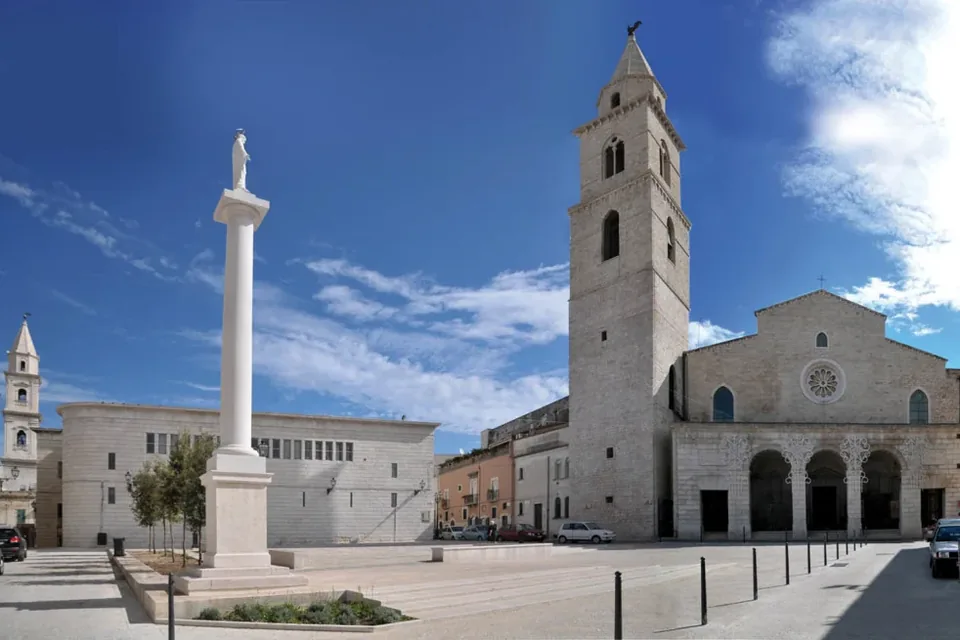
It was the emperor who called it faithful, as a Latin inscription on the Sant'Andrea gate recalls. In the crypt of the Cathedral of the Assumption, founded in the 12th century, lie Yolande of Brienne and Isabella of England, two of his wives; the church of Sant'Agostino, founded by the Templars, also dates from that period. Around the town there are older shrines and hermitages, used by Basilian monks in Byzantine times.
Andria's food tradition goes beyond burrata: the guide mentions mozzarella and butter, the wine and oil of the Castel del Monte designation and sugared almonds, to which the town dedicates the Giovanni Mucci Confetti Museum, housed in an Art Nouveau building.
Sources: Italia.it — Andria
Castel del Monte and the Murgia of farmsteads
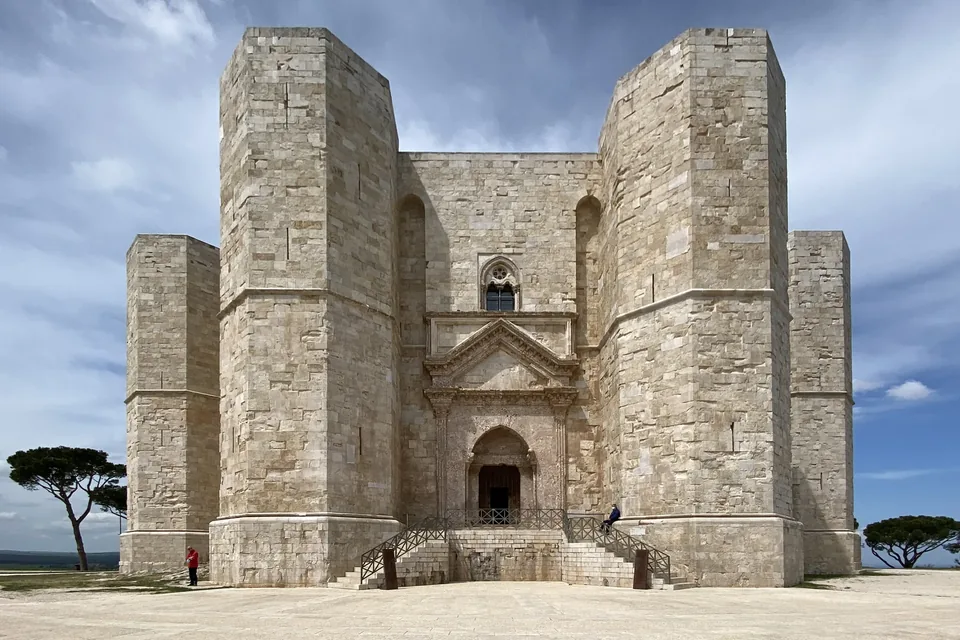
Less than 20 kilometres from Andria, inside the Alta Murgia National Park, Castel del Monte stands on a hill at 540 metres. Italia.it explains that Frederick II had it built from 1240 with extreme geometric rigour: an octagonal plan, eight octagonal towers at the corners, eight rooms on each floor, spiral staircases turning anticlockwise. UNESCO inscribed it as World Heritage in 1996.
The castle has no moat or curtain wall, which is why scholars tend to rule out a defensive role: it may have been a secluded place for study and representation. On the upper floor, only one window has three lights, the one facing Andria.
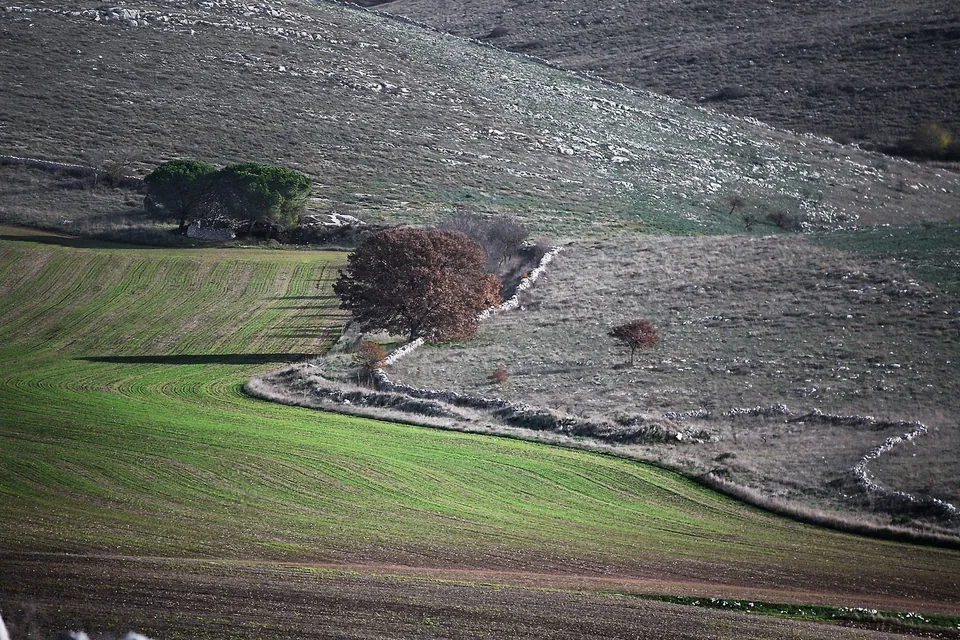
The Alta Murgia Park describes a rural landscape of poste and jazzi for flocks, of farmsteads that arose from the 15th century under the Royal Customs of sheep grazing, and of ancient transhumance droving tracks that can still be walked. Some farmsteads still raise animals and produce food, others welcome visitors: this is the world of milk and pasture from which the area's dairy tradition comes.
Sources: Italia.it — Castel del Monte · Parco nazionale dell'Alta Murgia — L'ambiente rurale
How to taste it
Burrata is at its best on the day it is made, just cool: take it out of the fridge a few minutes beforehand, because the cold dulls the scent of cream and milk. I would taste it first on its own, with a piece of bread, to feel the difference between the elastic casing and the soft filling.
Then it can be paired with tomato, grilled vegetables or a drizzle of extra virgin olive oil, without smothering it: it is a delicate cheese and little is needed to overpower it. Small sizes suit a starter for one or two people; large ones are opened at the table and shared, and it is a pleasure to watch the stracciatella spread across the plate.
In Andria and nearby towns, look for it in local dairies and trattorias and ask when it was made: freshness matters more than any topping. If at the dairy the burrata has just come out of the water, it is worth eating it straight away, perhaps on a bench, before heading off towards the Murgia.
Festivals and the journey home
We have not found on official sources a burrata festival with fixed dates to report, so we list none: any festivities should be checked year by year on the Consortium's and the municipality's channels. The product is available all year, so the trip can be built around other things: Castel del Monte, the Murgia, Frederick II's towns and the Adriatic coast.
In spring and autumn the Murgia is green or golden and the days are suited to walking among farmsteads and droving tracks; in summer it is best to visit the castle in the cooler hours and keep the burrata lunch at the centre of the day.
Taking it home is possible only on short journeys: a cool bag, ice and eating it soon, because burrata tolerates neither heat nor waiting. For a long flight it is better to give up and choose products that travel well, such as the local oil or Andria's sugared almonds, leaving burrata to the memory of the Puglian table.
A thread for your journey
Journey idea: a morning in Andria between the Sant'Andrea gate and the cathedral, a simple lunch with that day's burrata, an afternoon at Castel del Monte and on the Murgia. Dairy visits arranged with local operators.
Talk to us