APULICA / Food guides
Puglia's festival calendar, month by month
In Puglia the festival calendar follows both the farming year and the religious year: January bonfires, a long carnival, patron saints between May and September, then autumn and winter food fairs. This guide includes only events described by municipalities, foundations, the Region, basilicas or the National Park, with the dates those sources publish. Dates change every year, so always check the official programme for the current edition before travelling.
January: St Anthony's bonfires, from Novoli to Gallipoli
The Salento festival year opens with fire. The Fòcara Novoli Foundation presents the Fòcara as a rite of ancient origin linked to the feast of St Anthony the Abbot, patron saint of Novoli, celebrated between 16 and 18 January every year. In his honour a bonfire 25 metres high and 20 metres across is built, called the fòcara, a sight that fascinates adults and children alike.
For the patron saint's feast, the Novoli municipality also promotes a series of civic events alongside the religious rite. It is one of the most recognisable moments of the Apulian winter.
St Anthony's fire is not only Novoli's. The municipality of Gallipoli explains that on 17 January bonfires called focareddhe light up the start of the Gallipoli carnival: olive branches and vine shoots are tied in bundles and stacked. The custom, the municipality says, goes back to an ancient belief that fire had the power to purify the community.
Sources: Fondazione Fòcara Novoli — La Fòcara · Comune di Gallipoli — Feste patronali
From Saint Stephen's Day to Shrove Tuesday: Putignano
The Putignano Carnival website traces the festival back to 1394, when the coast was exposed to Saracen raids and the relics of St Stephen the Protomartyr were moved inland from the abbey of Monopoli. On 26 December they reached the church of Santa Maria la Greca, where they still lie. According to oral tradition, farmers grafting vines by layering left their work to follow the procession, dancing and improvising satirical verses in dialect: so the Festa delle Propaggini was born.
Since then the carnival has begun every 26 December and ended on Shrove Tuesday, when the 365 strokes of the Macaroni Bell mark the start of Lent. 17 January, St Anthony the Abbot's day, opens the wildest events.
Then come the Thursdays: once given over to banquets and masked dances in the old town's ground-floor rooms, now to social satire, in a fixed order running from the Monsignors to the Cuckolds. Allegorical floats arrived in the twentieth century, and papier-mâché triumphed in the 1950s.
Sources: Carnevale di Putignano — La storia
May: Saint Nicholas in Bari, procession and sea
The 2026 programme published by the Basilica of San Nicola sets out the May festival, preceded by a solemn novena from late April to 7 May. On 7 May the Historical Procession sets off from piazza Federico II di Svevia and arrives in piazza San Nicola; on the same day the Saint's painting is taken out to sea.
8 May is the day of the sea procession: the Saint's statue is taken aboard a fishing boat, drawn by lot in the preceding days, after the blessing of the sea, and lands in the evening to return in procession to piazza del Ferrarese as the illuminations are switched on. On 9 May the 939th anniversary of the Translation of the relics from Myra, in 1087, is celebrated with the collection of the Holy Manna in the Basilica.
The calendar continues with the tribute of the children and families of the old town, with the Day of Seafarers and the statue's return to the Basilica on 17 May, and on 22 May with the feast of the Translation according to the Julian calendar, deeply felt by Orthodox pilgrims.
Sources: Basilica Pontificia di San Nicola — Sagra di San Nicola 2026, programma
July: Scorrano and the light of Santa Domenica
The municipality of Scorrano devotes a page to the patron saint festival of Santa Domenica, which it says traditionally takes place from 5 to 8 July, in the heart of the Salento summer. For 2026 we found no programme with dates on the municipal website: check the year's programme before travelling.
The devotion dates back at least to the 17th century. According to tradition the saint appeared in a dream to a local woman, promising deliverance from a severe plague; the miracle came true and every year since the townspeople have renewed their vow. The religious celebrations begin with the novena and culminate in the procession, with the statue accompanied by the faithful, confraternities, officials and bands, amid petals and fireworks.
Around the cult grew the art of the luminarie, born for this very festival as an expression of devotion through light. Today, the municipality writes, it makes Scorrano known around the world, so much so that the town is called the world capital of illuminations: the evening of the festival is the right time to see them lit.
Summer in Gallipoli: the Carmine, Santa Cristina and swordfish
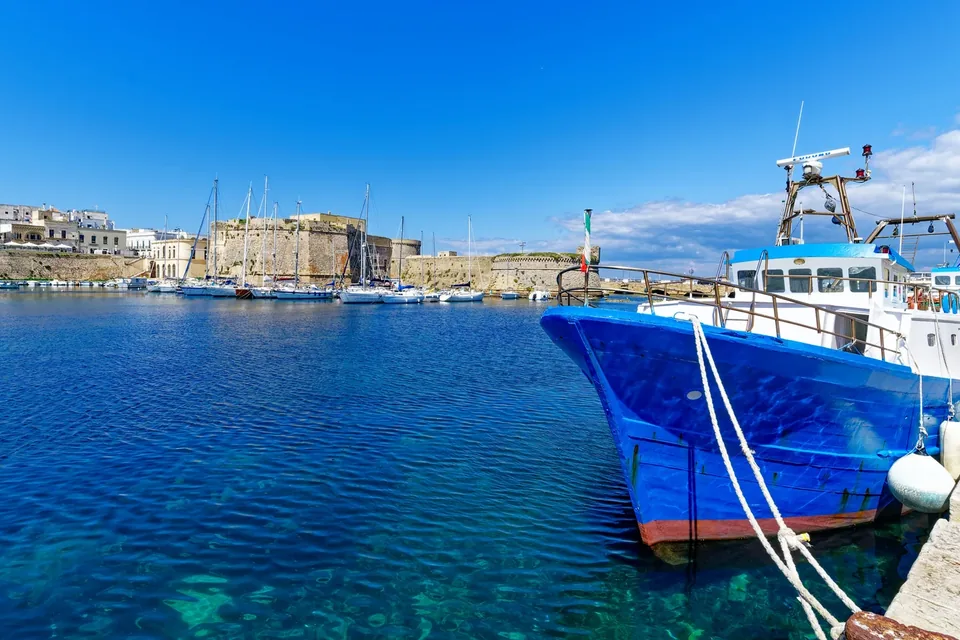
The municipality of Gallipoli describes a summer marked by religious and sea festivals. On 15 and 16 July the Madonna del Carmine is celebrated, with the small church of the same name at the heart of the festivities and moments of music and tastings.
From 23 to 25 July the town honours its patron saint, Santa Cristina, in the most important religious event of the year. The devotion dates from 1876, when the faithful believe the saint freed Gallipoli from cholera. The festival opens at dawn with fireworks and continues in the afternoon with a sea procession around the town walls: the icon, aboard a fishing boat, leaves the harbour followed by the fishermen's boats, whose protector she is. Then the statue is carried through the streets until evening, amid illuminations, stalls and food stands offering scapece, a traditional fish dish.
From 15 to 18 August the Swordfish Festival is a true feast of the sea: fried small fish, grilled cuttlefish, swordfish steaks, orecchiette with langoustines, fish soups and octopus cooked in a clay pot.
August: La Notte della Taranta
The Notte della Taranta Foundation, based in Melpignano, announced the 29th edition of the Concertone for Saturday 22 August 2026, presented as the largest concert devoted to traditional folk music in Europe. On stage, alongside the Folk Orchestra, are Italian and international artists; for 2026 the Foundation named Ermal Meta as maestro concertatore.
Before the Concertone comes the travelling festival: twenty stops from the Grecìa Salentina to the sea, from Lecce to Galatina, each presented as a popular festival in which pizzica, music and dance are renewed in the squares. Pizzica is the traditional Salento dance used in the rites of tarantism, an ancient musical ritual born to exorcise pain and crisis.
The Foundation describes itself as a permanent laboratory combining research, live performance and cultural policy to promote Salento's ethnographic heritage. Its timeline starts in 1998 and gives 1999 as the first full year; over the years the stage has hosted musicians of many genres and countries. Dates for the next edition should be checked on the official website.
Sources: Fondazione La Notte della Taranta — Concertone 2026 · Fondazione La Notte della Taranta — La storia
September: the Fiera del Levante and regional food
The Campionaria of the Fiera del Levante is held in September at the Bari exhibition grounds, run by Nuova Fiera del Levante, which since 2017 has held the concession to redevelop and manage the fair authority's areas. The 89th edition ran from Saturday 19 to Sunday 27 September 2026, under the title "Dialogue starts from the Levant – Businesses, peoples and cultures at the heart of the Mediterranean" and with nine days of meetings and debates. The Campionaria's press release also announced the presence of the statue of St Nicholas at the fairground, as in the previous edition.
For the food sector, on Wednesday 23 September the Puglia Region devoted pavilion 152 to the Filiera Agricoltura Puglia day, with a plenary session and five themed rooms on "From land to value: building the supply chains of the future": cooperation among producers, processing, research, markets and generational change.
The fair calendar also lists LUV, the table grape fair, from 20 to 22 October 2026. It is a trade event rather than a tourist one, but it helps to show how much table grapes matter in the region's farm economy.
Sources: Nuova Fiera del Levante — Quartiere fieristico e calendario · Nuova Fiera del Levante — Campionaria 2026, comunicato stampa · Regione Puglia — Fiera del Levante 2026, Filiera Agricoltura Puglia
September and December: zampina and eel
Two food festivals show the gastronomic soul of the calendar. The municipality of Sammichele di Bari published the full programme of the 60th Festival of the Zampina, the Bocconcino and Good Wine, held on 25, 26 and 27 September 2026: three days of music, fun and food and wine around the products that give the festival its name.
On the Gargano, the National Park describes the Lesina Eel Festival, founded in 2004 and usually held in the second week of December, which opens the promontory's Christmas season. It is linked to the Lesina eel, a Slow Food Presidium, and that very recognition is what gave rise to it.
The dishes tell the story of the lagoon: troccoli with eel sauce, wild hyacinth bulbs with potatoes and eel, split eel grilled over embers, fried eel and sand smelt. To give an idea of the turnout, the Park notes that the 2008 edition lasted three days, with thirteen stands and about three thousand dishes served, along with traditional music of the Gargano and Capitanata and talks on promoting local resources.
Sources: Comune di Sammichele di Bari — 60ª Sagra della Zampina · Parco Nazionale del Gargano — Sagra delle anguille di Lesina
Reading a patron saint festival through food
A patron saint festival is not a food fair: food goes with it, but the heart remains the procession, the band, the lights. That is why it is worth watching in two stages. By day, follow the rite and see how the town prepares, with confraternities, statues and boats heading out to sea; in the evening, walk among the stalls, where sweets, dried fruit and simple street dishes often appear.
Food fairs, on the other hand, grow around a specific product and put it at the centre: zampina, eel, swordfish. Choosing between the two means deciding whether you want to see a community celebrating or taste a speciality in its season.
Often the two meet, as in Gallipoli, where scapece appears among the stands of Santa Cristina. Either way, it is worth eating where local families eat, unhurriedly, and keeping a moment to look at the illuminations once they are lit: they are as much part of the meal as what is on the plate.
Planning without taking anything for granted
The dates in this guide come from official pages, but many refer to a specific edition. Before building a trip around a festival I would check the year's programme on the website of the municipality or organiser, and allow time for closed roads, distant parking and crowded old towns.
For evening festivals it is best to sleep nearby, not an hour's drive away, so you can stay until the end and walk back. Sea processions and big concerts draw large crowds: arriving early and choosing a quiet viewpoint makes the experience more enjoyable.
It is also worth combining a festival with a slow day nearby: a village, a farmstead, the sea out of season. In January the Salento bonfires pair well with a visit to Lecce; in May the St Nicholas festival with a walk through Bari's old town; in December the Lesina festival with a day on the lagoon and the Gargano. Visits should be arranged with local operators.
A thread for your journey
Journey idea: a weekend built around a single festival, with the rite by day and the stalls by night, plus a slow day nearby. Bari and Saint Nicholas in May, Gallipoli in July, Melpignano in August; visits and dinners arranged with local operators after checking the year's official programme.
Talk to us