APULICA / Food guides
Altamura bread: durum semolina, sourdough and stone ovens
Altamura bread is a durum wheat semolina loaf with a thick crust and a yellow crumb, made to last. It is the best-known product of the Alta Murgia, the plateau of masserie, pastures and wheat fields between Bari and Matera, and has held a Protected Designation of Origin since 2003. This guide brings together the specification, the Slow Food Presidium for traditional bread, the history of public ovens and the surrounding landscape.
What the specification says
According to the Qualigeo page, Pane di Altamura PDO is made within the Alta Murgia National Park, in five municipalities: Altamura, Gravina in Puglia and Poggiorsini in the province of Bari, Spinazzola and Minervino Murge in that of Barletta-Andria-Trani. There are only four ingredients: re-milled durum wheat semolina, mother yeast or sourdough, sea salt and water.
The consortium specifies that at least 80% of the semolina must come from the Appulo, Arcangelo, Duilio and Simeto varieties, alone or together, grown in the same five municipalities; the rest may come from other varieties, as long as they are from the same area. This link between field, mill and oven is what defines the designation.
Two shapes are allowed: the overlapped accavallata, locally called skuanète, with 'kisses' on the sides, and the low priest's-hat shape without them. Each loaf weighs at least 500 grams, the crust is about 3 millimetres thick and the soft, straw-yellow crumb has an even honeycomb.
Sources: Qualigeo — Pane di Altamura DOP · Consorzio Pane di Altamura DOP — Fasi della lavorazione · Consorzio Pane di Altamura DOP — Il bollino DOP
From mother yeast to oven: the stages
The consortium describes the process step by step. The mother yeast is refreshed at least three times with water and semolina until it makes up 20% of the semolina to be kneaded; for every hundred kilos of semolina there are also two kilos of sea salt and about sixty litres of water at 18 degrees. Kneading lasts twenty minutes.
The dough then rests under a thick cotton cloth, so that it rises at an even temperature, for at least ninety minutes. Weighing and two rounds of hand shaping follow, with rests of thirty and fifteen minutes; before going into the oven the loaf is turned over and guided in with light pressure of the hand.
The oven must reach 250 degrees; if heated directly, it must burn oak wood. The first fifteen minutes of baking are with the door open, the next forty-five with it closed; at the end it is opened again for at least five minutes so the steam escapes and the crust turns crisp. The loaves are laid out on wooden boards.
Sources: Consorzio Pane di Altamura DOP — Fasi della lavorazione · Qualigeo — Pane di Altamura DOP
Stone ovens and oak wood
Alongside the PDO there is the Slow Food Presidium for the traditional bread of Alta Murgia, which protects the oldest way of making it. The Presidium starts from the raw materials: re-milled durum wheat semolina from the Alta Murgia around Bari, natural sourdough yeast, lukewarm water and sea salt. The dough rises for three or four hours under a cotton cloth, then is shaped and rests for another hour.
The heart of the Presidium is the ovens. The stone ones built in the 19th century, with very tall hoods, can hold more than 300 kilos of bread per batch: machines designed for a whole community, not a single family. The Presidium's rules allow only oak wood and call for a long bake of about an hour and a half.
It is a slow bake, designed for a bread that has to last. Visitors to Altamura can ask in the bakeries of the old town whether they still bake with wood: it is the best way to grasp the difference between any bread and the bread of the Murgia.
Sources: Fondazione Slow Food — Presidio del pane tradizionale dell'Alta Murgia
Bread made at home, baked in the public oven
The consortium relates that bread, the staple food of the Alta Murgia people, was made in large loaves in the overlapped shape. It was kneaded mostly by women, at home, and taken to be baked in public ovens: a collective act in which family life met that of the community.
Baking bread at home was forbidden. Anyone who did so, whatever their social standing, risked a fine of a third of the cost of the whole batch. So that loaves would not be mixed up, the baker marked them before baking with an iron stamp bearing the initials of the owner or head of the family.
The most important quality was keeping power. Farmers and shepherds spent weeks away from home, in the fields and on the pastures of the Murgia hills, and their lunch was often a bread soup with oil and salt. Until the middle of the 20th century, the consortium recalls, the baker's call announcing that the bread was ready could be heard at dawn in the streets of Altamura.
Sources: Consorzio Pane di Altamura DOP — Storia · Qualigeo — Pane di Altamura DOP
Horace, the statutes and the mills
The first reference to the bread of this land comes from Horace. In the Satires the poet, revisiting the places of his childhood in the spring of 37 BC, speaks of the best bread in the world, so good that the shrewd traveller takes a supply for the rest of the journey. The consortium acknowledges that the reference concerns the Murgia area rather than Altamura strictly speaking.
Later documents are closer to the town. A deed of 1420 exempted Altamura's clergy from the bread duty, and the Municipal Statutes of 1527 include articles on the 'oven duty', transcribed and published in 1954 in the bulletin of the town's archive, library and museum.
Milling was also concentrated in town: at the beginning of the 17th century, the consortium and Qualigeo note, as many as 26 mills were working in the area. It is the sign of a farming and herding society that lived on durum wheat. Ingredients and stages of production, the consortium writes, have stayed essentially the same since then.
Sources: Consorzio Pane di Altamura DOP — Storia · Qualigeo — Pane di Altamura DOP
The PDO, the consortium and the seal
Qualigeo gives 18 July 2003 as the PDO registration date and counts 34 operators; inspections are entrusted to an authorised body. Italia.it notes that Pane di Altamura was the first bakery product in Europe to obtain the PDO mark, and the consortium, based in Altamura, presents it as the symbolic food of the farming and pastoral culture of Alta Murgia.
The consortium brings together farmers, millers and bakers and follows every stage, from the origin of the wheat to the loaf, partly to fight imitations. After twenty years of PDO it has begun the process of nominating the bread as UNESCO intangible heritage.
Recognising it is easy. PDO bread is sold either in micro-perforated packs with a label or unwrapped, with a seal made of biological material reading pane DOP di Altamura. The mark is a Samnite shield topped by a crown, quartered in red and white, with the name in the centre of an oval.
Sources: Qualigeo — Pane di Altamura DOP · Italia.it — Altamura · Consorzio Pane di Altamura DOP · Consorzio Pane di Altamura DOP — Storia · Consorzio Pane di Altamura DOP — Il bollino DOP
The rural landscape of Alta Murgia
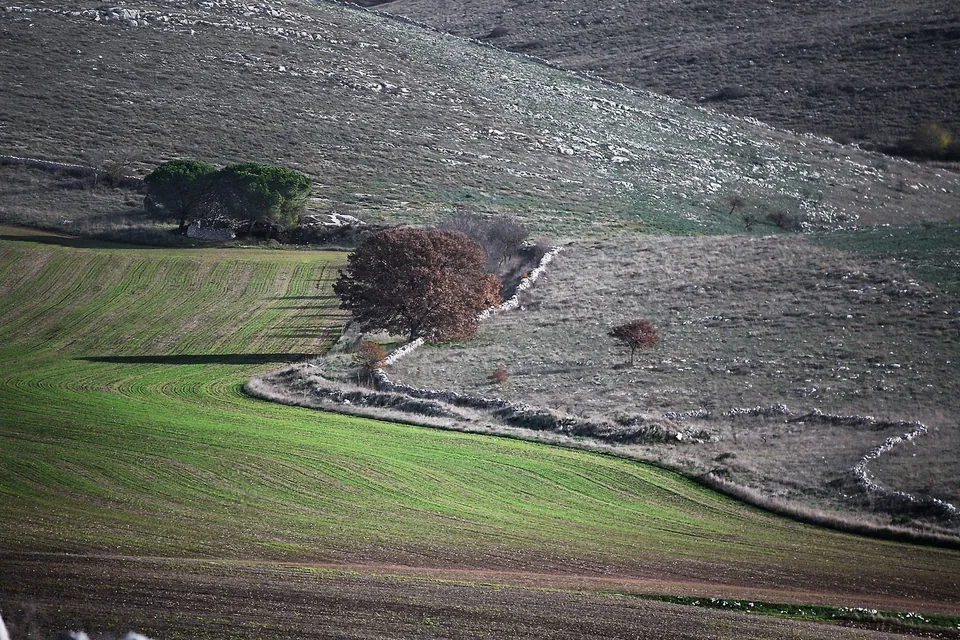
The Alta Murgia National Park describes a landscape shaped by the work of fields and flocks. The masserie, fortified farmsteads, date from the 15th century, when the royal customs office for sheep imposed a strict organisation of farming in favour of herding; their number and size were regulated until the 17th century, when they became the hubs of large estates. Some still work, others have opened to guests.
Next to the masserie stand the poste, which sheltered herds from bad weather, and the jazzi, sheep pens built on the most sheltered south-facing slopes. Some transhumance tratturi, very long grassy and dirt droveways, can still be walked.
The Park also mentions small rock-cut churches and medieval castles, from Garagnone to the castle of Gravina, as far as Castel del Monte, Frederick II's fortress overlooking much of the plateau. This is the setting in which bread fed those who stayed away from home for weeks.
Sources: Parco nazionale dell'Alta Murgia — L'ambiente rurale
Altamura in town
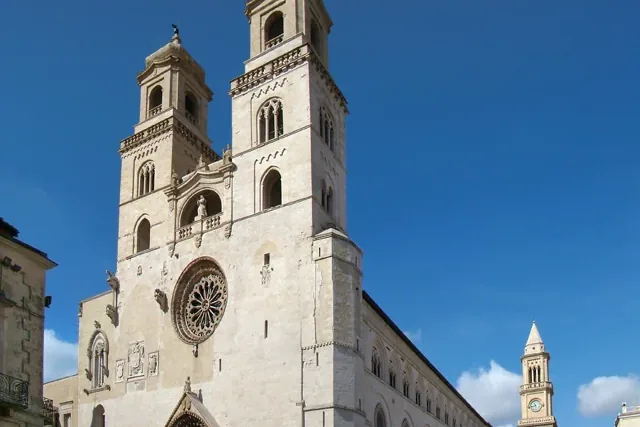
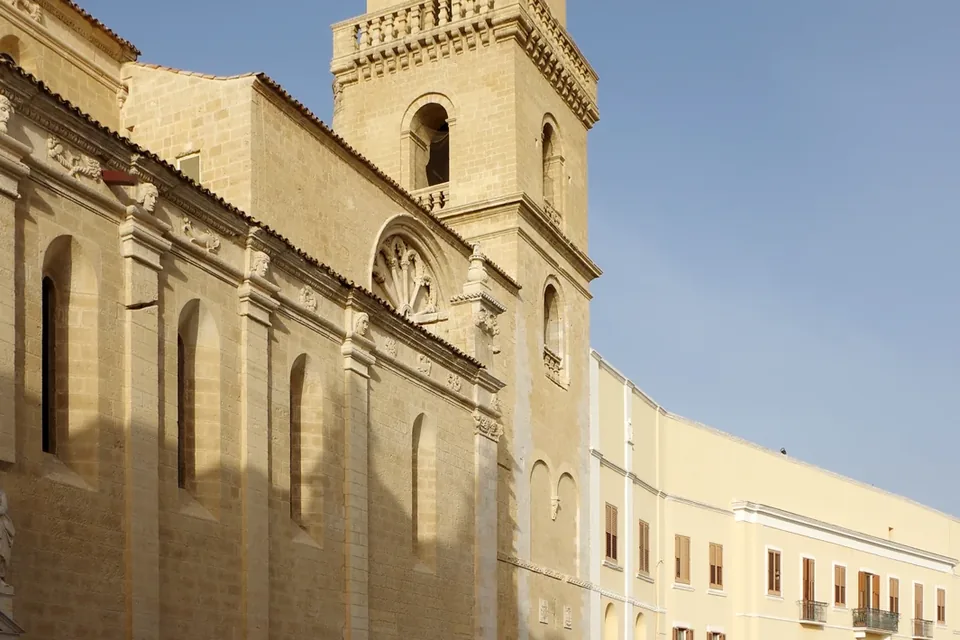
Italia.it describes Altamura as a town of old palazzi, churches and claustri, the small courtyards onto which the houses of the old town open. Its heart is the Cathedral of Santa Maria Assunta, an example of Apulian Romanesque joined with elegant Frederician Gothic.
The consortium, on its page about the town, relates that the present core was founded in the first half of the 13th century at the wish of the Swabian emperor, on the remains of a Peucetian acropolis of the 5th to 3rd century BC, whose megalithic walls survive. At the end of the 18th century Altamura was one of the richest towns of the Kingdom of Naples, able to welcome and integrate different peoples; in 1799, for having joined the Parthenopean Republic, it was besieged and sacked by Cardinal Ruffo's army.
In the surrounding countryside, Italia.it notes, the remains of Altamura Man, a Palaeolithic skeleton, were found. Bread, cathedral, courtyards and prehistory are enough to fill a whole day.
Sources: Italia.it — Altamura · Consorzio Pane di Altamura DOP — Altamura, luogo di produzione
At the table: from the red slice to pancotto
Qualigeo suggests tasting it in the simplest way: sliced, dressed with extra virgin olive oil and salt, sometimes with tomato. The consortium's recipe book calls this bruschetta 'fèdda rosse', the red slice, and lists it among the starters.
Pane di Altamura is also at its best when stale, because Murgia cooking was born to waste none of it. The consortium suggests pancotto, 'pen cuett', the cold cialda, 'cialledde fredd', and hot bread soup; Qualigeo mentions cialde with tomatoes, onions, potatoes and olives and the fetta francesca, stale bread soaked in milk and topped with mortadella, cheese and eggs before baking. Among main courses there is also pane in carrozza.
For a first taste I would try it the day after baking, when the crust is still crisp and the crumb has settled: first on its own, then with oil, then in a soup. In the bakeries it is worth asking which shape you are buying and looking at the colour of the crumb.
Sources: Qualigeo — Pane di Altamura DOP · Consorzio Pane di Altamura DOP — Ricette
Festivals and taking it home
On the Municipality of Altamura's events calendar we found, at the time of checking, no bread festival with official dates to list, so we do not suggest one. Bread is made all year round, and the trip can follow the seasons of the Murgia: green wheat in spring, harvest in summer, the burnt colours of autumn on ploughed fields.
A large loaf is one of the easiest food souvenirs to pack. Wrapped in a cotton cloth or a paper bag and kept somewhere cool and dry, it holds up well for a few days of travel; sealed plastic is best avoided, as it softens the crust. The PDO seal or label helps you be sure of what you are taking home.
For those with time, I would combine the visit to the town with a day in the Park among masserie and droveways, and a stop in Gravina in Puglia, which is part of the same production area. Visits to bakeries and farms should always be arranged with the operators.
A thread for your journey
Journey idea: a morning in Altamura among the cathedral and the claustri, a stop at a town bakery to see the two bread shapes, an afternoon in the Alta Murgia among masserie and droving roads. Bakery and masseria visits arranged with operators.
Talk to us