Why go
Gravina in Puglia stands on the edge of a ravine more than one hundred metres deep, one of the canyon-like clefts that water has carved into the limestone of the Murge and from which the town takes its name. This is the western Murgia, close to the border with Basilicata, between the Alta Murgia and the Murgia of Matera; a large part of the municipal territory lies within the Alta Murgia National Park. The municipality calls it a "town of water and stone", and the description holds up on the ground.
The reason to come is the chance to read, within a few steps, a very long history written in rock: cave quarters, churches cut into the tuff, an underworld of cellars and tunnels, and above them the Norman cathedral overlooking the ravine. On the far side of the canyon, reached across the aqueduct bridge, are the rock sanctuary of the Madonna della Stella and the Botromagno archaeological park.
Gravina is also a farming town, summed up by an old motto, "Grana dat et vina": it gives grain and wine. At the table this means Pallone, a stretched-curd cheese that tells the story of transhumance, cardoncello mushrooms and the wild greens gathered on the Murgia. A stay of one or two days lets you combine town, countryside and the nature of the park.
Sources: Regione Puglia, Viaggiare in Puglia — Gravina in Puglia · Italia.it (Ministero del Turismo, ENIT) — Gravina in Puglia · Comune di Gravina in Puglia — Turismo, città di acqua e di pietra · Comune di Gravina in Puglia — Scopri la città: itinerari, percorsi, come arrivare (PDF) · Fondazione Slow Food — Pallone di Gravina
History
The Gravina area has been inhabited without interruption since the Palaeolithic. Peucetians, Greeks and Romans succeeded one another here, and in Roman times the settlement was called Silvium. The present town was born in the early Middle Ages, when the inhabitants of the nearby hill of Petramagna, also called Botromagno, took refuge in caves dug along the opposite side of the ravine: this is how the Piaggio and Santovito quarters began, and the first cathedral was the rock church of San Michele delle Grotte, in use from the eighth century. In 999, according to tradition, a cave beside this church was the scene of the massacre of the townspeople by Saracen raiders.
A bishop's see in the Byzantine period, Gravina passed to the Normans after 1040, and they built a Latin-rite cathedral. The Swabians brought the castle Frederick II used for hunting: the emperor was fond of the town and called it a "garden of delights". The Angevins followed and, from 1380, the Orsini, feudal lords until feudalism was abolished in 1807. From this family came Pier Francesco Orsini, born in Gravina and elected pope in 1724 as Benedict XIII.
For centuries the town was an important stop on the drove road running from Melfi down to Castellaneta: flocks and shepherds passed through, and the San Giorgio fair, held since 1294, keeps that memory alive.
Sources: Consorzio Pane di Altamura DOP — Gravina in Puglia · Italia.it (Ministero del Turismo, ENIT) — Gravina in Puglia · Regione Puglia, Viaggiare in Puglia — San Michele delle Grotte · Comune di Gravina in Puglia — Turismo, città di acqua e di pietra · Comune di Gravina in Puglia — Scopri la città: itinerari, percorsi, come arrivare (PDF) · Fondazione Slow Food — Pallone di Gravina
What to see
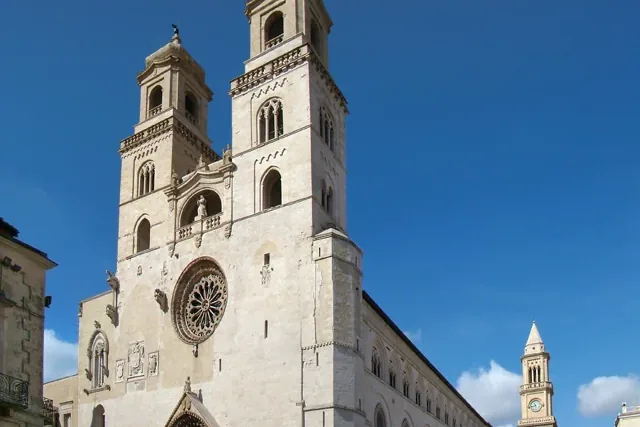
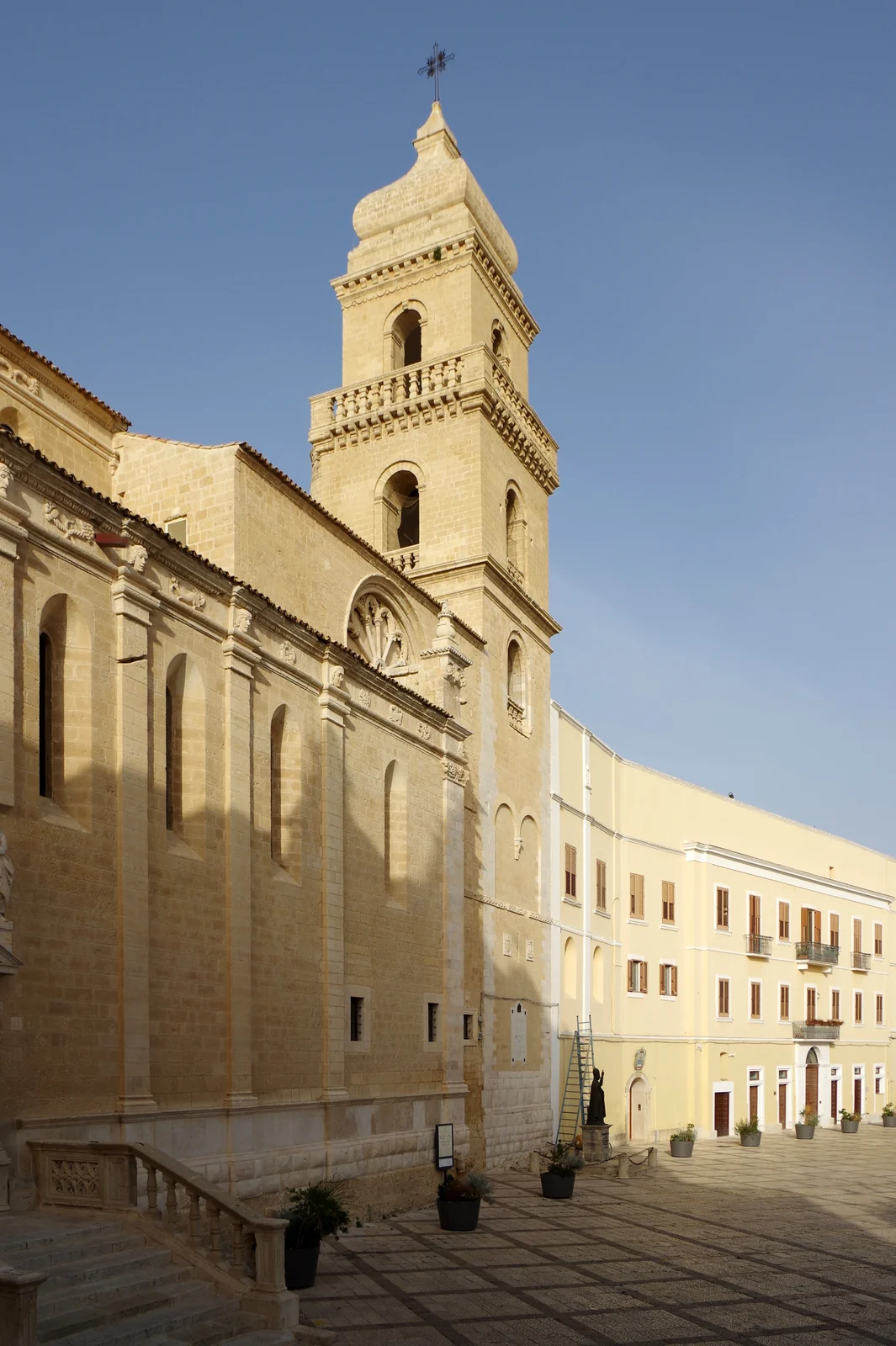
Piazza Benedetto XIII is the heart of the old town. Here stands the Co-Cathedral of Santa Maria Assunta, of Norman origin, with a large rose window bearing the Virgin of the Assumption at its centre and a façade divided by pilasters and three doorways. The basilica-plan interior has a Baroque ceiling of carved and gilded wood, eighteenth-century altars in polychrome marble of the Neapolitan school and a Saint Michael by Stefano da Putignano; a stairway beside the forecourt leads down to the church of Santa Croce, the lower church with burials and sixteenth-century frescoes. On the same square the church of the Purgatorio, built in the mid-seventeenth century as the Orsini family's funerary chapel, is recognisable by the skeletons carved over its doorway and the bears supporting its columns; beside it is the Finia Library, one of the oldest in the region, housed in a building of 1740.
From the square, stairways descend into the oldest quarters. The rock church of San Michele delle Grotte, cut from a single bank of stone, has five naves supported by fourteen pillars and keeps traces of frescoes; an outdoor walkway overlooks the cave dwellings of the Fondovico district, houses on several levels linked by stairs.
The Pomarici Santomasi Foundation Museum, in a seventeenth-century palace, holds the Byzantine-style frescoes detached from the crypt of San Vito Vecchio, the family apartment with eighteenth-century furniture, a picture gallery with seventeenth-century Neapolitan canvases, archaeological finds from the area and an exhibition on Pope Benedict XIII.
Sources: Regione Puglia, Viaggiare in Puglia — Concattedrale di Santa Maria Assunta · Regione Puglia, Viaggiare in Puglia — Chiesa del Purgatorio · Regione Puglia, Viaggiare in Puglia — Biblioteca Finia · Regione Puglia, Viaggiare in Puglia — San Michele delle Grotte · Regione Puglia, Viaggiare in Puglia — Habitat rupestre di Gravina · Regione Puglia, Viaggiare in Puglia — Museo Fondazione Pomarici Santomasi · Ministero della Cultura — Fondazione Pomarici Santomasi
Food and wine
Gravina's coat of arms bears the motto "Grana dat et vina", and the town has always been a land of grain and wine. The Slow Food Foundation describes an area of plenty: figs, cardoncello mushrooms, cured meats, cooking that makes the most of a remarkable variety of wild greens, and a widespread dairy tradition. Tassel hyacinth bulbs and wild asparagus also grow on the park's plateau, and the know-how of mushroom and herb gatherers is part of the identity the municipality claims for its table.
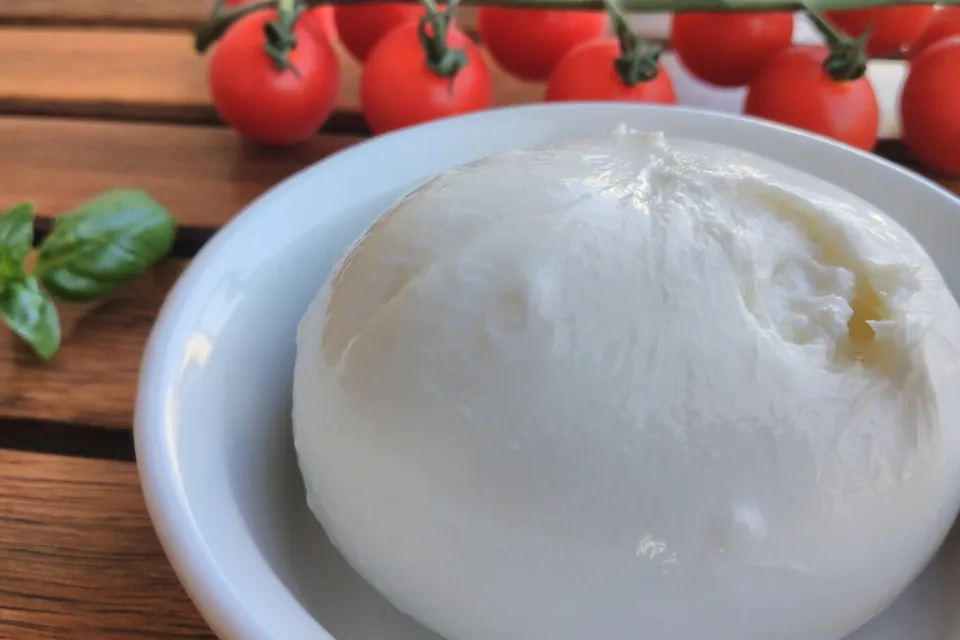
The emblematic product is Pallone di Gravina, a Slow Food Presidium supported by the Alta Murgia Park. It is a hard stretched-curd cheese made from raw cow's milk, round and without the small neck typical of caciocavallo; it is made from January to March and weighs from one to ten kilos. Its production dates back to the era of transhumance. After stretching and brining it matures in natural cellars, once in tuff caves: after three months the paste turns golden and sharp, with notes of caramel and grass. Only a few dairies still make it today, and the Presidium focuses on raw milk and long ageing.
Gravina is also one of the production places of Pane di Altamura, the bread protected by a designation of origin that its consortium links to a small network of Murgia towns: a good companion for Pallone and for country dishes.
Sources: Fondazione Slow Food — Pallone di Gravina · Regione Puglia, Viaggiare in Puglia — Parco Nazionale dell’Alta Murgia · Comune di Gravina in Puglia — Turismo, città di acqua e di pietra · Consorzio Pane di Altamura DOP — Gravina in Puglia
Things to do
Much of the Gravina experience lies in walking between the two sides of the canyon. The Aqueduct Bridge, built in the seventeenth century so that pilgrims could reach the sanctuary of the Madonna della Stella and rebuilt in the following century as an aqueduct, has two tiers of arches in local calcarenite and offers the best view of the town's skyline; it is also the bridge chosen for a scene of the film "No Time to Die". Across it lie the rock church of the Madonna della Stella, a Marian sanctuary since 1550, and, along a rough path, the Sette Camere complex, seven rooms cut on three levels. On the west bank, the Botromagno archaeological park preserves part of the ancient settlements.
Beneath the town lies Gravina Sotterranea, a network of tunnels, wells and hand-dug cellars larger than the old town above it, including the cellar twenty metres deep under the Orsini palace. It can be visited on routes of different lengths.
For walkers, the municipality points to the Via dei Piloni, a family-friendly route to the Dolcecanto viewpoint among springs and historic aqueducts, and to the Cammino Materano along the Via Peuceta, which starts from the basilica of San Nicola in Bari. Tourism consortia, licensed guides and the Pro Loco organise guided visits and itineraries.
Sources: ENIT — Ponte dell’Acquedotto di Gravina · Regione Puglia, Viaggiare in Puglia — Santuario rupestre della Madonna della Stella · Regione Puglia, Viaggiare in Puglia — Complesso delle Sette Camere · Italia.it (Ministero del Turismo, ENIT) — Gravina in Puglia · Regione Puglia, Viaggiare in Puglia — Gravina sotterranea · Comune di Gravina in Puglia — Scopri la città: itinerari, percorsi, come arrivare (PDF)
When to go
Gravina can be visited all year round: churches, museum and underground passages offer shelter on the coldest or hottest days, while the paths along the canyon and in the Alta Murgia Park are best enjoyed in mild weather. Winter coincides with the season of Pallone, made from January to March.
The oldest event is the San Giorgio Fair, held every year in April, in the second half of the month, and dated by the sources to 1294: one of the oldest fairs in Italy, renewing trade, encounters between people and the ancient ritual of transhumance. It is accompanied by a historical procession organised by a local association, which has re-enacted the tradition for almost thirty years.
In September, in the third week of the month, the town hosts a gathering of historical processions that had reached its twentieth edition by 2023, while at Christmas Gravina Nativitas recreates Palestine in the time of Jesus. For runners, the Trail delle 5 Querce follows the paths of the Alta Murgia, the Difesa Grande wood and the ravine. Check the exact dates of each edition on the municipality's official channels before travelling.
Sources: Regione Puglia, Viaggiare in Puglia — Gravina in Puglia · Comune di Gravina in Puglia — Scopri la città: itinerari, percorsi, come arrivare (PDF) · Comune di Gravina in Puglia — Turismo, città di acqua e di pietra · Fondazione Slow Food — Pallone di Gravina
Getting there and around
Gravina lies just over ten kilometres from Altamura and less than fifty from Bari. The nearest airport is Bari Karol Wojtyla International: according to the municipality's directions, you reach central Bari from the airport on the Ferrotranviaria Bari-Nord railway and from there take the Ferrovie Appulo Lucane line to Gravina, passing through several Murgia towns. Alternatively, Trenitalia trains reach Gioia del Colle, from where you continue to Gravina. The Ferrovie Appulo Lucane also run a bus network along the Bari-Altamura-Gravina route.
By car, from the airport follow signs for Modugno and then the SS96 towards Altamura, Matera and Gravina. Drivers on the A16 motorway exit at Canosa di Puglia and continue via Minervino, Spinazzola and Poggiorsini; those on the A14 exit at Bari Nord and follow signs for Altamura. Always check timetables and connections on the operators' websites before departure.
The old town is best explored on foot: stairways lead down from Piazza Benedetto XIII to the cave quarters, and the aqueduct bridge takes you across to the other bank. For countryside sites such as the Pulicchio, about ten kilometres north, or the park's sheepfolds, you need your own transport or an organised visit.
Sources: Regione Puglia, Viaggiare in Puglia — Gravina in Puglia · Comune di Gravina in Puglia — Scopri la città: itinerari, percorsi, come arrivare (PDF) · Ferrovie Appulo Lucane — rete ferroviaria e automobilistica · Regione Puglia, Viaggiare in Puglia — Pulicchio di Gravina
Nearby
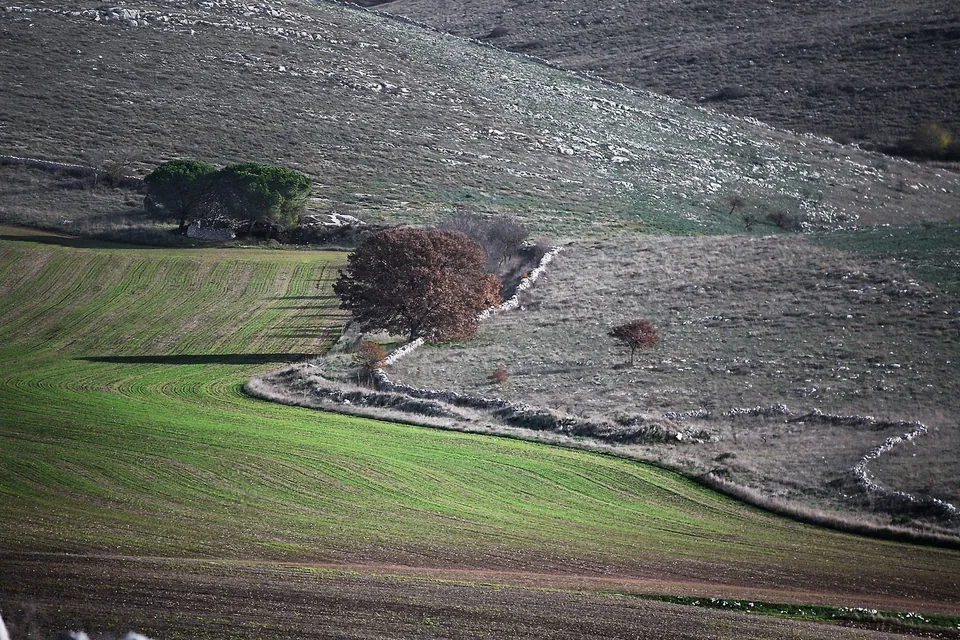
Gravina is one of the thirteen municipalities of the Alta Murgia National Park, and the park authority has its headquarters in the town. The park protects Italy's last example of Mediterranean steppe, among limestone, dry-stone walls and masserie that from the fifteenth century were the centre of the farming economy; its territory belongs to the MurGEopark, recognised as a UNESCO Global Geopark. In Gravina the Pomarici Santomasi Museum has opened a permanent display of the fossils collected by the geologist Arcangelo Scacchi, who in the nineteenth century described the ancient seas that once covered Puglia.
About ten kilometres north, along the road to Corato, the Pulicchio is a large oval karst sinkhole, about four hundred metres long and almost ninety deep, reforested in the 1950s. Near the Pellicciari wood, the Jazzo Pantano shows how a shelter for flocks was organised, with enclosures of tuff and dry stone and rooms for cheesemaking. The Difesa Grande wood, covering about 1,890 hectares, is one of the most important woodlands in Puglia.
Altamura, around ten kilometres away, continues the story of grain and Murgia prehistory, while the nearby Murgia of Matera makes it natural to carry on to Matera and its Sassi, giving each town its own time.
Sources: Parco Nazionale dell’Alta Murgia — Territorio e comuni del Parco · Parco Nazionale dell’Alta Murgia — Gravina, allestimento dedicato ad Arcangelo Scacchi (MurGEopark UNESCO) · Regione Puglia, Viaggiare in Puglia — Parco Nazionale dell’Alta Murgia · Regione Puglia, Viaggiare in Puglia — Pulicchio di Gravina · Regione Puglia, Viaggiare in Puglia — Jazzo Pantano · Comune di Gravina in Puglia — Scopri la città: itinerari, percorsi, come arrivare (PDF) · Regione Puglia, Viaggiare in Puglia — Gravina in Puglia · Italia.it (Ministero del Turismo, ENIT) — Gravina in Puglia
Local tourist information
Local tourist offices help with opening times, events and transport on the day.
- Info-point turistico di Gravina in Puglia · Via Matteotti 17, 70024 Gravina in Puglia (BA) · +39 080 350 4516 · infopointtouristgravina@gmail.com · Official website
Source: Regione Puglia, Viaggiare in Puglia — Info-point Gravina in Puglia · checked on
Where to stay
In the municipality of Gravina in Puglia the national database of the Ministry of Tourism lists 149 accommodation businesses with a verified CIN code: 3 hotels, 56 other licensed accommodation and 90 other types such as B&Bs and private rentals.
Licensed businesses from the official list of Regione Puglia, each with a checked national CIN code: matching municipality and category. Private individuals are not listed. Check directly with the property before booking.
DUCA ORSINI
Guest rooms
CIN IT072023B400071610
FONDOVITO
Guest rooms · Website
CIN IT072023B400100371
GESTA DI CAZZORLA PAOLO
Guest rooms
CIN IT072023B400021995
IL BORGO DI COLONNA ROSA
Guest rooms
CIN IT072023B400024524
LA DIMORA DELL'ARCHITETTO
Guest rooms · Website
CIN IT072023B400023895
LA GRAVINA DI MANFREDI
Guest rooms · Website
CIN IT072023B400039423
LA VILLA DEL SENATORE
Guest rooms
CIN IT072023B400113060
LE FORNACI IMPERIAL LODGE
Guest rooms
CIN IT072023B400080796
La Cola Cola Affittacamere
Guest rooms · Website
CIN IT072023B400121248
OPPIP
Guest rooms
CIN IT072023B400027813
PALAZZO FONTANA
Guest rooms · Website
CIN IT072023B400072595
STANZE ORSINI
Guest rooms · Website
CIN IT072023B400033090
Santa Sofia
Guest rooms
CIN IT072023B400099398
Suite Vecchia Stalla
Guest rooms
CIN IT072023B400124953
AGRITURISMO MASSERIA SANT'ANGELO
Farm stay
CIN IT072023B500020919
BORGO SCARINGELLA
Farm stay
CIN IT072023B500027254
B&B S. FIGHERA
B&B
CIN IT072023B400023797
CLASSIC ROOMS EXPERIENCE
B&B
CIN IT072023B400027524
EXECUTIVE B&B
B&B
CIN IT072023B400060096
EXECUTIVE B&B DI PARISI LEONARDO
B&B
CIN IT072023B400128043
GRANTO' B&B
B&B · Website
CIN IT072023B400062294
Giardino delle Delizie B&B
B&B
CIN IT072023B400055765
Principe Relais Suite & Spa
B&B
CIN IT072023B400086231
SUITES & ROOMS
B&B
CIN IT072023B400027523
CASA VACANZE DANTE
Holiday home
CIN IT072023B400100584
MOD'S APARTMENTS
Holiday home
CIN IT072023B400057876
Ètoile Palace - Gravina
Holiday home
CIN IT072023B400121900
HOTEL 7 CAMERE
Hotel · ★★★
CIN IT072023A100027608
LA CAVALLERIZZA
Hotel · ★★★★
CIN IT072023A100086498
MASSERIA PROTOMASTRO HOTEL
Hotel · ★★★
CIN IT072023A100021472
Sources: Regione Puglia – ARET Pugliapromozione (DMS), CC BY 4.0, 2026-10-12 · Ministero del Turismo – Banca Dati Strutture Ricettive (dashboard pubblica), 2026-10-12
YOUR JOURNEY
How to shape a journey here
Inhabited rock, bridge and agricultural culture: discover Pallone di Gravina after understanding land and work.
Talk to us about it