APULICA / Food guides
Lenticchia di Altamura: a Murgia legume between Puglia and Basilicata
Altamura is famous for its bread, but the Murgia uplands also produce a large, round, flat lentil whose colour ranges from green to brown. Since December 2017 it has been a Protected Geographical Indication that crosses the border between Puglia and Basilicata, from Andria to Matera. It is an interesting story because it is not a romantic one: the permitted varieties are modern, the revival is recent, and the link with the land lies mainly in the soil and in the work of those who grow it. This guide tells it through official documents and suggests how to bring it to the table.
From family economy to export
For a long time the Altamura lentil was a product of the family farm economy. Slow Food's Ark of Taste explains that its rise began in the 1930s: it became a widely grown legume exported to England, Germany, the United States, Canada and Australia, with a strong impact on the economy of the town, already known for flax and wool.
Until the 1970s legumes contributed to local growth. Then production declined for a combination of reasons: industrialisation and urbanisation, lack of mechanisation, the arrival of cheap imported lentils and the spread of cereal monoculture. Qualigeo adds the abandonment of the countryside, which brought the crop close to disappearing.
The revival began in the early 2000s, when growers decided to make use of the Murgia's soils and return to crop rotation. The process culminated in the European registration of the Protected Geographical Indication on 18 December 2017, according to the Qualigeo profile.
Sources: Fondazione Slow Food, Arca del Gusto — Lenticchie di Altamura · Qualigeo (Fondazione Qualivita) — Lenticchia di Altamura IGP
Nineteen towns, two regions
Qualigeo lists the production area: in the province of Bari, Altamura, Gravina in Puglia, Ruvo di Puglia, Corato, Poggiorsini, Cassano delle Murge and Santeramo in Colle; in Barletta-Andria-Trani, Andria, Minervino Murge and Spinazzola; in Basilicata, province of Potenza, Montemilone, Palazzo San Gervasio, Genzano di Lucania, Banzi, Forenza and Tolve; in the province of Matera, Irsina, Tricarico and Matera.
The Puglia Region describes the area as the Bari and Matera Murgia and the neighbouring Pre-Murgia trough, between 300 and 600 metres above sea level, partly inside the Alta Murgia National Park. The specification distinguishes the south-eastern from the north-western Murge, which together with the Pre-Murgia trough are influenced by moist currents from the Apennines.
The logo, too, tells the geography of the designation: according to the specification it consists of 19 stylised lentils of different sizes, arranged according to the size and position of the towns, above the words Lenticchia di Altamura IGP on three lines, with Altamura in the middle.
Sources: Qualigeo (Fondazione Qualivita) — Lenticchia di Altamura IGP · Regione Puglia, Produzioni di qualità — Lenticchia di Altamura IGP · Regione Puglia — Disciplinare di produzione IGP Lenticchia di Altamura (Ministero delle politiche agricole)
Laird and Eston: modern varieties, precise rules
One detail surprises anyone expecting an ancient ecotype: the PGI covers the dried seeds of two varieties, Laird and Eston. The lentil is round and flat, with a colour ranging from green to brown, depending also on when it is harvested. Laird is the larger, 5 to 7 millimetres across; Eston ranges from 3 to 4.9. Qualigeo describes a sweet taste with grassy, aromatic notes.
The specification forbids sowing lentils after another legume, sets sowing between November and March depending on the environment and growing method, and fixes a maximum yield of 2.5 tonnes of seed per hectare.
After harvest the crop must be treated against pests within 24 hours inside the designation area, to control the lentil weevil; it is then cleaned of foreign matter, sorted with optical readers to make the seeds uniform, cleared of any metal and stored in lined big bags or silos. Retail packs hold no more than 10 kilos and must carry the European PGI symbol, the producer's details and the logo.
Sources: Regione Puglia — Disciplinare di produzione IGP Lenticchia di Altamura (Ministero delle politiche agricole) · Qualigeo (Fondazione Qualivita) — Lenticchia di Altamura IGP
Limestone soils, nitrogen and iron
The specification explains the link with the area through climate and soil. The climate is Mediterranean, with mild winters and hot, dry summers: rainfall is around 604 millimetres a year, lowest in July and highest in November and December; January lows can fall below zero and summer highs reach 40 degrees, with an annual average of 15.
The soils are mostly deep, medium-textured tending to clay, with plenty of stones, organic matter and lime, and a pH between 7.6 and 8. According to the text, these conditions favour the Rhizobium bacteria living in root nodules that fix nitrogen, and therefore a high protein content.
Iron also depends on pH: in very alkaline soils lime locks it up, whereas here it stays available to the plant, and the lentil is said to contain more of it than the same varieties grown elsewhere. Finally, the specification recalls that for centuries local people relied on legumes as a source of protein in place of meat.
Generations in the fields and the Consortium's festival
The Puglia Region highlights a human side of the designation: farmers' knowledge of the plant, the soil and the climate passes from one generation to the next, and in recent years it has become ever more common to see two, sometimes three generations working together in the fields.
The Consortium for the protection and promotion of Lenticchia di Altamura PGI is based in Altamura, and Qualigeo lists 201 registered operators, a sign of a supply chain involving many Murgia farms. The same source recalls that in 2018 the Consortium organised the first Lenticchia di Altamura PGI festival, designed to showcase the agricultural, culinary, historical and cultural heritage of the production area.
We found no official dates for recent editions of the festival, which should therefore be checked on the Consortium's channels before travelling. Among the news gathered by Qualigeo there is also an innovation project on a new cultivar developed from ancient seeds: a sign that the story of the Murgia lentil is still moving.
Sources: Regione Puglia, Produzioni di qualità — Lenticchia di Altamura IGP · Qualigeo (Fondazione Qualivita) — Lenticchia di Altamura IGP
In the kitchen: soup, broth and bread
The Ark of Taste notes that in Puglia these lentils were not served as a side dish to zampone or cotechino but only in soup: soaked the night before, cooked slowly in water with celery, onion and garlic and brought to the table in bowls with plenty of olive oil.
Qualigeo observes that, being large, they need longer soaking and cooking, which makes them especially suited to soups, minestrone and broths; a traditional example is the soup with sausage and croutons of Pane di Altamura PDO. They also work as a side dish, in salads or alongside meat and fish, simply dressed with oil and oregano or with tomato sauce and bay leaf.
The specification mentions their traditional New Year's Day consumption and their use in many recipes across Italy. Nutritionally, Qualigeo describes them as rich in iron, carbohydrates and protein, yet easy to digest thanks to fibre, minerals and vitamins. Kept in a cool, dry place, they last a long time.
Sources: Fondazione Slow Food, Arca del Gusto — Lenticchie di Altamura · Qualigeo (Fondazione Qualivita) — Lenticchia di Altamura IGP · Regione Puglia — Disciplinare di produzione IGP Lenticchia di Altamura (Ministero delle politiche agricole)
Altamura bread, a table companion
In Altamura the lentil shares the table with the town's most famous bread. Qualigeo describes Pane di Altamura PDO as a dough of re-milled durum wheat semolina, sourdough starter, sea salt and water, made in the Alta Murgia Park towns of Altamura, Gravina in Puglia, Poggiorsini, Spinazzola and Minervino Murge. Italia.it notes that it was the first bakery product in Europe to obtain PDO status.
There are two traditional shapes: the accavallata, called skuanete, and the priest's hat, in loaves of at least half a kilo with a crust about 3 millimetres thick and a soft yellow crumb. Horace, in his Satires, called it the best bread in the world; the Municipal Statutes of 1527 already mention an oven toll, and families once kneaded at home and baked in public ovens, marking loaves with the head of the family's initials.
The bread keeps for several days and, when stale, goes into recipes such as fetta francesca. With a lentil soup it is the most natural companion, not least because both come from the same Murgia fields.
Sources: Qualigeo (Fondazione Qualivita) — Pane di Altamura DOP · Italia.it — Altamura
Altamura and the Murgia of farmsteads
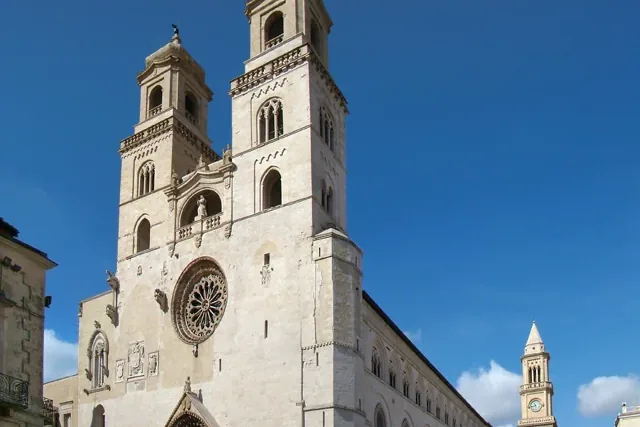
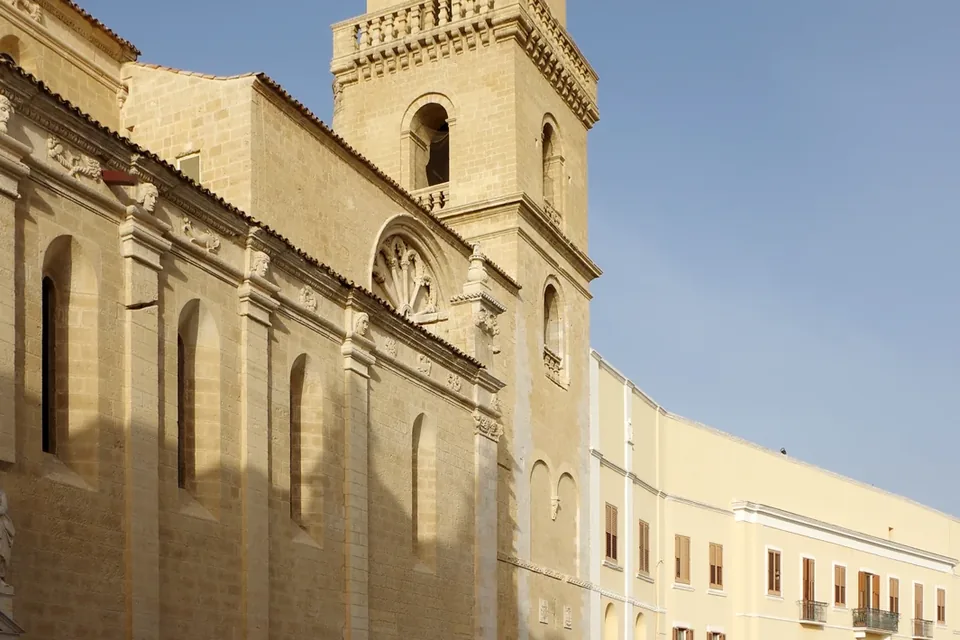
Italia.it presents Altamura as a town of old mansions, churches and cloisters, whose heart preserves architecture of great value. The Cathedral of Santa Maria Assunta stands out, combining Apulian Romanesque with the elegant Gothic of Frederick II's age. In the countryside around the town the remains of Altamura Man, a Palaeolithic human skeleton, were found.
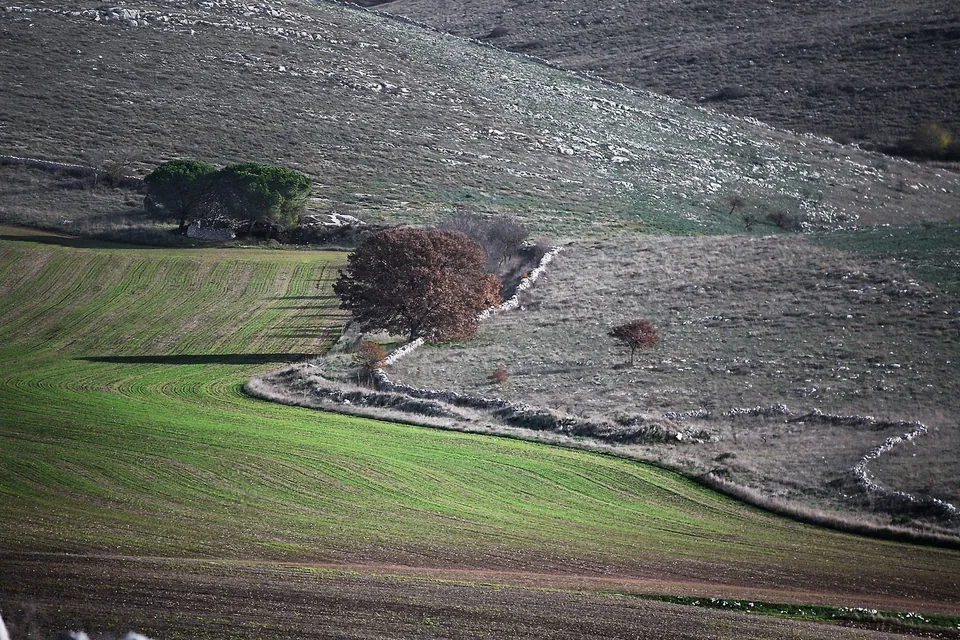
Outside the centre begins the farming landscape in which lentils are rotated with cereals. The Alta Murgia National Park describes a rural architecture of poste, where shepherds sheltered their flocks, of jazzi for sheep and of farmsteads that arose from the 15th century under the Royal Customs of sheep grazing. Some farmsteads are still working, others have opened up to visitors.
The Park also mentions the ancient transhumance droving tracks, long grassy routes that can still be walked, rock-cut chapels and castles such as Garagnone and Castel del Monte. To read the designation it is worth leaving town and following these back roads among fields, dry-stone walls and farmsteads.
Sources: Italia.it — Altamura · Parco nazionale dell'Alta Murgia — L'ambiente rurale
Other traditional lentils
The lentil has many local stories in Italy. The national list of traditional food products includes, among others, the lentils of Santo Stefano di Sessanio in Abruzzo, the Potenza lentil in Basilicata, the Sannio and Valle Agricola lentils in Campania, a general entry for Molise, and in Lazio the lentils of Onano, Rascino and Ventotene.
These are regional recognitions of a tradition, attesting processing methods established over time, without a European specification. The Lenticchia di Altamura is instead a PGI, with precise rules on varieties, area, cultivation and processing, checked by an independent body.
The comparison is useful for anyone wanting to understand what each label guarantees and why a legume of modern varieties can still have a geographical indication: the link with the land, according to the specification, lies in the soil, the climate and the work of growers rather than in the origin of the seed. It is a different, but equally concrete, way of telling the story of a local product.
Sources: Masaf — Elenco nazionale dei prodotti agroalimentari tradizionali 2022, allegato I (copia pubblicata dal progetto regionale Biodiversità Puglia) · Regione Puglia — Disciplinare di produzione IGP Lenticchia di Altamura (Ministero delle politiche agricole)
A day on the Murgia
Lentils can be bought all year, but the journey makes sense when you read the landscape: in spring the winter-sown fields are green between dry-stone walls and farmsteads, in summer the stubble tells of rotation with cereals, in autumn the new oil arrives.
I would combine a visit to Altamura, with its cathedral, old town and a bakery, with a back road towards Gravina in Puglia or towards the Lucanian border, and ask a farm, by prior arrangement, to see the cleaning and sorting. Those continuing to Matera cross the Lucanian part of the same designation.
At the table I would choose the simple soup described by the Ark of Taste, with Altamura bread and a drizzle of oil. For the journey home, a sealed pack with the 19-lentil logo is best: it weighs little, keeps for a long time in a dry place and lets you make the same soup at home. Remember to soak it the night before: it is the secret Murgia cooks have always known.
A thread for your journey
Journey idea: a day between Altamura and Gravina in Puglia with a detour into the farmed Murgia, a farm visit to be arranged with the operators to see cleaning and sorting, and a lentil soup with Altamura bread; those continuing to Matera cross the Lucanian part of the same designation.
Talk to us