Calabria's red gold
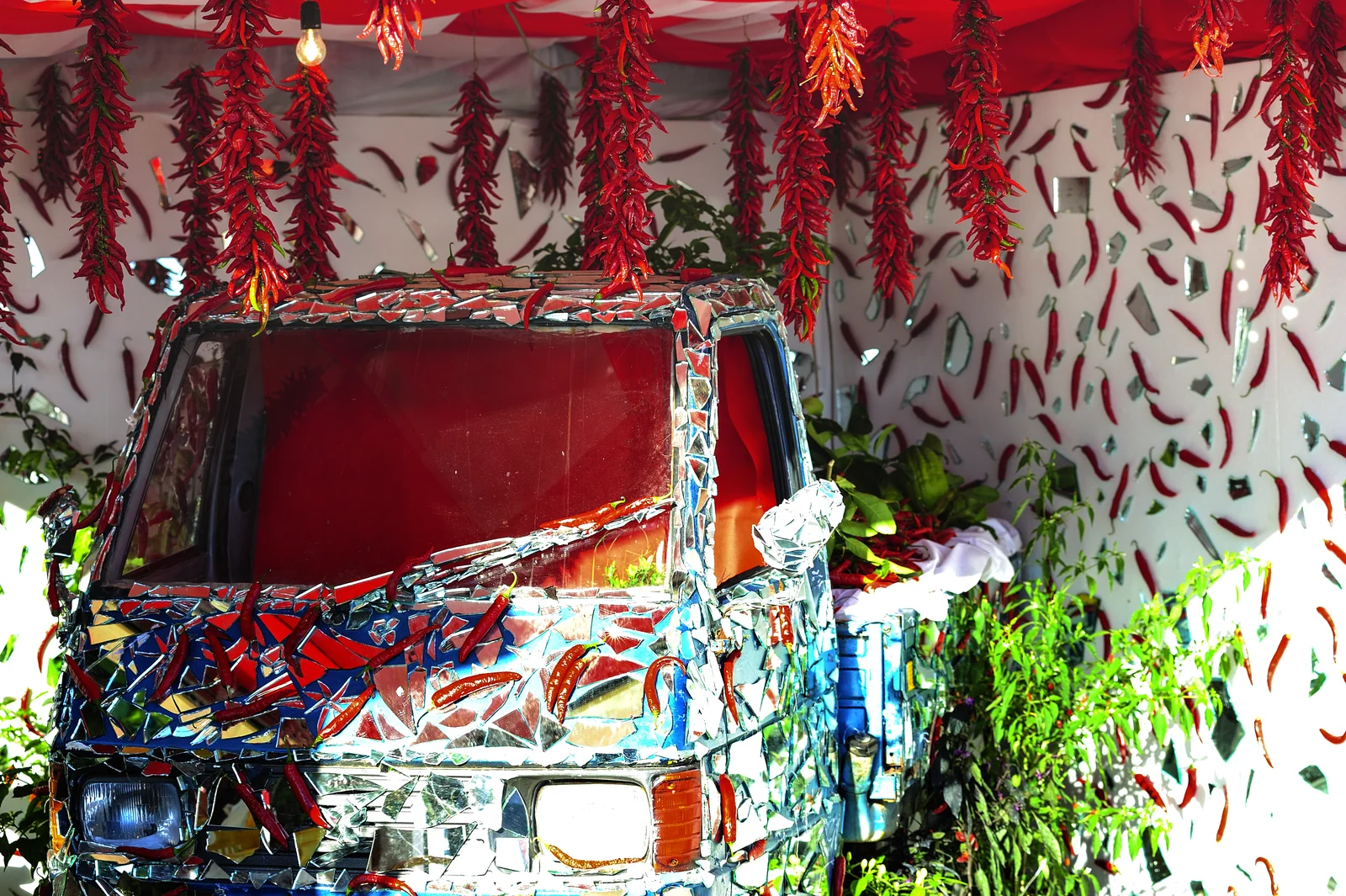
Italia.it devotes a whole itinerary to chilli, calling it Calabria's red gold and the undisputed prince of the table, with intense flavours recalling Middle Eastern influences handed down in local cooking. Diamante, the same source says, is its capital, to the point of dedicating to the piparedduzzu an Academy that organises a festival of international renown every September. Chilli goes into a great many products: cured meats, starting with soppressata, sauces, 'nduja and Cosenza's mùstica. Slow Food, describing 'nduja, recalls that local chilli varieties were once grown by every family, even in pots on terraces, and that after picking they were threaded with needle and cotton into strings hung in the sun to dry.
Sources: Italia.it — La terra del peperoncino · Fondazione Slow Food — Arca del Gusto: 'Nduja di Spilinga (varietà locali di peperoncino)
Strings in the sun and local varieties
Slow Food's sheet on Spilinga 'nduja offers one of the most precise accounts of Calabrian chilli culture. The varieties considered best for Monte Poro cured meats are tri pizzi and casalese; they are grown locally but not in sufficient quantity for all the butchers, and cultivation is now recovering thanks to demand. Once dry, the strings were taken down in early December, at pig-killing time, and ground to flavour the cured meats. The same source stresses chilli's role as a natural preservative, thanks to its properties, and above all its job in the kitchen: to give intensity without masking the meat. It is a useful principle for travellers too: in Calabria, good heat is the kind that lets you taste the other ingredients.
Sources: Fondazione Slow Food — Arca del Gusto: 'Nduja di Spilinga (varietà locali di peperoncino)
The Peperoncino Festival
Italia.it describes Diamante's festival as an event combining cinema, art, culture, talks, debates, satire, music, fashion shows, street performance and plenty of food, always with chilli at its heart. It is organised by the Italian Chilli Academy, based in Diamante. According to the programme published by the organisers, the 34th edition took place in September 2026, opening on 9 September in Piazza Municipio with the mayor handing the city keys to the Chilli King, concerts on the seafront and riverfront and exhibitions in the centre. Earlier editions, collected in the festival archive, have almost always been held in September. Dates for the 2027 edition are not yet known: check the organisers' website or the town council before booking.
Sources: Italia.it — La terra del peperoncino · Accademia italiana del peperoncino — Peperoncino Festival 2026 (programma degli organizzatori) · Accademia italiana del peperoncino — Archivio delle edizioni del Peperoncino Festival
Diamante: murals and sea
Italia.it calls Diamante the pearl of the Tyrrhenian, at the heart of the Riviera dei Cedri, with beaches, volcanic cliffs and coves, and describes it as the town of murals: over 150 works on its walls, making it an open-air museum. The town council tells the story: the idea came from Milanese painter Nani Razetti, a Diamante resident by adoption, who suggested to mayor Evasio Pascale reviving the old town. Operation Murales began in June 1981 with eighty-three Italian and foreign painters; between 1986 and 1997 more were added, including the Marcon Triptych at Cirella, and new ones appear every year. On the outer wall of the Mother Church, in via Alfieri, a mosaic mural tells the story of Calabria from the Papasidero bull engraving to the civilisation of farmers and fishermen.
Sources: Italia.it — Diamante · Comune di Diamante — I murales
Cirella and Maierà
A few kilometres from the centre, Cirella is the hamlet where, according to italia.it, Diamante's seafaring history begins: probably founded by Greeks, it became an important trading hub thanks to its harbour. The town council describes the ruins of the old town, destroyed by the Napoleonic fleet in the early 1800s; a surviving late 16th-century fresco of the Madonna degli Angeli has been restored and is displayed in the parish church. Nearby stand the convent of San Francesco, of 1545, and the Teatro dei Ruderi, with about two thousand seats, which hosts summer shows and, in August, the Cirella antica festival. For chilli lovers, italia.it suggests a detour to Maierà, about eight kilometres from Diamante, where the ducal palace houses a Chilli Museum. Check opening times before going.
Sources: Italia.it — Diamante · Comune di Diamante — I ruderi di Cirella · Italia.it — La terra del peperoncino
From the sea to the Pollino and Cosenza
Italia.it's chilli itinerary continues north from Diamante to Scalea with its stepped old town and Praia a Mare with the Isola di Dino, then enters the Pollino National Park as far as Castrovillari, with its Aragonese castle of 1490. The park has been home for about five centuries to the Arbëreshë community, settled between 1470 and 1540: villages listed include Civita, with its museum, Acquaformosa, San Basile, Lungro, Plataci and Frascineto. The route then reaches Cosenza, with corso Mazzini, the old town and the cathedral, where the fiery speciality is mùstica, tiny fish coated in chilli, sun-dried and kept in oil. Among other products the same source names soppressata, pecorino, ricotta and citron, candied or as a liqueur, a Diamante speciality, and the red wines Donnici, Pollino and Savuto.
Sources: Italia.it — La terra del peperoncino
Tasting heat with judgement
Calabrian chilli is best understood in stages. Start with chilli oil on bruschetta, move on to a sauce where the heat is diluted, then to a cured meat such as soppressata and only at the end to 'nduja or mùstica, where it takes centre stage. Bread, fresh cheeses such as ricotta and a glass of red wine soothe the palate better than water. Note the difference between heat and flavour: good chilli also has aroma, sometimes fruity, and does not leave only a burn. In a restaurant, asking how hot a dish is is not a weakness but a way to truly enjoy it. Those with sensitive stomachs should go easy.
Buying it and taking it home
Chilli is one of the easiest Calabrian souvenirs to carry. Strings of dried chillies are pretty and light, but must be kept dry; ground and flaked chilli keep well in closed glass jars away from light. Sauces and preserves in oil are more delicate: by air they go in checked luggage, following the liquids rules. Always read the label to know where the chilli comes from, because not everything sold locally is grown in Calabria. During the festival the choice is wide, but shops in Diamante and nearby villages stock what you need all year. Visits to growers' plots and processing workshops must be arranged with operators.
A thread for your journey
Journey idea: two days on the Riviera dei Cedri. The first in Diamante among murals, seafront and a lunch of rising heat, with a detour to Maierà's Chilli Museum; the second at Cirella among the ruins and theatre, then towards the Pollino and Civita. September travellers can match their stay with the festival, after checking dates. Visits to plots and workshops arranged with operators.
Talk to us