
APULICA / FRUIT, VEGETABLES AND PULSES
Poverello white bean
PAT · Slow Food Presidium · Fruit, vegetables and pulses · Basilicata, Calabria
In brief
- A climbing bean with large, oval, glossy white seeds, grown since ancient times on irrigated land in the mountain villages of the Pollino park. (Fondazione Slow Food — Presidio Fagiolo poverello bianco)
- It is sown by mid-June and staked with chestnut poles; chemical weedkillers are banned. (Fondazione Slow Food — Presidio Fagiolo poverello bianco)
- In the 1990s the Calabrian farm agency ARSAC began its recovery with research bodies; the landrace resists pests that attack other beans. (Fondazione Slow Food — Presidio Fagiolo poverello bianco)
- It is harvested from October to early November; dried it is available all year. (Fondazione Slow Food — Presidio Fagiolo poverello bianco)
History and origin
The poverello white bean has been grown since very ancient times on the irrigated land of a few mountain villages on the Calabrian side of the Pollino park, where it is central to farming culture and local cooking.
During the twentieth century the area under cultivation shrank sharply: young people left the land and this laborious crop was abandoned. In the 1990s ARSAC, the Calabrian regional agency for agricultural development, began its recovery together with CNR in Bari, CREA in Pontecagnano, the Mediterranean University of Reggio Calabria and ENEA. The research revealed a valuable fact: this ecotype does not suffer the pest attacks that affect other beans in the same places.
Some farmers then decided to safeguard and relaunch it. The bean is listed among Calabria's traditional food products and is a Slow Food Presidium, which also protects the landscape of the irrigated plots.
Sources: Fondazione Slow Food — Presidio Fagiolo poverello bianco · Masaf — Elenco nazionale dei prodotti agroalimentari tradizionali, XXVI revisione (2026)
Area and method of production
By tradition it is sown «a postarelle», in small clusters, by the first half of June. It is a climbing bean: the young plants climb chestnut poles cut from the nearby coppice woods. The plants need irrigation, and weeds are controlled by hand or, in some cases, mechanically; chemical weedkillers are banned, and the soil is fed only with well-rotted manure.
Harvesting is by hand between October and early November. The fully dried pods are spread on «cannizzi», cane racks where they dry for a few more days. They are then put in sacks and beaten, and the seeds are shelled by hand and cleaned of pebbles, soil and leaves.
It is long, patient work, which explains both the risk of abandonment it faced in the past and the value the Presidium's growers give it today.
Sources: Fondazione Slow Food — Presidio Fagiolo poverello bianco
How to recognise it
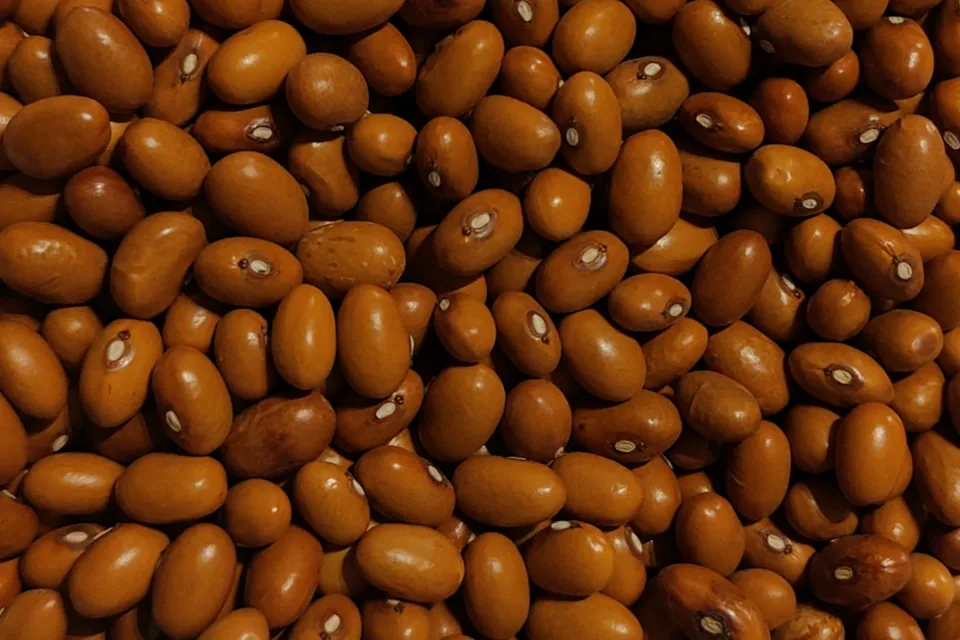
The poverello white bean has large, egg-shaped seeds with a thin, white, glossy skin and no markings. It is easy to cook and delicate in taste; before cooking it needs at least 45 minutes of soaking.
It is a local ecotype, grown since very ancient times in the same irrigated mountain plots, and well suited to its environment: research carried out in the 1990s showed its natural resistance to pests that attack other varieties in the same area. The Presidium also safeguards how it is grown, with no chemical weedkillers and only manure as fertiliser.
It is harvested in autumn, but as a dried product it can be found all year round.
Sources: Fondazione Slow Food — Presidio Fagiolo poverello bianco
In the kitchen
The poverello bean goes into creams, minestrone, toasts and salads, but the dish that best represents it is a particular pasta and beans. It is made with tubetti, a short smooth pasta, extra virgin olive oil, zafarana, a powder of crisp red peppers, and hot chilli.
For the oil, the Presidium profile suggests that of the dolce di Rossano cultivar, itself protected by a Slow Food Presidium: a pairing that brings together two products of the same region.
The best cooking is slow, over the fire, in a clay pot, which respects the thin skin and keeps the bean soft and whole. It is a cuisine that asks for time, like the farming it comes from.
Sources: Fondazione Slow Food — Presidio Fagiolo poverello bianco
Where to taste it
The poverello bean is grown in the municipalities of the Pollino National Park, especially in the mountain villages on the Calabrian side where irrigated plots are still in use. It is in these villages, among chestnut woods and irrigated plots, that visitors can see the farming landscape the Presidium aims to protect.
The best time to visit the area with this product in mind is autumn, between October and early November, when the pods are picked and laid out to dry on racks. The dried bean, however, is available all year.
A trip to the Pollino, the large park straddling Basilicata and Calabria, is a chance to taste pasta and beans made the local way, with zafarana and chilli.
Sources: Fondazione Slow Food — Presidio Fagiolo poverello bianco
Protection
- Traditional agri-food product (PAT) — Calabria, n. 88, 26th revision (Masaf — Elenco nazionale dei prodotti agroalimentari tradizionali, XXVI revisione (2026))
- Slow Food Presidium — fagiolo-poverello (Fondazione Slow Food — Presidio Fagiolo poverello bianco)
When
- Harvest: October–November (Fondazione Slow Food — Presidio Fagiolo poverello bianco)
- Autumn
Where

Pollino
A mountain landscape shared by Calabria and Basilicata, explored through walks, villages and a considered pace.
Read the guide →Photo: Gianni Lupindo / Wikimedia Commons — CC BY-SA 3.0 · Resized and converted to WebP.

Read more
Beans and cooking of the Pollino
From Rotonda white beans to the Calabrian poverello bianco, from Terranova beans to paddaccio and mischiglio: the cooking of Italy's largest national park, across its Lucanian and Calabrian sides.
Read the guide →Photo: Generale Lee / Wikimedia Commons — CC BY-SA 4.0 · Resized and converted to WebP.
