APULICA / Food guides
Rotonda: the aubergine that looks like a tomato and the white beans of the Mercure valley
Rotonda, on the Lucanian side of the Pollino, is a small village of kitchen gardens with two protected designation of origin products. The red aubergine, orange and round like a tomato, has an aroma recalling prickly pear and a spicy, slightly bitter taste; the white beans, with very thin skins, grow on chestnut stakes in the Mercure valley. This guide explains where they come from, how they are grown, what the specifications say, how they are cooked and how to fit them into a trip to the Pollino National Park in late summer and autumn.
An aubergine from Africa
The Rotonda red aubergine belongs to the species Solanum aethiopicum, a distant relative of the common aubergine. Sources agree on its African origin but not on the date. Qualigeo recounts that many Rotonda families emigrated for work to the colonies and that in 1935, before the Ethiopian war, those who returned brought this 'curious' aubergine with them, which adapted to the area and eventually became distinct from the very African varieties it came from. The Slow Food Foundation, in its Ark of Taste entry, instead dates its arrival to the late 19th century, probably with soldiers returning from colonial wars. Both sources mention the dialect name: 'merlingiana a pummadora', tomato aubergine. Qualigeo cites interviews with the oldest farmers, collected in a 1992 CNR research project, as evidence of widespread use since the mid-20th century.
Sources: Qualigeo (Fondazione Qualivita) — Melanzana Rossa di Rotonda DOP · Fondazione Slow Food — Arca del Gusto: Melanzana rossa di Rotonda
Orange, fragrant, white when cut
Under the specification summarised by Qualigeo, the PDO red aubergine is grown in Rotonda, Viggianello, Castelluccio Superiore and Castelluccio Inferiore. Seedlings, 10-15 centimetres tall and from the area, are transplanted in May and June; harvest, by hand with scissors, runs from July to November, with a maximum of 60 tonnes per hectare. The fruit is round like a tomato, weighs up to 200 grams and turns from greenish to bright orange shading to glossy red; the flesh is meaty, the aroma intense and fruity, recalling prickly pear, and the taste spicy with a slightly bitter finish. Its chlorogenic acid content is very low, about 800 parts per million against 4,300 in other products of the same species: that is why the flesh stays white long after cutting. Slow Food stresses that this makes it well suited to processing and preserving.
Sources: Qualigeo (Fondazione Qualivita) — Melanzana Rossa di Rotonda DOP · Fondazione Slow Food — Arca del Gusto: Melanzana rossa di Rotonda
White beans on chestnut stakes
Fagioli Bianchi di Rotonda PDO include two ecotypes, the Fagiolo Bianco and the Tondino or Poverello Bianco, sold fresh in the pod or dried. The area is the same as for the aubergine, inside the Pollino National Park. Qualigeo describes a handed-down technique: sowing, by hand or machine, runs from 20 April to 10 July, and the climbing plants grow up handmade stakes of chestnut wood from the Mercure valley woods, arranged 'a postarella' or 'a rete', a local system that helps air circulate between rows. The specification published by the Basilicata Chamber of Commerce names the irrigated area on the Lucanian side of the Mercure valley and sets the fresh harvest from 1 August to 30 October, up to 13 tonnes per hectare, and the dry harvest from 15 September to 30 November, up to 2.5 tonnes. The Park adds that these beans do not adapt below 600 metres.
Sources: Qualigeo (Fondazione Qualivita) — Fagioli Bianchi di Rotonda DOP · Camera di Commercio della Basilicata — Disciplinare DOP Fagioli bianchi di Rotonda · Parco Nazionale del Pollino — Sapori
Thin skins and Garibaldi's visit
Fresh pods are white, shading to yellow or ivory, without streaks; the seeds are round-oval, white and unspeckled, with a very thin skin. Qualigeo attributes the thin skin to soils low in limestone and abundant water, which favour starch build-up, and reports up to 27% protein in the dried beans; the practical advantage is much shorter cooking. The first historical references, again according to Qualigeo, appear in Filippo Cirelli's 1853 monograph 'Il Regno delle due Sicilie descritto ed illustrato', which stresses the area's abundant water. Then there is an anecdote: an article in the 'Eco di Basilicata Calabria Campania' of 2 September 1860 recounts that Giuseppe Garibaldi, stopping in Rotonda to eat and sleep, liked these beans so much that he took a small quantity to Caprera.
Sources: Qualigeo (Fondazione Qualivita) — Fagioli Bianchi di Rotonda DOP
Two PDOs and a Presidium
The Qualigeo records give two registration dates: 15 July 2010 for Melanzana Rossa di Rotonda PDO and 11 March 2011 for Fagioli Bianchi di Rotonda PDO. Both fall in the fruit, vegetables and cereals category. Qualigeo lists a protection consortium for each, based in Rotonda. The Pollino National Park notes that the red aubergine has also been a Slow Food Presidium since 2002. The national list of traditional products shows how rich Rotonda's kitchen gardens are: besides these, Basilicata lists the Castelluccisa, Occhio di bue, Panzaredda and Za' Vicenza beans of Rotonda, Rotonda tomato and tomato passata, and sweets such as cucciddatu and Sant'Antonio paniceddri.
Sources: Qualigeo (Fondazione Qualivita) — Melanzana Rossa di Rotonda DOP · Qualigeo (Fondazione Qualivita) — Fagioli Bianchi di Rotonda DOP · Parco Nazionale del Pollino — Sapori · Elenco nazionale dei prodotti agroalimentari tradizionali, XXVI revisione (DM 6 febbraio 2026), suddiviso per regione — copia pubblicata dalla Regione Campania
In the kitchen and the pantry
For the red aubergine, Qualigeo lists very concrete Lucanian recipes: fried and scented with mint and garlic, paired with caciocavallo podolico to dress fusilli, mixed with sausage in meatballs; the leaves, more tender than those of other aubergines, are eaten too, and Slow Food specifies that they are usually battered and fried. Traditionally it is preserved 'nzertata', tied in bunches and hung to dry under eaves, or in oil and vinegar; Slow Food also mentions sweet-and-sour versions, jam, liqueur and chocolates. The Park suggests it as a starter or side dish with meat, with light red wines. For the white beans, Qualigeo mentions escarole and beans, cabbage and beans and minestra impastata of potatoes and beans; fresh beans keep in the fridge in their pods for a few days, dried ones for a long time in a sealed jar in a cool place.
Sources: Qualigeo (Fondazione Qualivita) — Melanzana Rossa di Rotonda DOP · Fondazione Slow Food — Arca del Gusto: Melanzana rossa di Rotonda · Parco Nazionale del Pollino — Sapori · Qualigeo (Fondazione Qualivita) — Fagioli Bianchi di Rotonda DOP
Rotonda and the Pollino Ecomuseum
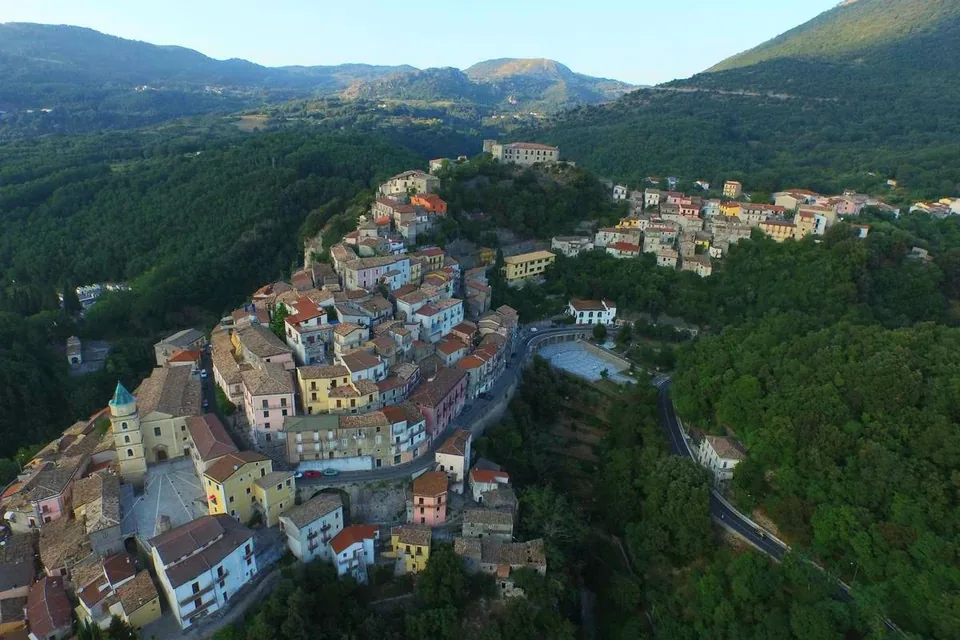
Slow Food describes Rotonda as a village of about 3,000 people at around 600 metres, some fifty kilometres from the sea at Maratea, a small capital of traditional vegetable growing inside the Pollino National Park. In Rotonda, in the monumental complex of Santa Maria della Consolazione, the Park has set up the Pollino Ecomuseum, which uses exhibits, films, 3D reconstructions and tactile and sound settings to tell the history of the protected area, its flora, fauna, culture and traditions: a good starting point to understand the landscape where the aubergines and beans grow. Opening times change with the season and should be checked on the Park website. The Park also mentions, among local cheeses, 'paddaccio', made from sheep's and goat's milk, seasonal, handmade, neither aged nor salted, produced especially in Rotonda, Viggianello and Terranova di Pollino.
Sources: Fondazione Slow Food — Arca del Gusto: Melanzana rossa di Rotonda · Parco Nazionale del Pollino — Ecomuseo del Pollino · Parco Nazionale del Pollino — Sapori
When to go and how to taste
The right season to see and taste both products fresh is August to October: aubergines are harvested from July to November, fresh beans from August to late October, and in September the Mercure valley fields show chestnut stakes laden with pods. Qualigeo mentions an annual red aubergine festival, but in the sources consulted we found no official, fixed dates: ask the Municipality or the consortia. At the table I would try the aubergine two ways, fried with mint and garlic and preserved in oil, to feel how the spiciness changes; the beans in a simple soup, to appreciate the skin that almost disappears. To take home, dried beans and aubergines in oil travel well. Visits to kitchen gardens and workshops should be arranged with the operators.
A thread for your journey
Journey idea: a September morning in Rotonda, with the Pollino Ecomuseum to understand the park and a walk among the kitchen gardens of the Mercure valley, where beans climb chestnut stakes; for lunch red aubergine fried with mint and garlic and a white bean soup; in the afternoon Viggianello and its views over the valley. Field visits to be arranged with the operators.
Talk to us