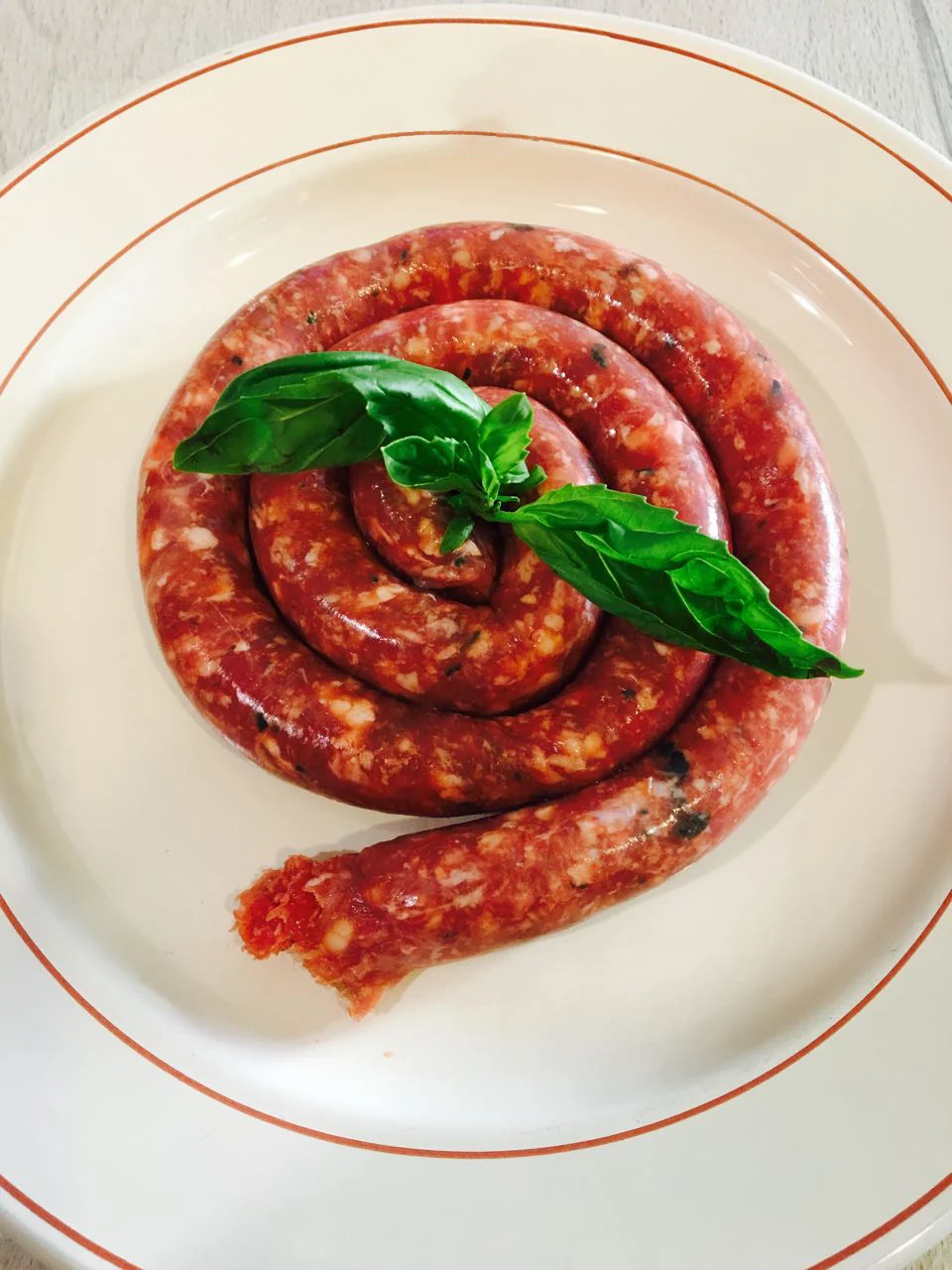
The zampina of Sammichele
The proposed production rules drafted by the promoting committee and published by the Region describe zampina as beef and lamb or mutton, aged cheese, tomato, basil, pepper and salt, stuffed into casing and coiled into a spiral for cooking. The atlas of traditional foods also includes some pork and notes that proportions change with the season and from one butcher’s family to another: some add white wine to the mix, others have replaced thyme with basil.
The casing is lamb or kid, and the spiral is held by two wooden skewers which, some say, recall a hen’s foot. Another explanation of the name, recorded by the Sammichele poet Stefano Mallardi, tells of a misunderstanding between the Count of Mola, the Portuguese Miguel Vaaz, and a servant: for the count the “zampina” was the iron that held the spit, not the sausage.
What matters here is the combination of meats and the way it is cooked, always over embers. We do not extend this recipe to all Puglian sausages, nor do we attribute to the proposal a PGI status the source does not document.
Sources: Regione Puglia — proposta di disciplinare Zampina · Atlante dei PAT di Puglia (Regione Puglia, Università di Bari) — Zampina di Sammichele di Bari
The zampina festival
The PAT atlas notes that the zampina festival was founded in 1967 by the butchers of Sammichele di Bari, to make this traditionally prepared sausage better known. It has grown since then and is now called the Festival of Zampina, Bocconcino and Good Wine.
The Municipality of Sammichele has published the programme of the sixtieth edition, presented as three days of music, celebration, food and wine. The PAT profile places the event traditionally at the end of September; when planning a trip, always check dates and programme for the year on the municipal website, as they can change.
The atlas also records that the product’s name has changed in the national list of traditional foods: added in 2001 as “Zampina”, since 2014 it has appeared as “Zampina di Sammichele di Bari”, explicitly linking the recipe to the town. Zampina is sold in butchers’ shops, grill houses and restaurants, loose or packaged; it must be kept refrigerated and eaten within a few days, one more reason to taste it on the spot.
Sources: Atlante dei PAT di Puglia (Regione Puglia, Università di Bari) — Zampina di Sammichele di Bari · Comune di Sammichele di Bari — Programma della 60ª Sagra della Zampina, del Bocconcino e del Buon Vino
Knife-cut on the Murgia
On the Alta Murgia the atlas records a different sausage, cut “a punta di coltello”, with the tip of a knife. It belongs to the tradition of Gravina in Puglia and is also found in Altamura, Poggiorsini and especially Spinazzola. It is made from lean pork, ham and shoulder, with a small proportion of lard, all cut by hand; wild fennel seeds, hot chilli known as “diavolicchio” or sweet chilli, sea salt and Malvasia white wine from Gravina are added.
The casing has its own preparation: it is washed with salted water and left to steep with fennel and orange peel. Once stuffed, the sausage is divided into lengths called “ferse” and pricked with a large needle, the “cuscedd”, to release water and air. It then hangs for three or four weeks to dry and mature.
The result, according to the profile, is dark red interrupted by white cubes of lard, soft in texture and sweet in flavour with strong notes of wild fennel and chilli. It is made in autumn and winter, and Spinazzola dedicates a festival to it.
Salento and the Daunian Mountains: two distant recipes
At the two ends of the region the atlas describes very different sausages. In the province of Lecce, Salento-style sausage combines equal parts of pork and beef, finely minced and seasoned with salt, black pepper and lemon zest, which gives a fresh note; parsley, cinnamon or cloves are often added. It is only a few centimetres long, cooked on the grill or in a pan, and the profile cites a Salento recipe of bucatini with wild hyacinth bulbs and sausage.
In the Apennines of Capitanata, around Lucera, Faeto, Biccari and Sant’Agata di Puglia, the sausage is pork only, knife-cut and seasoned with ground chilli and fennel. It is shaped like a horseshoe, dries for three or four weeks in airy rooms and can be preserved under lard or extra virgin olive oil. The season given runs from September to May.
Setting these two profiles side by side shows how much the territory matters: a fresh, citrus-scented sausage on one hand, a dried mountain sausage on the other, each with festivals in many villages.
Sources: Atlante dei PAT di Puglia (Regione Puglia, Università di Bari) — Salsiccia alla salentina · Atlante dei PAT di Puglia (Regione Puglia, Università di Bari) — Salsiccia dell’Appennino Dauno
The beef salsicciotti of Laterza
In Laterza, in the province of Taranto, the atlas records a sausage that stands apart for two reasons. The first is the meat: beef trimmings rather than pork, finely minced and seasoned with salt, pepper and parsley, then mixed with water. The second is the shape: the mixture goes into sheep casings tied at short intervals, and each salsicciotto remains a single piece rather than forming a ring or a spiral like zampina.
Cooking is part of its identity. The salsicciotti are threaded onto a spit and cooked briefly in the town’s typical domed oven, fired with woodland timber. The profile specifies that the meat comes from local breeds raised traditionally on the Murgia, and that the dialect name is “salszett da Terz”.
Among the references is a 1941 book on the history of Laterza, a sign of a long-documented tradition. The local butchers’ association organises a roast-meat festival in summer, and a bread and roast festival takes place in September: chances to taste them alongside meat cooked in the fornello.
Sources: Atlante dei PAT di Puglia (Regione Puglia, Università di Bari) — Salsicciotti di Laterza
Fornello meats and bombette
In the Itria Valley, grilled meat has a precise setting: the butcher’s fornello oven. The atlas describes Locorotondo’s fornello meat as skewers of lamb and young mutton, offal included, cooked in a closed oven over oak or holm-oak embers; the skewers stand upright, away from the fire, so that fat does not drip onto the coals. The profile recounts that butchers used to cook meat for farm workers who bought it ready at the end of the day: hence the butcher-trattorias and grill houses of today.
Italia.it describes Cisternino as the village of “fornelli pronti”, butchers’ shops with an oven and small rooms where you can eat gnummareddi and bombette. It also mentions Locorotondo’s fornello meat and tripe rolls slow-cooked in an earthenware pot, noting that names and dishes change from village to village.
The bombetta, according to the PAT, is a round roll of pork capocollo filled with cheese, salt and pepper, cooked on the grill or in the fornello. The profile dates it to 1980 in Martina Franca, an invention also claimed by Cisternino. A grilled roll, then, is not necessarily a sausage.
Sources: Atlante dei PAT di Puglia (Regione Puglia, Università di Bari) — Carne al fornello di Locorotondo · Italia.it — prodotti e piatti pugliesi · PAT Puglia — Bombetta
One preparation at a time
For a first tasting, choose a simple preparation and ask which meat and seasoning were used. The profiles show big differences: pork, beef, lamb or a mix; fennel, lemon, cheese or tomato. Knowing what is inside makes the tasting far more interesting.
When comparing a sausage with a roll, separate the texture of the meat from the flavour of the seasoning: a more useful question than the vague “which is best?”. Look first at the surface, then at the cut: how the outside and centre hold together, and which ingredient remains recognisable. A bite with little accompaniment lets you follow the meat; a later one with the side dish suggests the pairing.
Do not turn the meal into a contest of variations: three different fillings on the same plate can hide the point of the method. A small side dish and bread leave room for the meat, and richer variants can become a second comparison on another day. For anyone who loves cooking, the butcher’s explanation is worth as much as the dish itself.
Itria Valley and Murgia: a route
For the journey, link Martina Franca, Locorotondo and Cisternino. Italia.it suggests exactly this route: Martina Franca for capocollo, made from pigs raised in the woods around the town, and for Martina Franca DOC wine; Locorotondo a few kilometres away, along the wine roads of the Itria Valley; Cisternino with its lanes scented by embers. Choose one town for dinner and leave the others for walking.
Santeramo in Colle can be a different chapter, beside the Murgia. The Alta Murgia National Park has sponsored the town’s roast-meat festival, held in September in recent editions, with tastings of oil, wine, bread, fresh pasta and cheese from local producers, presented as an expression of the Murgia’s short supply chain.
The common thread is the passage from the butcher’s counter to the cooked dish, keeping in mind that every town has its own recipe. Before leaving, always check festival calendars, and for dinner prefer a single main stop, so that the memory of each preparation stays distinct.
Sources: Italia.it — prodotti e piatti pugliesi · Parco nazionale dell’Alta Murgia — 13ª Sagra della carne arrosto a Santeramo in Colle
A thread for your journey
Journey idea: an Itria Valley dinner devoted to one well-explained preparation. Place any Murgia comparison on another day so that meat remains part of the journey rather than dominating it.
Talk to us