
APULICA / FISH AND SEAFOOD
Salted anchovies
PAT · Fish and seafood · Calabria, Campania
In brief
- Salting gave families anchovies for months, even when rough seas kept the boats in harbour. (Regione Campania — Acciughe sotto sale e alicette piccanti (prodotto tradizionale))
- In Calabria the headless, gutted anchovies are laid in layers with coarse salt and pressed under weights. (Regione Calabria — Schede PAT: preparazioni di pesci, molluschi e crostacei (237-257))
- The Calabrian record gives a maturing period in a cool room of roughly six months to a year. (Regione Calabria — Schede PAT: preparazioni di pesci, molluschi e crostacei (237-257))
- Calabria and Campania list them as traditional products, under three separate entries in the national list. (Masaf — Elenco nazionale dei prodotti agroalimentari tradizionali, XXVI revisione (2026))
History and origin
Putting anchovies under salt is one of the oldest ways of keeping oily fish, and along the coasts of Campania and Calabria it has stayed an everyday practice. The Campania Region notes that anchovy fishing is alive in every coastal town of the provinces of Naples and Salerno, and that the salted recipe has not changed over time for a practical reason: salted fish keeps for months and can be eaten when bad weather stops the boats going out or the catch is poor.
The Calabria Region's record tells a similar story. Salted anchovies began as a preserve made by the fishermen themselves, and production later spread to other food businesses. In the past the acciugai, the people who worked this fish, kept the jars in their cellars, where it kept best, just like cured meats and cheeses.
The product appears three times in the national list: as Alici salate and as Acciughe salate in Calabria, and as Acciughe sotto sale in Campania.
Sources: Regione Campania — Acciughe sotto sale e alicette piccanti (prodotto tradizionale) · Regione Calabria — Schede PAT: preparazioni di pesci, molluschi e crostacei (237-257) · Masaf — Elenco nazionale dei prodotti agroalimentari tradizionali, XXVI revisione (2026)
Area and method of production
In Campania the method, used both at home and by small businesses, involves two saltings. The fresh anchovies stay under salt for about two days, are then fully cleaned, salted a second time and covered with weights, so that the pressure draws out the blood naturally. The fish is then left to mature.
The Calabrian record, which covers the whole region, describes entirely manual work. The fresh fish, with head and guts removed, goes into brine in large glass containers; it is then washed in salted water and arranged in layers, each covered with coarse salt. After a week, once the fish has given up water and fat, the containers are pressed and stacked in towers. Brine is added every day, bringing the remaining fat to the surface to be skimmed off.
The anchovies then mature in cool rooms, at around 6-7 degrees and under special weights, for anywhere from six months to a year. Work is concentrated between March and June, and maturing carries on even after the containers are sealed.
Sources: Regione Campania — Acciughe sotto sale e alicette piccanti (prodotto tradizionale) · Regione Calabria — Schede PAT: preparazioni di pesci, molluschi e crostacei (237-257)
How to recognise it
Calabrian salted anchovies are long and tapered, about nine or ten centimetres on average, and are sold in packs of around half a kilo. The regional record describes the taste as that of lightly salted fish, the smell as very pleasant and, for the Alici salate entry, the colour as grey. There are only three ingredients: fresh fish, salt and wild fennel.
In Calabrian dialect the product is called alici salati. The mark of careful work is the removal of fat, which in the final stage is skimmed off day after day as the brine brings it to the surface.
In Campania, alongside plain salted anchovies, there is a spicy version: at the second salting the fish is mixed with ground chilli and small pieces of garlic. This variant, alicette piccanti, has its own entry among the region's traditional products.
Sources: Regione Calabria — Schede PAT: preparazioni di pesci, molluschi e crostacei (237-257) · Regione Campania — Acciughe sotto sale e alicette piccanti (prodotto tradizionale) · Masaf — Elenco nazionale dei prodotti agroalimentari tradizionali, XXVI revisione (2026)
Where to taste it
In Campania salted anchovies belong to the seaside towns of the provinces of Naples and Salerno, where anchovy fishing is still a widespread activity: the Amalfi Coast and the Cilento are among the shores where they can be found, in local shops and at the small businesses that prepare them as families once did.
In Calabria the regional record names the whole region as the production area. To prove a tradition of more than twenty-five years it cites Calabrian cookery texts and a business in Cariati, on the Ionian coast in the province of Cosenza, that had been making salted anchovies for twenty years.
Until they are sold, the Calabrian packs stay in cold rooms under the same conditions as during maturing: buyers get fish that has matured slowly, and that keeps doing so even after the container is closed.
Sources: Regione Campania — Acciughe sotto sale e alicette piccanti (prodotto tradizionale) · Regione Calabria — Schede PAT: preparazioni di pesci, molluschi e crostacei (237-257)
Protection
- Traditional agri-food product (PAT) — Calabria, n. 242, 26th revision (Masaf — Elenco nazionale dei prodotti agroalimentari tradizionali, XXVI revisione (2026))
- Traditional agri-food product (PAT) — Calabria, n. 240, 26th revision (Masaf — Elenco nazionale dei prodotti agroalimentari tradizionali, XXVI revisione (2026))
- Traditional agri-food product (PAT) — Campania, n. 581, 26th revision (Masaf — Elenco nazionale dei prodotti agroalimentari tradizionali, XXVI revisione (2026))
When
- Production: March–June (Regione Calabria — Schede PAT: preparazioni di pesci, molluschi e crostacei (237-257))
- Spring
- Summer
Where
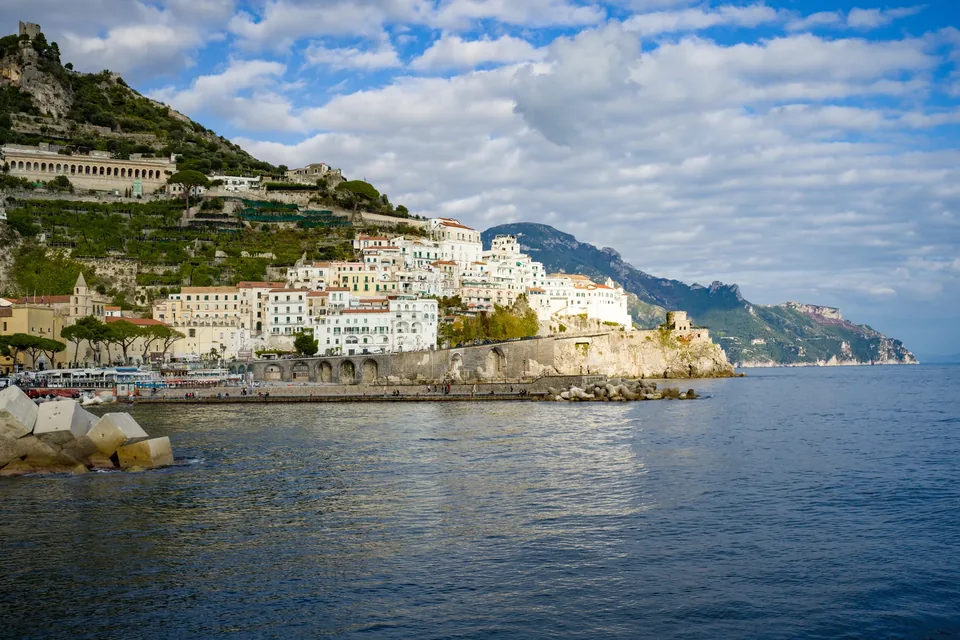
Amalfi Coast
The UNESCO cultural landscape between Positano and Vietri sul Mare: citrus terraces, footpaths, inland valleys and the history of a maritime republic.
Read the guide →Photo: Wolfgang Moroder / Wikimedia Commons — CC BY-SA 3.0 · Resized and converted to WebP.


Cilento
The Cilento, Vallo di Diano and Alburni National Park: coastline, karst mountains, Paestum, Velia and the Padula Charterhouse.
Read the guide →Photo: PaestumPaestum / Wikimedia Commons — CC BY-SA 4.0 · Resized and converted to WebP.
,_East_view.jpg)