

Why go
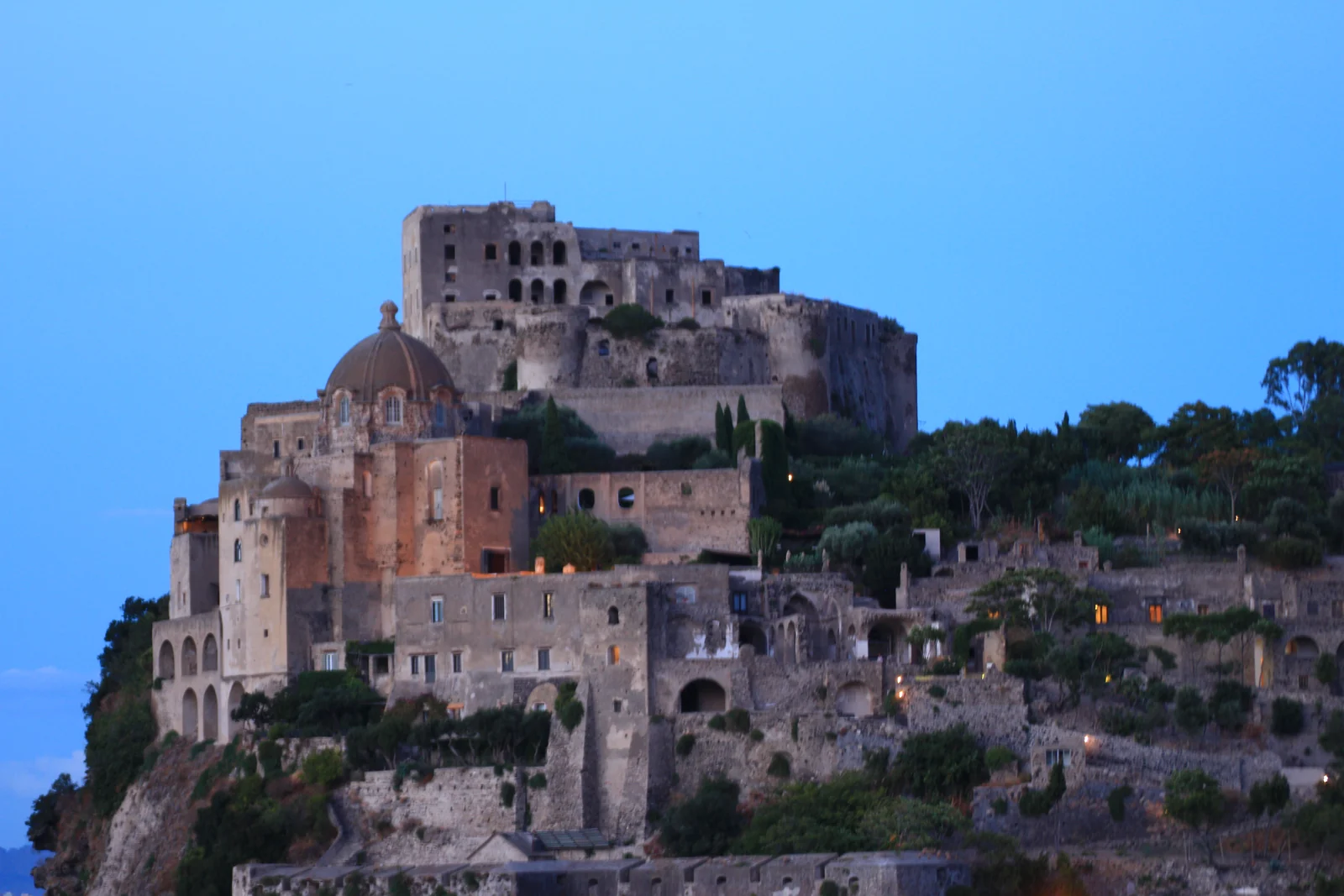
People come to Ischia above all for the Aragonese Castle. The town council describes it as a fortress on a 113-metre islet of trachyte rock, joined by a 220-metre masonry bridge to the old village of Celsa, today Ischia Ponte; inside, a tunnel cut into the rock in the mid-fifteenth century climbs towards the top among churches, terraces and gardens.
The municipality has two faces. Ischia Ponte is the old fishing village, with the cathedral of the Assunta, its lanes and the Spiaggia dei Pescatori below the Castle. Ischia Porto grew up around the harbour that Ferdinand II of Bourbon had opened in 1853-1854 in an old volcanic lake, and has become the island’s point of arrival.
Then there is the sea: the bay of Cartaromana with the Guevara Tower and the rocks of Sant’Anna, where the town council points to hot springs that allow bathing even in midwinter, and where the remains of ancient Aenaria lie on the seabed. On 26 July, at the Sea Festival at the rocks of Sant’Anna, the Castle “catches fire” in a show of lights and fireworks over the water.
Sources: Comune di Ischia — Luoghi: Castello Aragonese (aggiornata il 30 settembre 2026) · Comune di Ischia — Etimologia del nome: il Castello Aragonese e il borgo di Ischia Ponte, il Porto e la Villa de’ Bagni, Cartaromana, l’Acquedotto (aggiornata il 17 febbraio 2021) · Comune di Ischia — Il Mare: le spiagge del Comune d’Ischia (aggiornata il 17 febbraio 2021) · Comune di Ischia — «Ischia in festa», progetto del cartellone degli eventi metropolitani 2025-2026
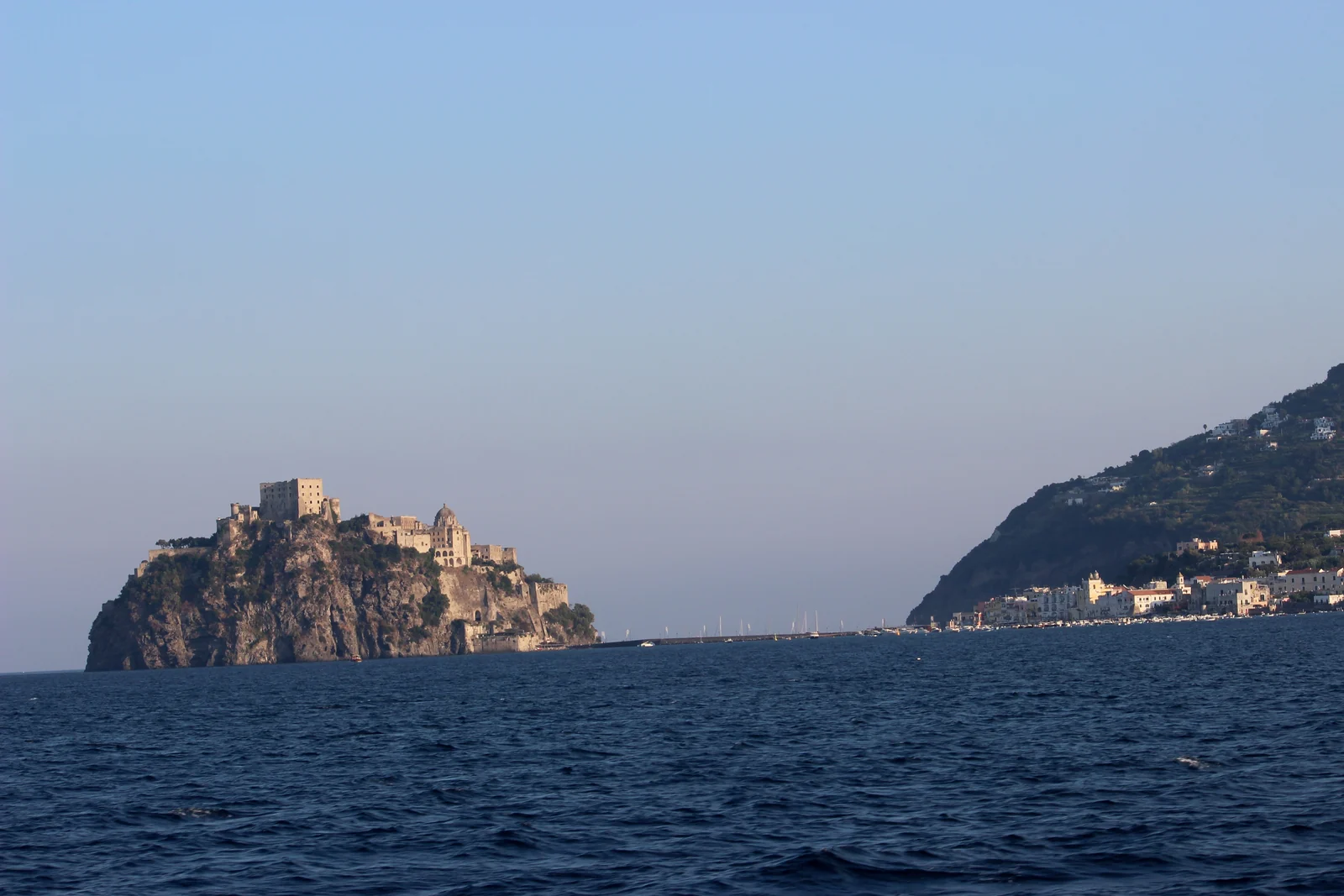
Photo: Miguel Hermoso Cuesta / Wikimedia Commons — CC BY-SA 4.0 · Resized and converted to WebP.
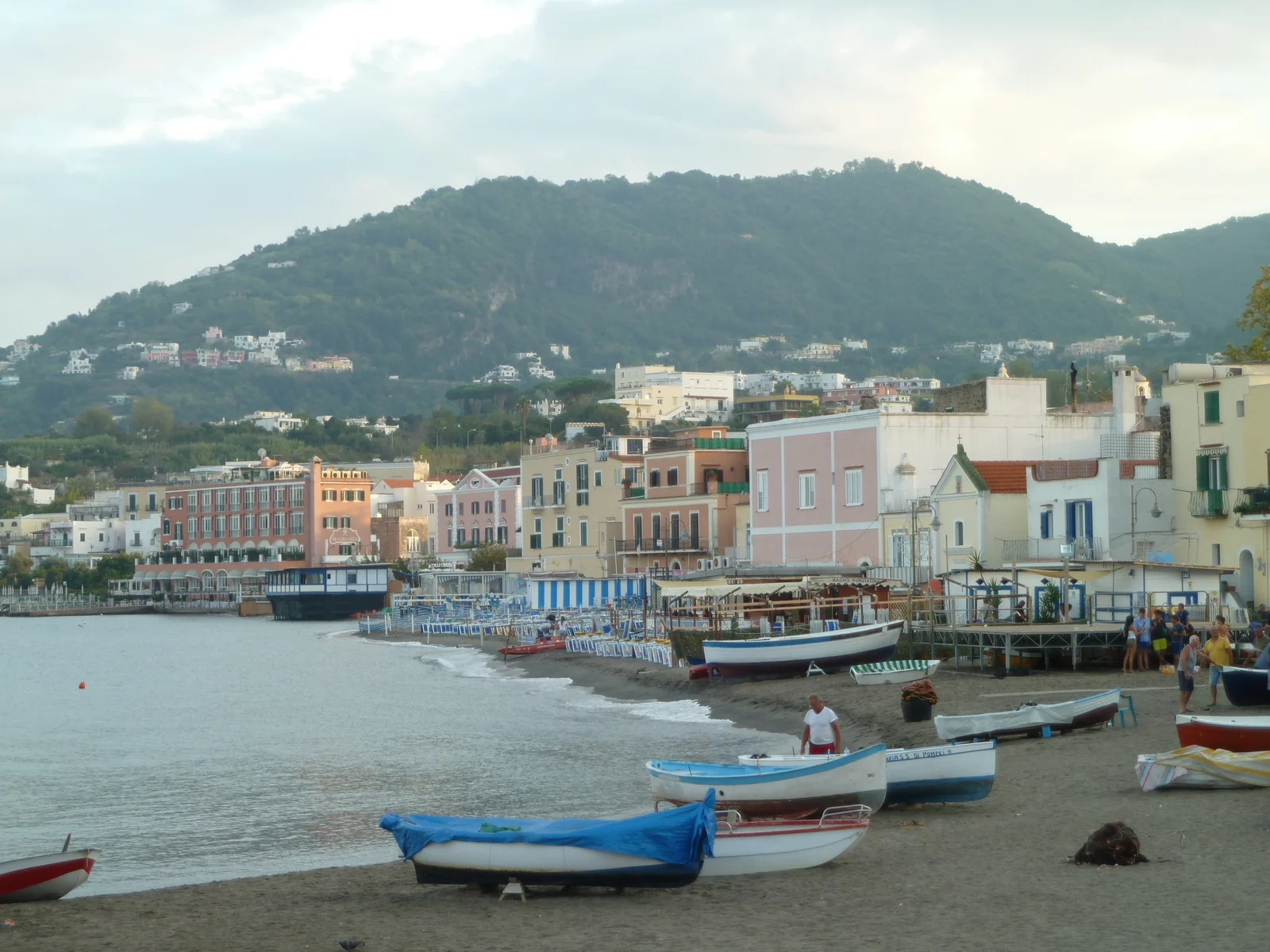
Photo: Abxbay / Wikimedia Commons — CC BY-SA 4.0 · Resized and converted to WebP.
The municipality at a glance
Ischia is a municipality in the Metropolitan City of Naples, in Campania. Its ISTAT code is 063037. On 1 January 2025 it had 19,492 residents. The municipal territory covers 8.14 km² and ranges from -2 to 394 metres above sea level; the town hall stands at about 6 metres.
The municipality includes Ischia Porto, which grew up around the nineteenth-century Bourbon harbour, the old village of Ischia Ponte, also called Celsa, with the islet of the Aragonese Castle, and the hill districts of Campagnano, Sant’Antuono and San Michele, as well as Pilastri, Arenella and Cartaromana.
Sources: ISTAT, Codici statistici delle unità amministrative territoriali: elenco dei comuni al 21 febbraio 2026 · ISTAT, Popolazione residente per età, sesso e stato civile al 1° gennaio 2025 (POSAS) · ISTAT, Principali statistiche geografiche sui comuni: superficie e altimetria al 31 dicembre 2021 · Comune di Ischia — Etimologia del nome: il Castello Aragonese e il borgo di Ischia Ponte, il Porto e la Villa de’ Bagni, Cartaromana, l’Acquedotto (aggiornata il 17 febbraio 2021) · Comune di Ischia — La Natura: le pinete, il Palazzo Reale e la Casina Buonocore, le contrade, il Monte Epomeo (aggiornata il 17 febbraio 2021) · Comune di Ischia — Partenze intelligenti: collegamenti, periodo migliore, in auto a Ischia (aggiornata il 17 febbraio 2021)
History
The town council notes that the name Ischia first appears in 813, in a letter from Pope Leo III to Charlemagne. The island’s oldest names are Greek and Latin: Pithecusa, traced back either to monkeys or to the large clay jars (“pithoi”) made by the Euboeans, and Aenaria in Roman times.
According to the Castle’s website, in 474 BC Hiero of Syracuse, who had come to help the people of Cumae, built a first settlement on the rock, and its old name “Castrum Gironis” is linked either to him or to the ring of walls around the islet. At the foot of the Castle stood the Roman town of Aenaria, stretching from the beach of Cartaromana to today’s cathedral in Ischia Ponte. The town council says that finds from the sea document workshops, metalworking and a busy port, and that the town vanished between AD 130 and 150; on the seabed of Cartaromana there remains a lead and tin foundry at a depth of 5 to 7 metres.
In the Middle Ages the rock was the inhabitants’ refuge against raids. After the Arso eruption of 1301-1302, which destroyed the medieval village and the first cathedral, the people of Ischia moved onto the Castle and built the cathedral of the Assunta there. Alfonso of Aragon took the fortress in 1423, had the access tunnel dug, strengthened the keep and replaced the wooden bridge with the masonry one. On 27 December 1509 the Castle’s cathedral hosted the wedding of Vittoria Colonna and Ferrante d’Avalos: the poet lived on the Castle for some 35 years and gathered a literary circle there. Tradition, as told by the town council, has it that Michelangelo stayed in the Guevara Tower to be near her.
Once the raids ended, people came down from the rock: in 1770 only 63 people lived on the Castle, while the village of Celsa grew and in the eighteenth century became the richest centre on the island. In June 1809 fighting between the French and the Anglo-Bourbon forces devastated the Castle and its cathedral; afterwards the fortress served as a prison, political prisoners included, until 1860. In 1912 the lawyer Nicola Ernesto Mattera bought it from the State for 25,000 lire, and his family has restored it and opened it to the public.
In 1853 Ferdinand II of Bourbon, who stayed at the Buonocore palace beside the Lago del Bagno, had the lake opened to the sea: in July 1854 the royal steamer Delfino entered the new harbour, inaugurated that September. Ischia Porto grew up around it, with the Antiche Terme Comunali and the pine woods planted by the botanist Giovanni Gussone on the Arso lava; after the Second World War tourism made it a fast-growing centre.
Sources: Comune di Ischia — Etimologia del nome: il Castello Aragonese e il borgo di Ischia Ponte, il Porto e la Villa de’ Bagni, Cartaromana, l’Acquedotto (aggiornata il 17 febbraio 2021) · Castello Aragonese d’Ischia (sito ufficiale) — La storia del Castello · Comune di Ischia — La Natura: le pinete, il Palazzo Reale e la Casina Buonocore, le contrade, il Monte Epomeo (aggiornata il 17 febbraio 2021) · Diocesi di Ischia — La Cattedrale
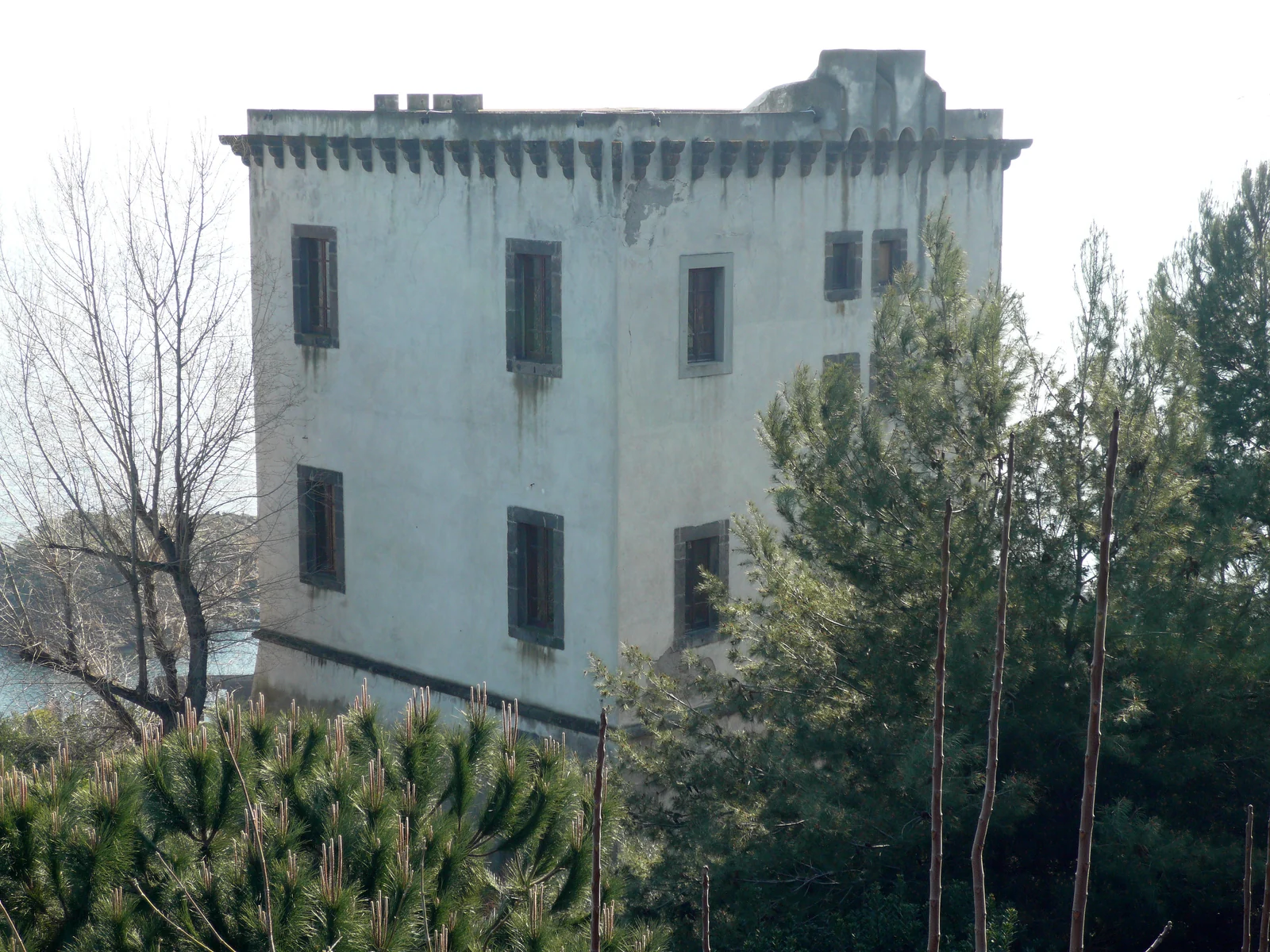
Photo: Dr.Conati Roberto De Martino / Wikimedia Commons — Public domain · Resized and converted to WebP.
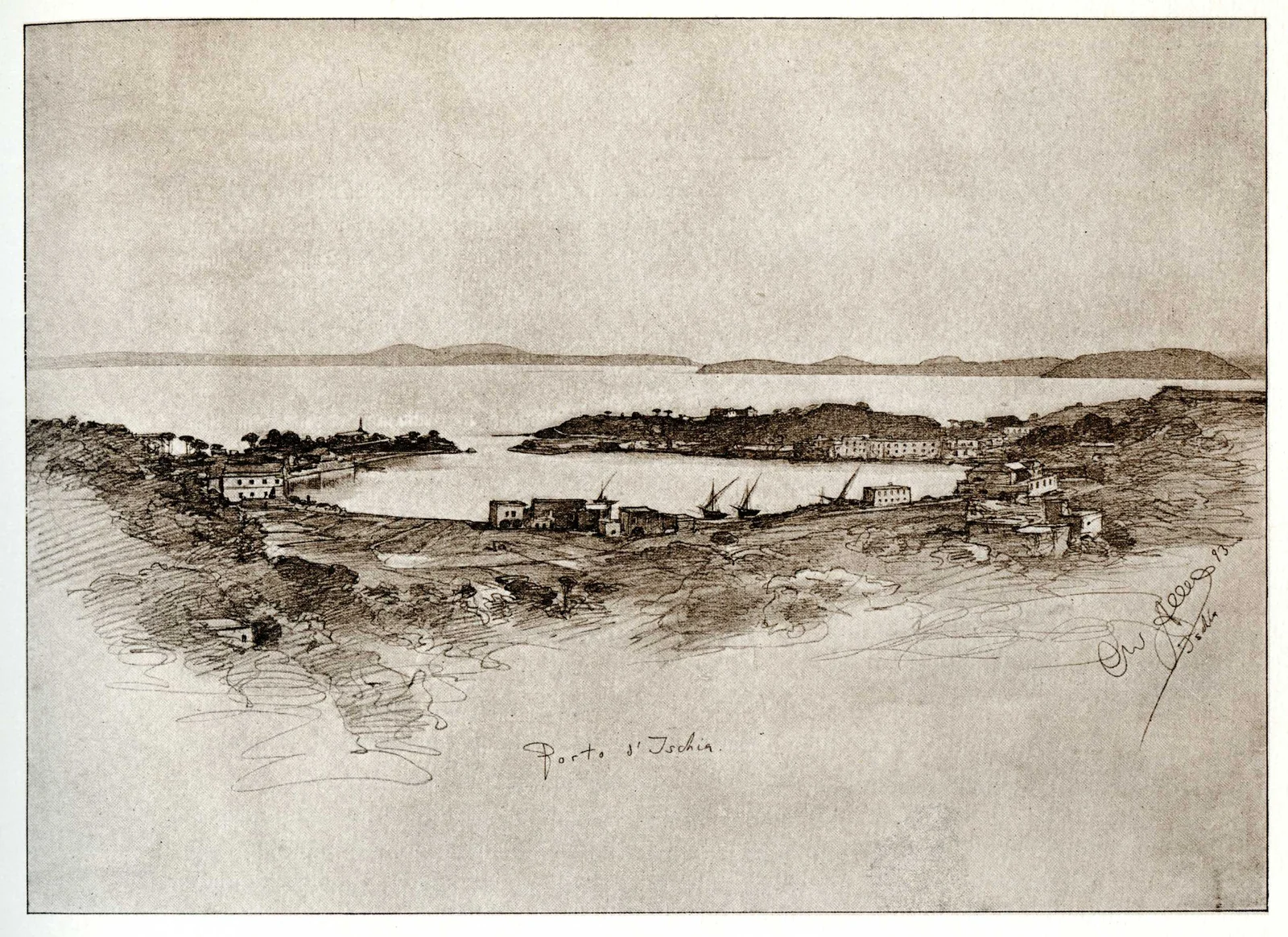
Photo: DenghiùComm / Wikimedia Commons — Public domain · Resized and converted to WebP.
What to see
The Aragonese Castle is a 10-15 minute walk from the town hall, along Via Iasolino and the seafront to the bridge (Via Ponte Aragonese 3). The access tunnel is 400 metres long, lit by skylights that also served as murder holes; since the 1970s a lift cut into the rock has climbed to 60 metres. The official website describes a route of almost 2 kilometres, mostly in the open air, taking about an hour and a half: the church and terrace of the Immacolata, the convent of the Poor Clares with their cemetery, the Bourbon prison, the church of San Pietro a Pantaniello, the old wine presses, the ruins of the cathedral of the Assunta with its frescoed crypt. Wheelchair users can visit only the terrace and church of the Immacolata, with staff assistance booked at least 24 hours ahead. From 3 November 2026 to 6 January 2027 the route is shortened; from 7 January to early March the Castle closes for maintenance.
In Ischia Ponte the cathedral of the Assunta is the former Augustinian church of Santa Maria della Scala, granted to the Chapter in 1810 after the Castle cathedral was destroyed. The Diocese says that today’s building was completed in 1752 to a design by Antonio Martinetti, with stucco work by Cesare Starace and large canvases by Giacinto Diano from 1759-1760. It keeps the wooden Crucifix of the thirteenth to fifteenth century and the icon of the Madonna della Libera brought down from the Castle, and the font where Saint John Joseph of the Cross was baptised on 15 August 1654, made partly with marble from the tomb of Giovanni Cossa. The church was dedicated on 8 July 1860.
Beyond the bridge, at Cartaromana, the Guevara Tower, also called Michelangelo’s Tower, stands in a meadow facing the Castle, a few metres from the rocks of Sant’Anna, on Via Nuova Cartaromana. The town council links it to Alfonso of Aragon’s 1433 plan of coastal towers and to the Guevara family. On the boundary with Barano runs the Pilastri aqueduct, begun in 1580 and resumed in 1673 by Bishop Girolamo Rocca to bring the water of the Buceto spring to Ischia Ponte. In Ischia Porto stand the Casina Reale Buonocore, from 1735, now a military facility with two lions at the entrance, and the Pompeian-red Palazzo D’Ambra on the left bank of the harbour. The Biblioteca comunale Antoniana, at the Mandra, holds about 27,000 volumes.
Sources: Comune di Ischia — Luoghi: Castello Aragonese (aggiornata il 30 settembre 2026) · Castello Aragonese d’Ischia (sito ufficiale) — Programma la tua visita: informazioni, orari, tariffe, accessibilità · Diocesi di Ischia — La Cattedrale · Diocesi di Ischia — San Giovan Giuseppe della Croce · Comune di Ischia — Luoghi: Torre di Guevara · Comune di Ischia — Etimologia del nome: il Castello Aragonese e il borgo di Ischia Ponte, il Porto e la Villa de’ Bagni, Cartaromana, l’Acquedotto (aggiornata il 17 febbraio 2021) · Comune di Ischia — La Natura: le pinete, il Palazzo Reale e la Casina Buonocore, le contrade, il Monte Epomeo (aggiornata il 17 febbraio 2021) · Comune di Ischia — Luoghi: Comando di polizia municipale, Palazzo D’Ambra · Comune di Ischia — Luoghi: Biblioteca comunale Antoniana
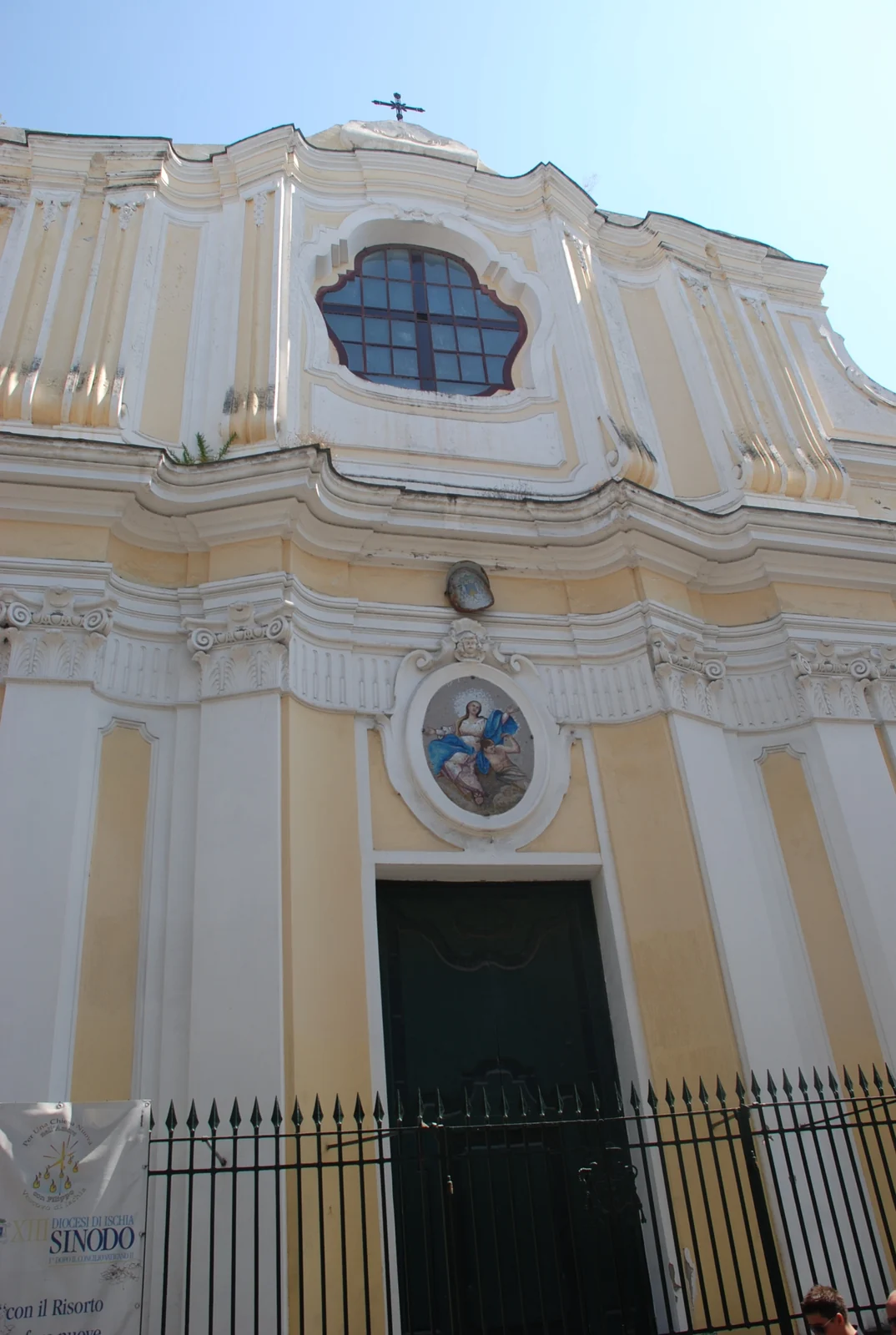
Photo: chiaramarra / Wikimedia Commons — CC BY 2.0 · Resized and converted to WebP.
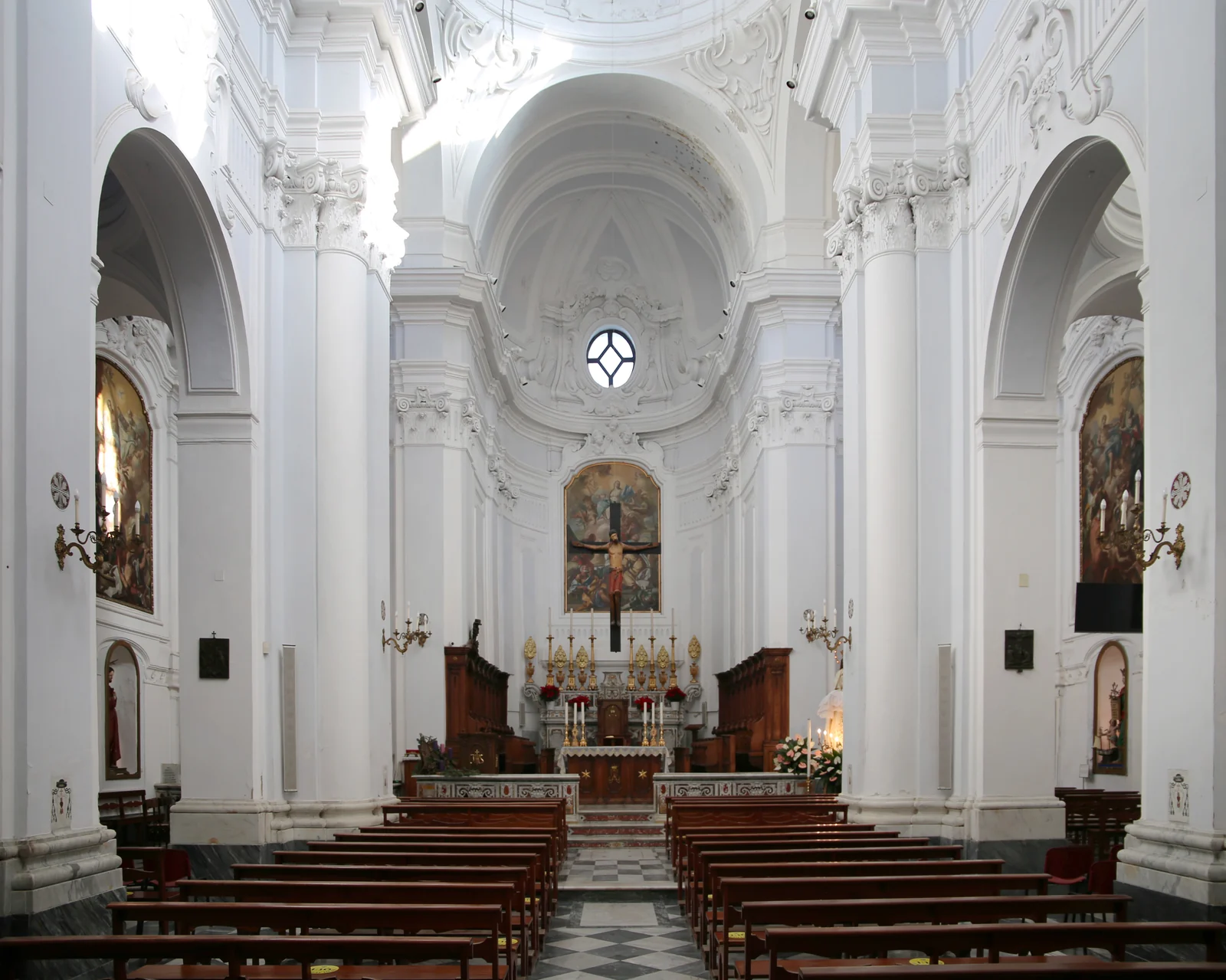
Photo: Sailko / Wikimedia Commons — CC BY-SA 4.0 · Resized and converted to WebP.
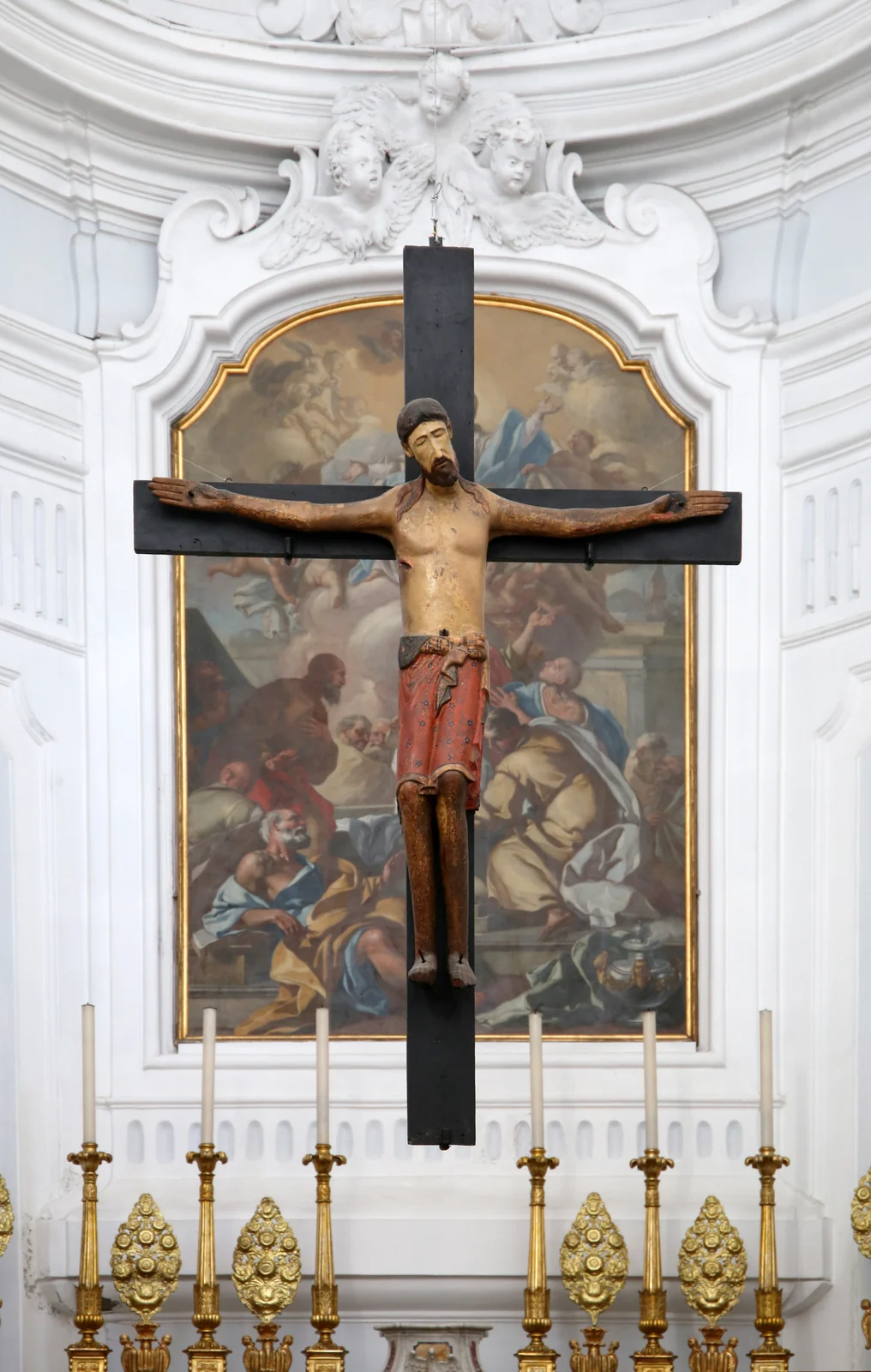
Photo: Sailko / Wikimedia Commons — CC BY-SA 4.0 · Resized and converted to WebP.
Food and wine
The town council describes a cuisine born of fishing and farming on an island where everyone tilled their own small plot. The Sunday dish is rabbit Ischia-style; in recent years the raising of “coniglio di fosso” has returned, rabbits growing in deep burrows dug into the ground and fed on grass. From the sea comes fish “all’acqua pazza”, which the council considers an entirely Ischian dish: born of the leftover bait that sea bream fishermen gave to the poorest, cooked in water with garlic, chilli and parsley. Bread and onion and stale bread soaked in the cooking water of beans also belong to the old frugal table.
The wine has been a controlled designation of origin, “Ischia”, since 1966. The production rules allow white (also superiore and sparkling), red, Forastera, Biancolella and Piedirosso, locally called Per’ e Palummo, also as a passito. The white combines Forastera and Biancolella, the red Guarnaccia and Piedirosso. The grapes must come from the island, from vineyards on volcanic soils rich in pumice, and winemaking, bottle ageing and sparkling production take place on the island. The districts of Campagnano, Sant’Antuono and San Michele, the council says, still have vineyards and olive groves.
Sources: Comune di Ischia — In cucina: storia minima della gastronomia ischitana (aggiornata il 17 febbraio 2021) · Ministero dell’agricoltura, Catalogo nazionale delle varietà di vite — Disciplinare di produzione dei vini a DOC «Ischia» (ultima modifica DM 7 marzo 2014) · Comune di Ischia — La Natura: le pinete, il Palazzo Reale e la Casina Buonocore, le contrade, il Monte Epomeo (aggiornata il 17 febbraio 2021)
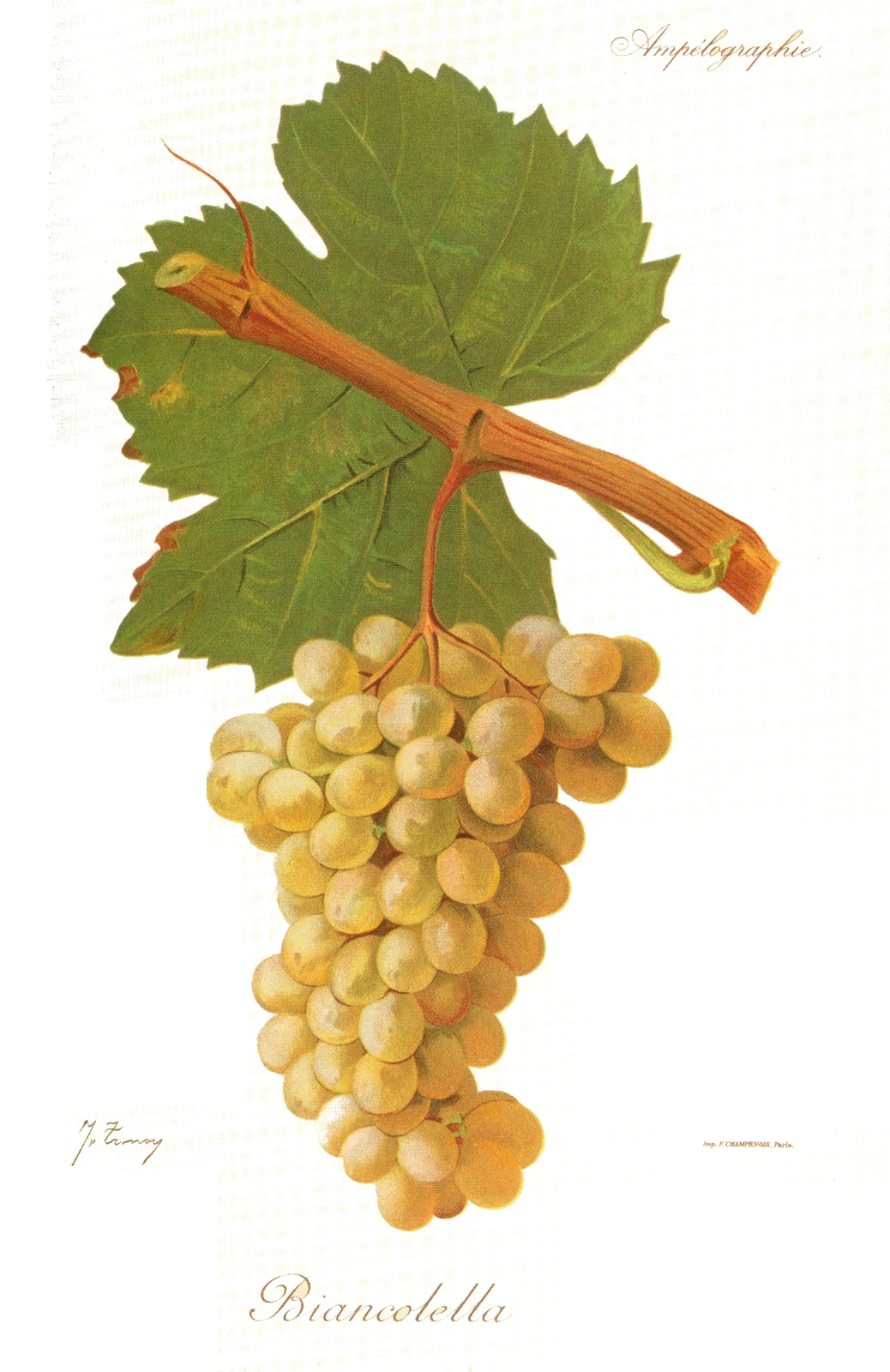
Photo: Jules Troncy / Wikimedia Commons — Public domain · Resized and converted to WebP.
Things to do
The municipality’s beaches, as described by the town council, run from the harbour to the Ponte: the beach of San Pietro, where boats were once hauled ashore, and the long fine-sand Spiaggia dei Pescatori at the Mandra, with beach clubs and equipped stretches. The Spiaggia degli Inglesi, about 800 metres from the harbour, is reached on foot over the Sant’Alessandro hill or from the Banchina Olimpica, or by boat; it is sheltered, of pebbles and sand, with a gently shelving bottom suited to children. Cartaromana is reached from Via Cartaromana by a footpath of about 700 metres or by taxi boat from Ischia Porto and Ischia Ponte; its seabed, rich in posidonia, is popular with divers.
For greenery, the council points to the three pine woods grown on the Arso lava, planted from 1850 with stone and maritime pines, among them the Villari and the Nenzi Bozzi. The districts of Campagnano, Sant’Antuono and San Michele lend themselves to long walks, with views of Capri and Cumae. The municipality, the council says, is easy to get around on foot or by bicycle.
At the Castle, in summer, there is a theatrical visit on Wednesday evenings by booking, “I fantasmi del Castello”; there are guided tours, two panoramic cafés and art exhibitions. The town council organises free concerts in its squares: on 29 December 2025 in Piazza degli Eroi, and New Year’s Eve in Piazza Antica Reggia.
Sources: Comune di Ischia — Il Mare: le spiagge del Comune d’Ischia (aggiornata il 17 febbraio 2021) · Comune di Ischia — La Natura: le pinete, il Palazzo Reale e la Casina Buonocore, le contrade, il Monte Epomeo (aggiornata il 17 febbraio 2021) · Comune di Ischia — Come mi muovo: autobus, taxi, noleggi (aggiornata il 17 febbraio 2021) · Castello Aragonese d’Ischia (sito ufficiale) — Programma la tua visita: informazioni, orari, tariffe, accessibilità · Comune di Ischia — «Ischia in festa», progetto del cartellone degli eventi metropolitani 2025-2026
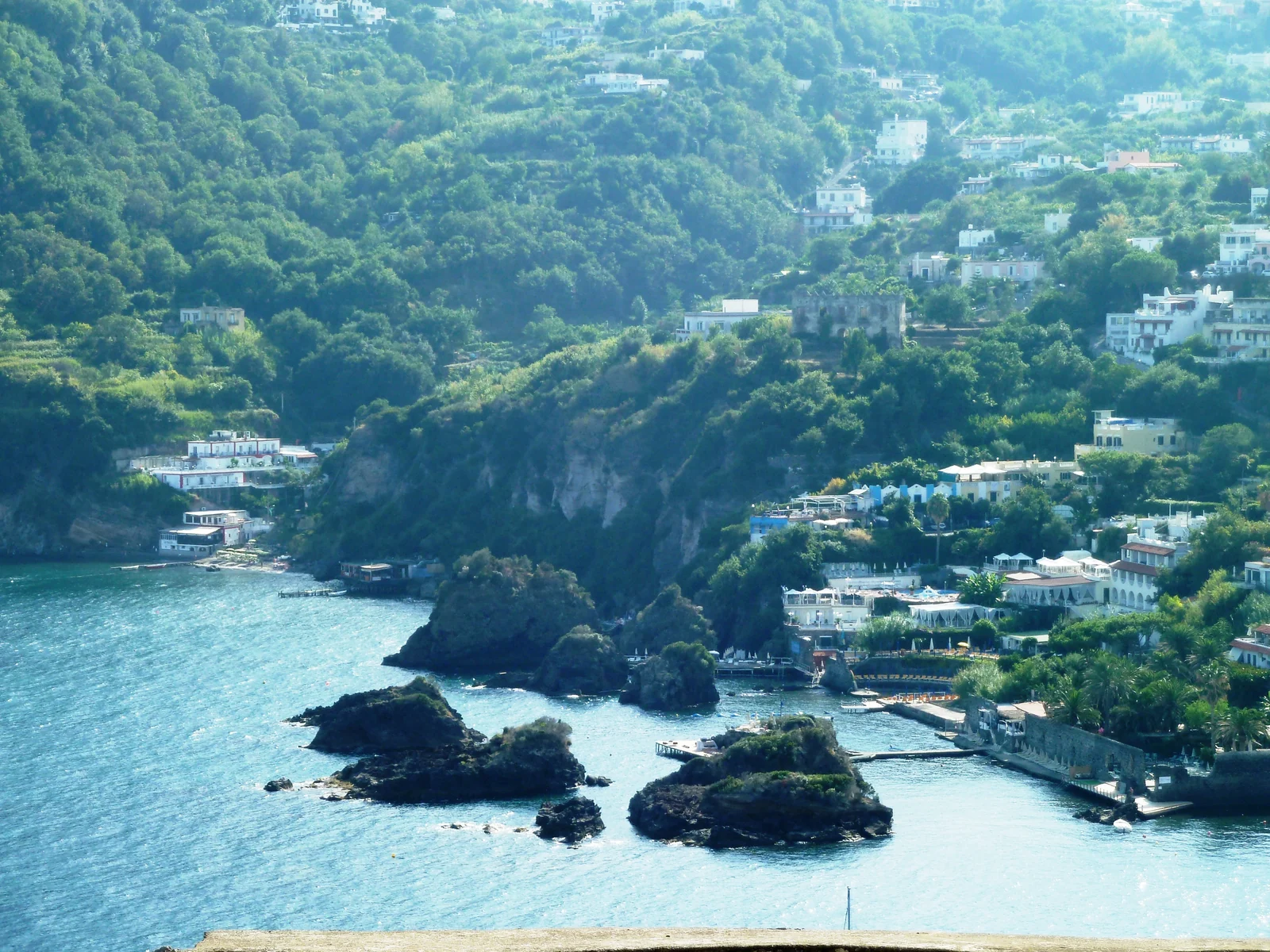
Photo: Abxbay / Wikimedia Commons — CC BY-SA 4.0 · Resized and converted to WebP.
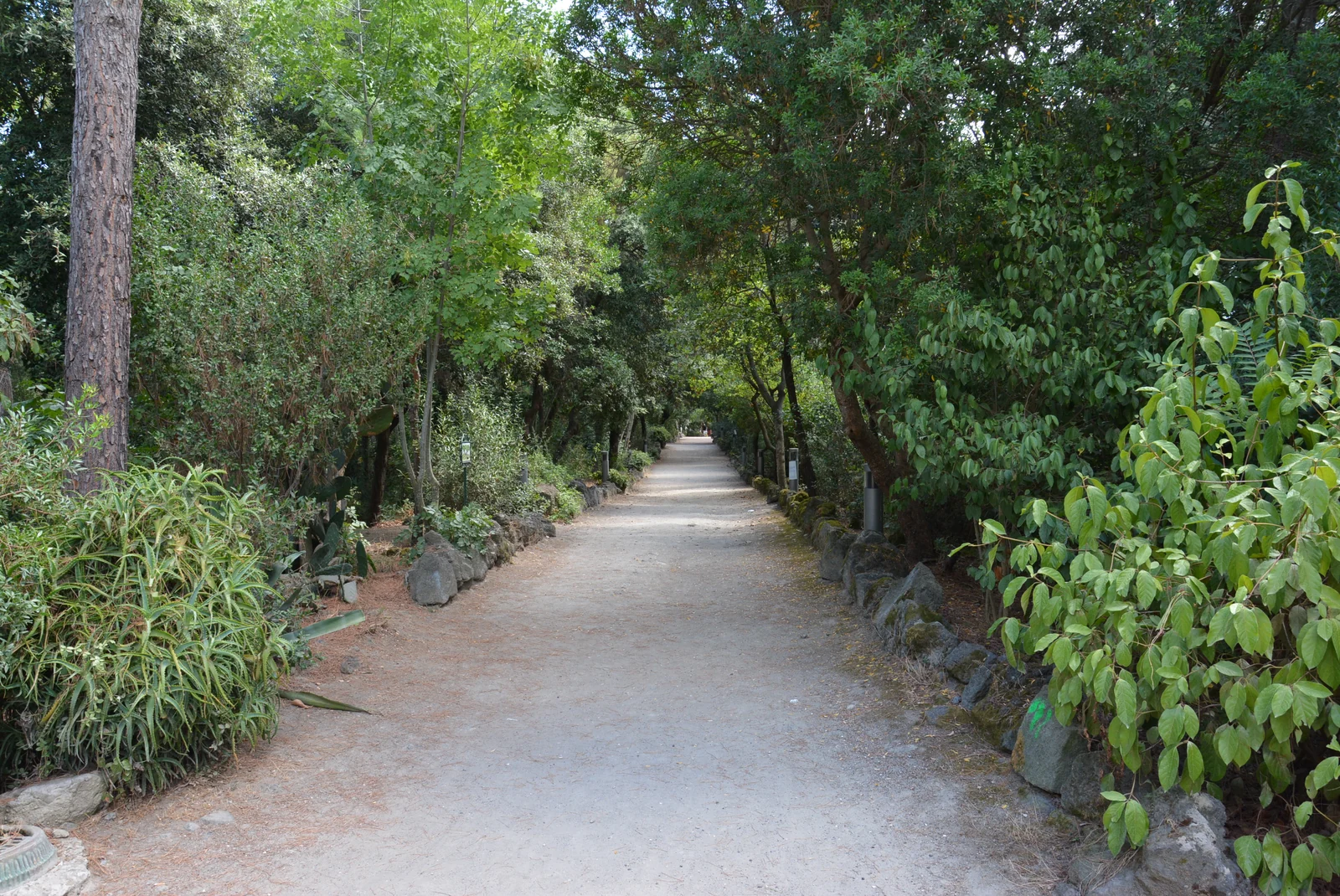
Photo: Mentnafunangann / Wikimedia Commons — CC BY-SA 4.0 · Resized and converted to WebP.
When to go
The town council suggests May for the blossom and the first swims, June and September as the best months, without the August crowds, and July as a good alternative; the rest of the year suits thermal and nature tourism, with fewer hotels open than between April and October.
The most awaited day is 26 July, with the Sea Festival at the rocks of Sant’Anna, organised by the town council: 2026 was its 94th edition. In the evening, in the bay of Cartaromana, allegorical rafts and boats parade in competition, then the Aragonese Castle is “set on fire” with lights and flares to the notes of “Blue Dolphin” by Stephen Schlaks, and the show ends with fireworks set to music.
Saint John Joseph of the Cross, born in the village of Celsa in 1654, has been patron of the diocese of Ischia since 1963 together with Saint Restituta. His remains, which returned to the island on 30 September 2003, are kept by the Friars Minor in the church of Sant’Antonio di Padova at the Ponte, and his birthplace is a public oratory. Every 5 March, the anniversary of his death, a Mass is said in the chapel dedicated to him along the Castle tunnel. The Castle closes from 7 January to early March.
Sources: Comune di Ischia — Partenze intelligenti: collegamenti, periodo migliore, in auto a Ischia (aggiornata il 17 febbraio 2021) · Comune di Ischia — Festa di Sant’Anna 2026: avviso per emittenti e testate giornalistiche · Comune di Ischia — Sfilata delle zattere allegoriche, Festa a mare agli scogli di Sant’Anna, 94ª edizione, 2026 · Comune di Ischia — Bando per i fuochi piromusicali e la simulazione dell’incendio del Castello Aragonese, 26 luglio 2025 (93ª edizione) · Comune di Ischia — «Ischia in festa», progetto del cartellone degli eventi metropolitani 2025-2026 · Diocesi di Ischia — San Giovan Giuseppe della Croce · Diocesi di Ischia — La Cattedrale · Castello Aragonese d’Ischia (sito ufficiale) — La storia del Castello · Castello Aragonese d’Ischia (sito ufficiale) — Programma la tua visita: informazioni, orari, tariffe, accessibilità
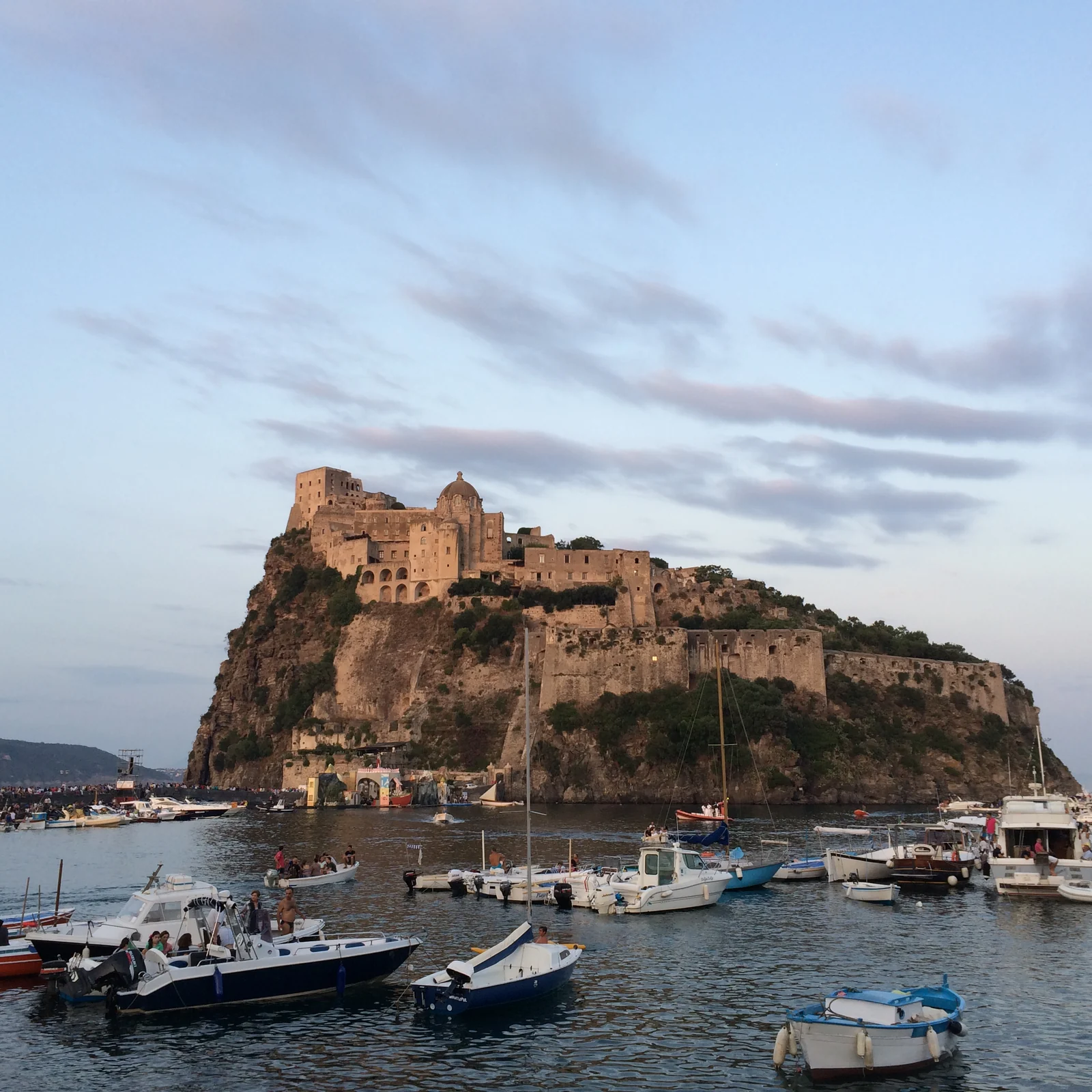
Photo: marktristan from Bristol, UK / Wikimedia Commons — CC BY-SA 2.0 · Resized and converted to WebP.
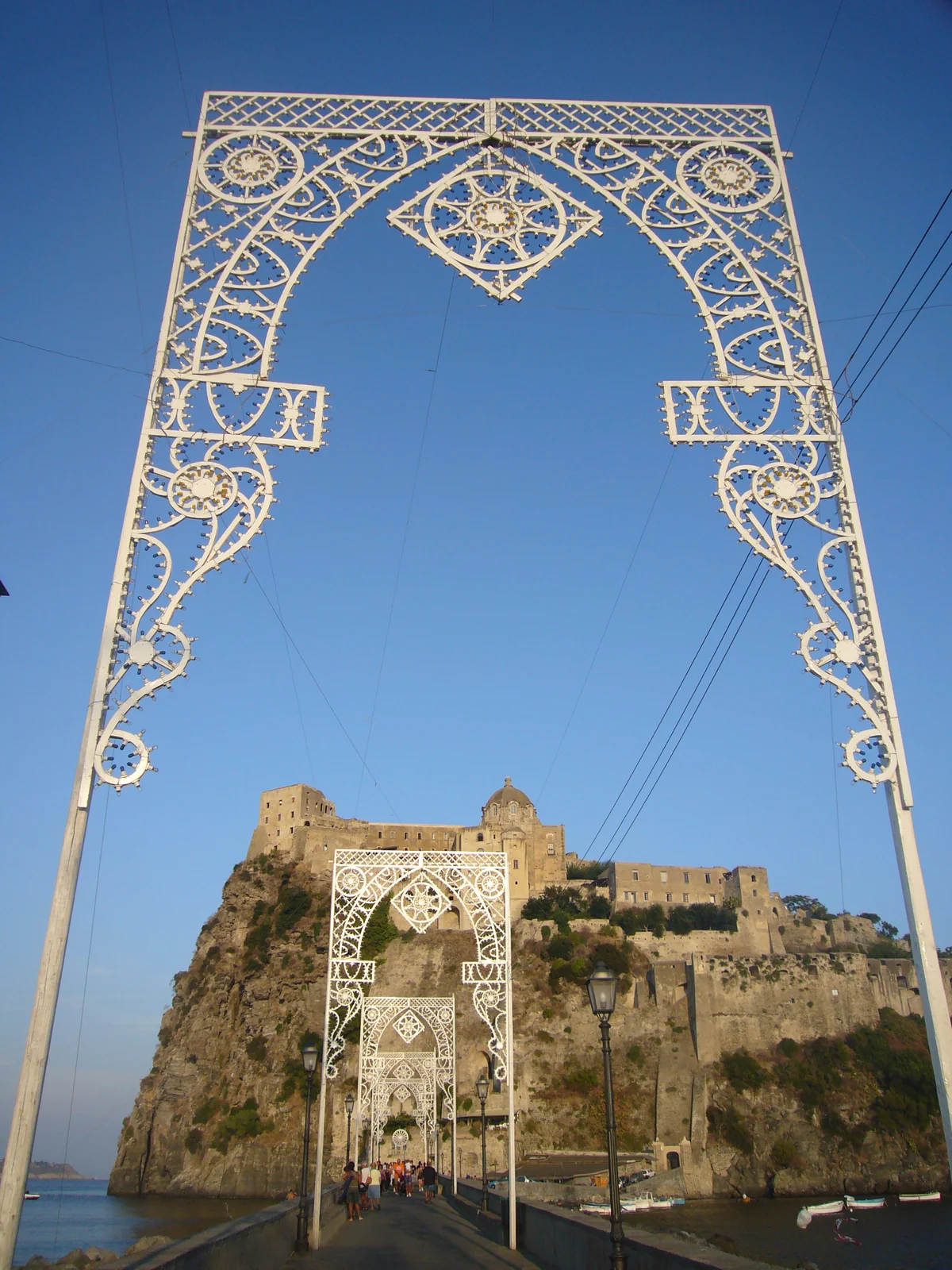
Photo: Lalupa / Wikimedia Commons — CC BY-SA 3.0 · Resized and converted to WebP.
Getting there
Ischia can only be reached by sea. The town council lists hydrofoils from Naples and ferries from Naples and Pozzuoli, with vehicle boarding that can be booked; it advises arriving at the terminals about thirty minutes early and, on peak travel days, buying the ticket the day before. Caremar links the port of Ischia with Naples, Pozzuoli and Procida, with ferries and fast craft that berth at the main quay, a few hundred metres from the main bus station; other lines call at Casamicciola.
Coming by car, the council writes, is “forcing things”: the ministerial decree limiting the landing of vehicles applies, and the municipality has a traffic-reduction plan. From the harbour the Variante Esterna, known as “la sopraelevata”, leads to the centre or on towards Pilastri, Arenella, Sant’Antuono, San Michele, Cartaromana and Campagnano. There are limited-traffic zones enforced by the municipal police.
On the island buses are run by EAV, with their terminus in Piazza Trieste e Trento. From the harbour to the Castle, according to the Castle’s website, it takes about 15 minutes on bus line 177, 5-10 minutes by taxi or 20-30 minutes on foot. The taxi ranks listed by the council are in Piazza Antica Reggia, Piazza degli Eroi, Piazzetta San Girolamo, Via Alfredo De Luca and Via Mirabella.
Sources: Comune di Ischia — Partenze intelligenti: collegamenti, periodo migliore, in auto a Ischia (aggiornata il 17 febbraio 2021) · Caremar — Destinazioni: Ischia, Porto di Ischia · Comune di Ischia — Come mi muovo: autobus, taxi, noleggi (aggiornata il 17 febbraio 2021) · Castello Aragonese d’Ischia (sito ufficiale) — Programma la tua visita: informazioni, orari, tariffe, accessibilità · Comune di Ischia — Sezione polizia municipale: verbali, zone a traffico limitato (aggiornata l’11 febbraio 2026)
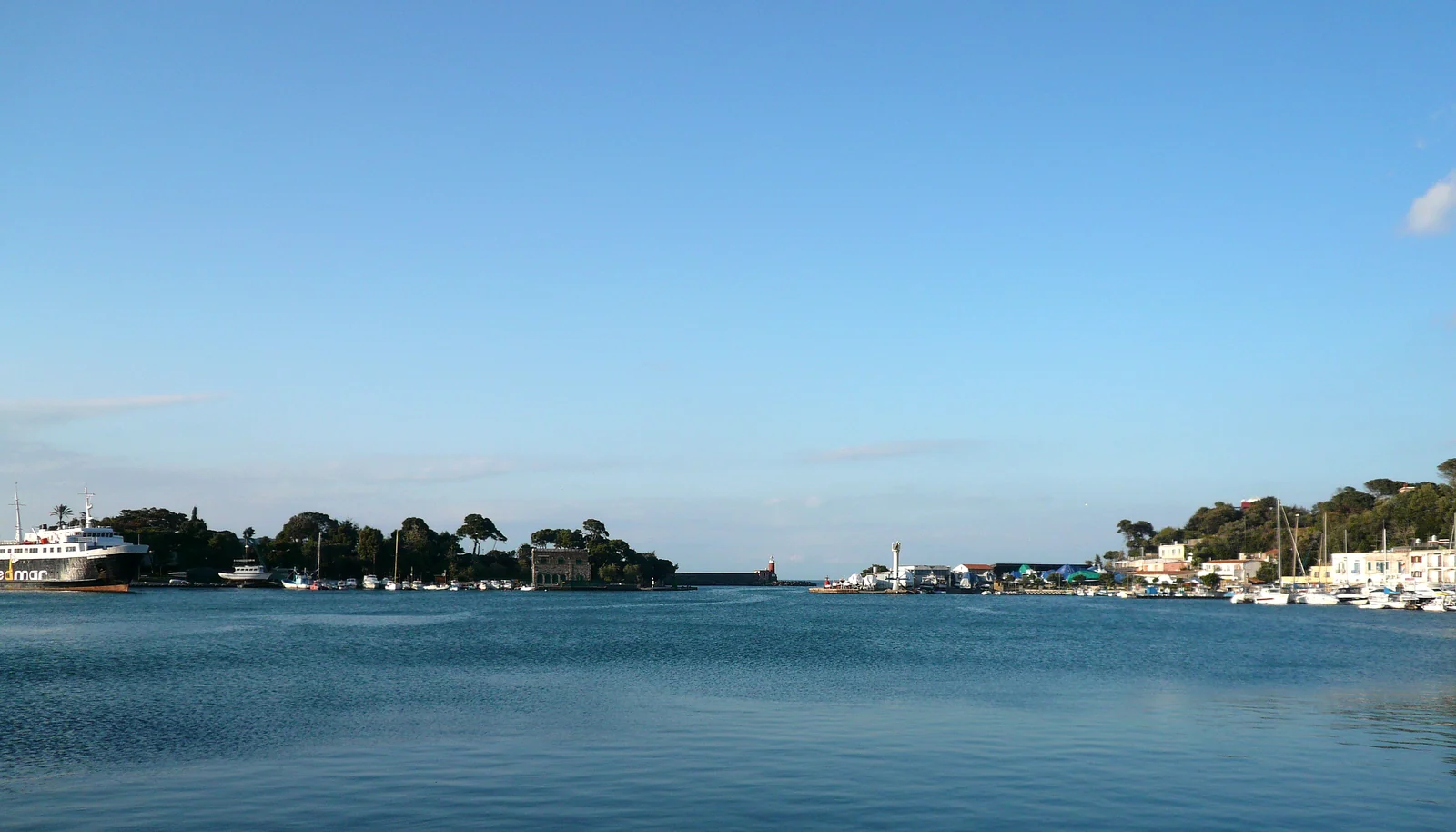
Photo: Dr.Conati / Wikimedia Commons — Public domain · Resized and converted to WebP.
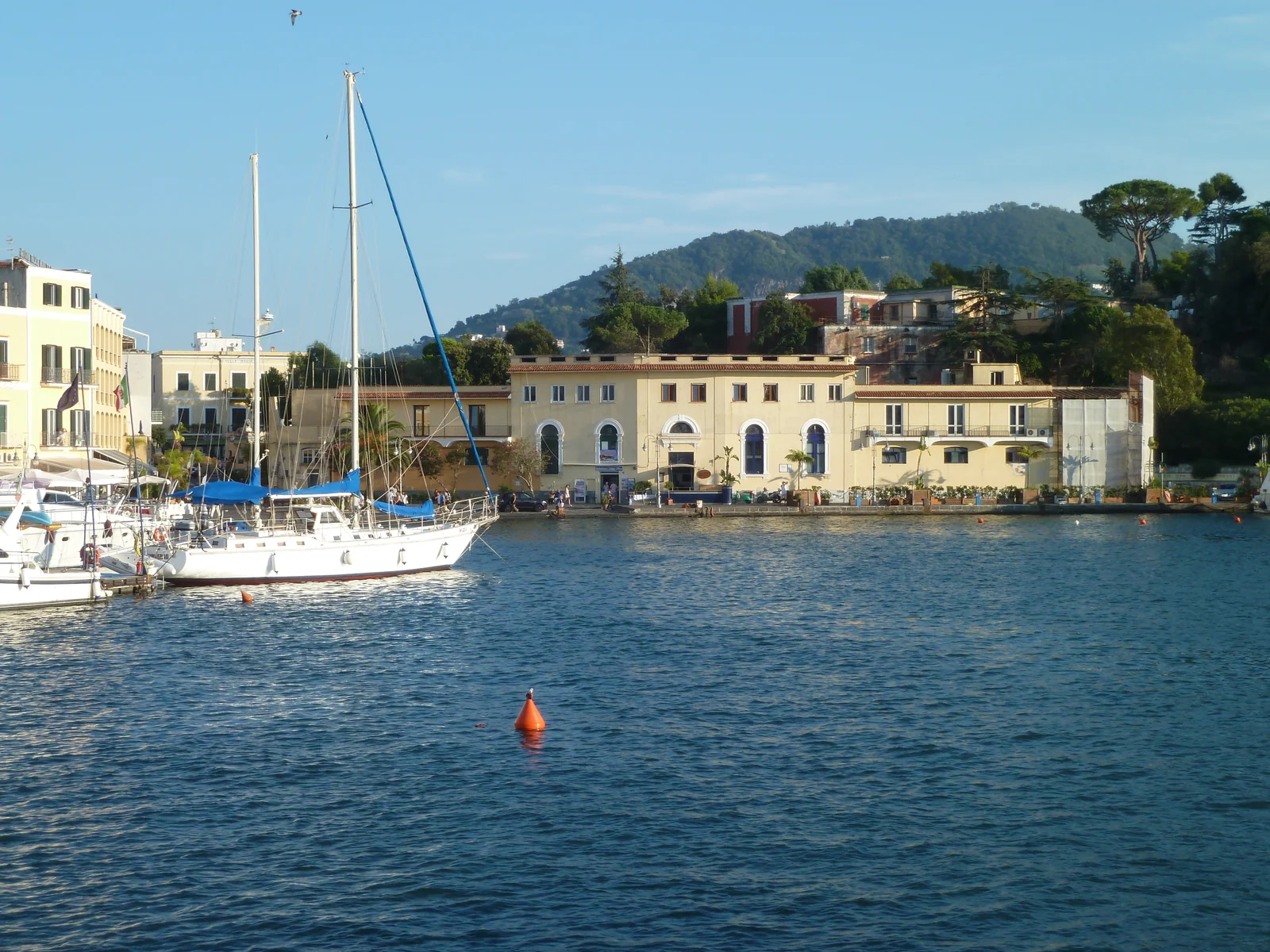
Photo: Abxbay / Wikimedia Commons — CC BY-SA 4.0 · Resized and converted to WebP.
Tourism
Anyone staying overnight in the municipality of Ischia pays the tourist tax all year round, per person and per night, for up to seven nights. Under the rates in force since 15 May 2026 the amount depends on the type of accommodation and the season: from 1 April to 31 October it is 4 euros in one- to three-star hotels, bed & breakfasts, guest rooms and holiday homes, and 5 euros in four- and five-star hotels; in January, February, March, November and December it falls to 3 euros, and to 3.50 and 4 euros in four- and five-star hotels. Minors are exempt, as are people with 100% disability who receive the attendance allowance, together with their companion, on presenting their documentation to the accommodation.
The sea around Ischia is part of the «Regno di Nettuno» marine protected area, and the regulation approved by the Ministry of the Environment in 2009 sets rules that also apply to those who come by boat or to swim. In the A zones there is no swimming, no navigation and no mooring; throughout the area jet skis and water skiing are not allowed, and the caves may be entered only in rowing boats. In the B zones motor boats keep below 5 knots within 300 metres of the shore and below 10 knots between 300 and 600 metres, and the same speeds apply in zone C. No anchor is dropped on posidonia meadows, on coralligenous seabeds or near mooring fields; in zone C, from 1 June to 30 September, those who do not live in the area’s municipalities anchor only with the authorisation of the managing body, issued in limited numbers each day. Divers do not touch the seabed, take or damage nothing, do not feed the fish and report litter and abandoned fishing gear on the seabed to the managing body or the maritime authority.
Sources: Città di Ischia — Tariffe imposta di soggiorno, in vigore dal 15 maggio 2026 · Ministero dell’Ambiente — Decreto 30 luglio 2009, Regolamento di esecuzione e organizzazione dell’area marina protetta «Regno di Nettuno» (GU n. 198 del 27 agosto 2009)
“Come to Ischia as a guest, not as a tourist: that is how these places truly let you know them.”
Accommodation in figures
In the Ministry of Tourism’s national database of accommodation (BDSR), on 12 October 2026, Ischia had 712 establishments with a verified national identification code (CIN): 71 hotel-type establishments, 38 non-hotel establishments and 603 other establishments.
Sources: Ministero del Turismo – Banca Dati Strutture Ricettive (dashboard pubblica)
Nearby
The island of Ischia is divided among six municipalities: besides Ischia, Casamicciola Terme, Lacco Ameno, Forio, Barano d’Ischia and Serrara Fontana, grouped by the Diocese into four deaneries. Ferries and hydrofoils also call at Casamicciola; in Lacco Ameno, excavations beneath the basilica of Santa Restituta show Christian communities as early as the second and third centuries. The Pilastri aqueduct runs along the boundary with Barano, and the Ischia town council recalls the Nitrodi spring, already visited in Roman times.
At the centre of the island rises Monte Epomeo, 787 metres, with a 360-degree view and the little church of San Nicola at the top, already recorded in 1459. From the port of Ischia Caremar sails to Procida, and from there to Pozzuoli and Naples.
Sources: Diocesi di Ischia — La storia della nostra Diocesi · Comune di Ischia — Partenze intelligenti: collegamenti, periodo migliore, in auto a Ischia (aggiornata il 17 febbraio 2021) · Comune di Ischia — Etimologia del nome: il Castello Aragonese e il borgo di Ischia Ponte, il Porto e la Villa de’ Bagni, Cartaromana, l’Acquedotto (aggiornata il 17 febbraio 2021) · Comune di Ischia — La Natura: le pinete, il Palazzo Reale e la Casina Buonocore, le contrade, il Monte Epomeo (aggiornata il 17 febbraio 2021) · Caremar — Destinazioni: Ischia, Porto di Ischia
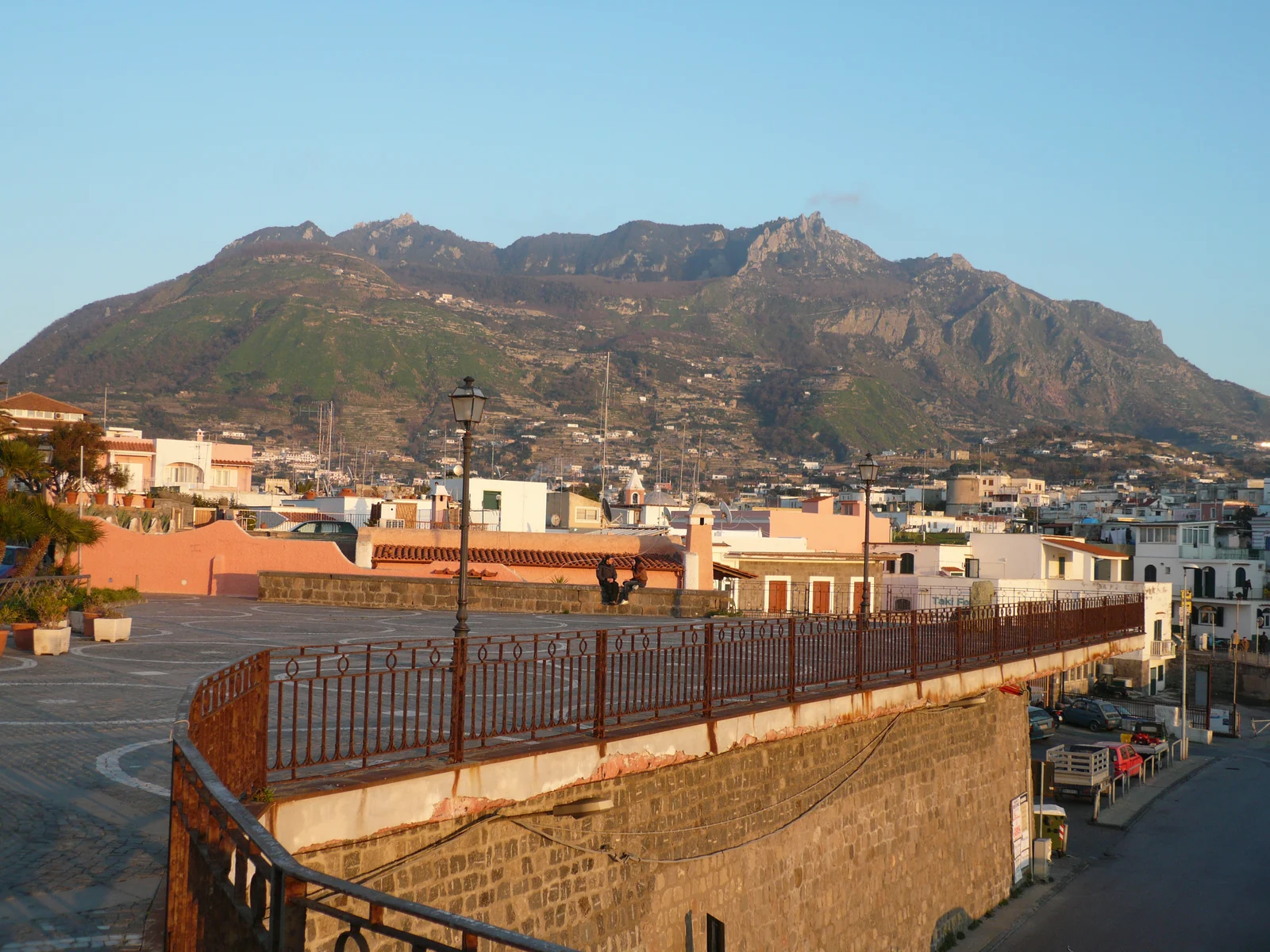
Photo: Roberto De Martino / Wikimedia Commons — Public domain · Resized and converted to WebP.
The town council
The official website of the Comune di Ischia, registered in IndicePA, the index of the digital addresses of Italy’s public administrations, is the reference for the town council’s offices, opening hours and news. Its address is listed among the sources of this section.
The town hall is at Via Iasolino 1, telephone +39 081 3333111. The municipal police headquarters is in Palazzo D’Ambra, Via Iasolino 59, telephone +39 081 981070. The Biblioteca comunale Antoniana is at Via Rampe Sant’Antonio 2, telephone +39 081 3333255.
Sources: Comune di Ischia, sito istituzionale · IndicePA (AgID), Indice dei domicili digitali delle pubbliche amministrazioni: dataset Enti · Comune di Ischia — Luoghi: Municipio · Comune di Ischia — Luoghi: Comando di polizia municipale, Palazzo D’Ambra · Comune di Ischia — Luoghi: Biblioteca comunale Antoniana
Where to stay
In the municipality of Ischia the national database of the Ministry of Tourism lists 712 accommodation businesses with a verified CIN code: 71 hotels, 38 other licensed accommodation and 603 other types such as B&Bs and private rentals.
Licensed businesses from the official list of accommodation named as the source in this section. Where the list gives it, the property's official identification code appears next to its name: the national CIN code, or the code assigned by the Region or by the body that keeps the list. Private individuals are not listed. This list is the official census of licensed businesses, not a list of Apulica partners: to stay in Ischia you do not have to check one property after another yourself; write to Apulica and we look for the stay that suits your journey, checking availability and conditions before any confirmation.
Excelsior Ischia s.r.l
Hotel · ★★★★★
Regional code (CUSR) 15063037ALB0025
Eurocamping dei Pini
Campsite · ★★
Regional code (CUSR) 15063037EXT0024
Blu Dalia
Guest rooms
Regional code (CUSR) 15063037EXT0348
Residenza Mareluna
Holiday house
Regional code (CUSR) 15063037EXT0079
Grand Hotel Moresco s.r.l
Hotel · ★★★★★
Regional code (CUSR) 15063037ALB0027
IL LENTISCO
Guest rooms
Regional code (CUSR) 15063037EXT0094
Mare Blu
Hotel · ★★★★★
Regional code (CUSR) 15063037ALB0072
ITALIAN DELICIOUS
Guest rooms
Regional code (CUSR) 15063037EXT0096
Miramare e Castello
Hotel · ★★★★★
Regional code (CUSR) 15063037ALB0073
La Vigna
Guest rooms
Regional code (CUSR) 15063037EXT0173
First the places that presented themselves to Apulica, the latest first; then one place of each type in turn, by official category and stars, then by name. No position is paid for.
All 92 entries in alphabetical order
Page 1 of 10
| Name | Type | Identification code |
|---|---|---|
| Aegidius | Hotel | Regional code (CUSR) 15063037ALB0001 |
| Albergo Annabelle | Hotel | Regional code (CUSR) 15063037ALB0002 |
| Albergo Atlantic | Hotel | Regional code (CUSR) 15063037ALB0003 |
| Albergo Da Maria | Hotel | Regional code (CUSR) 15063037ALB0004 |
| Albergo Don Felipe | Hotel | Regional code (CUSR) 15063037ALB0005 |
| Albergo Eugenios | Hotel | Regional code (CUSR) 15063037ALBBMY3 |
| Albergo La Capannina | Hotel | Regional code (CUSR) 15063037ALBXTJ6 |
| Albergo Macrì | Hotel | Regional code (CUSR) 15063037ALB0010 |
| Albergo Noris | Hotel | Regional code (CUSR) 15063037ALB0011 |
| Albergo Rivamare | Hotel | Regional code (CUSR) 15063037ALB0017 |
Ask Apulica for a stay in Ischia We reply shortly, within a few hours at most, with a proposal for you to consider.
Sources: Ministero del Turismo – Banca Dati Strutture Ricettive (dashboard pubblica), 2026-10-12
YOUR JOURNEY
How to shape a journey here
To include Ischia in a trip, or to ask for a guide or a transfer, you can write to Apulica with the button below.
Plan your tripKeep exploring
Procida
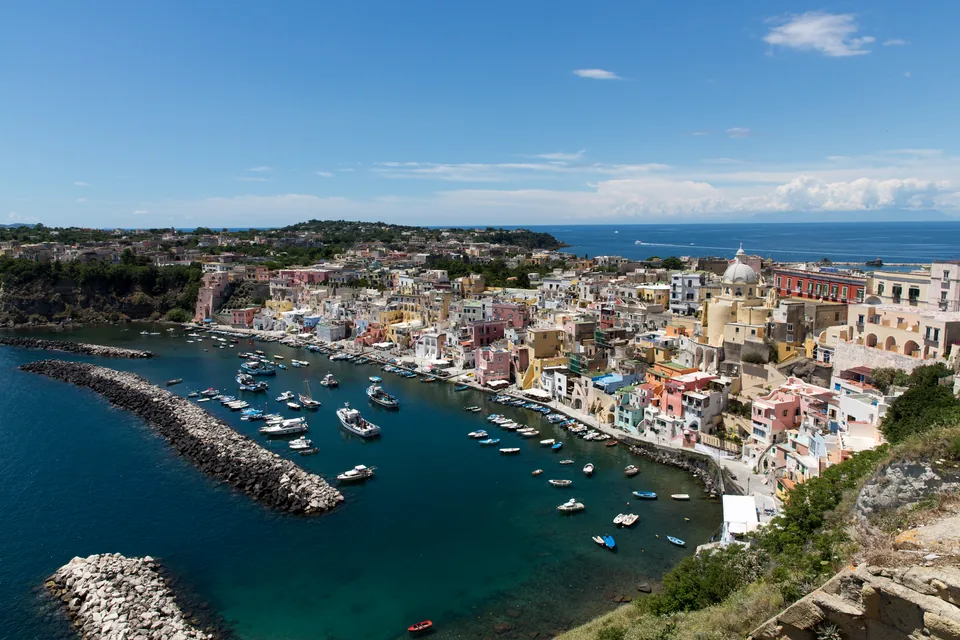
Procida (NA), Campania: 10,004 residents, 4.26 km². The official facts of the municipality, its town council website and its registered accommodation. Marina Corricella, the walled quarter of Terra Murata with the Abbey of San Michele and Palazzo d’Avalos, the Vivara nature reserve, the Misteri of Good Friday, the Procida lemon and the ferries from Naples and Pozzuoli.
Read the guide →Photo: Ekrem Canli / Wikimedia Commons — CC BY-SA 4.0 · Resized and converted to WebP.

Casamicciola Terme
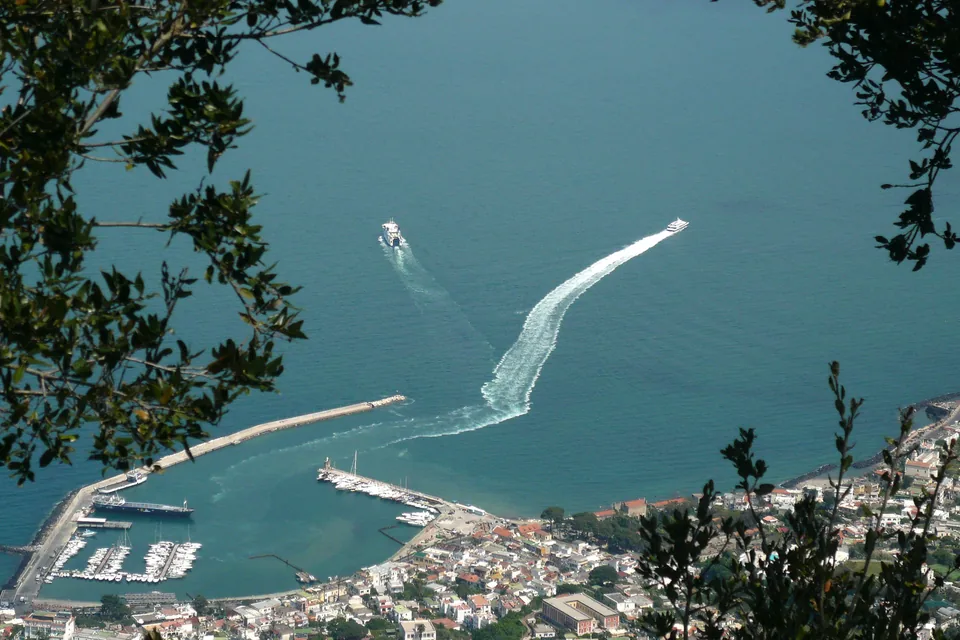
Casamicciola Terme (NA), Campania: 7,428 residents, 5.86 km². The official facts of the municipality, its town council website and its registered accommodation.
Read the guide →Photo: Dr.Conati Roberto De Martino / Wikimedia Commons — Public domain · Resized and converted to WebP.

Lacco Ameno
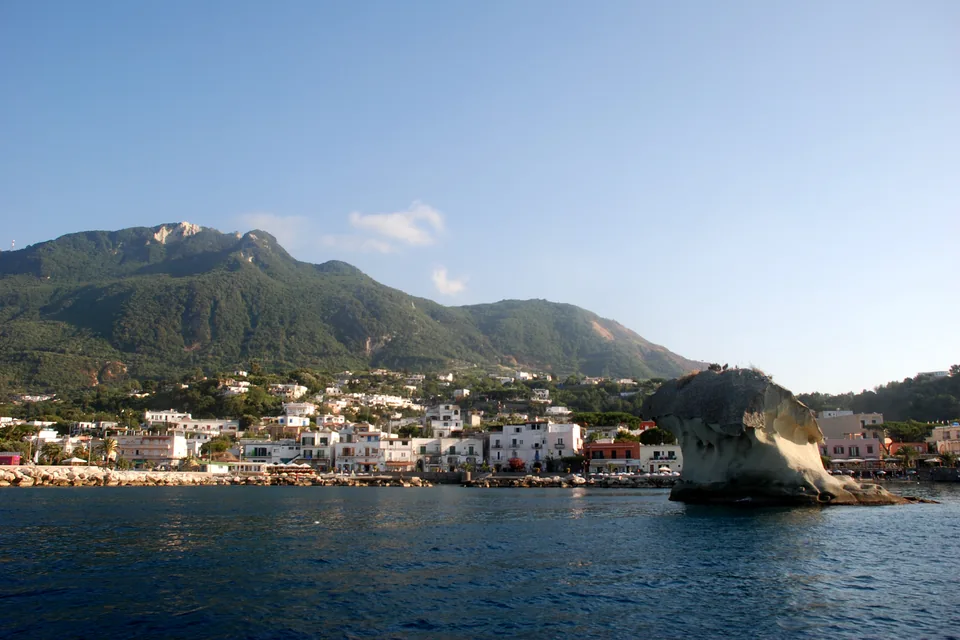
Lacco Ameno (NA), Campania: 4,471 residents, 2.08 km². The official facts of the municipality, its town council website and its registered accommodation.
Read the guide →Photo: Chiara Marra / Wikimedia Commons — CC BY 2.0 · Resized and converted to WebP.

Forio
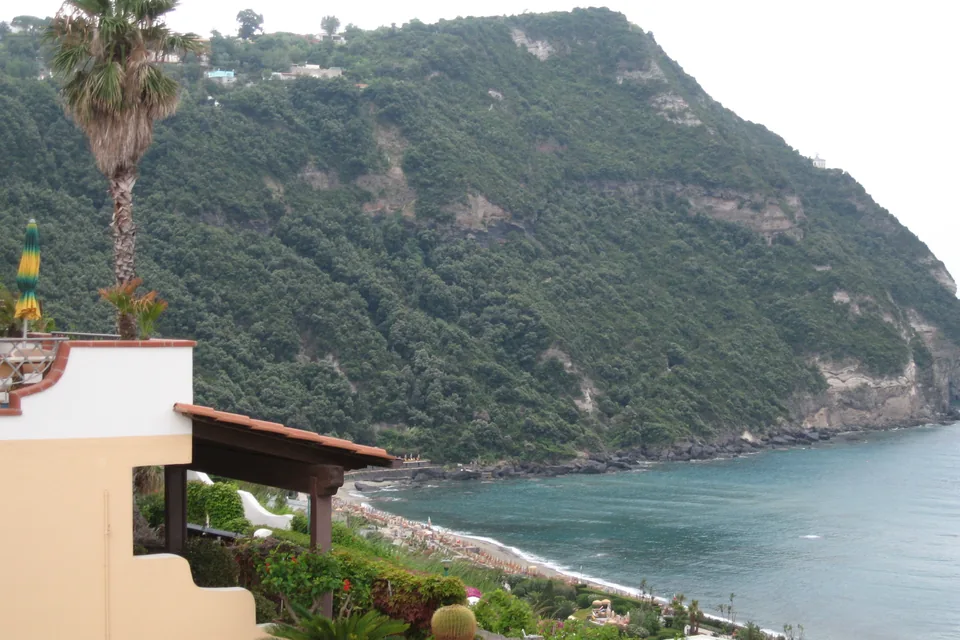
Forio (NA), Campania: 17,531 residents, 13.07 km². The official facts of the municipality, its town council website and its registered accommodation.
Read the guide →Photo: francverde / Wikimedia Commons — CC BY 3.0 · Resized and converted to WebP.

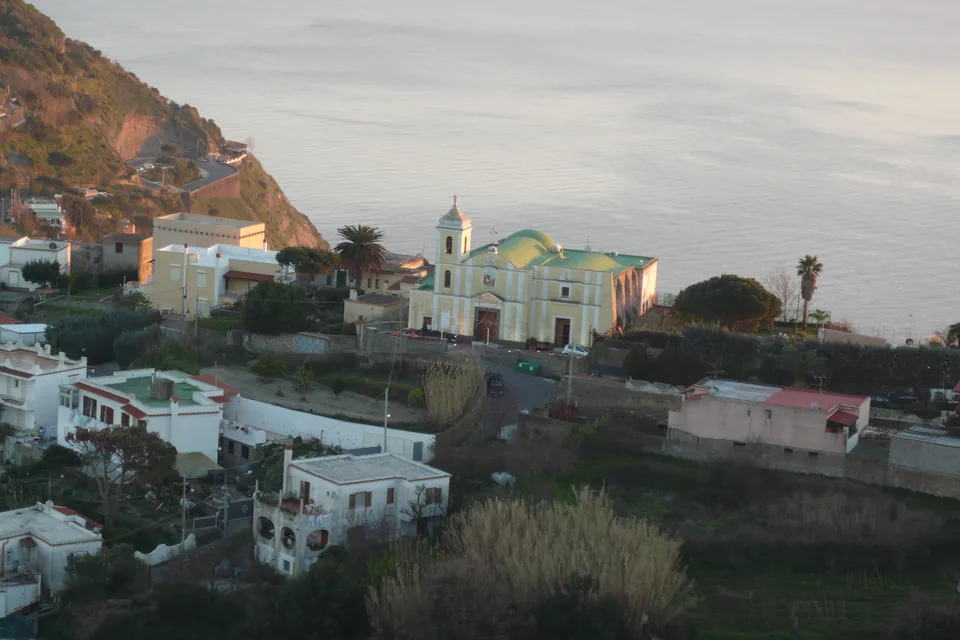
Barano d'Ischia
Barano d'Ischia (NA), Campania: 9,983 residents, 10.98 km². The official facts of the municipality, its town council website and its registered accommodation.
Read the guide →Photo: Dr.Conati / Wikimedia Commons — Public domain · Resized and converted to WebP.

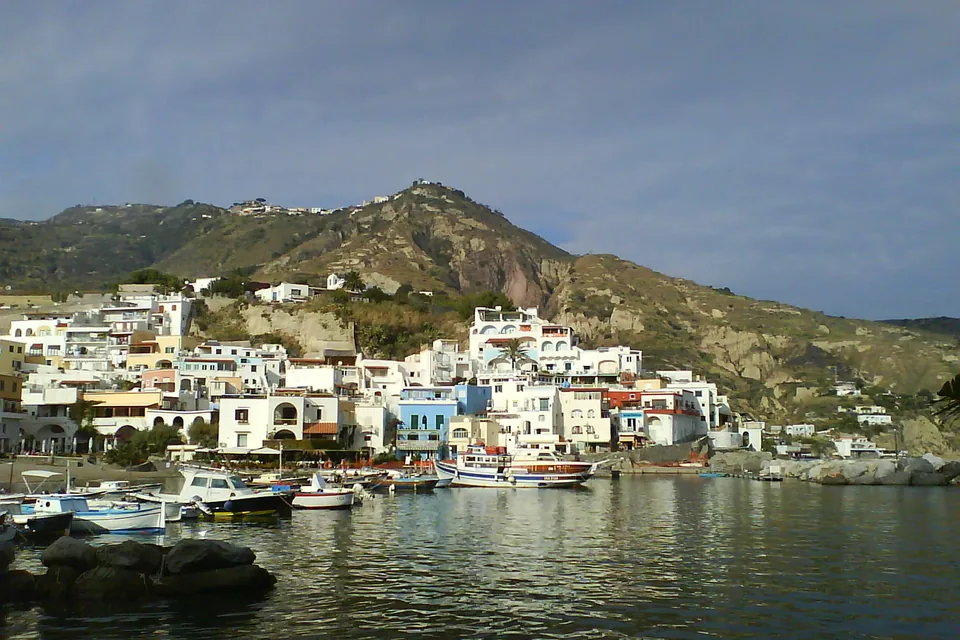
Serrara Fontana
Serrara Fontana (NA), Campania: 3,058 residents, 6.45 km². The official facts of the municipality, its town council website and its registered accommodation.
Read the guide →Photo: Vito Calise / Wikimedia Commons — Public domain · Resized and converted to WebP.

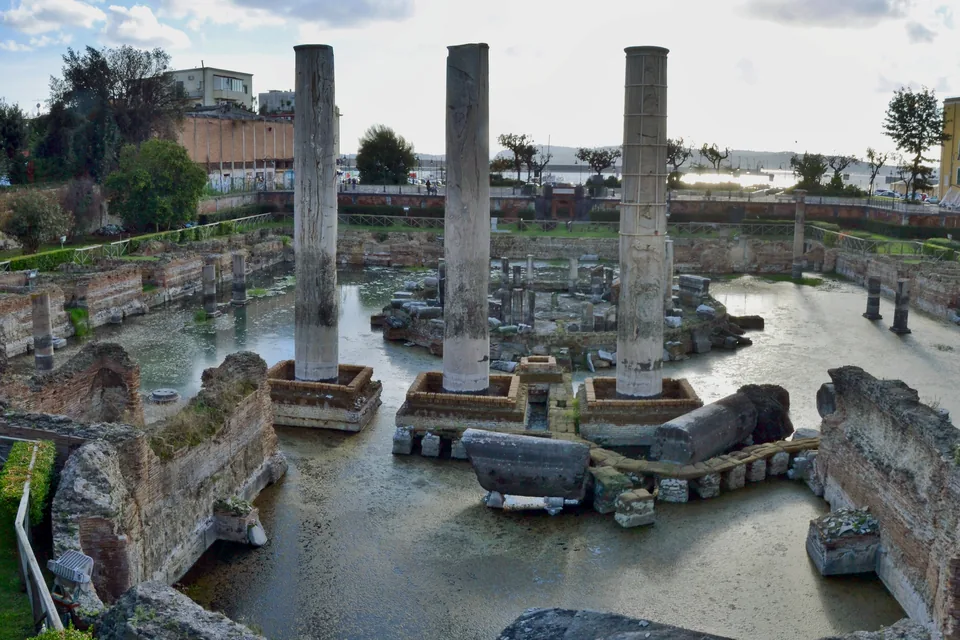
Pozzuoli
Pozzuoli (NA), Campania: 75,375 residents, 43.84 km². The official facts of the municipality, its town council website and its registered accommodation. The Flavian Amphitheatre, the Macellum, the Rione Terra, the Phlegraean Fields and bradyseism, the port for Ischia and Procida.
Read the guide →Photo: Rolf Cosar / Wikimedia Commons — CC BY-SA 4.0 · Cropped, resized and converted to WebP.

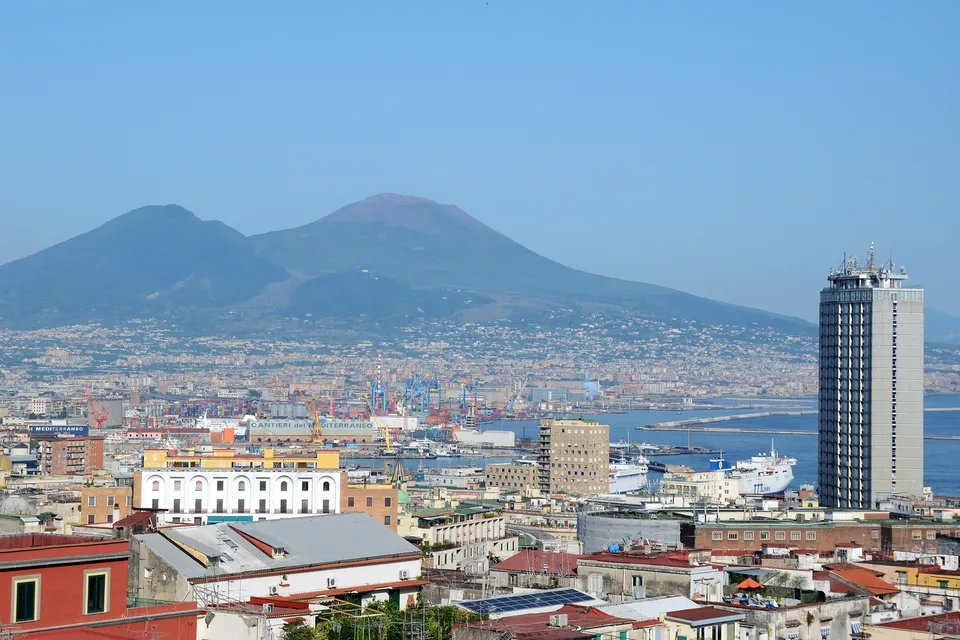
Naples
Naples (NA), capital of Campania: 909,013 residents, 119.24 km². The UNESCO-listed historic centre, the museums, the San Carlo, pizza as UNESCO heritage, San Gennaro and, nearby, Vesuvius, Pompeii and the islands.
Read the guide →Photo: Livioandronico2013 / Wikimedia Commons — CC BY-SA 4.0 · Resized and converted to WebP.

Capri
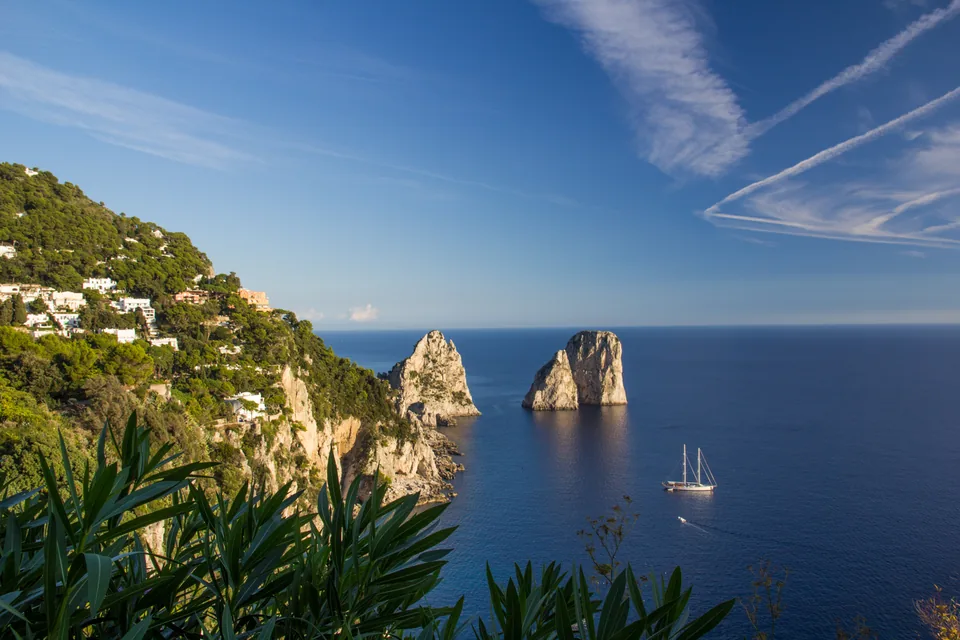
Capri (NA), Campania: 6,722 residents, 4.06 km². The official facts of the municipality, its town council website and its registered accommodation. The Faraglioni, the Piazzetta, the Gardens of Augustus and Via Krupp, the Certosa di San Giacomo with the Archaeological Museum, Tiberius’s Villa Jovis, Villa Lysis, and the island’s PGI lemon and DOC wine.
Read the guide →Photo: Marlis Börger / Wikimedia Commons — CC BY-SA 2.0 · Resized and converted to WebP.
