

Why go
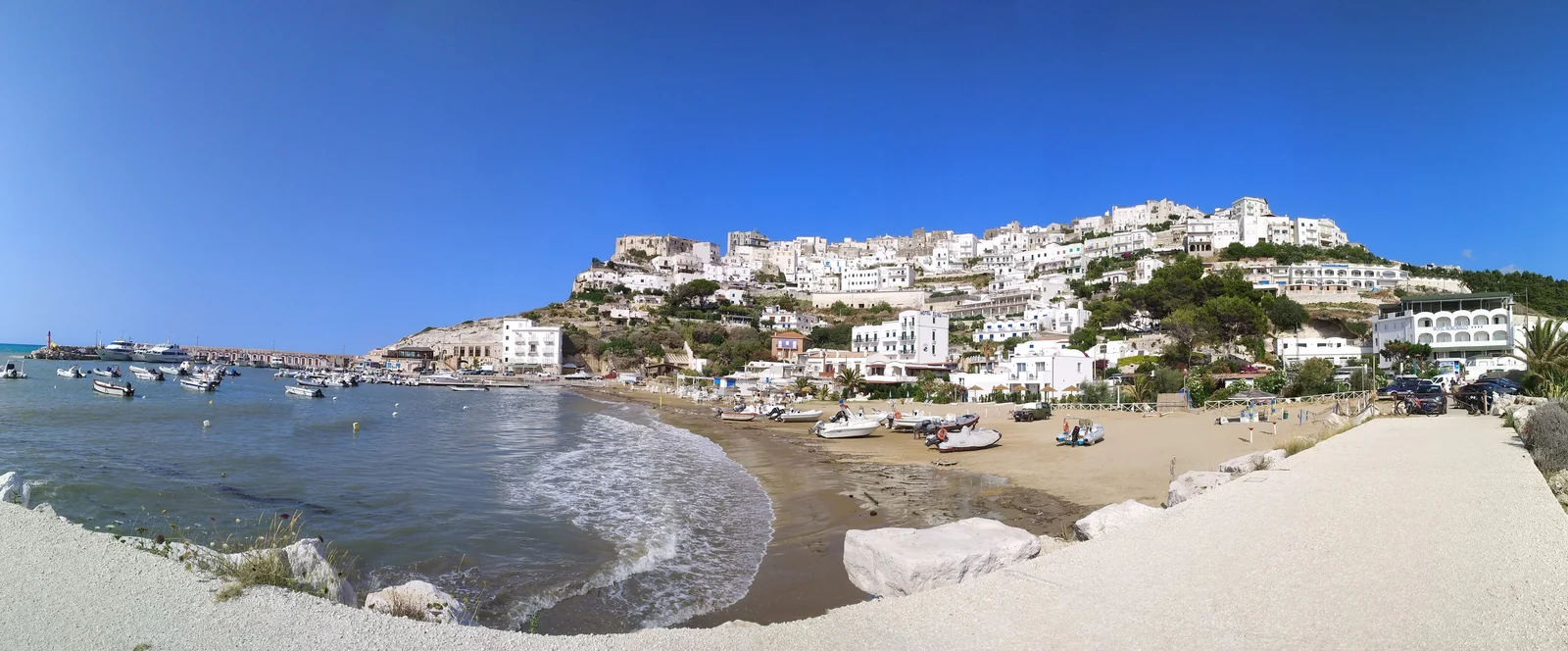
Peschici stands on a cliff dropping sheer into the sea, at the northernmost point of Puglia, and from its edge the view runs along the coast as far as Rodi Garganico. The old town is a tangle of white cube-shaped houses, arches, stairways and small churches, closed on the seaward side by the castle built on the tip of the rock. It is a compact village, best discovered on foot, that shows a different face at every viewpoint.
The municipality explains how the houses grew along the cliff and the walls, with alleys and steps running down towards the sea: the very shape of the village reveals its past as a place that had to be defended. Below the cliff, the small harbour shelters fishing boats and the scheduled ferries to the Tremiti Islands.
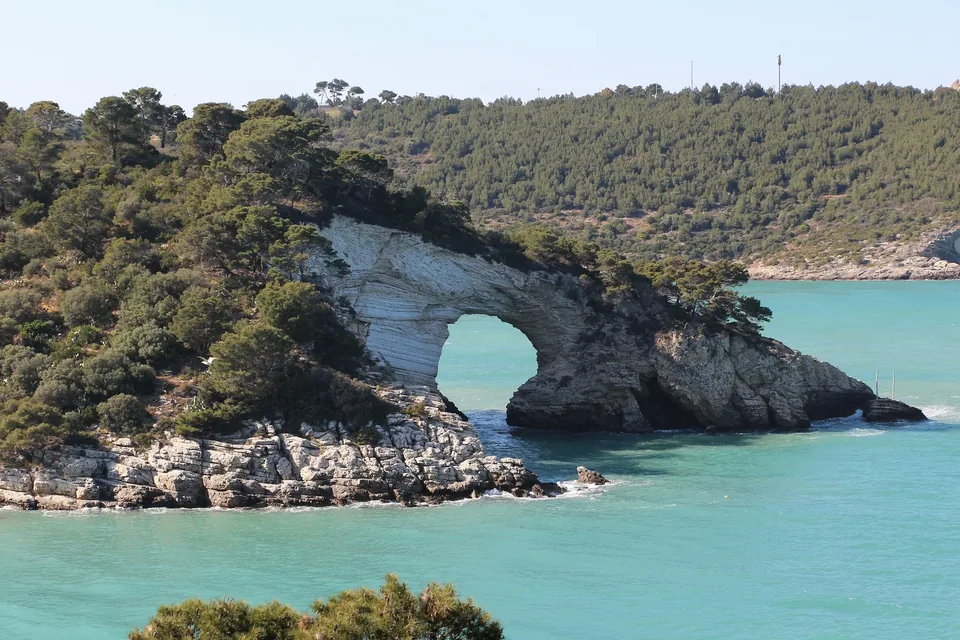
The second reason to come is the variety of the coast: the bay at the foot of the village, quieter coves and, to the west, the long beach of Calenella fringed by pine woods and wheat fields. Behind it rise the hills and woodland of the Gargano National Park, which make Peschici a good base for alternating sea and nature.
Sources: Peschici — fonte istituzionale · Comune di Peschici — Storia del Comune · Parco nazionale del Gargano — Calenella
History
According to the municipality, in 970 the Slavs led by Sueripolo, sent by Emperor Otto I to free the Gargano from Saracen raiders, founded «Pesclizo» on the ruins of a destroyed hamlet; the name is thought to be Slavic and to refer to the sandy soil. Eleventh-century documents bearing Slavic personal names record donations to the monastery of the Tremiti and the link with the Benedictine abbey of Santa Maria di Calena, documented from the eleventh century and later run by Cistercians and Lateran Canons.
The castle was repaired or rebuilt around 1240, in the Swabian period. Under the Angevins the harbour went through a busy phase: the municipality notes that, together with Manfredonia, it was the only port used to ship Gargano timber to France, and that galleys for the kingdom's fleet were built at Peschici. From the fourteenth century the village appears on nautical charts under different names, until the present form in 1570.
In the late fifteenth century a new wave of migrants from Dalmatia and the Balkans settled here. In the sixteenth century the fief passed to the Turbolo family, who lived in the castle. The present harbour was rebuilt from 1933 and since the 1980s has also served as a tourist landing.
Sources: Comune di Peschici — Storia del Comune · Peschici — fonte istituzionale · Comune di Peschici — Abbazia di Kalena · Comune di Peschici — Porto di Peschici
What to see
The natural route starts at the castle, on the tip of the cliff, and crosses the baronial enclosure with its walls strengthened by small towers and its old gates, Porta del Ponte and Porta di Basso. The municipality recalls that Porta del Ponte opened at dawn and closed at sunset with a drawbridge over a ditch. Within the walls stands the small church of San Michele, already mentioned in a document of 1176.
In the centre, the church of Sant'Elia Profeta, dedicated to the patron saint, keeps the polychrome wooden statue of the Madonna di Calena, which came from the abbey of the same name. The Calena complex, behind the small harbour, preserves its boundary walls, the remains of the cloister, a well dated 1561 and two churches, but it is privately owned and normally closed: you can learn its story and look at it from outside.
Along the coast you will spot the trabucchi; at Peschici there are seven, all privately owned, unlike the municipal ones in Vieste. The park and the municipality treat them as heritage to be made safe; view them from the shore without assuming they are open to visitors.
Sources: Peschici — fonte istituzionale · Comune di Peschici — Storia del Comune · Comune di Peschici — Chiesa di Sant’Elia e festa patronale · Comune di Peschici — Abbazia di Kalena · Parco e Comune — trabucchi storici di Peschici
Food and wine
The table at Peschici brings sea and countryside together. The municipality notes that as early as the Angevin period the area produced wine and timber and imported grain, a sign of an economy tied to the coast and the woods. Today fish from the small harbour sits alongside produce from the nearby hills, and religious feasts bring their own sweets: for the Madonna di Loreto people bake «can'strillë», little pastry baskets with an egg in the middle, along with «panettelle» and «culace».
A few kilometres away, between Rodi Garganico, Vico del Gargano and Ischitella, grow the citrus fruits that the park describes as a historic landscape, now protected by geographical indication: the Arancia del Gargano and the Limone Femminello del Gargano, as well as the rare sweet bitter orange. Extra virgin olive oil from the Gargano hills, where the Ogliarola garganica variety prevails, falls under the Dauno PDO with the Gargano mention.
Inland, at Carpino, farmers grow the Fava di Carpino, a small sand-coloured broad bean sown in autumn in rotation with wheat and harvested in summer. It is a good reason to ask for a dish of beans and greens, one of the simplest and most recognisable flavours of the promontory.
Sources: Comune di Peschici — Chiesa Madonna di Loreto · Parco nazionale del Gargano — Agrumi dell’oasi agrumaria · Parco nazionale del Gargano — Fava di Carpino · Parco nazionale del Gargano — Olio extravergine di oliva · Comune di Peschici — Storia del Comune
Things to do
The sea offers more than one option. The bay below the village is wide and popular with families, while Italia.it points to quieter coves and, to the west, a series of long beaches such as Calenella, which the park describes as golden sand with gently shelving water and pine woods behind, almost free of facilities. It is ideal for an unhurried half-day by the sea, alternated with a visit to the village.
In the summer months boats for the Tremiti Islands leave from the small harbour: the park lists Peschici among the Gargano ports with sailings between June and September. A day in the archipelago deserves some planning, choosing whether to give it to the history of San Nicola or the nature of San Domino.
Walkers and cyclists will find inland the Grande Traversata Garganica, a loop of about two hundred kilometres waymarked in red and white, open to hikers, cyclists and riders, which passes through Vico del Gargano and the Foresta Umbra. In the forest, with its reserves and great trees, the cool air under the beeches sets a completely different pace from the coast.
Sources: Parco nazionale del Gargano — Calenella · Peschici — fonte istituzionale · Area marina protetta Isole Tremiti — Come arrivare · Parco nazionale del Gargano — La Grande Traversata Garganica · Parco nazionale del Gargano — Foresta Umbra
When to go
Spring and autumn are the best periods for exploring the village, walking inland and getting to know the coast at a gentle pace. Summer is the season for the sea and for the Tremiti ferries, which run from Peschici between June and September.
The festival calendar offers chances to see the village at its liveliest. The Madonna di Loreto is celebrated on the Monday after Easter Monday, with a procession to the small sanctuary two kilometres from the centre, full of votive offerings shaped like boats and oars given by fishermen and emigrants. For St Elijah, the patron, the novena begins on 11 July and the solemn procession takes place on the 20th. On 8 September the chapter and the residents organise a walk to the abbey of Calena while reciting the Rosary.
These are the dates the municipality gives as recurring; before you travel, check the current year's programme and the weather, since some celebrations take place outdoors.
Sources: Comune di Peschici — Chiesa di Sant’Elia e festa patronale · Comune di Peschici — Chiesa Madonna di Loreto · Comune di Peschici — Abbazia di Kalena · Area marina protetta Isole Tremiti — Come arrivare
Getting there and around
Peschici is the terminus of the Ferrovie del Gargano railway, the electrified single-track line that starts at San Severo, a station on the national network, and crosses the promontory for about seventy-four kilometres via San Nicandro, Cagnano Varano, Carpino, Ischitella and Rodi Garganico. Peschici station is at Calenella, on the coast, and the company lists among its services a ticket machine, car park, waiting room and bus connections to the village.
Ferrovie del Gargano also runs an intercity bus network between the towns of the promontory as part of the regional Cotrap consortium. If you fly, the nearest airport is Gino Lisa in Foggia; by sea, the harbour links Peschici with the Tremiti Islands in the summer months.
The old town is explored on foot, through lanes and stairways that can be steep. To reach the farther beaches, the forest or nearby villages out of season, plan transfers ahead and check current timetables and routes on the transport companies' websites.
In the village, the Puglia Region's tourism portal lists the Peschici Info-point in Via Magenta, a tourist information and welcome point that helps with connections and visits.
Sources: Ferrovie del Gargano — La rete ferroviaria · Ferrovie del Gargano — Stazione di Peschici · Ferrovie del Gargano — La rete autobus · Aeroporti di Puglia — Aeroporto di Foggia Gino Lisa · Area marina protetta Isole Tremiti — Come arrivare · Viaggiare in Puglia (Regione Puglia) — Info-point Peschici
Where to stay
In Peschici you can choose between two ways of staying. Sleeping in or near the old town lets you enjoy the village in the evening, when the lanes come alive and the stroll reaches the viewpoints over the sea. Accommodation along the coast, towards Calenella and San Menaio, puts you closer to the long beaches and pine woods and suits a seaside stay.
For a quieter stay, La Locanda della Castellana offers adults-only hospitality in the hills about a kilometre from the village, with a bistro bar; it mentions stairs and slopes and recommends a car for exploring the surroundings. Those who prefer to stay in the village will find rooms and holiday homes in the old town, handy for walking to the viewpoints over the bay and the square by the castle.
This is an editorial reference, not an Apulica partnership. Choose together with the length of your trip and how you plan to move: without a car, a base near the centre or near Calenella station will serve you better.
Sources: La Locanda della Castellana — struttura e posizione · Peschici — fonte istituzionale
Nearby
To the west the coast slopes gently towards Rodi Garganico, with the beaches of Calenella, Cento Scalini and San Menaio. Just inland, between Rodi, Vico del Gargano and Ischitella, the citrus gardens form a cultivated landscape that the park presents as one of the promontory's oldest farming traditions.
Along the coast, towards the eastern tip of the promontory, lies Vieste, the other large town on the Gargano coast, with its castle, cathedral and Pizzomunno: comparing the two clifftop towns is one of the pleasures of a trip on the promontory. Heading inland you enter the Foresta Umbra, with its nature reserves and a small museum in the heart of the woods.
Finally, from the port of Peschici the Tremiti Islands are the natural next step in the summer months. Give the archipelago a full day, or better a stay, rather than turning it into a short trip between two swims.
Sources: Peschici — fonte istituzionale · Parco nazionale del Gargano — Calenella · Parco nazionale del Gargano — Agrumi dell’oasi agrumaria · Parco nazionale del Gargano — Foresta Umbra · Area marina protetta Isole Tremiti — Come arrivare
Local tourist information
Local tourist offices help with opening times, events and transport on the day.
- Info-point Peschici · Via Magenta 3, 71010 Peschici (FG) · +39 0884 964966 · [email protected]
Source: Viaggiare in Puglia (Regione Puglia) — Info-point Peschici · checked on
Where to stay
In the municipality of Peschici the national database of the Ministry of Tourism lists 487 accommodation businesses with a verified CIN code: 31 hotels, 112 other licensed accommodation and 344 other types such as B&Bs and private rentals.
Licensed businesses from the official list of accommodation named as the source in this section. Where the list gives it, the property's official identification code appears next to its name: the national CIN code, or the code assigned by the Region or by the body that keeps the list. Private individuals are not listed. This list is the official census of licensed businesses, not a list of Apulica partners: to stay in Peschici you do not have to check one property after another yourself; write to Apulica and we look for the stay that suits your journey, checking availability and conditions before any confirmation.
Hotel Cala del Turco
Hotel · ★★★★
CIN IT071038A100097549
GARGANOMARE
Residence
CIN IT071038B400023789
VILLAGGIO TURISTICO VALLE SCINNI
Holiday village · ★★★★
CIN IT071038B200027856
CENTRO TURISTICO SAN NICOLA
Campsite · ★★★★
CIN IT071038B100103452
A PIANA DI CALENA
Farm stay
CIN IT071038B500023288
ALAMARINA
B&B
CIN IT071038B400022998
AFFITTACAMERE ARCOBALENO
Guest rooms
CIN IT071038B400027474
ACASUCC
Holiday home
CIN IT071038B400124004
HOTEL D'AMATO
Hotel · ★★★★
CIN IT071038A100055268
IL RIFUGIO
Residence
CIN IT071038B400024037
First the places that presented themselves to Apulica, the latest first; then one place of each type in turn, by official category and stars, then by name. No position is paid for.
All 123 entries in alphabetical order
Page 1 of 13
| Name | Type | CIN |
|---|---|---|
| A PIANA DI CALENA | Farm stay | IT071038B500023288 |
| ACASUCC | Holiday home | IT071038B400124004 |
| AFFITTACAMERE ARCOBALENO | Guest rooms | IT071038B400027474 |
| AFFITTACAMERE 'DA CARLINO' | Guest rooms | IT071038B400083952 |
| Agriturismo Millepini | Farm stay | IT071038B500110422 |
| AL CASTELLO | Hotel | IT071038A100020431 |
| ALAMARINA | B&B | IT071038B400022998 |
| Albergo Godenizzo | Hotel | IT071038A100094693 |
| APPARTAMENTI AL TRABUCCO DA MIMI' | Holiday home | IT071038B400027867 |
| APPARTAMENTI MARAZZURRO | Holiday home | IT071038B400092675 |
Ask Apulica for a stay in Peschici We reply shortly, within a few hours at most, with a proposal for you to consider.
Sources: Regione Puglia – ARET Pugliapromozione (DMS), CC BY 4.0, 2026-10-12 · Ministero del Turismo – Banca Dati Strutture Ricettive (dashboard pubblica), 2026-10-12
YOUR JOURNEY
How to shape a journey here
We can design Peschici through a headland walk, working heritage and food, with a town or hillside base and separate sea time.
Plan your tripKeep exploring
Vieste
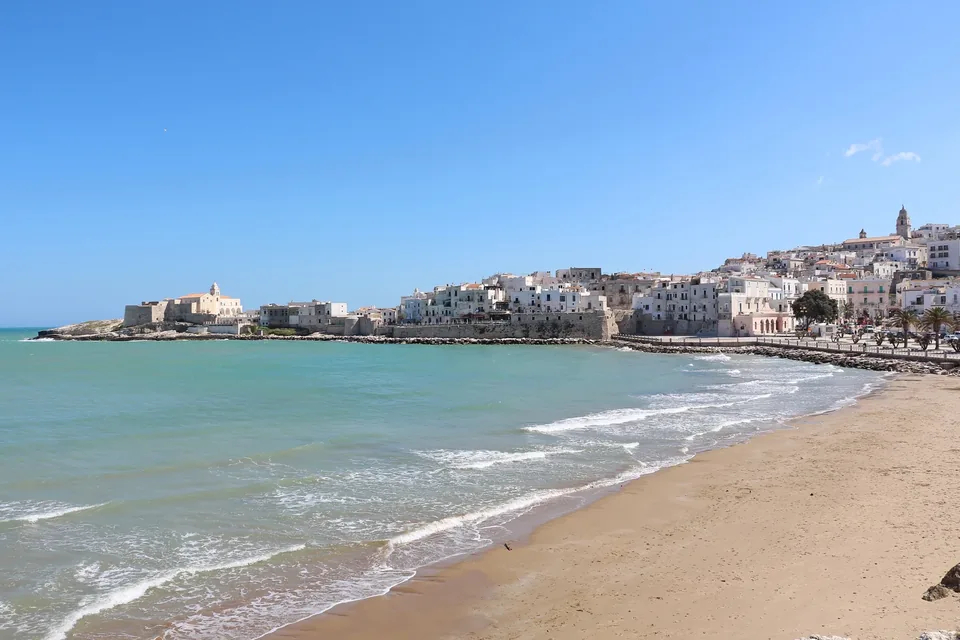
Vieste: old lanes and fishing structures. An old town on a rocky spur above the sea, its castle and cathedral, the Petrone viewpoint and trabucchi. The guide also covers the La Salata necropolis, the Sant’Eufemia lighthouse, the Petrone Museum with finds from the Defensola flint mine and the Pilgrims’ Way to Monte Sant’Angelo.
Read the guide →Photo: Bernard Gagnon / Wikimedia Commons — CC0 · Resized and converted to WebP.

Foresta Umbra
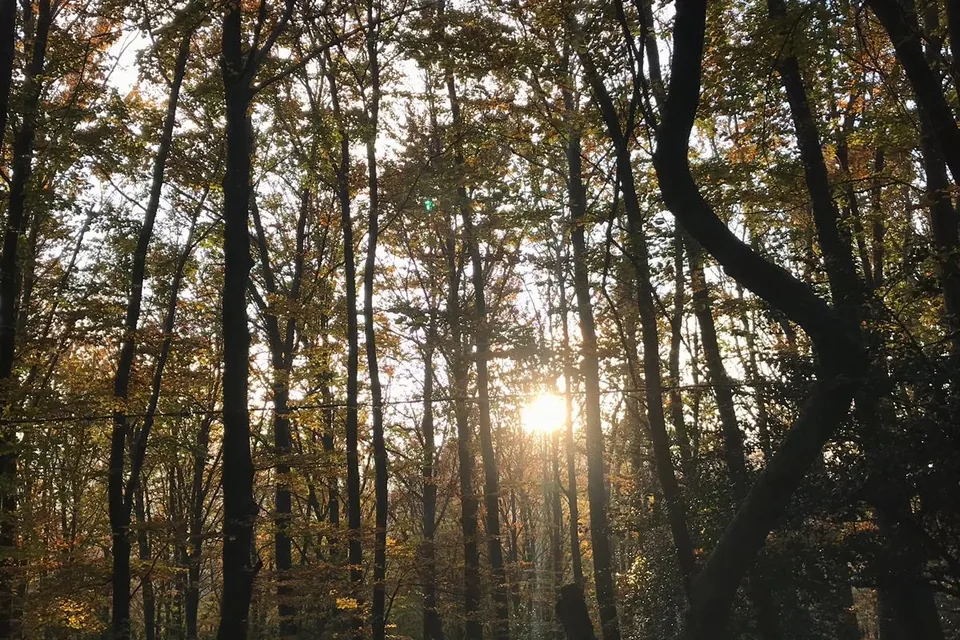
Foresta Umbra: Gargano beneath the beech trees. About 10,500 hectares of forest in the national park, with ancient beech woods on the UNESCO list since 2017.
Read the guide →Photo: Francesca Lenoci / Wikimedia Commons — CC BY-SA 4.0 · Resized and converted to WebP.

Isole Tremiti
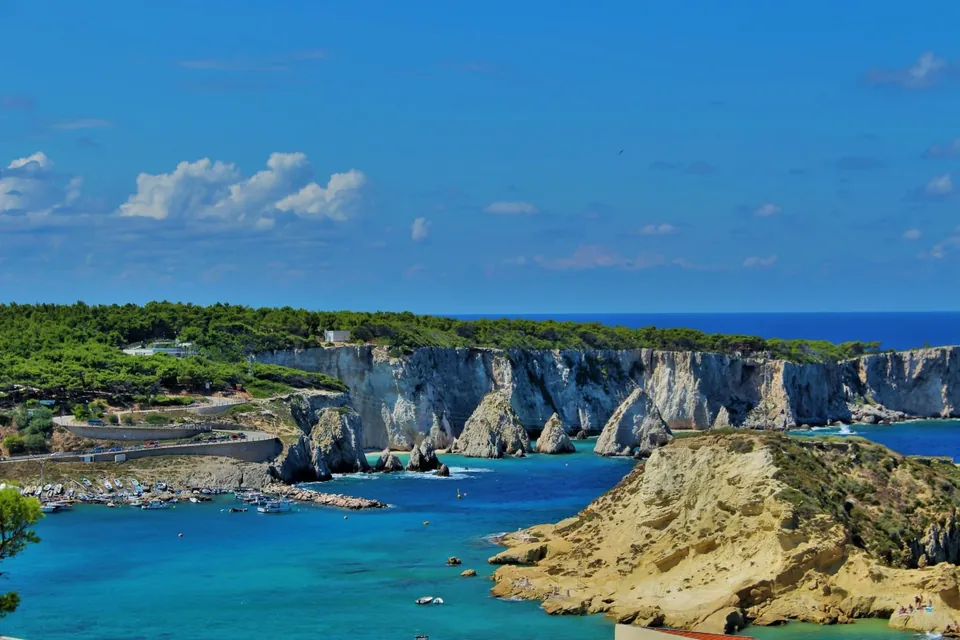
Tremiti: San Nicola and the island landscape. Puglia’s only archipelago, 12 nautical miles off the Gargano, with pine woods, white cliffs and an abbey fortress. In the marine protected area, 34 dive sites and wrecks from Roman times to the Lombardo, the steamer of Garibaldi’s Thousand; on San Nicola the church of Santa Maria a Mare with its eleventh-century mosaics, the cloisters and the memory of the political exiles.
Read the guide →Photo: Sara Caputo / Wikimedia Commons — CC BY-SA 4.0 · Resized and converted to WebP.

Gargano
Gargano: villages, woodland and coast. Beech woods, lagoons and white villages in the national park, the Archangel’s mountain and Ogliarola olives.
Read the guide →Photo: Bernard Gagnon / Wikimedia Commons — CC0 · Resized and converted to WebP.

“Come to Peschici as a guest, not as a tourist: that is how these places truly let you know them.”