

Why go
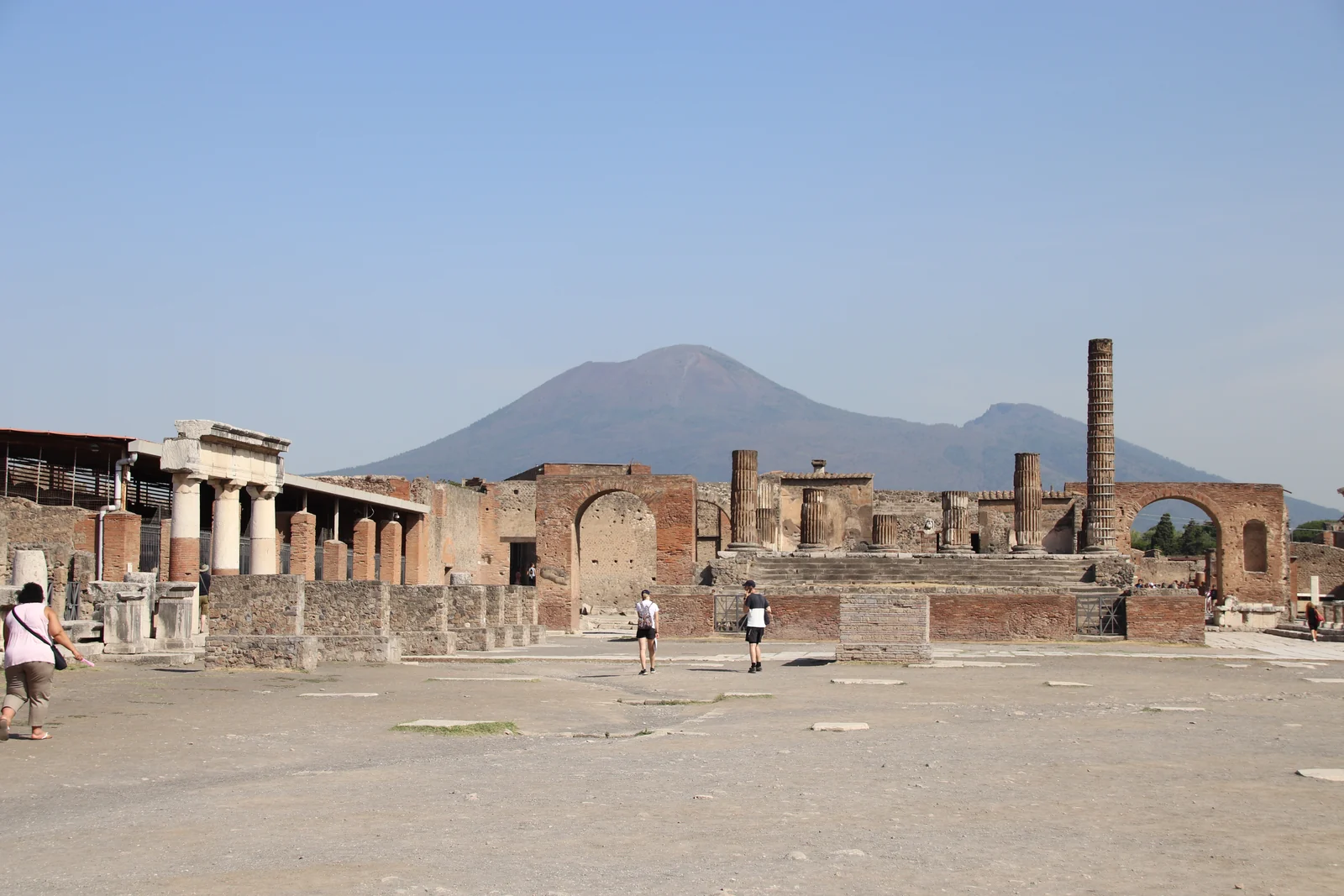
People come to Pompei above all for the Roman city that Vesuvius buried in AD 79. The Archaeological Park of Pompeii notes that the archaeological area covers about 66 hectares, of which about 45 have been excavated: streets, frescoed houses, temples, baths, shops and taverns of a middling town of ancient Italy. In 1997 UNESCO inscribed the “Archaeological Areas of Pompei, Herculaneum and Torre Annunziata” on the World Heritage List as “a complete and living testimony of the society and daily life at a specific moment in the past”.
The second reason is modern Pompei. Around the Shrine of the Blessed Virgin of the Holy Rosary, which Saint Bartolo Longo began to build in 1876, a new town grew up, with houses for the workers, the railway station and charitable institutions for the children of prisoners. Twice a year, on 8 May and on the first Sunday of October, thousands of pilgrims gather in front of the Shrine’s façade for the Supplication to the Virgin.
Sources: Parco Archeologico di Pompei — Guida agli scavi di Pompei (PDF) · Parco Archeologico di Pompei — Antiquarium · Parco Archeologico di Pompei — Ufficio Unesco · Pontificio Santuario di Pompei — San Bartolo Longo · Pontificio Santuario di Pompei — Supplica alla Madonna di Pompei
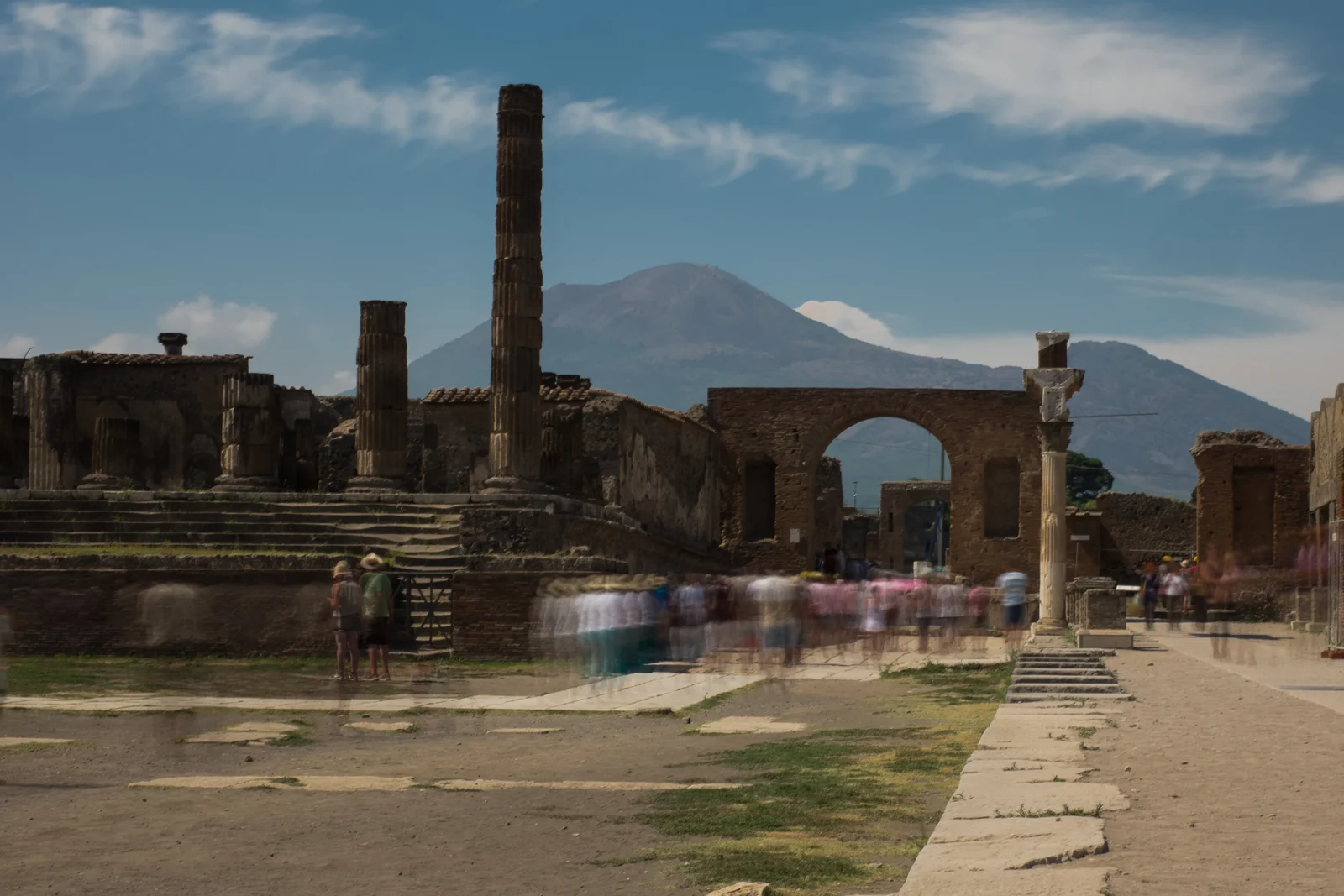
Photo: Sarahhoa / Wikimedia Commons — CC BY-SA 2.0 · Resized and converted to WebP.
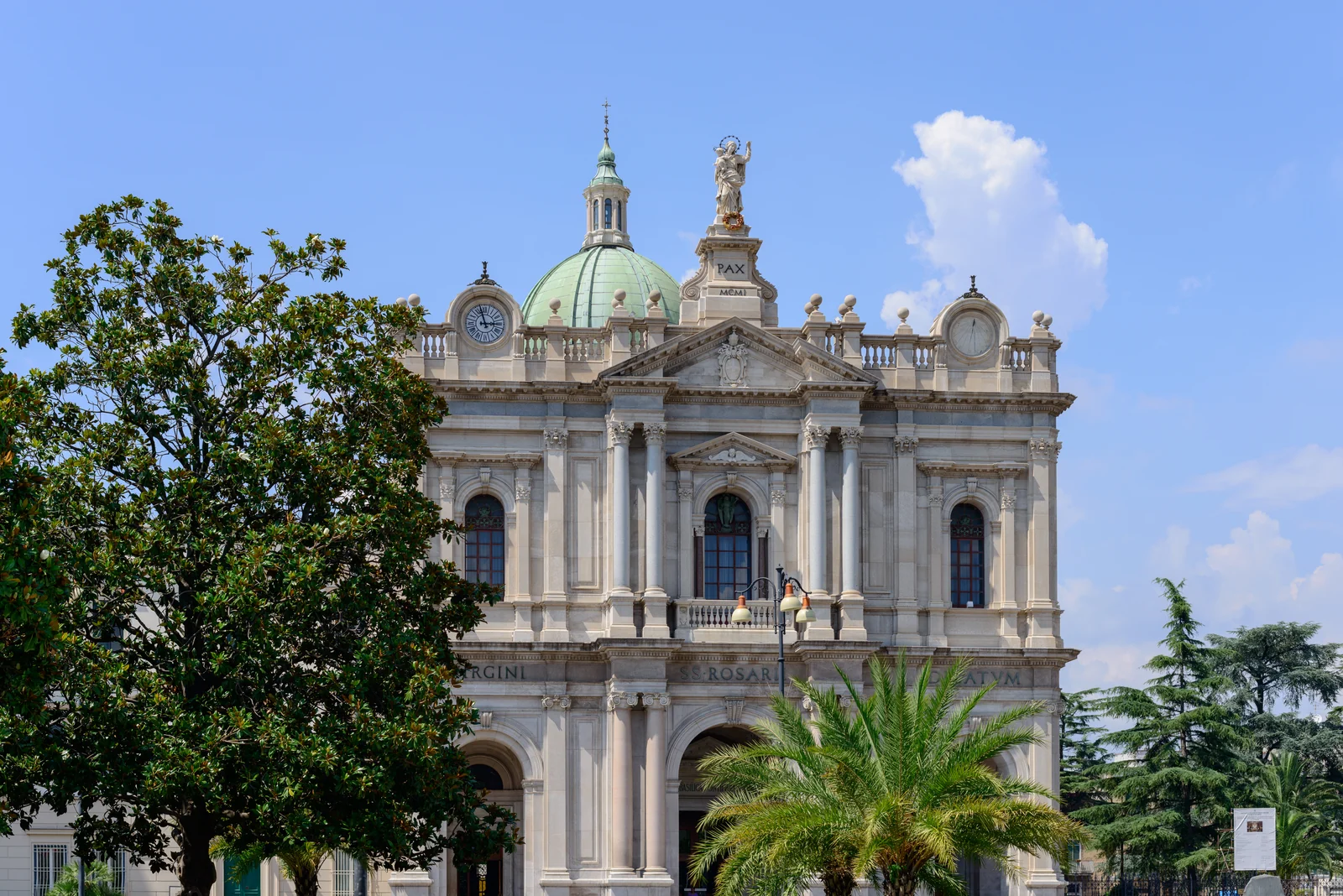
Photo: Norbert Nagel / Wikimedia Commons — CC BY-SA 3.0 · Resized and converted to WebP.
The municipality at a glance
Pompei is a municipality in the Metropolitan City of Naples, in Campania. Its ISTAT code is 063058. On 1 January 2025 it had 23,647 residents. The municipal territory covers 12.43 km² and ranges from 0 to 54 metres above sea level; the town hall stands at about 14 metres.
The municipality holds two Pompeis: the excavations of the Roman city, cared for by the Archaeological Park of Pompeii, an institute of the Ministry of Culture, and the modern town, which grew from the late nineteenth century around the Shrine and became a municipality in its own right in 1928.
Sources: ISTAT, Codici statistici delle unità amministrative territoriali: elenco dei comuni al 21 febbraio 2026 · ISTAT, Popolazione residente per età, sesso e stato civile al 1° gennaio 2025 (POSAS) · ISTAT, Principali statistiche geografiche sui comuni: superficie e altimetria al 31 dicembre 2021 · Ministero della cultura — Luoghi della cultura: Parco Archeologico di Pompei (aggiornato il 14 ottobre 2025) · Pontificio Santuario di Pompei — San Bartolo Longo
History
According to the Archaeological Park, in the Archaic period (seventh to sixth century BC) Pompeii grew strongly under the influence of the Greek and Etruscan cities of the Bay of Naples: a main square, the sanctuaries of Apollo and Athena, walls more than three kilometres long. After the crisis of the fifth century BC the Samnites settled there. In 308 BC the towns of the Sarno valley allied themselves with Rome: it is the first historical record of Pompeii, told by Livy. The second century BC was the town’s “golden century”, with the theatre, the temple of Isis, the Samnite Palaestra, the Stabian Baths, the temple of Jupiter, the Basilica and the market.
In the Social War Pompeii sided with the Italic allies and in 89 BC it was besieged by Sulla: along the walls the holes left by catapult shots can still be seen. Under Augustus the Forum filled with monuments honouring the emperor, and in the Julio-Claudian age the imperial court spent long periods on the Bay, between Capri and Baiae. In AD 62 a violent earthquake struck the Vesuvius area; seventeen years later the town was still a building site.
In AD 79 Vesuvius rained pumice and rock fragments down on Pompeii, and the next morning a cloud of toxic gas and burning ash swept through the town. The Park gives the day as 24 August, or 24 October according to recent studies and finds. Exploration began in 1748 under the King of Naples, Charles III of Bourbon; in 1858 Giuseppe Fiorelli divided the city into regiones and insulae, the numbering still in use.
Today’s Pompei is a young town. Bartolo Longo, born in Latiano in 1841, came to the Valle di Pompei in 1872 to manage the estates of Countess Marianna Farnararo De Fusco, whom he married in 1885. On 13 November 1875 the painting of Our Lady of the Rosary arrived there, and on 8 May 1876 the first stone of the new church was laid; it was consecrated in 1891. Around the building site came houses for the workers, the telegraph, the railway station, a small hospital and the observatories; in 1887 the first orphanage, in 1892 the home for the children of prisoners. Longo died on 5 October 1926; two years later Pompei was recognised as a municipality in its own right.
Beatified by John Paul II on 26 October 1980, Bartolo Longo was canonised by Pope Leo XIV in St Peter’s Square on 19 October 2025. On 8 May 2026 Leo XIV himself celebrated Mass and the Supplication in Piazza Bartolo Longo in Pompei, a hundred and fifty years after the first stone of the Shrine was laid.
Sources: Parco Archeologico di Pompei — Antiquarium · Parco Archeologico di Pompei — Guida agli scavi di Pompei (PDF) · Pontificio Santuario di Pompei — San Bartolo Longo · Pontificio Santuario di Pompei — Icona della Vergine · Pontificio Santuario di Pompei — Bartolo Longo santo! (19 ottobre 2025) · Santa Sede — Visita pastorale a Pompei: Santa Messa e Supplica in piazza Bartolo Longo, omelia di Leone XIV (8 maggio 2026)
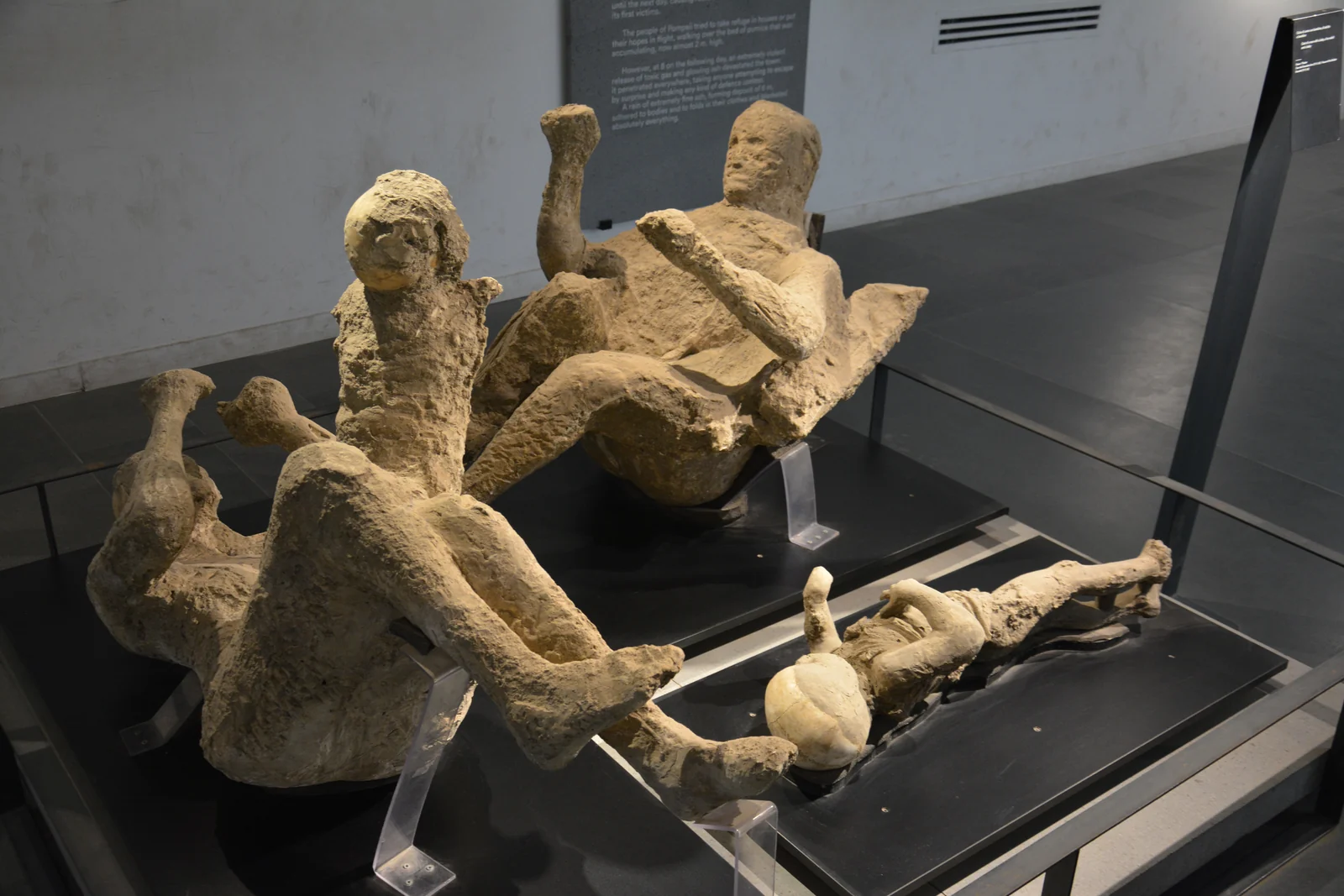
Photo: MentNFG / Wikimedia Commons — CC BY-SA 4.0 · Resized and converted to WebP.
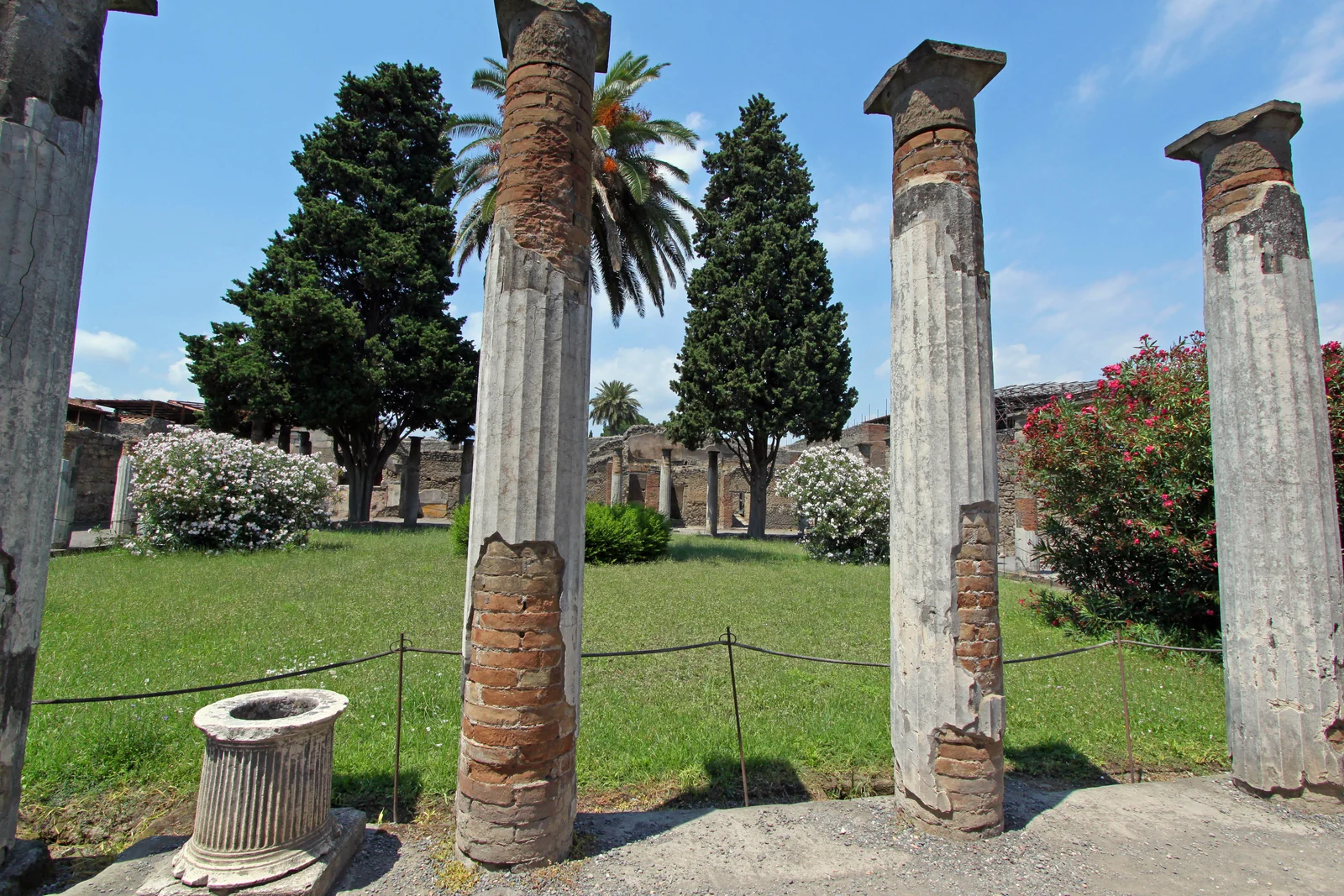
Photo: Carlo Pelagalli / Wikimedia Commons — CC BY-SA 3.0 · Resized and converted to WebP.
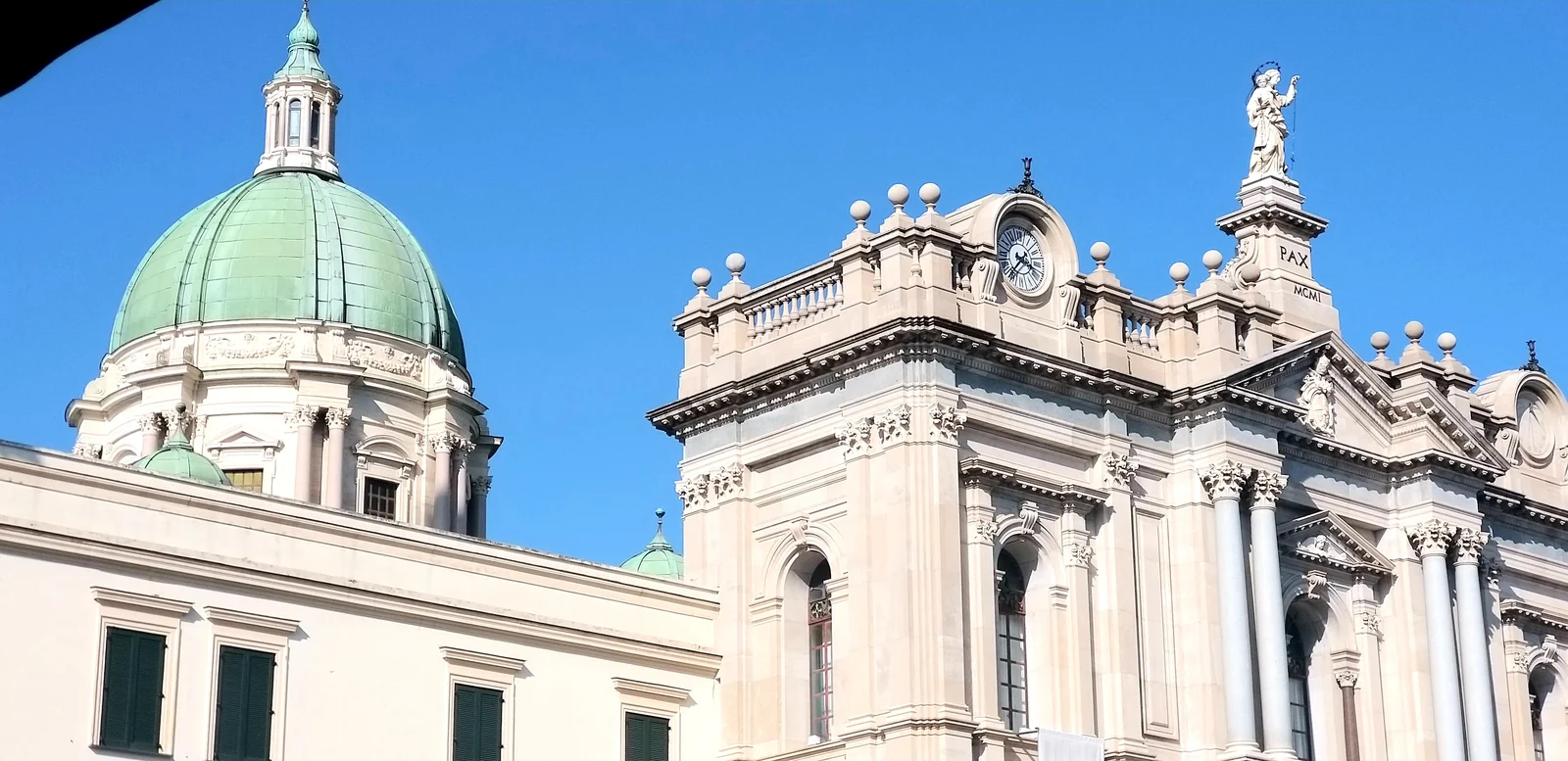
Photo: DinaBenedettoFerrandina / Wikimedia Commons — CC BY-SA 4.0 · Resized and converted to WebP.
What to see
The excavations are run by an institute of the Ministry of Culture with special autonomy, the Archaeological Park of Pompeii, which also looks after Oplontis, Boscoreale, Stabiae and the other Vesuvian sites. There are three entrances: Porta Marina, on Via Villa dei Misteri, Piazza Esedra and Piazza Anfiteatro. The Park suggests four routes, lasting from about two to about seven hours.
The Forum was the heart of civic life: around the square stood the buildings of administration and justice, the markets and the main temples, with the temple of Jupiter aligned on Vesuvius. The Amphitheatre, built in 70 BC, is the oldest known in the Roman world and could hold up to 20,000 spectators; the Large Theatre, from the middle of the second century BC, was the first great public building to be completely freed from the eruption deposits.
Among the houses, the House of the Faun takes up a whole block of about 3,000 square metres: it is named after the statue of the dancing satyr in the atrium, and the exedra holds a copy of the mosaic of the battle between Alexander the Great and Darius. The House of the Vettii, belonging to two freedman brothers who grew rich in trade, has the frieze of Cupids at work and a large garden with statues and fountains. Outside the walls, the Villa of the Mysteries is named after the great continuous fresco of a rite linked to Dionysus, one of the best preserved paintings of antiquity; the villa also had a wine-making quarter, with a reconstructed wooden press.
In the Garden of the Fugitives are the casts of thirteen victims, adults and children, caught while trying to flee towards Porta Nocera. The Antiquarium, opened by Giuseppe Fiorelli in 1873-1874 beneath the terrace of the Temple of Venus, has since 25 January 2021 told the town’s story from the Samnite period to the eruption in a new display: the frescoes of the House of the Golden Bracelet, the Moregine silver, the triclinium of the House of the Menander, the latest casts from the villa at Civita Giuliana.
In the new town, the Shrine of the Blessed Virgin of the Holy Rosary has a façade inaugurated on 5 May 1901 and dedicated to Universal Peace, in travertine from Monte Tifata; Aristide Leonori’s bell tower was inaugurated in 1925, and the dome rises to 57 metres. On the throne above the high altar is the icon of Our Lady with Saint Dominic and Saint Catherine of Siena. The Shrine’s museum holds the ex-votos; the Marian Picture Gallery keeps thirteen works, with a rediscovered painting by Andrea Mantegna. In front lies Piazza Bartolo Longo, laid out in 1929, with the founder’s monument inaugurated in 1962 and Palazzo De Fusco, the town hall.
Sources: Ministero della cultura — Luoghi della cultura: Parco Archeologico di Pompei (aggiornato il 14 ottobre 2025) · Parco Archeologico di Pompei — Chi siamo · Parco Archeologico di Pompei — Dove siamo e come raggiungerci · Parco Archeologico di Pompei — Pompei: regiones, approfondimenti e percorsi · Parco Archeologico di Pompei — Guida agli scavi di Pompei (PDF) · Parco Archeologico di Pompei — Antiquarium · Parco Archeologico di Pompei — Orari e tariffe · Parco Archeologico di Pompei — Nuovo sistema tariffario in vigore dal 1° gennaio 2027 (6 novembre 2026) · Pontificio Santuario di Pompei — Storia e arte · Pontificio Santuario di Pompei — Icona della Vergine · Pontificio Santuario di Pompei — La Pinacoteca Mariana del Santuario
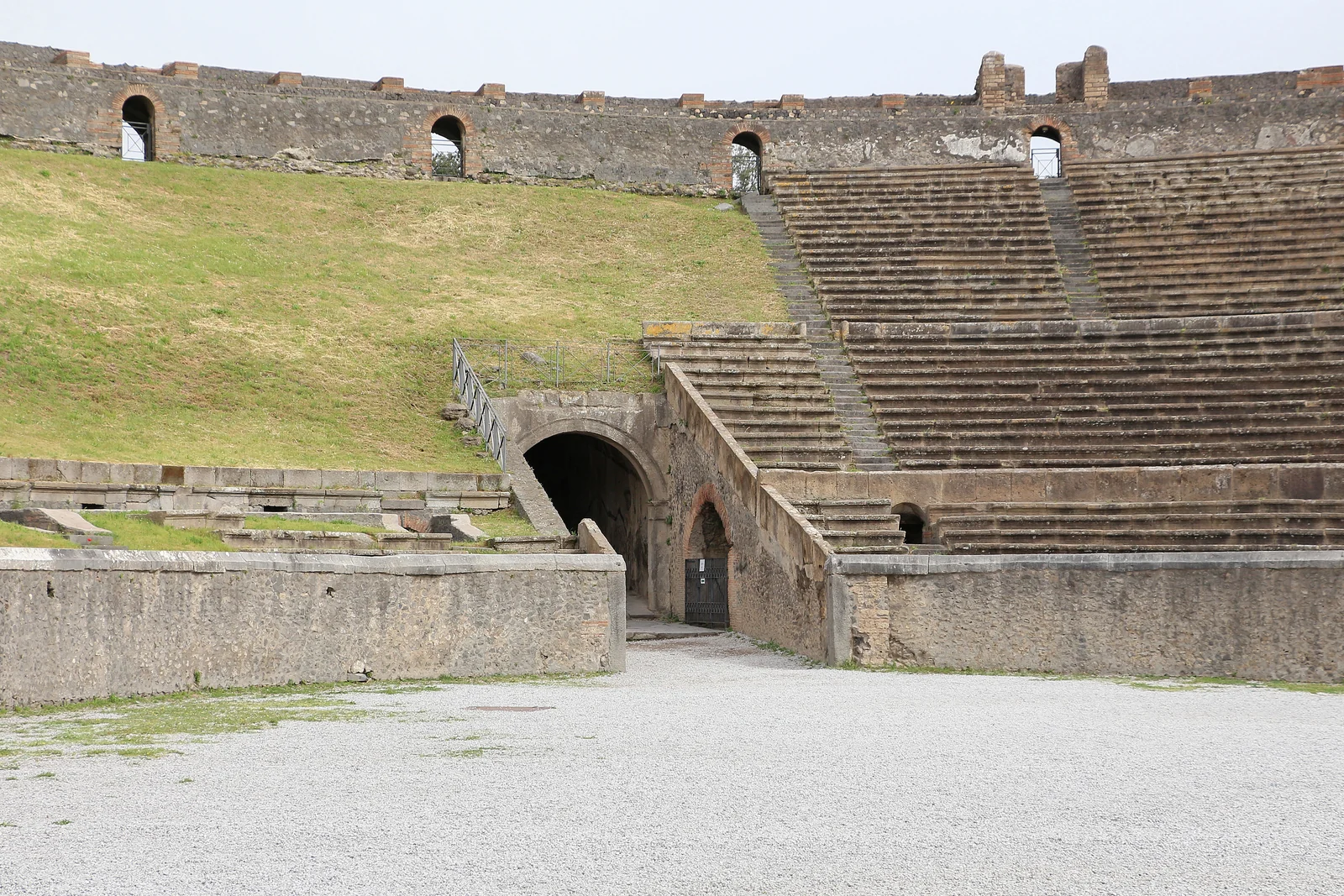
Photo: Bernard Gagnon / Wikimedia Commons — CC BY 4.0 · Resized and converted to WebP.
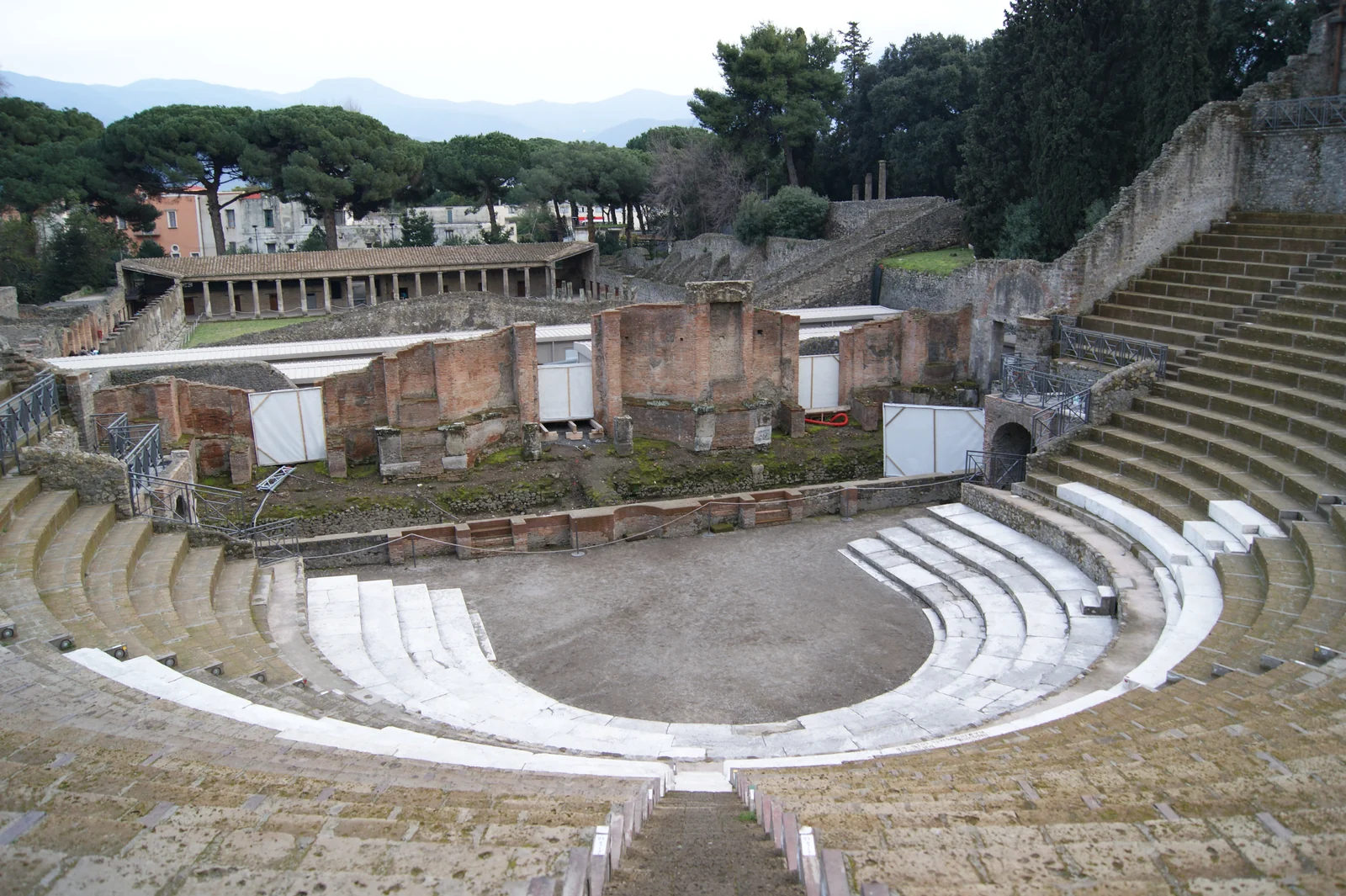
Photo: Sylvhem / Wikimedia Commons — CC BY-SA 3.0 · Resized and converted to WebP.
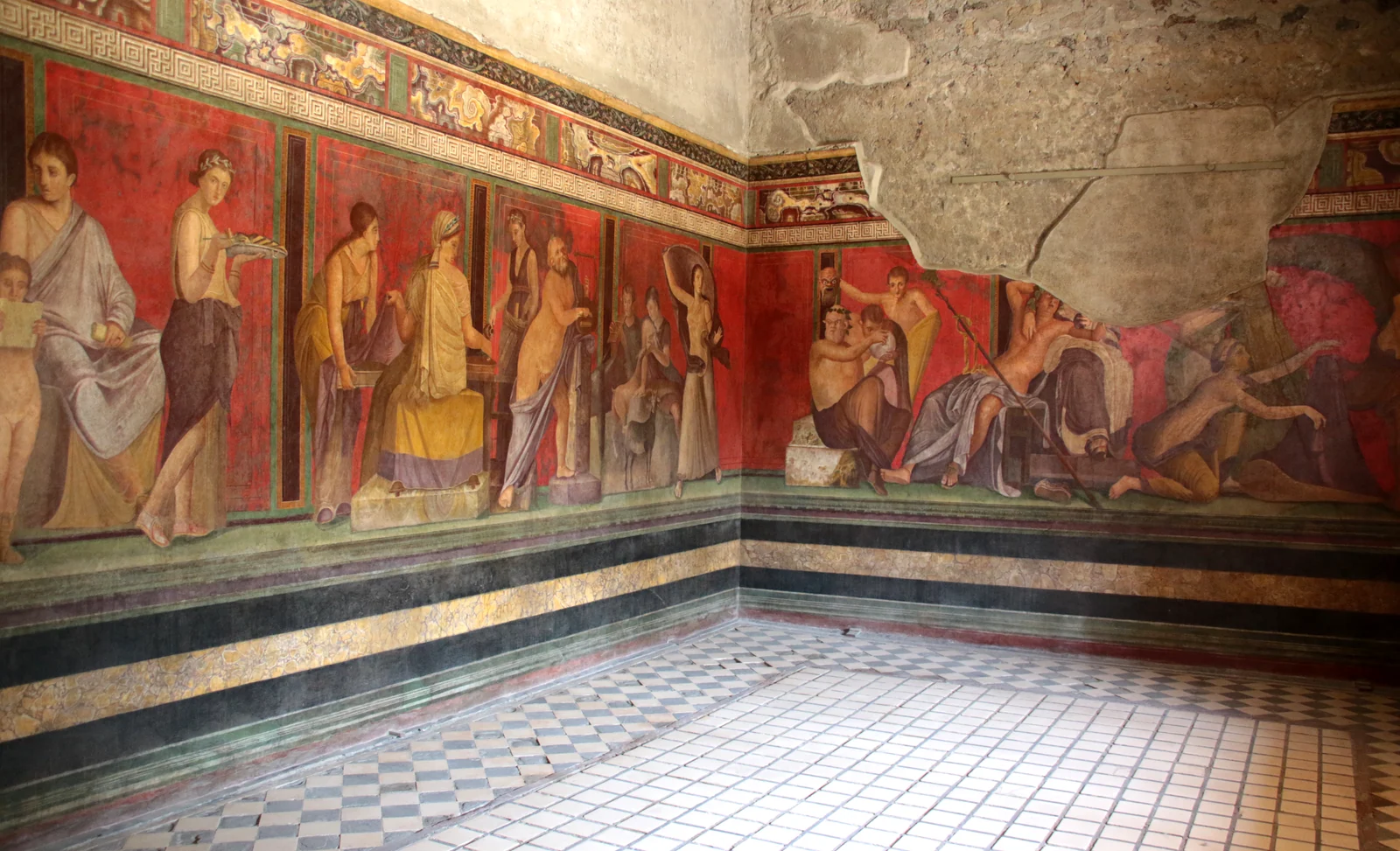
Photo: Raffaele pagani / Wikimedia Commons — CC BY-SA 4.0 · Resized and converted to WebP.
Flavours
In Pompei food is told first of all in the excavations. In the excavated part, two thirds of the ancient town, the Park’s guide counts 89 thermopolia, small taverns selling hot food, used above all by the humbler classes. The thermopolium of Regio V, with the image of a Nereid on horseback, partly excavated in 2019, has emerged in full with painted still lifes, food remains and animal bones.
Wine was serious business. Before the eruption the slopes of Vesuvius were covered with farm villas producing wine. In the Foro Boario excavations found a large vineyard trained in the “compluviata” manner, a press and ten large buried jars for a vintage estimated at about 120 hectolitres: today an experimental vineyard of native grape varieties grows there. The Garden of the Fugitives, too, had been turned into a vineyard in the years before the eruption, with a triclinium for open-air banquets under a pergola. Since 2024 a partnership agreement of the Park has entrusted private firms, for ten years, with the archaeological vineyards of Regiones I and II, about 15,540 square metres, and a new vineyard between the Insula Occidentalis and Via Villa dei Misteri, with a winery and a shop within the excavations.
Sources: Parco Archeologico di Pompei — Guida agli scavi di Pompei (PDF) · Parco Archeologico di Pompei — Riaffiora per intero il termopolio della Regio V · Parco Archeologico di Pompei — Accordo di partenariato per la gestione dei vigneti archeologici (29 novembre 2024)
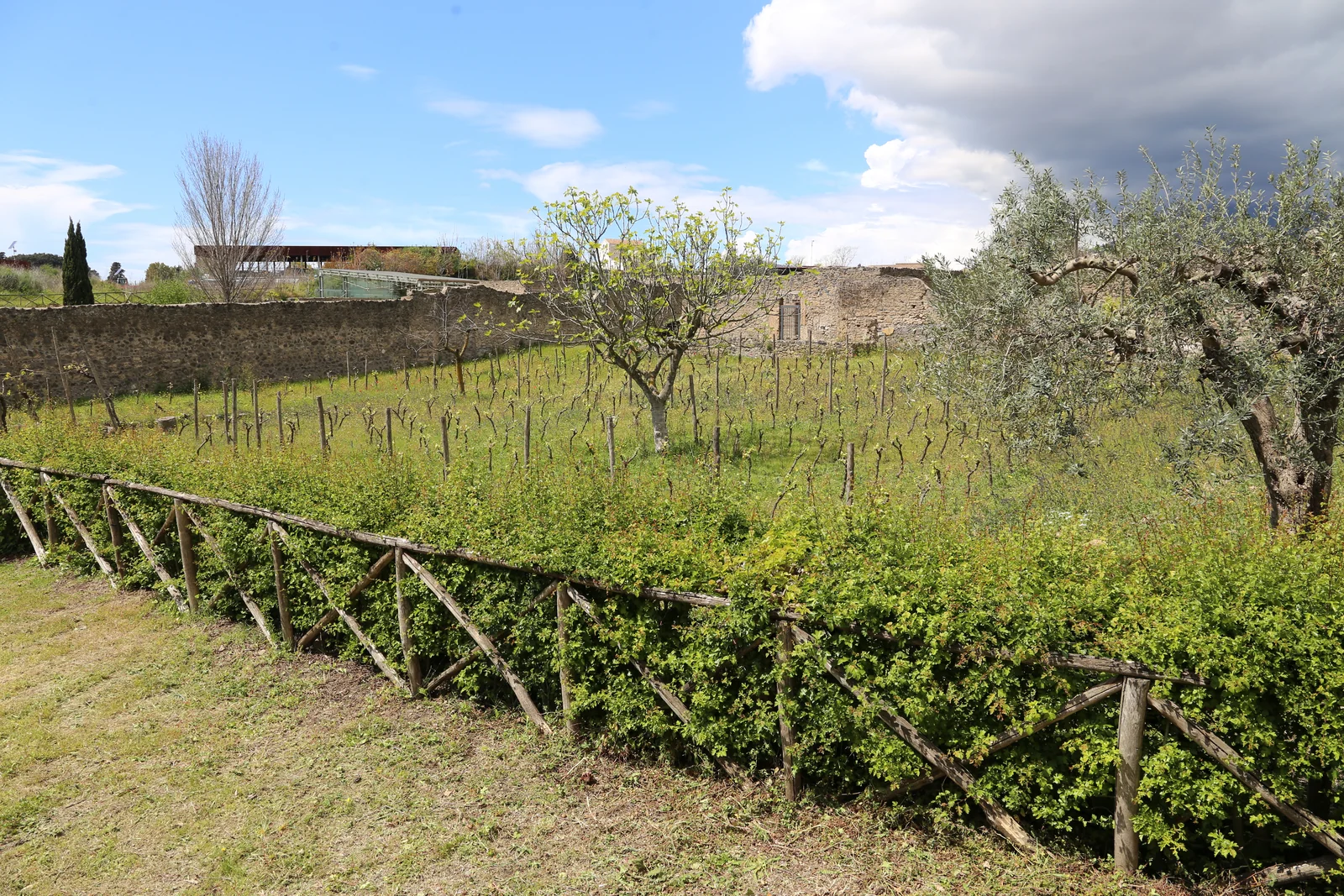
Photo: Sailko / Wikimedia Commons — CC BY-SA 4.0 · Resized and converted to WebP.
Experiences
Besides the standard ticket, the Park offers two themed routes of about an hour and a half, “Civic Pompeii” and “Everyday Pompeii”. With the excavations ticket the free Pompeii Artebus shuttle leaves Piazza Esedra for Villa Regina and the Antiquarium at Boscoreale and for the Villa of Poppaea at Oplontis; a third bus links, from Castellammare di Stabia, the villas of Stabiae and the Archaeological Museum.
From 12 November 2026 to mid-March 2027, every Thursday after closing time, the Villa of the Mysteries opens in the evening, lit up, with access from the street and a free shuttle from Piazza Esedra; five evenings are organised by the participating towns, Pompei’s on 26 November. For families the Park has launched the Pompeii Children’s Museum, the first space for children inside an archaeological area, destined for the Casina Rosellino on Via dell’Abbondanza, with travelling activities at the sites since July 2024.
At the Shrine, since 5 October 2018 visitors can see Bartolo Longo’s study and bedroom and a copy of the first version of the Supplication, written in 1883.
Sources: Parco Archeologico di Pompei — Orari e tariffe · Parco Archeologico di Pompei — Pompeii Artebus: orari e modalità · Parco Archeologico di Pompei — Al via «I Giovedì a Villa dei Misteri» (novembre 2026) · Parco Archeologico di Pompei — Pompeii Children’s Museum · Pontificio Santuario di Pompei — Storia e arte
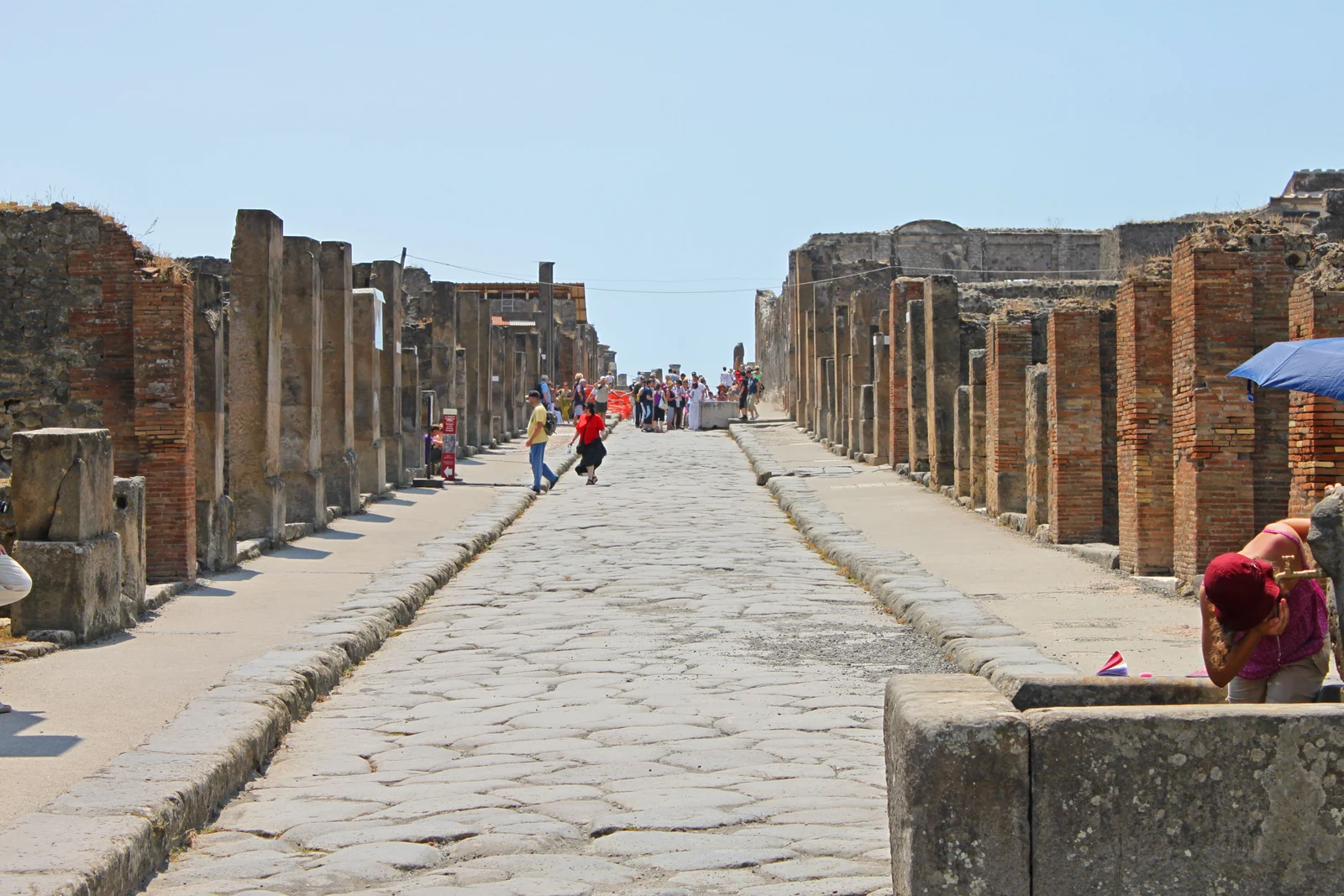
Photo: Carlo Pelagalli / Wikimedia Commons — CC BY-SA 3.0 · Resized and converted to WebP.
When to go
The new town’s calendar has two great days: the Supplication to the Virgin of the Rosary is recited solemnly at noon on 8 May and on the first Sunday of October, drawing thousands of pilgrims from Italy and abroad to the Shrine’s façade. The Supplication was first recited on 14 October 1883 by twenty thousand pilgrims.
At the excavations the Park has set a limit of 20,000 entries a day, with named tickets. From November to March there are the Thursday evening openings at the Villa of the Mysteries; between June and early October the Park’s calendar brings concerts to the Amphitheatre and the Large Theatre.
Sources: Pontificio Santuario di Pompei — Supplica alla Madonna di Pompei · Pontificio Santuario di Pompei — San Bartolo Longo · Parco Archeologico di Pompei — Nuovo sistema tariffario in vigore dal 1° gennaio 2027 (6 novembre 2026) · Parco Archeologico di Pompei — Al via «I Giovedì a Villa dei Misteri» (novembre 2026) · Parco Archeologico di Pompei — Eventi
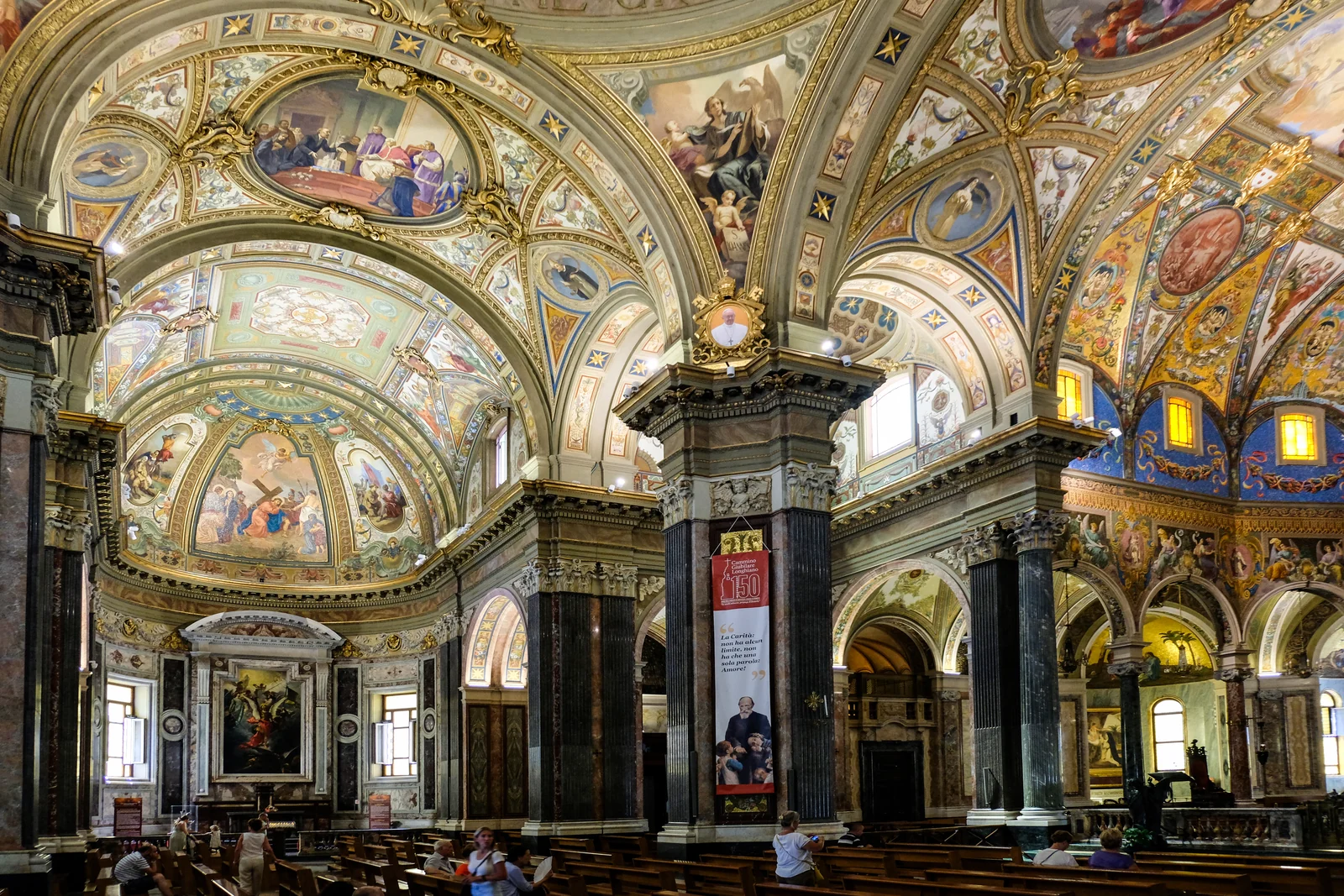
Photo: Kasa Fue / Wikimedia Commons — CC BY-SA 4.0 · Resized and converted to WebP.
Getting there
By train, according to the Park: for the Porta Marina and Piazza Esedra entrances take the Circumvesuviana Naples-Sorrento line to Pompei Villa dei Misteri; for Piazza Anfiteatro the Circumvesuviana Naples-Poggiomarino line to Pompei Santuario; there is also Pompei station on the FS Naples-Salerno line, linked to the excavations by the combined train and bus service Pompei Link in about 15 minutes. By bus, SITA lines arrive from Naples and Salerno and Busitalia Campania lines 4 and 50 from Salerno; by car, leave the A3 Naples-Salerno motorway at Pompei Scavi.
The official ticket offices are only at the entrances inside the archaeological area; tickets carry the visitor’s name and must be shown with an identity document, and only small bags are allowed, at most 30 x 30 x 15 centimetres. At the Piazza Esedra and Piazza Anfiteatro entrances there are 24 wheelchairs, to be booked through the Park’s info point. At Pompei Scavi Villa dei Misteri station, according to EAV, wheelchair users can board and alight by ramp only on trains towards Sorrento.
Sources: Parco Archeologico di Pompei — Dove siamo e come raggiungerci · Parco Archeologico di Pompei — Orari e tariffe · Parco Archeologico di Pompei — Nuovo sistema tariffario in vigore dal 1° gennaio 2027 (6 novembre 2026) · Parco Archeologico di Pompei — Si amplia il servizio di sedie a rotelle presso gli Scavi di Pompei · EAV — Accessibilità motoria: stazione di Pompei Scavi Villa dei Misteri, istruzioni
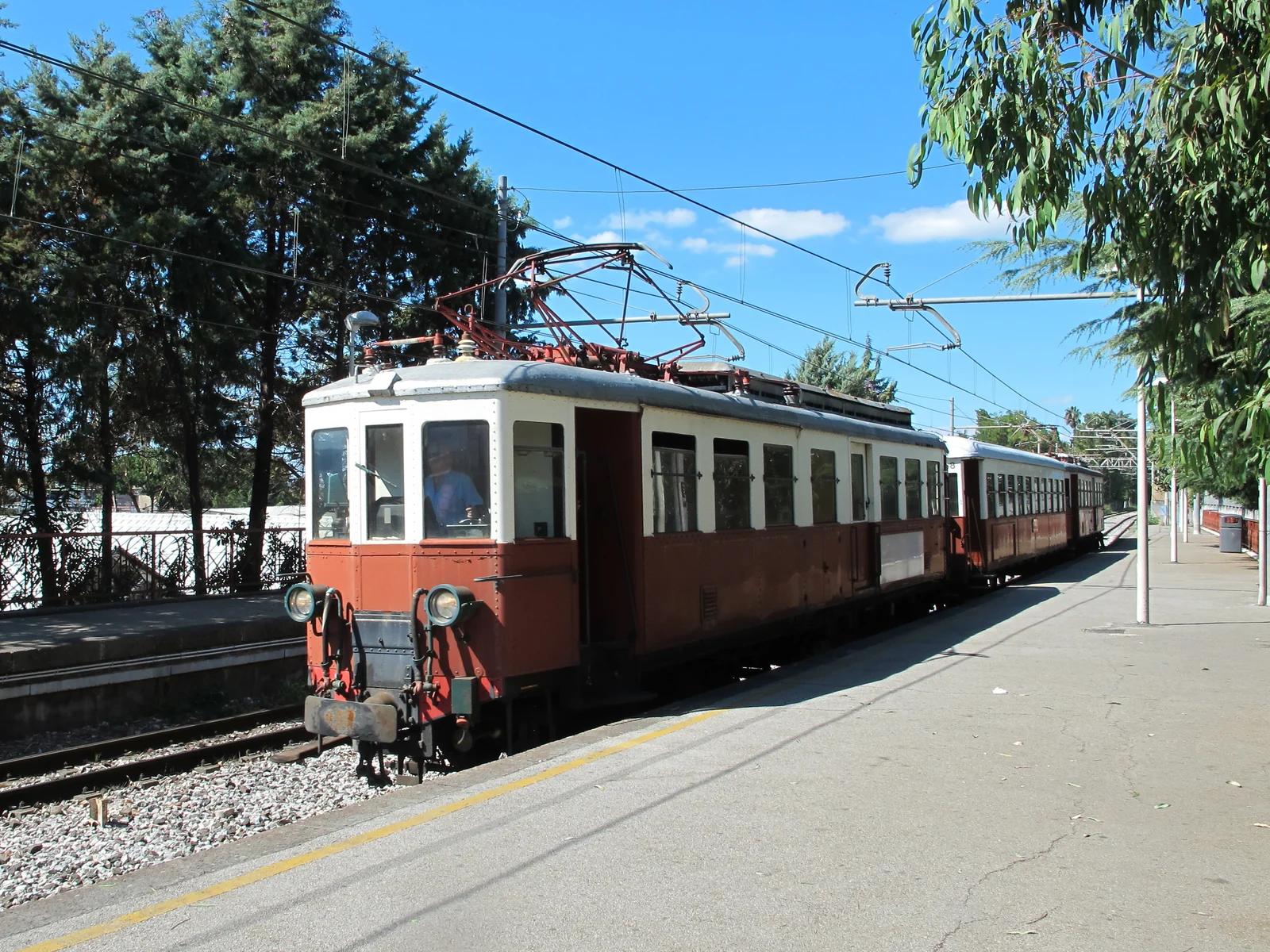
Photo: Manfred Kopka / Wikimedia Commons — CC BY-SA 4.0 · Resized and converted to WebP.
Accommodation in figures
In the Ministry of Tourism’s national database of accommodation (BDSR), on 12 October 2026, Pompei had 441 establishments with a verified national identification code (CIN): 26 hotel-type establishments, 106 non-hotel establishments and 309 other establishments.
Sources: Ministero del Turismo – Banca Dati Strutture Ricettive (dashboard pubblica)
Nearby
The Archaeological Park of Pompeii also looks after the Roman villas nearby: Villa Regina and the Antiquarium at Boscoreale, the Villa of Poppaea at Oplontis, in the municipality of Torre Annunziata, the villas Arianna and San Marco and the Archaeological Museum of Stabiae at Castellammare di Stabia, the Castle of Lettere, the Longola archaeological park at Poggiomarino, the former Bourbon Royal Powder Works at Scafati and the Royal Palace of Quisisana. With a Pompeii ticket, within 30 days, visitors can see free of charge the Castle of Lettere, the Longola park, the Terzigno archaeological museum and the National Archaeological Museum of Volcei at Buccino. Herculaneum and Torre Annunziata share the UNESCO site with Pompeii.
Sources: Parco Archeologico di Pompei — Chi siamo · Ministero della cultura — Luoghi della cultura: Parco Archeologico di Pompei (aggiornato il 14 ottobre 2025) · Parco Archeologico di Pompei — Orari e tariffe · Parco Archeologico di Pompei — Ufficio Unesco
The town council
The official website of the Comune di Pompei, registered in IndicePA, the index of the digital addresses of Italy’s public administrations, is the reference for the town council’s offices, opening hours and news. Its address is listed among the sources of this section.
The town hall is Palazzo De Fusco, at Piazza Bartolo Longo 36, opposite the Shrine; the switchboard answers on 081 8576111. For the excavations, the Archaeological Park’s info point answers on 081 8575347.
Sources: Comune di Pompei, sito istituzionale · IndicePA (AgID), Indice dei domicili digitali delle pubbliche amministrazioni: dataset Enti · Pontificio Santuario di Pompei — Storia e arte · Parco Archeologico di Pompei — Orari e tariffe
Where to stay
In the municipality of Pompei the national database of the Ministry of Tourism lists 441 accommodation businesses with a verified CIN code: 26 hotels, 106 other licensed accommodation and 309 other types such as B&Bs and private rentals.
Licensed businesses from the official list of accommodation named as the source in this section. Where the list gives it, the property's official identification code appears next to its name: the national CIN code, or the code assigned by the Region or by the body that keeps the list. Private individuals are not listed. This list is the official census of licensed businesses, not a list of Apulica partners: to stay in Pompei you do not have to check one property after another yourself; write to Apulica and we look for the stay that suits your journey, checking availability and conditions before any confirmation.
ABALON POMPEI RESORT
Hotel · ★★★★
Regional code (CUSR) 15063058ALB0162
FORTUNA VILLAGE
Holiday village · ★★★
Regional code (CUSR) 15063058EXT0429
CAMPING POMPEI
Campsite · ★★★
Regional code (CUSR) 15063058EXT0071
Azienda Agricola Bosco de Medici
Farm stay
Regional code (CUSR) 15063058EXTD49S
A CASA DI NINA
Guest rooms
Regional code (CUSR) 15063058EXT0009
AGORA' HOSTEL DELUXE
Hostel
Regional code (CUSR) 15063058EXTSTC0
ALBERGO AMLETO
Hotel · ★★★★
Regional code (CUSR) 15063058ALB0016
CAMPING SPARTACUS
Campsite · ★★★
Regional code (CUSR) 15063058EXT0072
Villa Julia
Farm stay
Regional code (CUSR) 15063058EXT0503
AFFITTACAMERE
Guest rooms
Regional code (CUSR) 15063058EXT0013
First the places that presented themselves to Apulica, the latest first; then one place of each type in turn, by official category and stars, then by name. No position is paid for.
All 125 entries in alphabetical order
Page 1 of 13
| Name | Type | Identification code |
|---|---|---|
| A CASA DI NINA | Guest rooms | Regional code (CUSR) 15063058EXT0009 |
| ABALON POMPEI RESORT | Hotel | Regional code (CUSR) 15063058ALB0162 |
| AFFITTACAMERE | Guest rooms | Regional code (CUSR) 15063058EXT0013 |
| AFFITTACAMERE DAMA POMPEI | Guest rooms | Regional code (CUSR) 15063058EXTGJDW |
| AFFITTACAMERE DIANA INN 4 | Guest rooms | Regional code (CUSR) 15063058EXT0505 |
| Affittacamere Diana Inn 5 | Guest rooms | Regional code (CUSR) 15063058EXTPD5U |
| AFFITTACAMERE STUDIO 83 POMPEI | Guest rooms | Regional code (CUSR) 15063058EXT0327 |
| AGORA' HOSTEL DELUXE | Hostel | Regional code (CUSR) 15063058EXTSTC0 |
| ALBERGO AMITRANO | Hotel | Regional code (CUSR) 15063058ALB0015 |
| ALBERGO AMLETO | Hotel | Regional code (CUSR) 15063058ALB0016 |
Ask Apulica for a stay in Pompei We reply shortly, within a few hours at most, with a proposal for you to consider.
Sources: Ministero del Turismo – Banca Dati Strutture Ricettive (dashboard pubblica), 2026-10-12
YOUR JOURNEY
How to shape a journey here
To include Pompei in a trip, or to ask for a guide or a transfer, you can write to Apulica with the button below.
Plan your tripKeep exploring
Torre Annunziata
Torre Annunziata (NA), Campania: 39,719 residents, 7.59 km². The official facts of the municipality, its town council website and its registered accommodation.
Read the guide →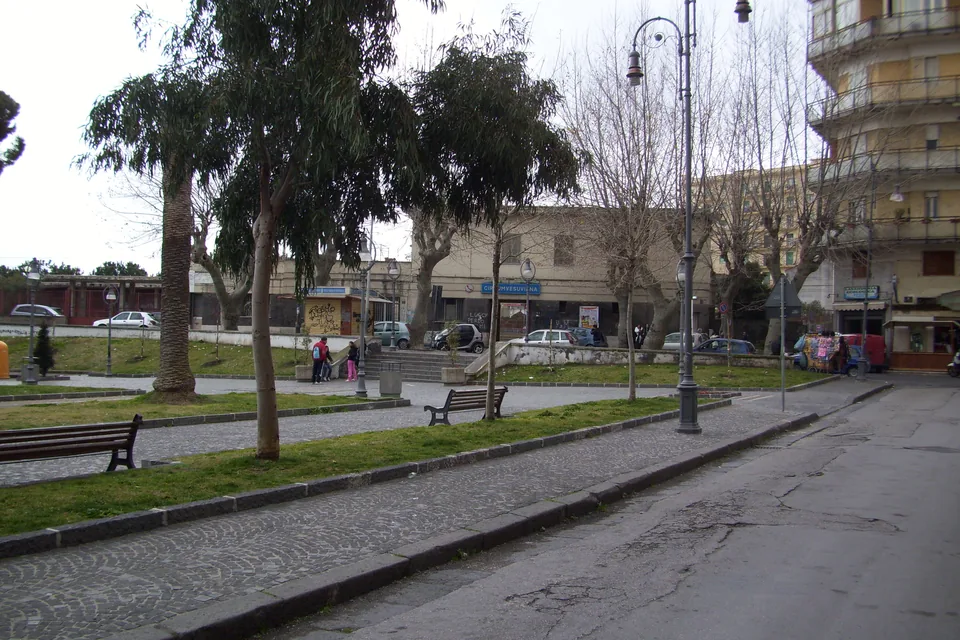
Boscoreale
Boscoreale (NA), Campania: 25,833 residents, 11.40 km². The official facts of the municipality, its town council website and its registered accommodation.
Read the guide →Photo: Alexdevil / Wikimedia Commons — CC BY-SA 3.0 · Resized and converted to WebP.

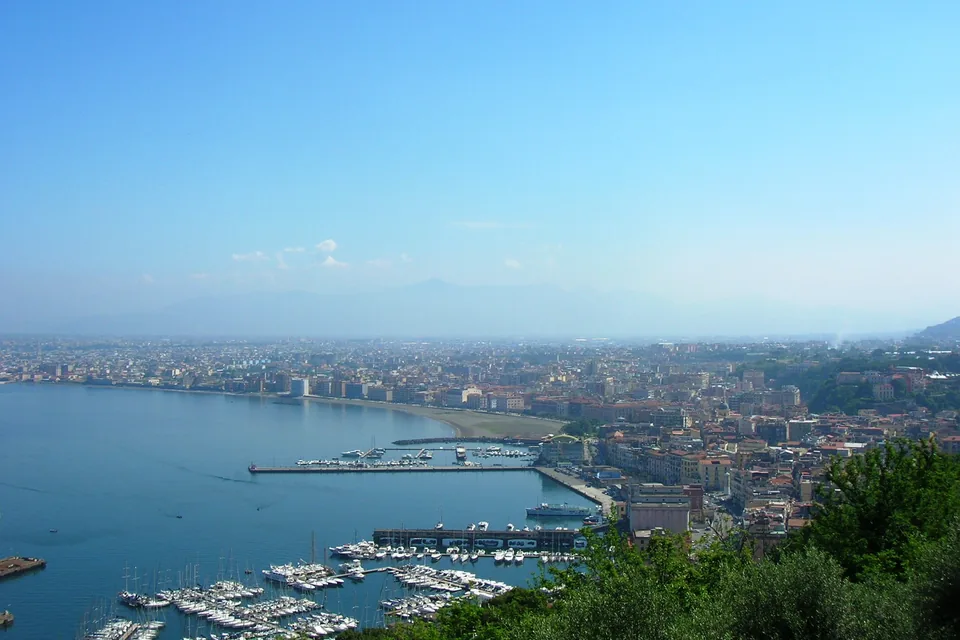
Castellammare di Stabia
Castellammare di Stabia (NA), Campania: 62,320 residents, 17.99 km². The official facts of the municipality, its town council website and its registered accommodation.
Read the guide →Photo: Mentnafunangann / Wikimedia Commons — CC BY-SA 3.0 · Resized and converted to WebP.

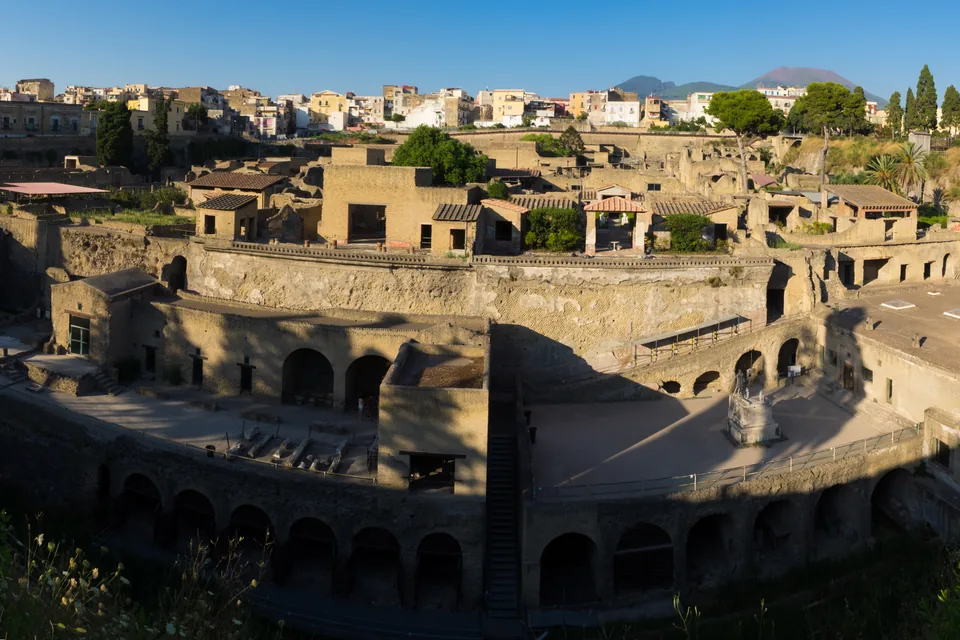
Ercolano
Ercolano (NA), Campania: 49,505 residents, 19.92 km². The official facts of the municipality, its town council website and its registered accommodation. The excavations of Herculaneum, a UNESCO World Heritage site, the Antiquarium and the boat from the ancient beach, the villas of the Miglio d’Oro, the Resina market, the piennolo cherry tomato PDO, Lacryma Christi wine and the Gran Cono trail up Vesuvius.
Read the guide →Photo: Sarahhoa / Wikimedia Commons — CC BY-SA 2.0 · Resized and converted to WebP.

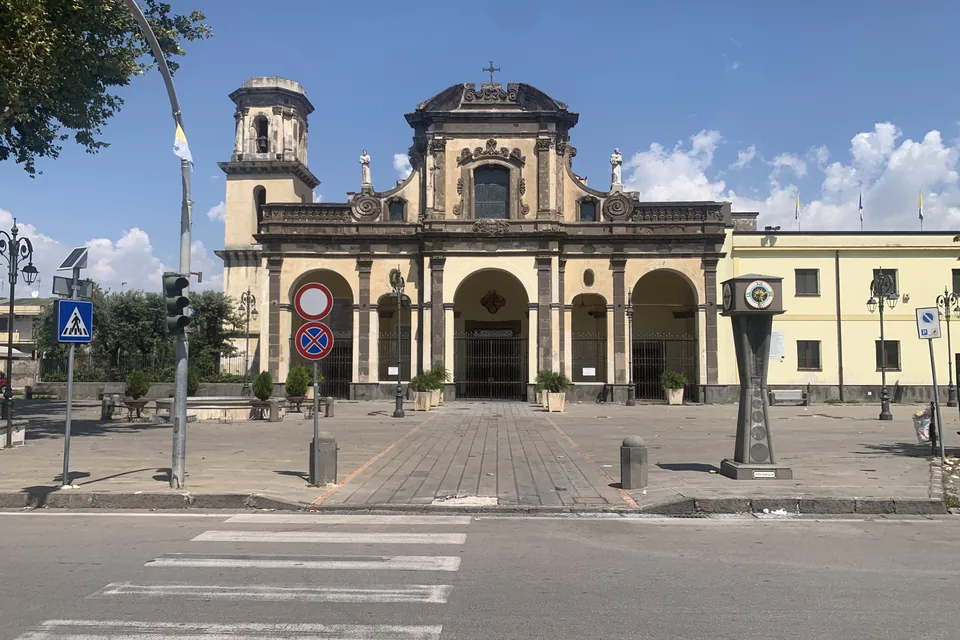
Scafati
Scafati (SA), Campania: 47,667 residents, 19.87 km². The official facts of the municipality, its town council website and its registered accommodation.
Read the guide →Photo: GiovAngri / Wikimedia Commons — CC BY-SA 4.0 · Resized and converted to WebP.

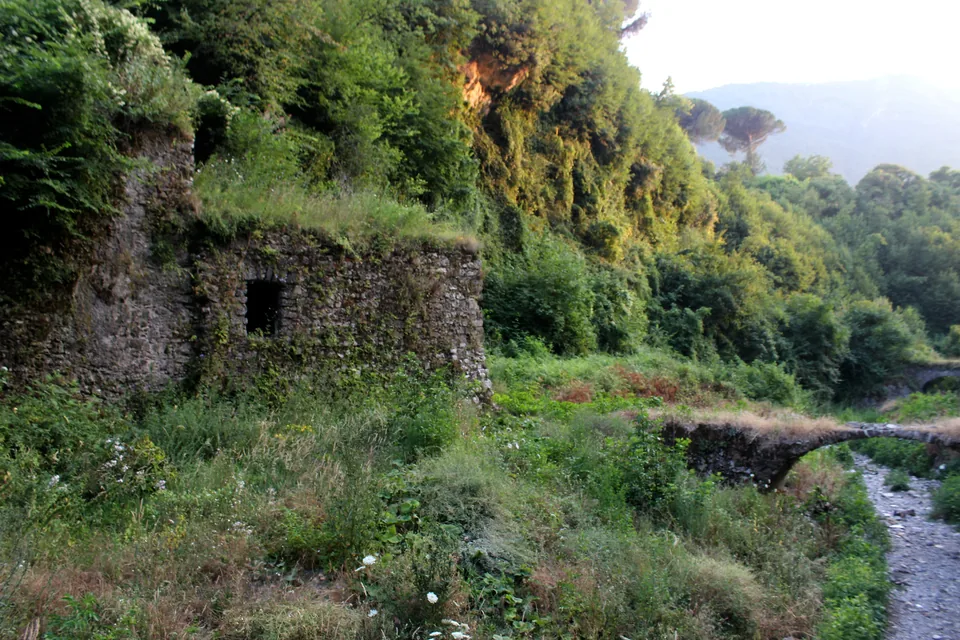
Gragnano
Gragnano (NA), Campania: 27,694 residents, 14.64 km². The official facts of the municipality, its town council website and its registered accommodation. The City of Pasta: Pasta di Gragnano PGI, the Valley of the Mills, Via Roma laid out for the wind, the Corpus Domini church and Santa Maria Assunta at Castello, the Roman villa of Carmiano and the September pasta festival.
Read the guide →Photo: Miguel Hermoso Cuesta / Wikimedia Commons — CC BY-SA 4.0 · Resized and converted to WebP.

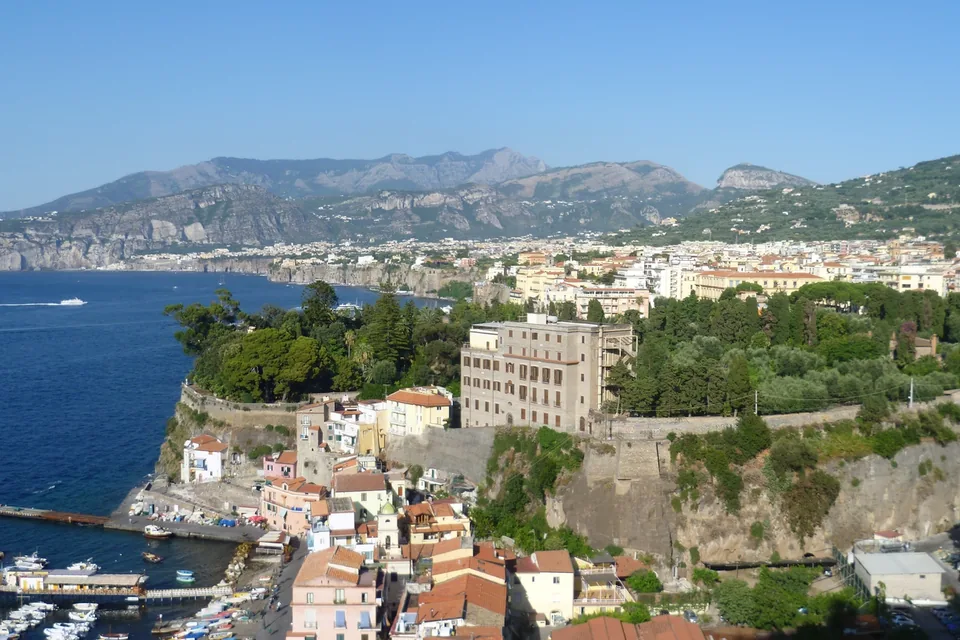
Sorrento
Sorrento (NA), Campania: 15,152 residents, 10.00 km². The official facts of the municipality, its town council website and its registered accommodation. The town on its tuff cliff, the old centre with the basilica of Sant’Antonino and the cloister of San Francesco, the Museo Correale, the Sorrento Lemon PGI, the marinas and the train from Naples.
Read the guide →Photo: Kim Traynor / Wikimedia Commons — CC BY-SA 3.0 · Resized and converted to WebP.

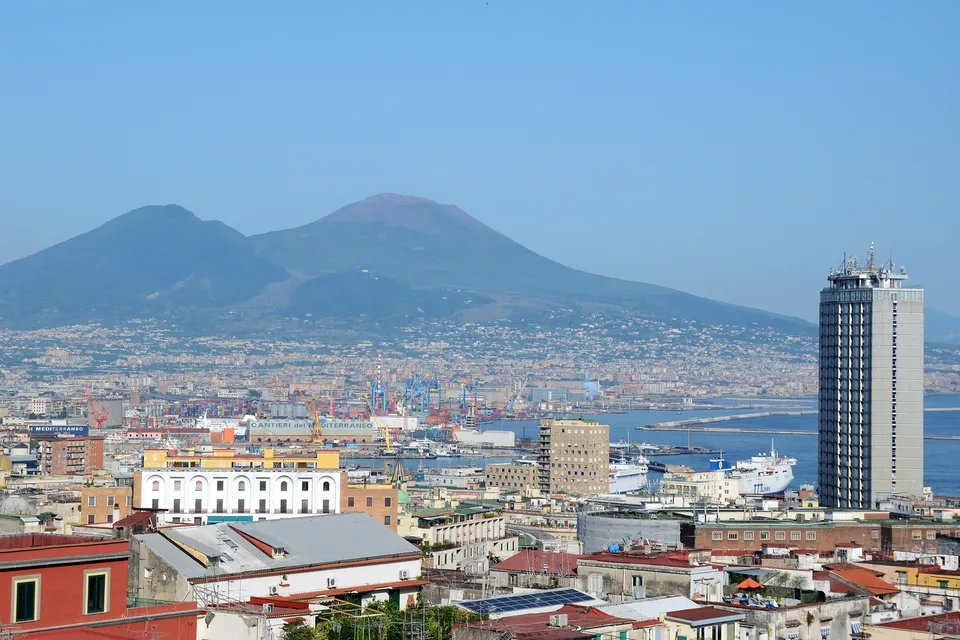
Naples
Naples (NA), capital of Campania: 909,013 residents, 119.24 km². The UNESCO-listed historic centre, the museums, the San Carlo, pizza as UNESCO heritage, San Gennaro and, nearby, Vesuvius, Pompeii and the islands.
Read the guide →Photo: Livioandronico2013 / Wikimedia Commons — CC BY-SA 4.0 · Resized and converted to WebP.

“Come to Pompei as a guest, not as a tourist: that is how these places truly let you know them.”