

Why go
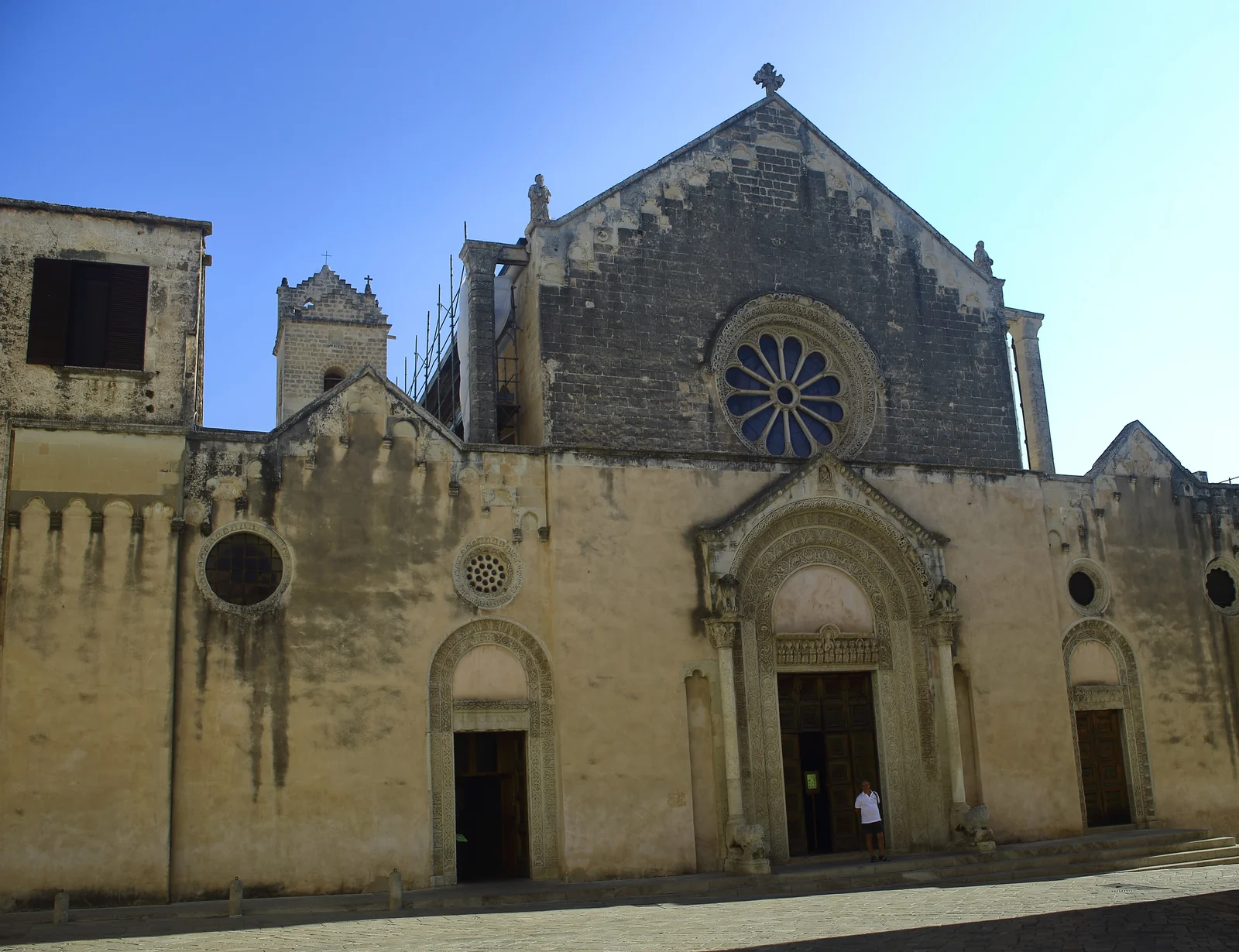
People come to Galatina above all for the basilica of Santa Caterina d’Alessandria. Raimondello Orsini del Balzo had it built: work began in 1383 and by 1391, the date carved on the lintel of the left-hand door, the church was complete. Inside, the town council writes, it is “all a picture gallery”: walls, pillars and vaults are covered by the fresco cycles commissioned by Maria d’Enghien and painted throughout the first half of the fifteenth century, and for their extent the council ranks the basilica second only to that of Saint Francis in Assisi.
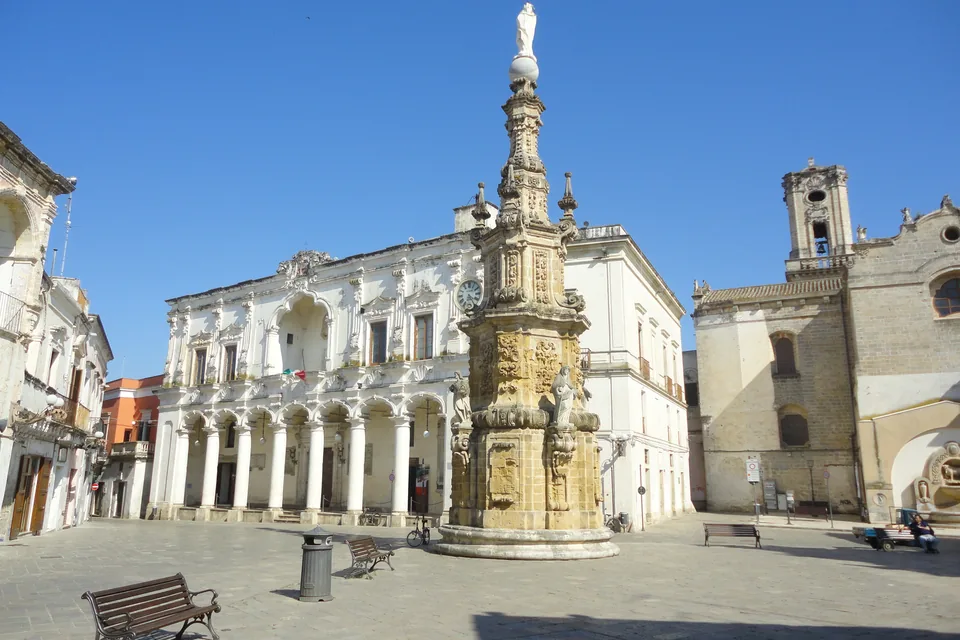
A few steps away lies Piazza San Pietro, with the Chiesa Madre of Saints Peter and Paul, in Lecce stone and late Baroque style, and the Chapel of Saint Paul, where until a few decades ago, for the patron saints’ feast at the end of June, the “tarantate” came from all over the Salento to ask the saint for healing. It is the place that ties Galatina’s name to tarantism, studied by many after Ernesto de Martino’s research.
Galatina also gives its name to a wine, the “Galatina” DOC, and to a crop, the “Patata novella di Galatina” PDO, both entered in the European register of designations. The old town keeps three gates of its walls, Baroque palazzi, Basilian crypts nearby and the civic museum named after Pietro Cavoti.
Sources: Comune di Galatina — Basilica di Santa Caterina d’Alessandria (sec. XIV) (aggiornato il 22 maggio 2024) · Comune di Galatina — Chiesa Madre Ss. Pietro e Paolo (sec. XVII-XVIII) (aggiornato il 18 aprile 2024) · Comune di Galatina — Città di Galatina (storia, monumenti, istituzioni) · Comune di Galatina — Cappella di San Paolo (aggiornato il 16 novembre 2023) · Ministero dell’agricoltura (MASAF), Registro nazionale delle varietà di vite — Disciplinare dei vini a DOC «Galatina» (DM 22.04.1997, modificato il 30.11.2011 e il 07.03.2014) · Commissione europea, registro eAmbrosia — «Galatina», DOP vino, PDO-IT-A0548, registrata · Commissione europea, registro eAmbrosia — «Patata novella di Galatina», DOP, PDO-IT-1148, registrata (GU UE L 246 del 23 settembre 2015)
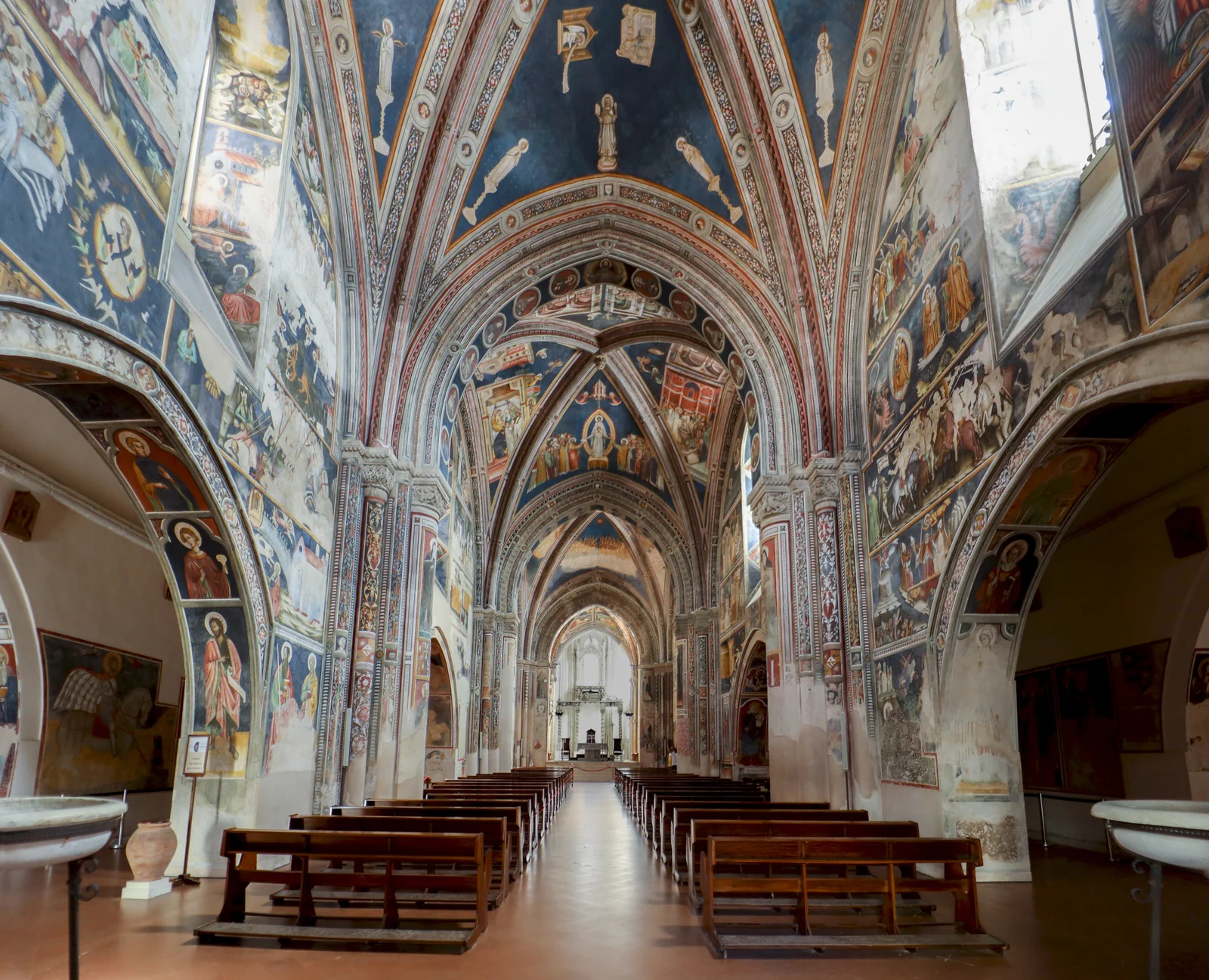
Photo: Fabrizio Garrisi / Wikimedia Commons — CC0 · Resized and converted to WebP.
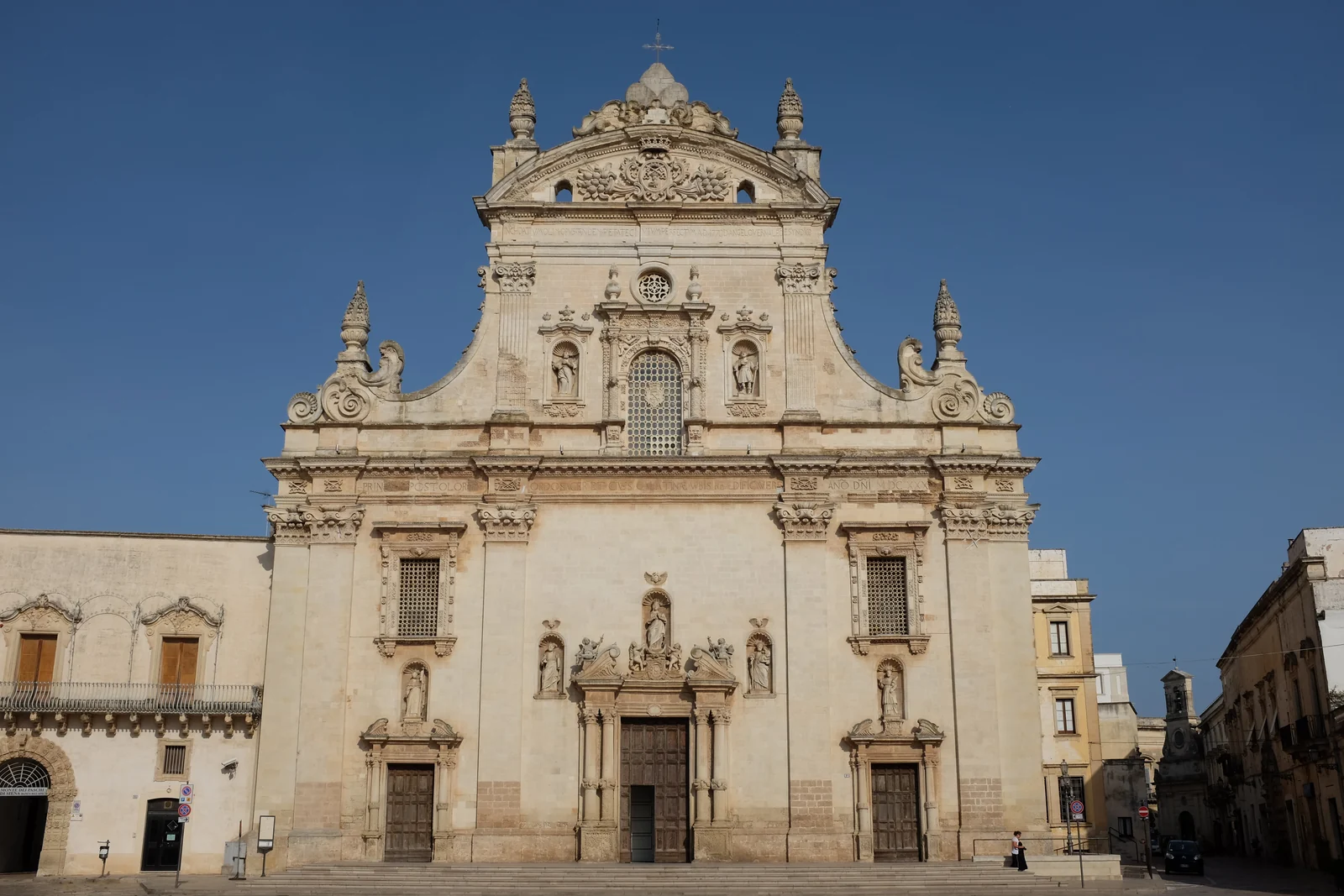
Photo: Alexander van Loon / Wikimedia Commons — CC BY-SA 2.0 · Resized and converted to WebP.
The municipality at a glance
Galatina is a municipality in the province of Lecce, in Puglia. Its ISTAT code is 075029. On 1 January 2025 it had 25,319 residents. The municipal territory covers 82.65 km² and ranges from 30 to 95 metres above sea level; the town hall stands at about 86 metres.
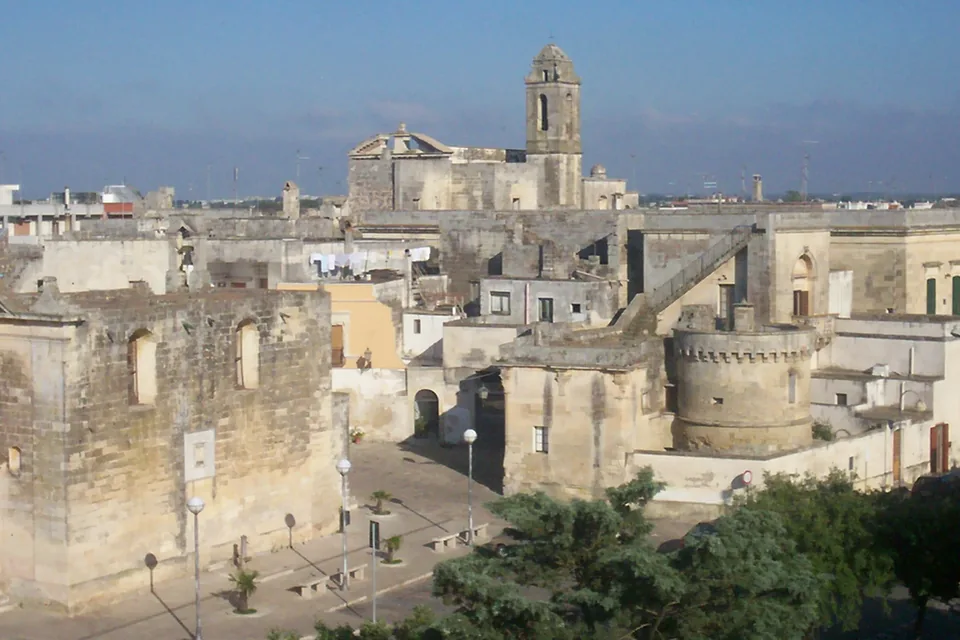
The municipality includes the villages of Noha, Collemeto and Santa Barbara. For centuries the town was called “San Pietro in Galatina”, after the tradition that the apostle Peter brought Christianity here; with the unification of Italy it took back the name Galatina. On 20 July 1793 a decree of Ferdinand IV of Bourbon raised it to the rank of city.
Sources: ISTAT, Codici statistici delle unità amministrative territoriali: elenco dei comuni al 21 febbraio 2026 · ISTAT, Popolazione residente per età, sesso e stato civile al 1° gennaio 2025 (POSAS) · ISTAT, Principali statistiche geografiche sui comuni: superficie e altimetria al 31 dicembre 2021 · Comune di Galatina — Città di Galatina (storia, monumenti, istituzioni)
History
Galatina’s history is documented from 1188, when a manuscript names the “casale of San Pietro in Galatina”. According to the town council, in the thirteenth century it was an important centre of Greek culture, language and rite, while the Latin rite spread with the Normans. In the Chiesa Madre Mass was said in the Greek rite until the time of Pope Sixtus IV (1471-1484), who imposed the Latin rite on all the clergy of the Salento dioceses.
San Pietro in Galatina was one of the fiefs of the county of Soleto. Charles I of Anjou granted it to Ugo del Balzo; his son Raimondo enlarged the town and surrounded it with walls, which a sixteenth-century chronicle dates to 1334. Childless, Raimondo left his fiefs to his nephew Raimondello Orsini, who added the del Balzo surname to his own and married Maria d’Enghien. The keys of Saint Peter in the town’s coat of arms, the council relates, were granted by Pope Urban VI, freed from captivity in Nocera by the people of Galatina led by Raimondello; the crown was added for the town’s resistance in 1484, the owl in the second half of the sixteenth century.
In 1383 Raimondello had an older church enlarged, with the friary and the hospital: the record of the Ministry of Culture’s catalogue notes the Greek inscription on the lintel of the smaller right-hand portal, a trace of the first foundation. After his marriage he became lord of Lecce and in 1399 prince of Taranto. On 30 August 1391 Pope Boniface IX called the Friars Minor of the Observance to the friary. Raimondello died on 17 January 1406; Maria d’Enghien, who later married King Ladislaus and became queen of Naples, carried on the work, and their son Giovanni Antonio Orsini del Balzo completed it, adding the octagonal choir around 1460.
The hospital Raimondello founded is now Palazzo Orsini, the town hall. The Ducal Palace was built when Galatina passed as a fief to the Castriota Scanderbeg family, and it was the home of the archbishop of Otranto Adarzo de Santander (1654-1674), who made Galatina his usual residence. The Chiesa Madre was rebuilt between 1621 and 1633, became a collegiate church in 1664 and was completed in 1770.
On 20 July 1793 a decree of Ferdinand IV of Bourbon raised Galatina to the rank of city, and Porta Luce, rebuilt in 1795, bears its coat of arms. With the unification of Italy the town, called San Pietro in Galatina for centuries, took back its original name, and in 1861 the Clock Tower was built, dedicated to Victor Emmanuel II. On 5 February 1905 the “Pietro Siciliani” municipal library opened in the former Dominican friary; in 1949 the Galatina Fair was born, as a show and market for farm and craft products. In the years just after the Second World War, the PDO specification says, the new potato that bears the town’s name arrived in the Salento.
Sources: Comune di Galatina — Città di Galatina (storia, monumenti, istituzioni) · Comune di Galatina — Chiesa Madre Ss. Pietro e Paolo (sec. XVII-XVIII) (aggiornato il 18 aprile 2024) · Ministero della cultura, Catalogo generale dei beni culturali — Bassorilievo della Madonna con Bambino, Museo della Basilica di Santa Caterina d’Alessandria (scheda ICCD 1600389282, 2024) · Comune di Galatina — Basilica di Santa Caterina d’Alessandria (sec. XIV) (aggiornato il 22 maggio 2024) · Comune di Galatina — Palazzo Orsini (aggiornato il 15 dicembre 2023) · Comune di Galatina — Palazzo Ducale o Castello (sec. XVI) (aggiornato il 30 agosto 2023) · Comune di Galatina — Porta Luce (aggiornato il 15 dicembre 2023) · Comune di Galatina — Palazzo il Sedile (aggiornato il 19 dicembre 2023) · Ministero dell’agricoltura (MASAF) — Disciplinare di produzione della DOP «Patata novella di Galatina»
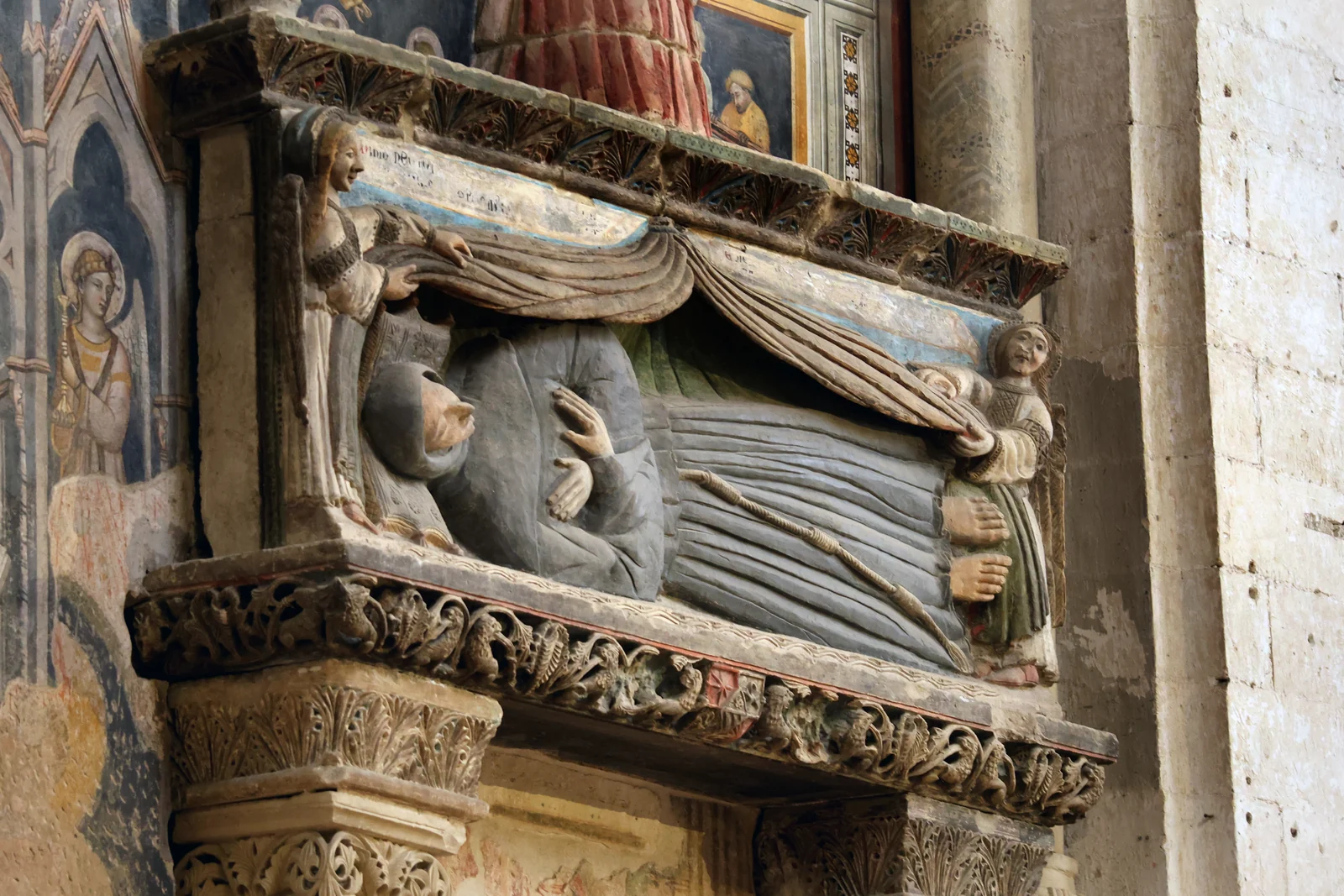
Photo: Fabrizio Garrisi / Wikimedia Commons — CC0 · Resized and converted to WebP.
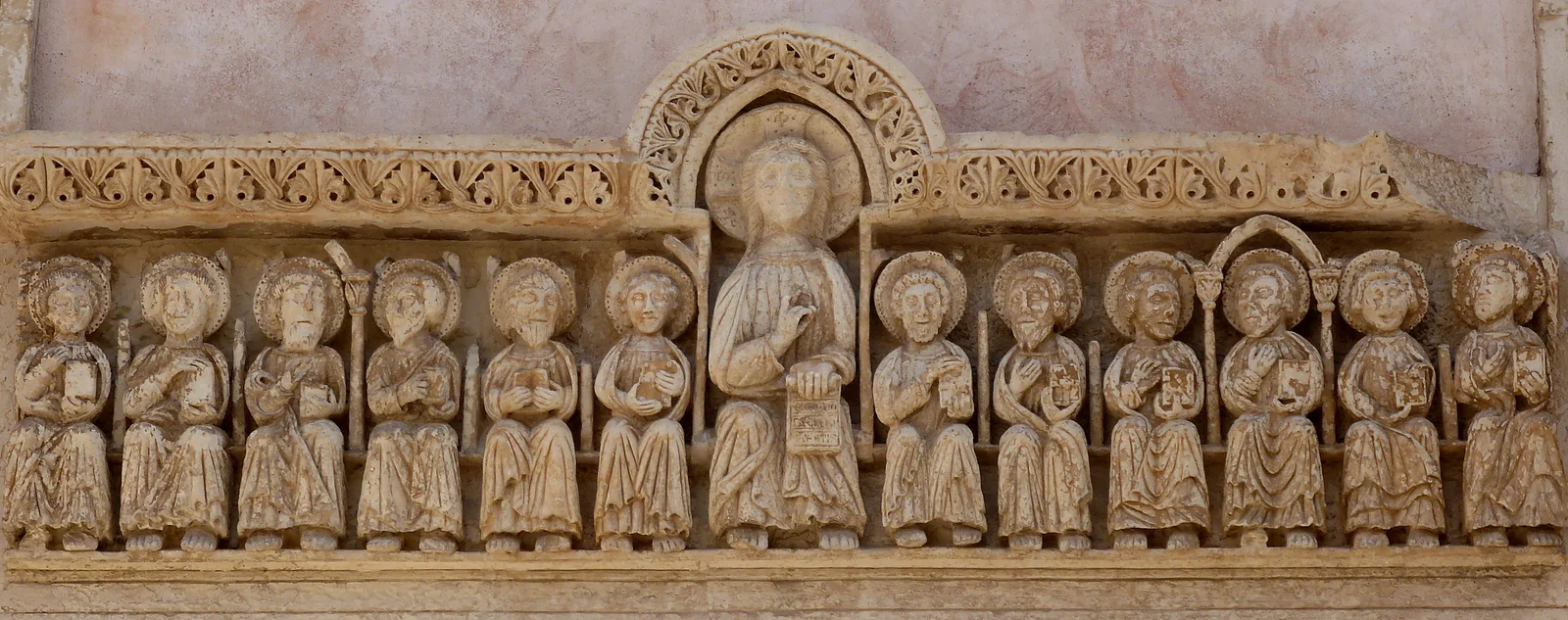
Photo: Blaustrumpf43 / Wikimedia Commons — CC BY-SA 4.0 · Resized and converted to WebP.
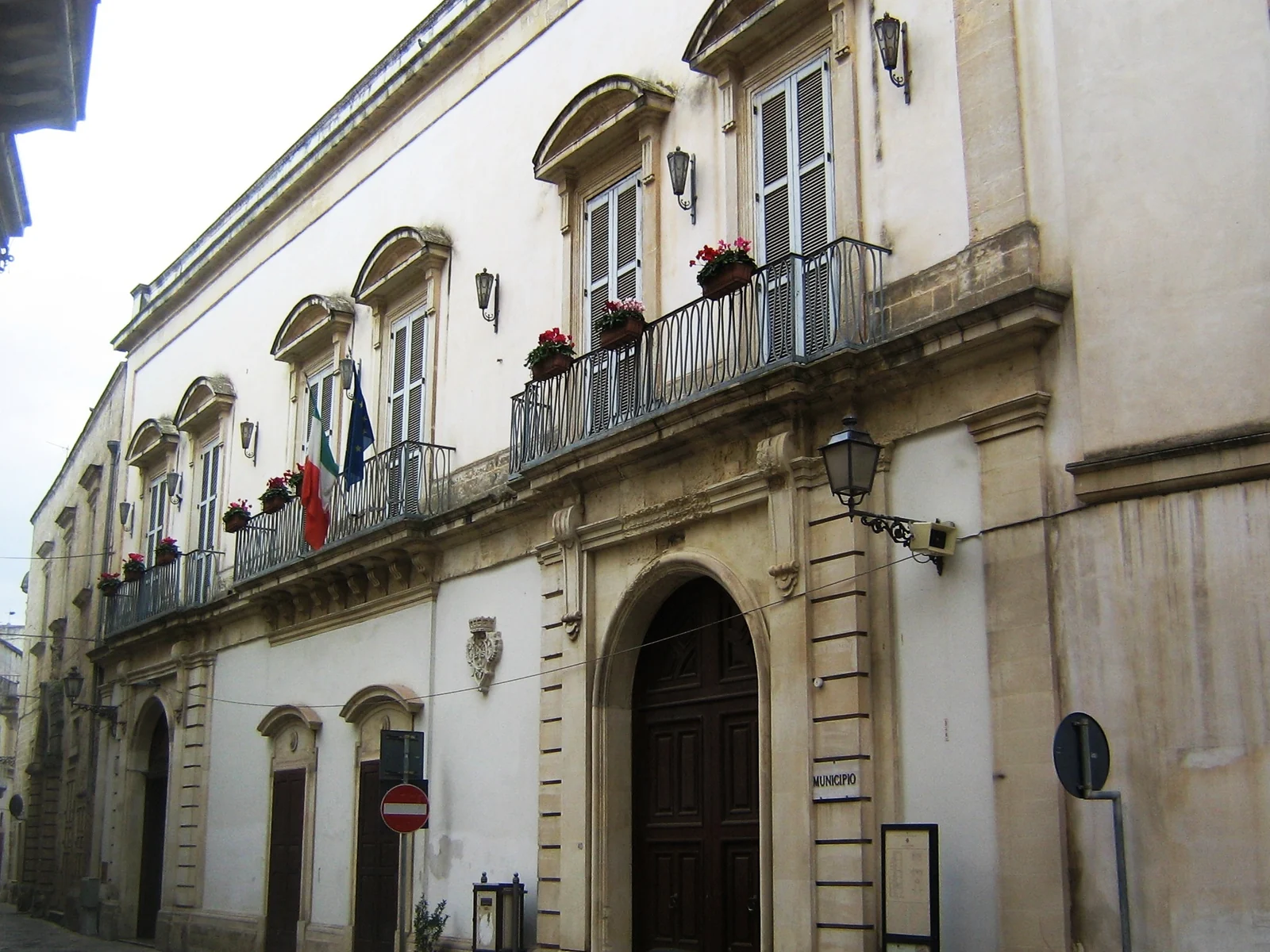
Photo: Lupiae / Wikimedia Commons — CC BY-SA 3.0 · Resized and converted to WebP.
What to see
The façade of the basilica of Santa Caterina has three gables and three portals carved in Lecce stone. The central one has a porch with two columns on column-bearing lions that hold up two eagles, and on the lintel a relief of Jesus among the twelve apostles; above, the rose window has at its centre the del Balzo arms in coloured glass. The interior has five aisles, and the nave is 50 metres long from the door to the choir.
The fresco cycles read from the entrance towards the apse: the Apocalypse in the first bay, Genesis in the second, the life of Christ in the third, the angels on the vault, the life of the Virgin above all in the smaller right aisle. The Orsini Chapel, the Ministry of Culture’s catalogue writes, is “a church within the church”: its cycle is devoted to the Virgin and the childhood of Christ, the scenes on the vault were finished by 1425, and the latest restoration ran from 2016 to 2019.
In the apse stand the funerary monuments of Raimondello, which shows him lying in death and again risen in prayer, as only sovereigns did, and of Giovanni Antonio Orsini del Balzo; of Maria d’Enghien’s, four columns remain. The museum set up in the old refectory keeps the basilica’s treasury: the reliquary with the finger of Saint Catherine, which tradition says Raimondello brought back from Sinai, a portable Byzantine mosaic of the late twelfth century with the Redeemer, and a relief of the Madonna and Child from the late thirteenth century, the work of a Neapolitan sculptor.
The Chiesa Madre of Saints Peter and Paul has the Immaculate Virgin at the centre of its façade, between Saint Peter and Saint Joseph. The vault was frescoed by the Neapolitan Vincenzo Paliotti in 1875 with scenes from the life of Saint Peter; the chapel of the Sacrament holds Giuseppe Sammartino’s white marble Immaculate Virgin, and among the canvases is Serafino Elmo’s Washing of the Feet, of 1756. A side chapel keeps the stone on which, tradition says, Saint Peter sat before entering the town, brought here in 1670 from the San Vito district.
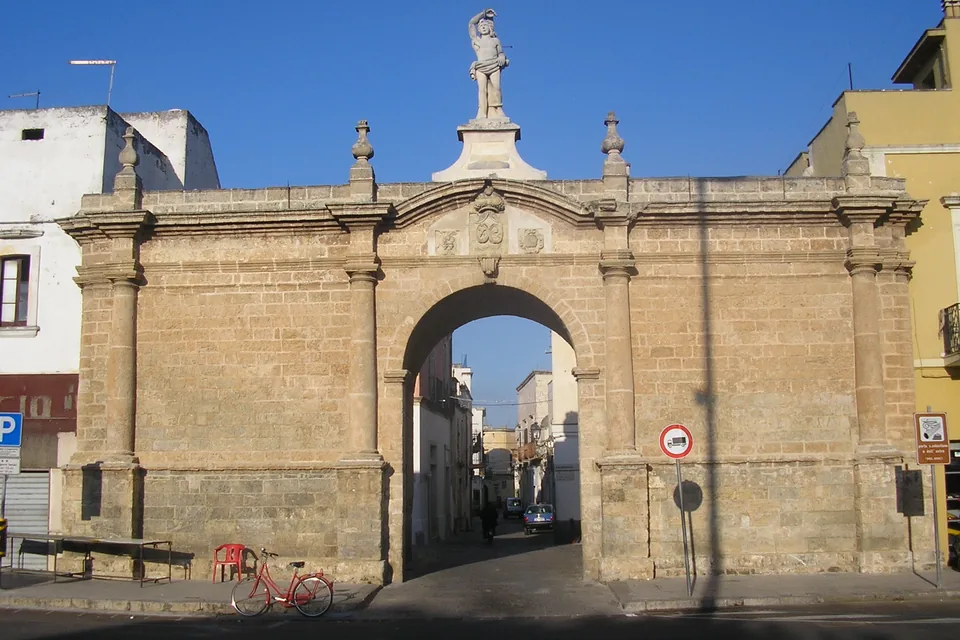
Three gates of the walls remain: Porta Luce to the west, Porta Nuova to the north with the statue of Saint Peter, and Porta Cappuccini to the east with an inscription recording a restoration of 1803. On Via Vittorio Emanuele II the Sedile, the old seat of the town government, shows fifteenth-century Aragonese arms and a sixteenth-century relief attributed to the master masons Nicola and Marcantonio Schindoni; opposite stands the Clock Tower. Palazzo Orsini has a late medieval high relief of a horseman in its entrance hall, and in the mayor’s room Agesilao Flora’s 1893 fresco “The Freedom of the Communes”.
The “Pietro Cavoti” civic museum, reopened in 1998 in the Dominican complex, gathers the town’s artistic, archaeological and epigraphic material, with rooms for the Galatina-born sculptor Gaetano Martinez and for Pietro Cavoti (1819-1890), whose drawings and paintings are recorded in the Ministry of Culture’s catalogue. The same complex houses the “Pietro Siciliani” library, with many incunabula and sixteenth-century books; the entrance to library and museum is from the small square on Via Cafaro.
Sources: Comune di Galatina — Basilica di Santa Caterina d’Alessandria (sec. XIV) (aggiornato il 22 maggio 2024) · Ministero della cultura, Catalogo generale dei beni culturali — Ciclo pittorico della Cappella Orsini, Santa Caterina d’Alessandria (scheda ICCD 1600389364, 2024) · Ministero della cultura, Catalogo generale dei beni culturali — Mausoleo di Raimondello Del Balzo Orsini (scheda ICCD 1600389363, 2024) · Ministero della cultura, Catalogo generale dei beni culturali — Bassorilievo della Madonna con Bambino, Museo della Basilica di Santa Caterina d’Alessandria (scheda ICCD 1600389282, 2024) · Comune di Galatina — Città di Galatina (storia, monumenti, istituzioni) · Comune di Galatina — Chiesa Madre Ss. Pietro e Paolo (sec. XVII-XVIII) (aggiornato il 18 aprile 2024) · Comune di Galatina — Palazzo il Sedile (aggiornato il 19 dicembre 2023) · Comune di Galatina — Palazzo Orsini (aggiornato il 15 dicembre 2023) · Comune di Galatina — Museo civico «Pietro Cavoti» (aggiornato il 12 giugno 2025) · Ministero della cultura, Catalogo generale dei beni culturali — Pietro Cavoti, dipinto (Museo civico di Galatina)
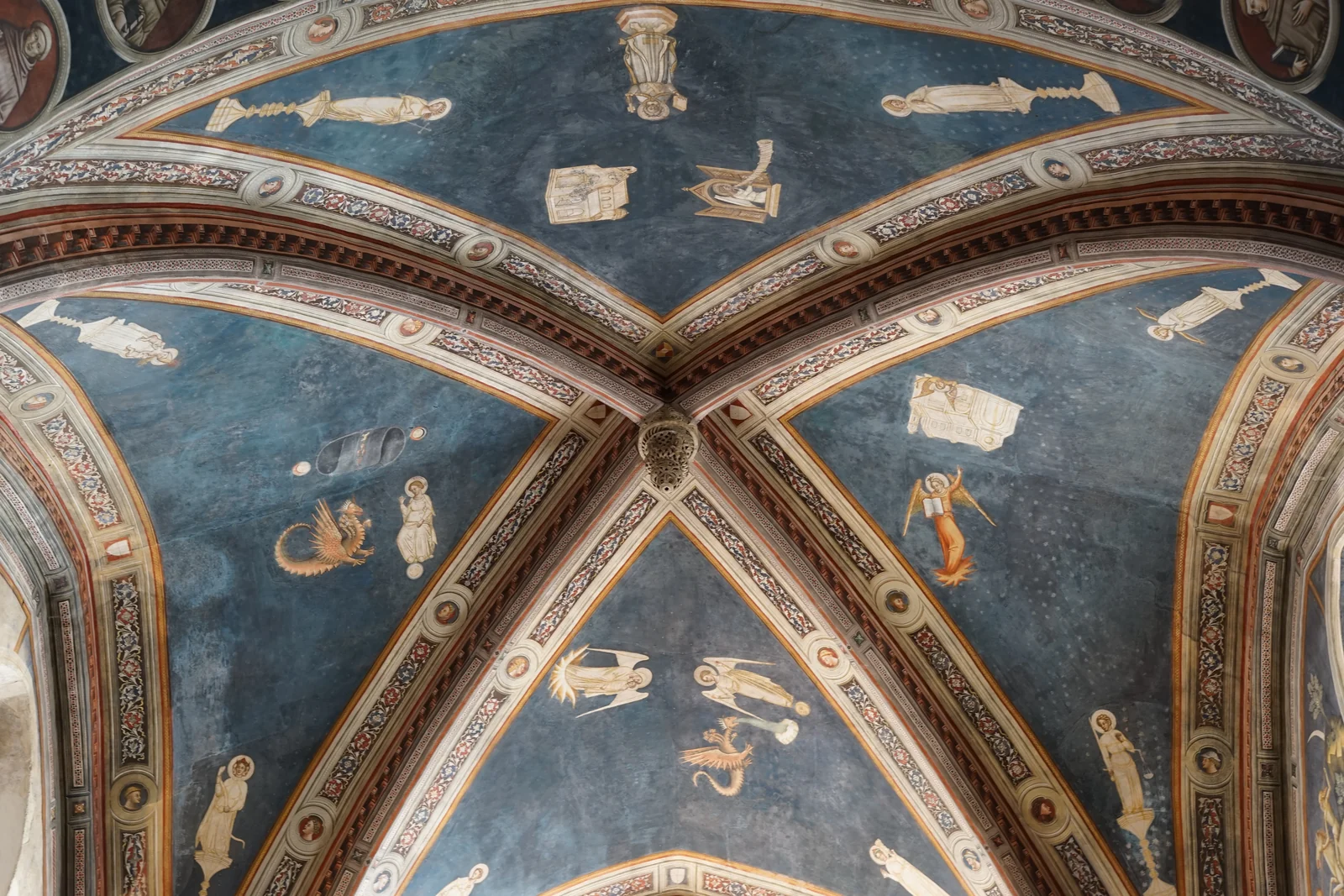
Photo: Fabrizio Garrisi / Wikimedia Commons — CC0 · Resized and converted to WebP.
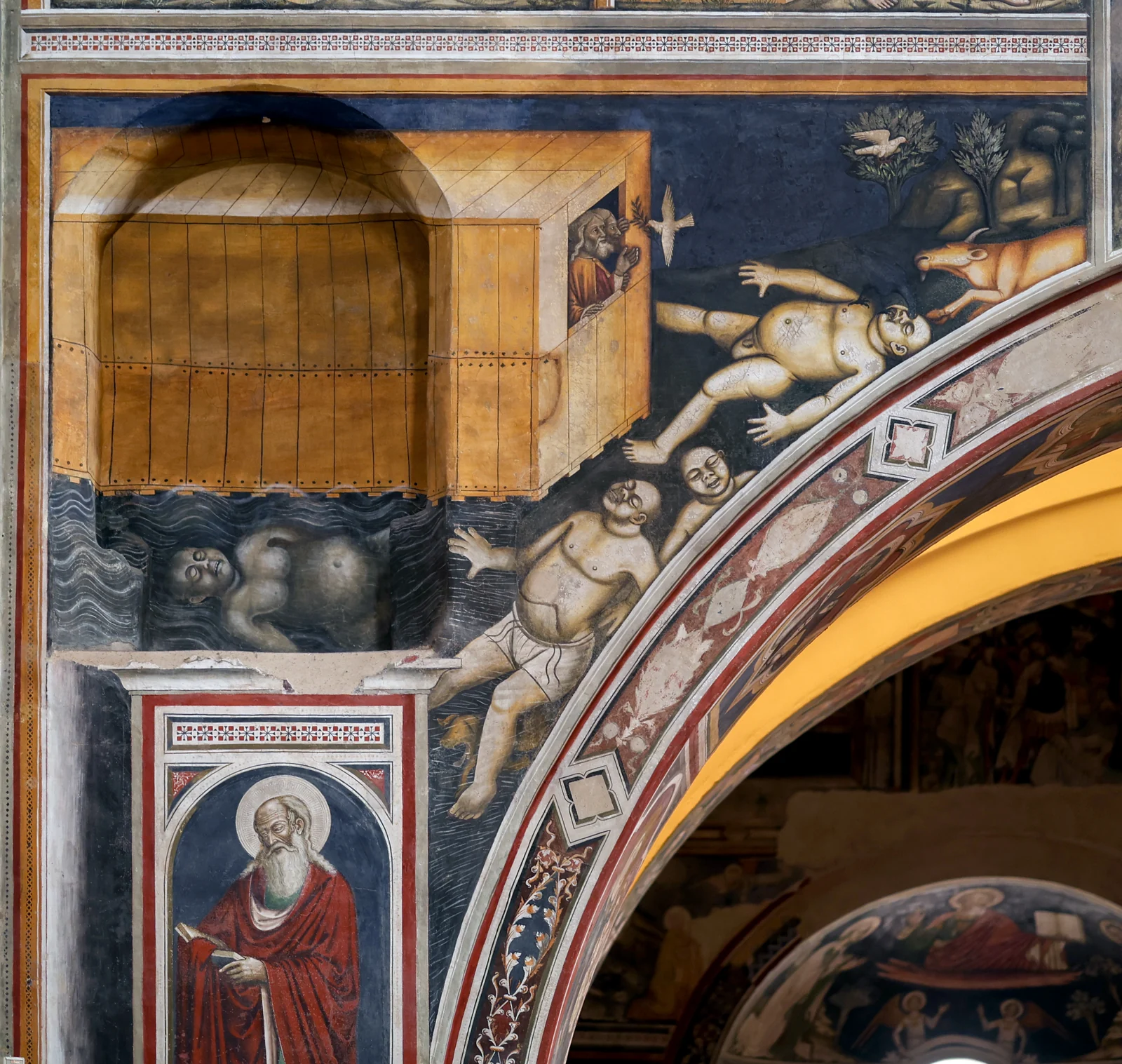
Photo: Fabrizio Garrisi / Wikimedia Commons — CC0 · Resized and converted to WebP.
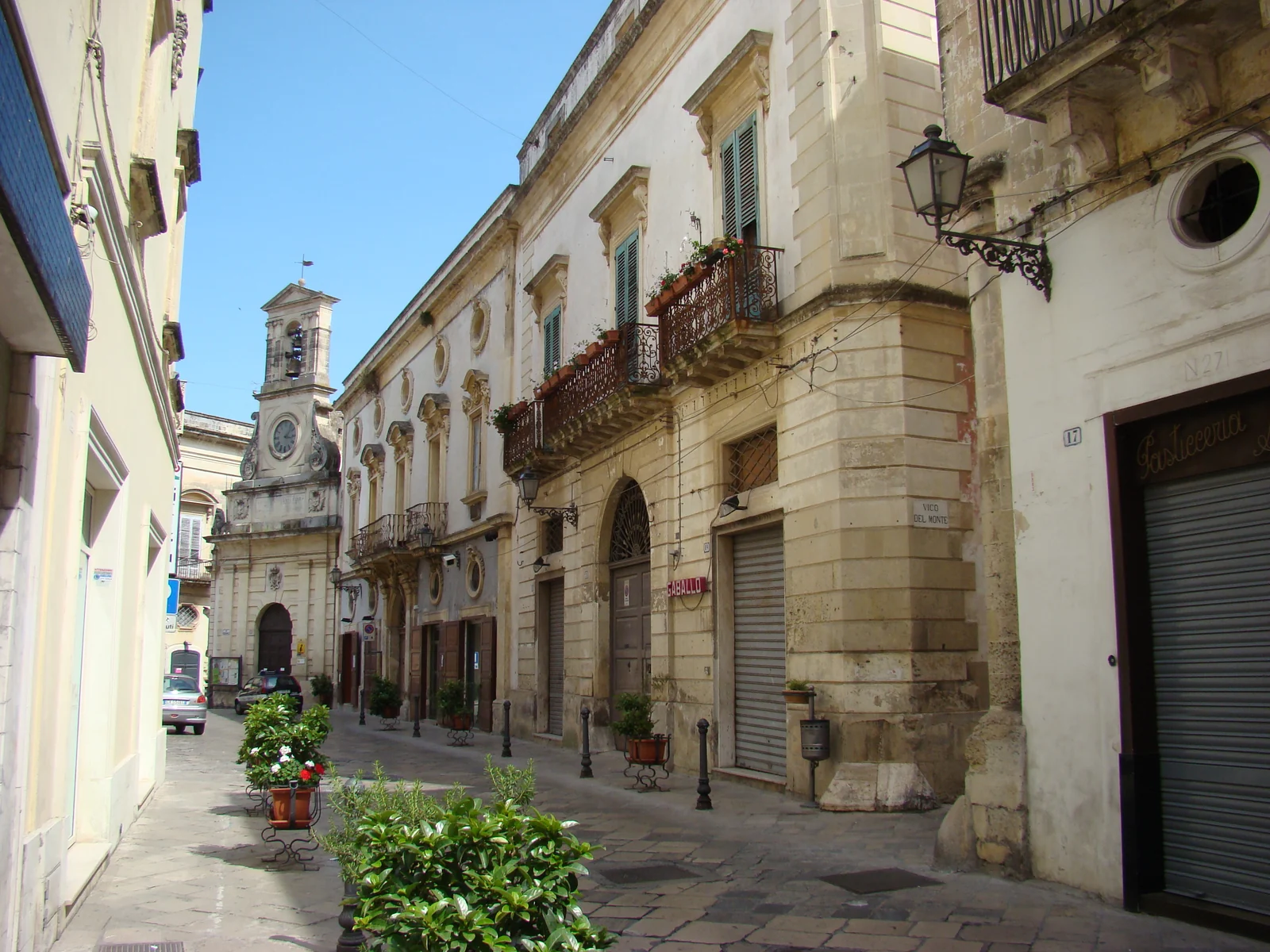
Photo: Kuebkamen / Wikimedia Commons — CC BY 3.0 · Resized and converted to WebP.
Flavours
The “Galatina” DOC, approved in 1997, covers white, red and rosé wines from grapes grown in Galatina and six nearby municipalities: Cutrofiano, Aradeo, Neviano, Seclì, Sogliano Cavour and Collepasso. The red and the rosé come from at least 65% Negroamaro; “Galatina” Negroamaro has at least 85% and, after two years of ageing including six months in wooden casks, may be called riserva; the white has at least 55% Chardonnay. The specification recalls the Statistics of the Kingdom of Naples ordered by Joachim Murat in 1811, with the first ordered information on the wines of Galatina. In the European eAmbrosia register “Galatina” is entered as a wine PDO.
The “Patata novella di Galatina” is a PDO registered in 2015. It is of the Sieglinde variety, its skin is a deep yellow that the red earth stains rust-coloured, and it is not washed after harvest, which begins in the first ten days of March and ends by 30 June. The area covers Galatina and eighteen municipalities towards the Ionian coast, among them Gallipoli, Nardò and Ugento: according to the specification the crop, which reached the Salento after the war, spread first in Galatina and then towards the sea, and almost all of it is exported, more than 80% to Germany.
In the national list of traditional food products Puglia also enters Galatina chicory and the round Galatina meloncella; the same list includes the pasticciotto.
Sources: Ministero dell’agricoltura (MASAF), Registro nazionale delle varietà di vite — Disciplinare dei vini a DOC «Galatina» (DM 22.04.1997, modificato il 30.11.2011 e il 07.03.2014) · Commissione europea, registro eAmbrosia — «Galatina», DOP vino, PDO-IT-A0548, registrata · Ministero dell’agricoltura (MASAF) — Disciplinare di produzione della DOP «Patata novella di Galatina» · Commissione europea, registro eAmbrosia — «Patata novella di Galatina», DOP, PDO-IT-1148, registrata (GU UE L 246 del 23 settembre 2015) · Elenco nazionale dei prodotti agroalimentari tradizionali, allegato I, aggiornamento 2022: tabella della Regione Puglia (copia pubblicata dal progetto regionale per la biodiversità vegetale)
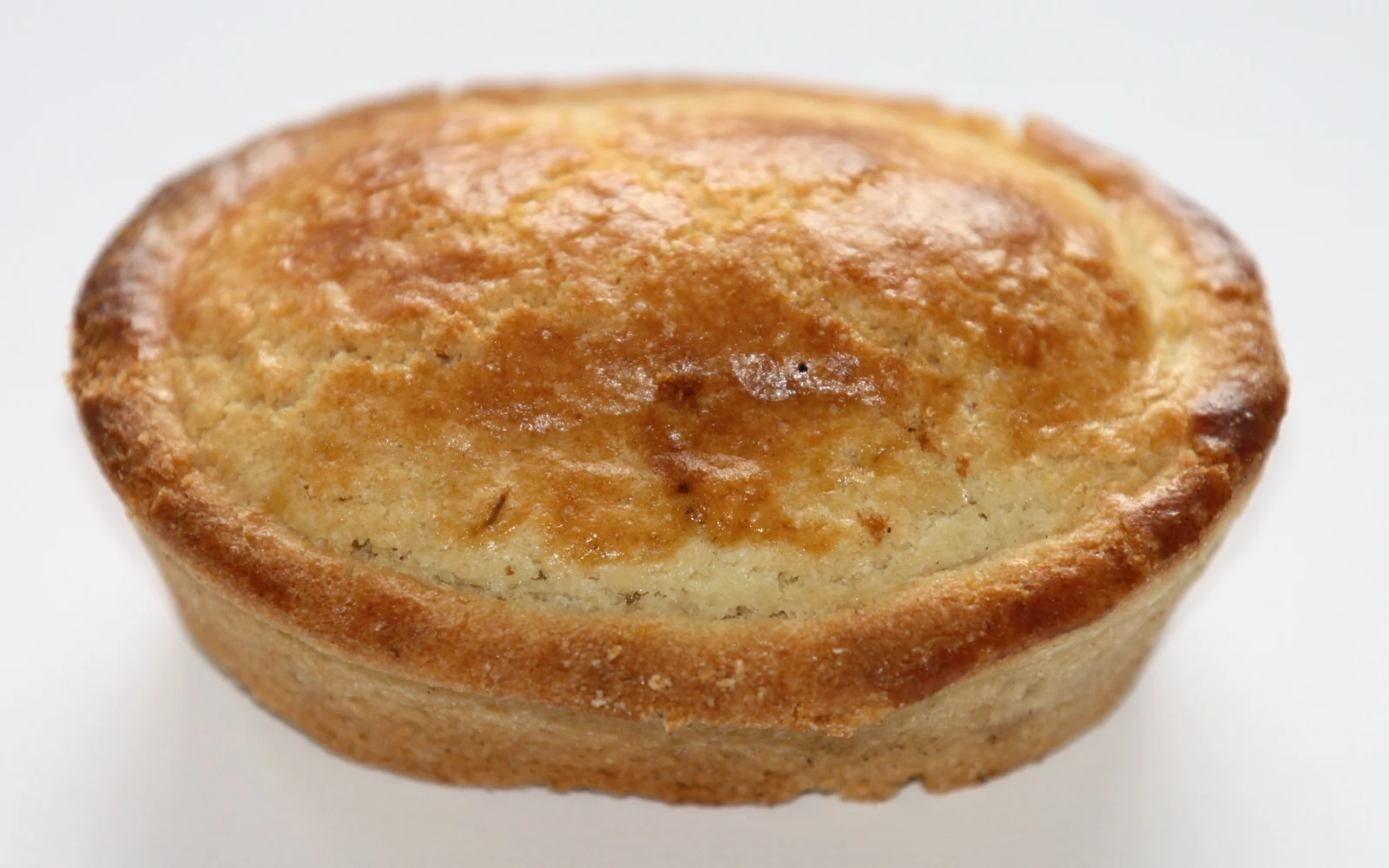
Photo: Renano / Wikimedia Commons — CC BY-SA 3.0 · Resized and converted to WebP.
Experiences
The council’s Info Point, in the Sala dell’Orologio at Via Vittorio Emanuele II 35, organises guided tours for groups and school parties in the old town and beyond, in Italian and other languages, and hosts a permanent exhibition of historical photographs and of work by local artists and craftspeople.
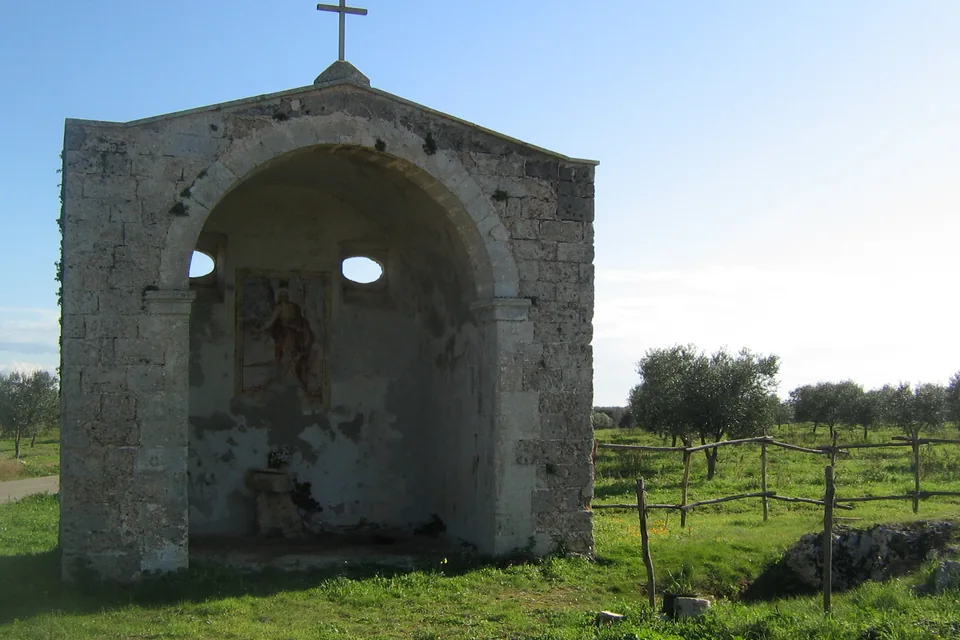
The Chapel of Saint Paul, known as the chapel of the Tarantate, is on Corso Garibaldi, beneath the eighteenth-century Palazzo Congedo, and keeps a canvas of Saint Paul. The tarantate came to drink the water of the well, believed miraculous, and to ask for healing; then they went on to the nearby Chiesa Matrice. The phenomenon has disappeared, but the chapel, the council writes, is still visited by many at the feast of Saints Peter and Paul, and the pizzica and the traditional music of the Salento have come back across Italy and abroad.
For those looking for the oldest places the council suggests an itinerary of its own: the three Basilian crypts of Santa Maria della Grotta, Sant’Anna in the Piani district and Santa Maria della Porta in the Pisanello district, left by monks who came from Byzantium.
Sources: Comune di Galatina — Info Point Galatina · Comune di Galatina — Cappella di San Paolo (aggiornato il 16 novembre 2023) · Comune di Galatina — Città di Galatina (storia, monumenti, istituzioni)
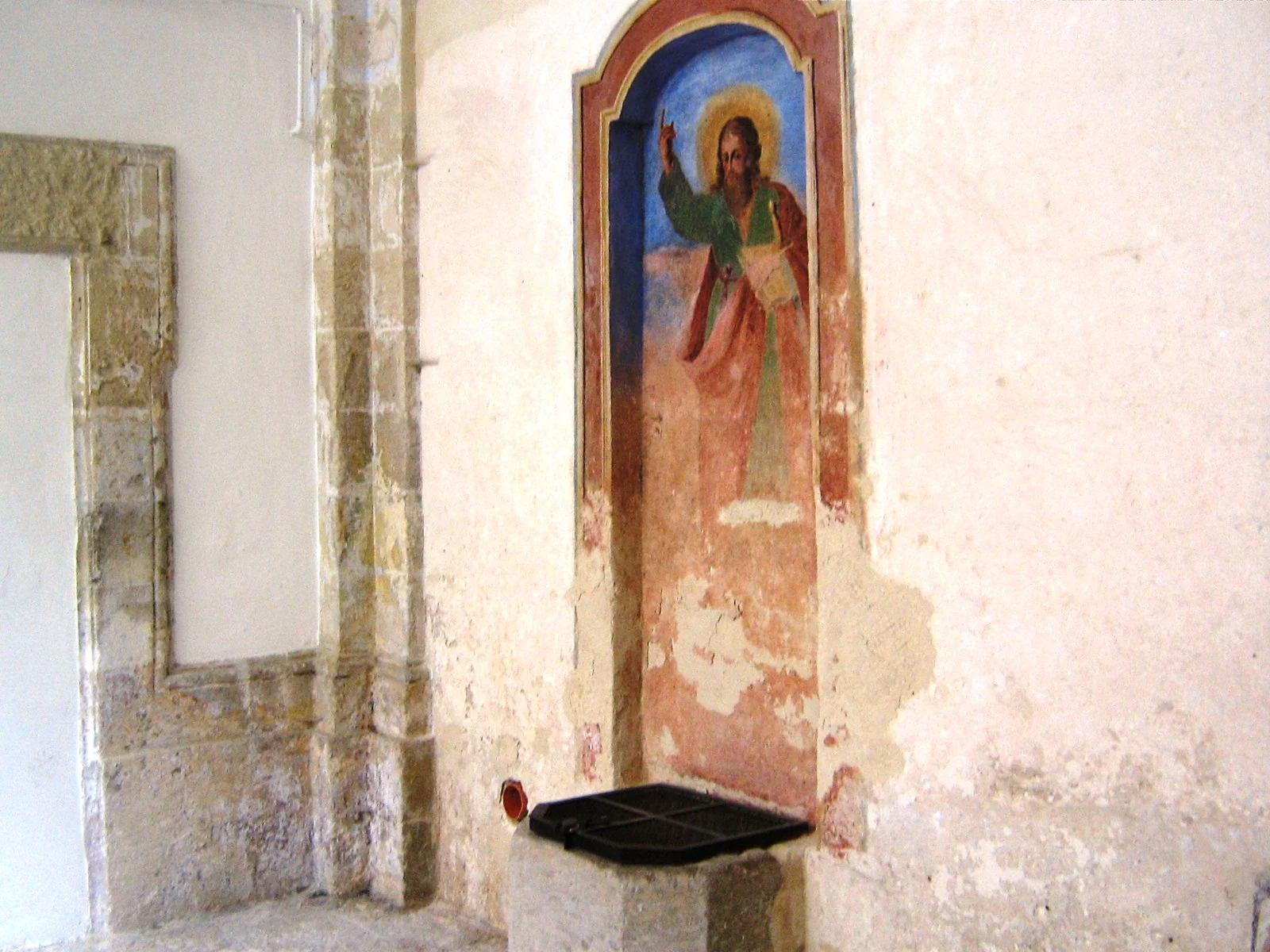
Photo: Lupiae / Wikimedia Commons — CC BY-SA 3.0 · Resized and converted to WebP.
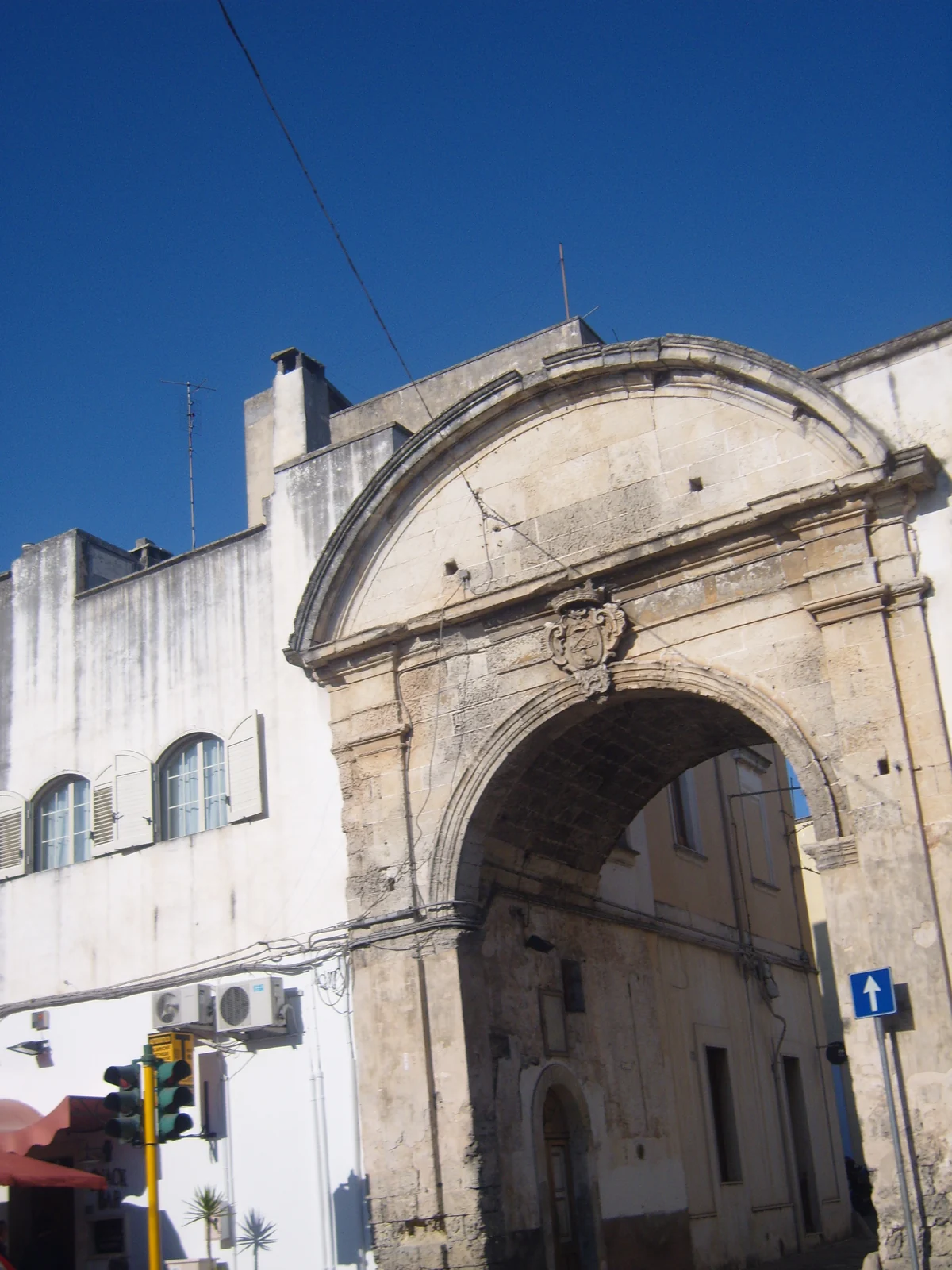
Photo: Freddyballo / Wikimedia Commons — CC BY-SA 3.0 · Resized and converted to WebP.
When to go
The high point of the year is the feast of the patron saints, Peter and Paul, at the end of June. In 2024, according to the Archdiocese of Otranto, the evening of 28 June brought Mass, the procession with the statues of the saints and the lighting of the illuminations, then folk music concerts and the “Night of the Ronde”; the 29th, the feast day itself, brought Masses from dawn and, in Piazza San Pietro, the re-enactment of “The ancient rite of tarantism”; the 30th was Saint Paul’s day.
Between March and June it is new-potato season: the PDO harvest begins in the first ten days of March and must end by 30 June.
The Galatina Fair, born in 1949 and now on the calendar of national fairs, has its grounds to the north of the town and hosts events throughout the year.
Sources: Arcidiocesi di Otranto — Festa dei santi Pietro e Paolo a Galatina. Il programma delle celebrazioni (28 giugno 2024) · Ministero dell’agricoltura (MASAF) — Disciplinare di produzione della DOP «Patata novella di Galatina» · Comune di Galatina — Città di Galatina (storia, monumenti, istituzioni)
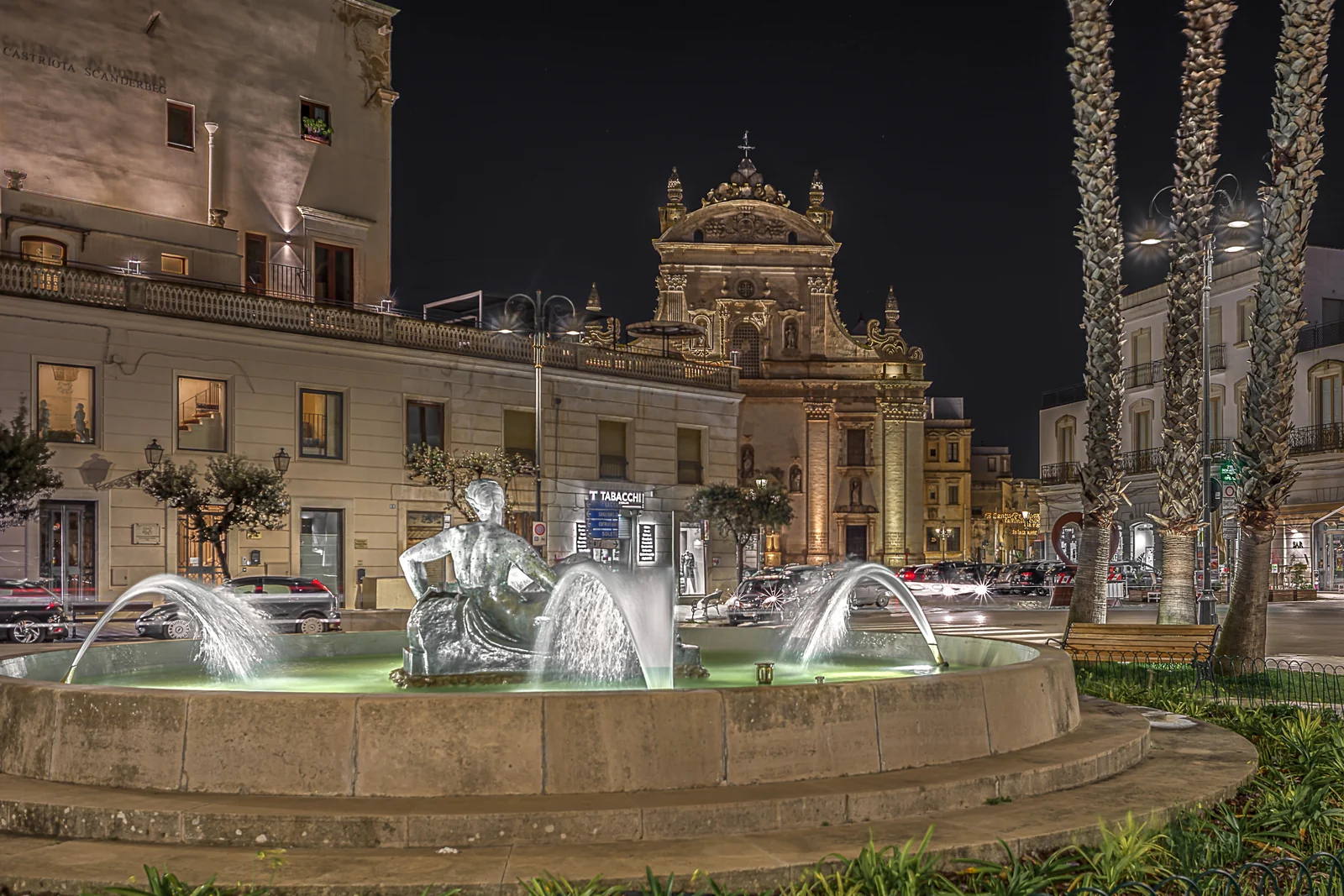
Photo: Graziano_Cannoletta / Wikimedia Commons — CC BY-SA 4.0 · Resized and converted to WebP.
Getting there and around
Galatina has a station on the FSE rail network. In timetable table 463 (Lecce – Zollino / Maglie – Gagliano del Capo / Nardò – Gallipoli) it lies on the stretch from Zollino to Nardò Centrale and Gallipoli, between Soleto and Nardò. The Puglia Region has entrusted the service to FSE from 1 July 2023 to 31 December 2032, with the Lecce – Zollino – Gagliano and Lecce – Gallipoli lines among others. Timetables change: check them on the FSE website.
The weekly market is on Thursday: for Christmas and New Year the council moved it to Sundays 21 and 28 December 2025.
Sources: FSE — Quadri orario ferroviari e automobilistici, indice delle località e quadro 463 (Lecce – Zollino / Maglie – Gagliano del Capo / Nardò – Gallipoli) · Regione Puglia — Avviso di post-informazione: affidamento del servizio ferroviario regionale a FSE, 2023-2032 · Comune di Galatina — Mercato settimanale (avviso per il 25 dicembre 2025 e il 1° gennaio 2026)
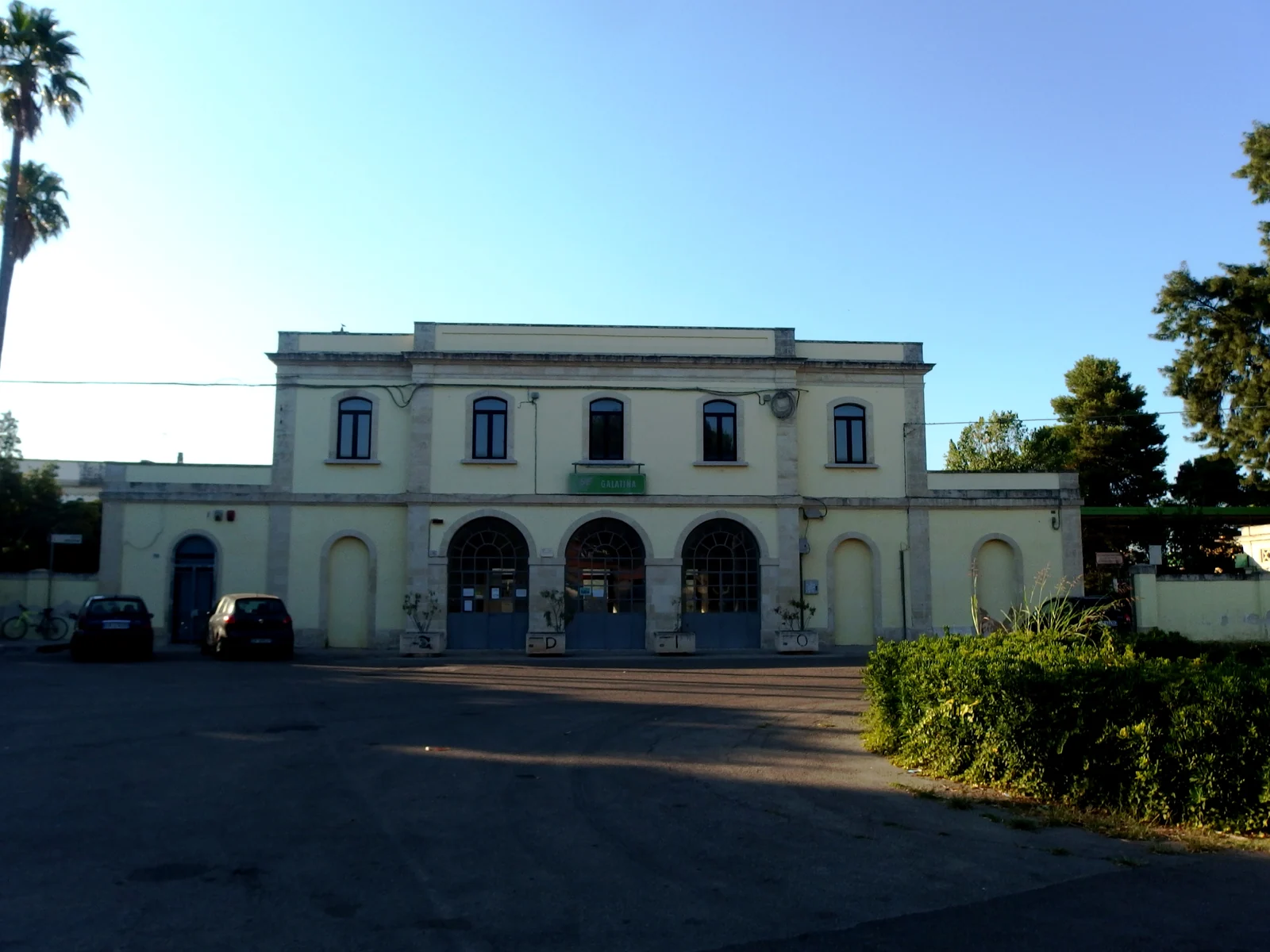
Photo: Palickap / Wikimedia Commons — CC BY-SA 4.0 · Resized and converted to WebP.
Accommodation in figures
In the Ministry of Tourism’s national database of accommodation (BDSR), on 12 October 2026, Galatina had 224 establishments with a verified national identification code (CIN): 3 hotel-type establishments, 42 non-hotel establishments and 179 other establishments. Puglia’s regional census of accommodation lists 33 with a verified national CIN, by type: 13 B&B, 10 guest rooms, 5 farm stay, 3 hotel, 1 holiday home and 1 residence.
Sources: Ministero del Turismo – Banca Dati Strutture Ricettive (dashboard pubblica) · Regione Puglia – ARET Pugliapromozione (DMS)
Nearby
Among the places Apulica already covers, the nearest are Sternatia (about 8 km), Martignano (about 12 km) and Martano (about 13 km): straight-line distances between the centres of the municipal territories.
The villages are close by: Noha about 1 km away, Santa Barbara about 3 km, Collemeto about 7 km. In Noha the church of San Michele Arcangelo, rebuilt in the early twentieth century, has Baroque altars in Lecce stone and above the rose window the village arms, three towers between an oak branch and an orange branch; Collemeto grew up around an abbey of Benedictine, later Basilian, monks, and Santa Barbara on once marshy ground. The “Galatina” DOC also covers Cutrofiano, Aradeo, Neviano, Seclì, Sogliano Cavour and Collepasso; the train runs to Soleto and Zollino one way, to Nardò and Gallipoli the other.
Sources: ISTAT/Openpolis, confini comunali della regione Puglia (CC BY 4.0, ISTAT/Openpolis) · Comune di Galatina — Noha (aggiornato il 25 ottobre 2023) · Comune di Galatina — Collemeto (aggiornato il 20 ottobre 2023) · Comune di Galatina — Santa Barbara (aggiornato il 31 agosto 2023) · Ministero dell’agricoltura (MASAF), Registro nazionale delle varietà di vite — Disciplinare dei vini a DOC «Galatina» (DM 22.04.1997, modificato il 30.11.2011 e il 07.03.2014) · FSE — Quadri orario ferroviari e automobilistici, indice delle località e quadro 463 (Lecce – Zollino / Maglie – Gagliano del Capo / Nardò – Gallipoli)
The town council
The official website of the Comune di Galatina, registered in IndicePA, the index of the digital addresses of Italy’s public administrations, is the reference for the town council’s offices, opening hours and news. Its address is listed among the sources of this section.
The town hall is in Palazzo Orsini, at Via Umberto I 40; the switchboard answers on 0836 527311. The tourist Info Point is in the Sala dell’Orologio, at Via Vittorio Emanuele II 35, in the old town.
Sources: Comune di Galatina, sito istituzionale · IndicePA (AgID), Indice dei domicili digitali delle pubbliche amministrazioni: dataset Enti · Comune di Galatina — Palazzo Orsini (aggiornato il 15 dicembre 2023) · Comune di Galatina — Info Point Galatina
Where to stay
In the municipality of Galatina the national database of the Ministry of Tourism lists 224 accommodation businesses with a verified CIN code: 3 hotels, 42 other licensed accommodation and 179 other types such as B&Bs and private rentals.
Licensed businesses from the official list of accommodation named as the source in this section. Where the list gives it, the property's official identification code appears next to its name: the national CIN code, or the code assigned by the Region or by the body that keeps the list. Private individuals are not listed. This list is the official census of licensed businesses, not a list of Apulica partners: to stay in Galatina you do not have to check one property after another yourself; write to Apulica and we look for the stay that suits your journey, checking availability and conditions before any confirmation.
Nohasi Palace Hotel
Hotel · ★★★★★
CIN IT075029A100070051
ATMOSPHERA GALATINA
Residence
CIN IT075029B400060347
AGRITURISMO PUNTARELLE
Farm stay
CIN IT075029B500024862
CAIOTI DI MARROCCO ANGELICA & C. S.A.S.
B&B
CIN IT075029B400069504
ALLO SCRIGNO
Guest rooms
CIN IT075029B400022032
IMPRESA FENICE LUNA
Holiday home
CIN IT075029B400128469
HERMITAGE
Hotel · ★★★★
CIN IT075029A100020463
LA CAMPINA
Farm stay
CIN IT075029B500026230
CASA DI MARCO
B&B
CIN IT075029B400023938
blu rooms
Guest rooms
CIN IT075029B400123362
First the places that presented themselves to Apulica, the latest first; then one place of each type in turn, by official category and stars, then by name. No position is paid for.
All 33 entries in alphabetical order
Page 1 of 4
| Name | Type | CIN |
|---|---|---|
| AGRITURISMO PUNTARELLE | Farm stay | IT075029B500024862 |
| ALLO SCRIGNO | Guest rooms | IT075029B400022032 |
| ATMOSPHERA GALATINA | Residence | IT075029B400060347 |
| blu rooms | Guest rooms | IT075029B400123362 |
| CAIOTI DI MARROCCO ANGELICA & C. S.A.S. | B&B | IT075029B400069504 |
| CASA DI MARCO | B&B | IT075029B400023938 |
| castello castriota scandeberg | B&B | IT075029B400064426 |
| damapaga | Guest rooms | IT075029B400068719 |
| EGO' | Guest rooms | IT075029B400031865 |
| Galatina Suites Via Scalfo | Guest rooms | IT075029B400126152 |
Ask Apulica for a stay in Galatina We reply shortly, within a few hours at most, with a proposal for you to consider.
Sources: Regione Puglia – ARET Pugliapromozione (DMS), CC BY 4.0, 2026-10-12 · Ministero del Turismo – Banca Dati Strutture Ricettive (dashboard pubblica), 2026-10-12
YOUR JOURNEY
How to shape a journey here
To include Galatina in a trip, or to ask for a guide or a transfer, you can write to Apulica with the button below.
Plan your tripKeep exploring
Soleto
Soleto (LE), Puglia: 5,106 residents, 30.46 km². The official facts of the municipality, its town council website and its registered accommodation.
Read the guide →Photo: Paolo Margari / Wikimedia Commons — CC BY-SA 2.0 · Resized and converted to WebP.

Sternatia
Grinding stones and presses beneath the town: the Granafei mill and historic centre tell the story of olive oil.
Read the guide →Photo: Freddyballo / Wikimedia Commons — CC BY-SA 3.0 · Resized and converted to WebP.

Martano
Courtyards, megalithic heritage and Cistercian culture in Grecìa Salentina. In the Terra, the old centre with its regular blocks, the Aragonese castle, the mother church of 1596 and the early eighteenth-century palaces; in the countryside the Teofilo menhir, 4.70 metres tall, the Specchia dei Mori and the medieval village of Apigliano.
Read the guide →Photo: Freddyballo / Wikimedia Commons — CC BY-SA 3.0 · Resized and converted to WebP.

Cutrofiano
Cutrofiano (LE), Puglia: 8,657 residents, 56.81 km². The official facts of the municipality, its town council website and its registered accommodation.
Read the guide →Photo: Lupiae / Wikimedia Commons — Public domain · Resized and converted to WebP.

Galatone
Galatone (LE), Puglia: 14,836 residents, 47.07 km². The official facts of the municipality, its town council website and its registered accommodation.
Read the guide →Photo: Fergio90 / Wikimedia Commons — Public domain · Resized and converted to WebP.

Nardò
Nardò (LE), Puglia: 30,752 residents, 193.27 km². The official facts of the municipality, its town council website and its registered accommodation.
Read the guide →Photo: Lupiae / Wikimedia Commons — CC BY-SA 3.0 · Resized and converted to WebP.

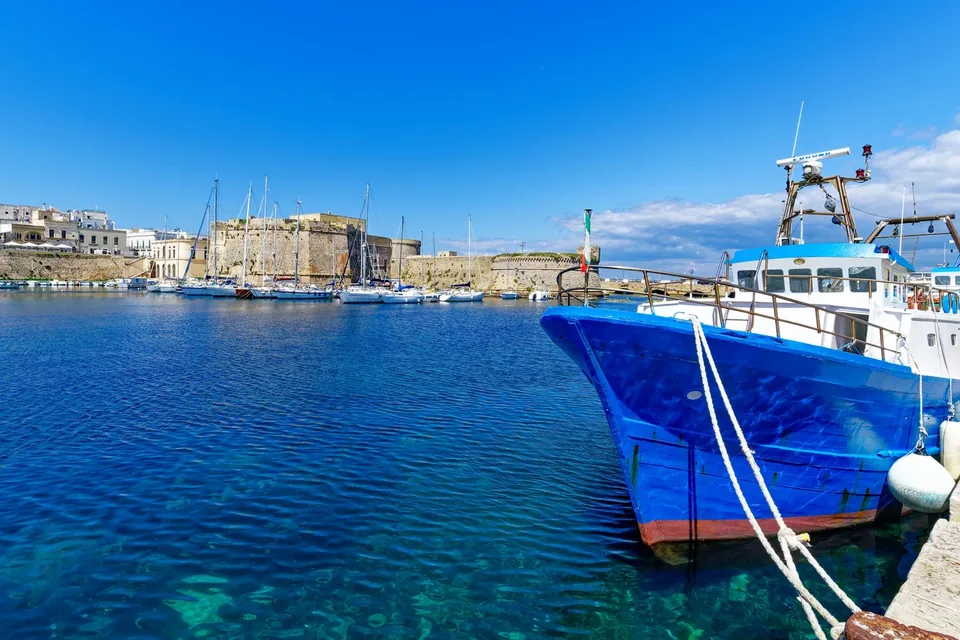
Gallipoli
The bridge, churches and Ionian townscape beyond a beach holiday. An old town on a fortified island, linked by a masonry bridge, and the local scapece.
Read the guide →Photo: Holger Uwe Schmitt / Wikimedia Commons — CC BY-SA 4.0 · Resized and converted to WebP.

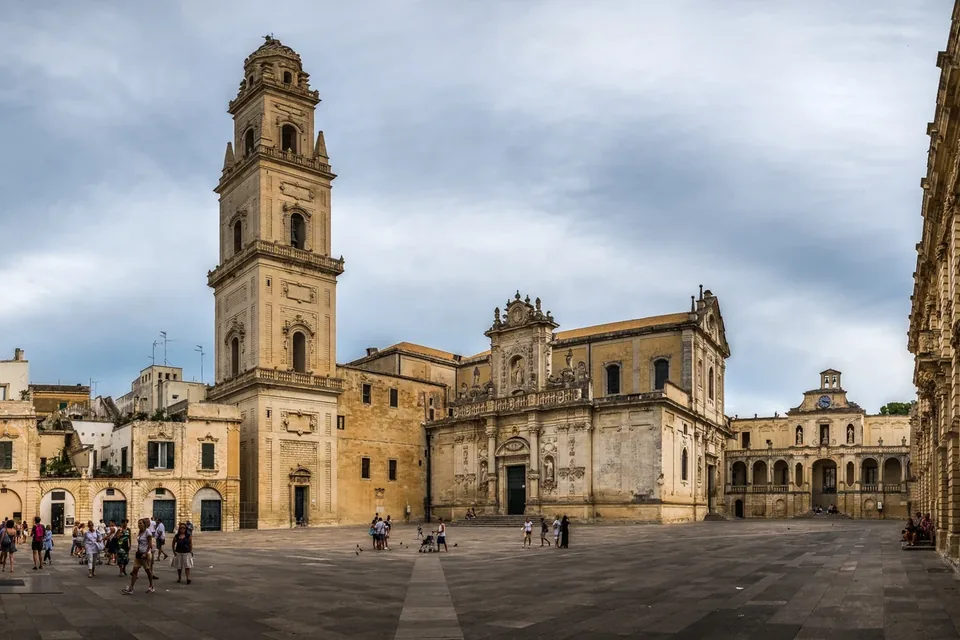
Lecce
Baroque architecture, papier-mâché and Salento food: a city of telling details.
Read the guide →Photo: Giuseppe Milo / Wikimedia Commons — CC BY 3.0 · Resized and converted to WebP.

“Come to Galatina as a guest, not as a tourist: that is how these places truly let you know them.”