

Why go
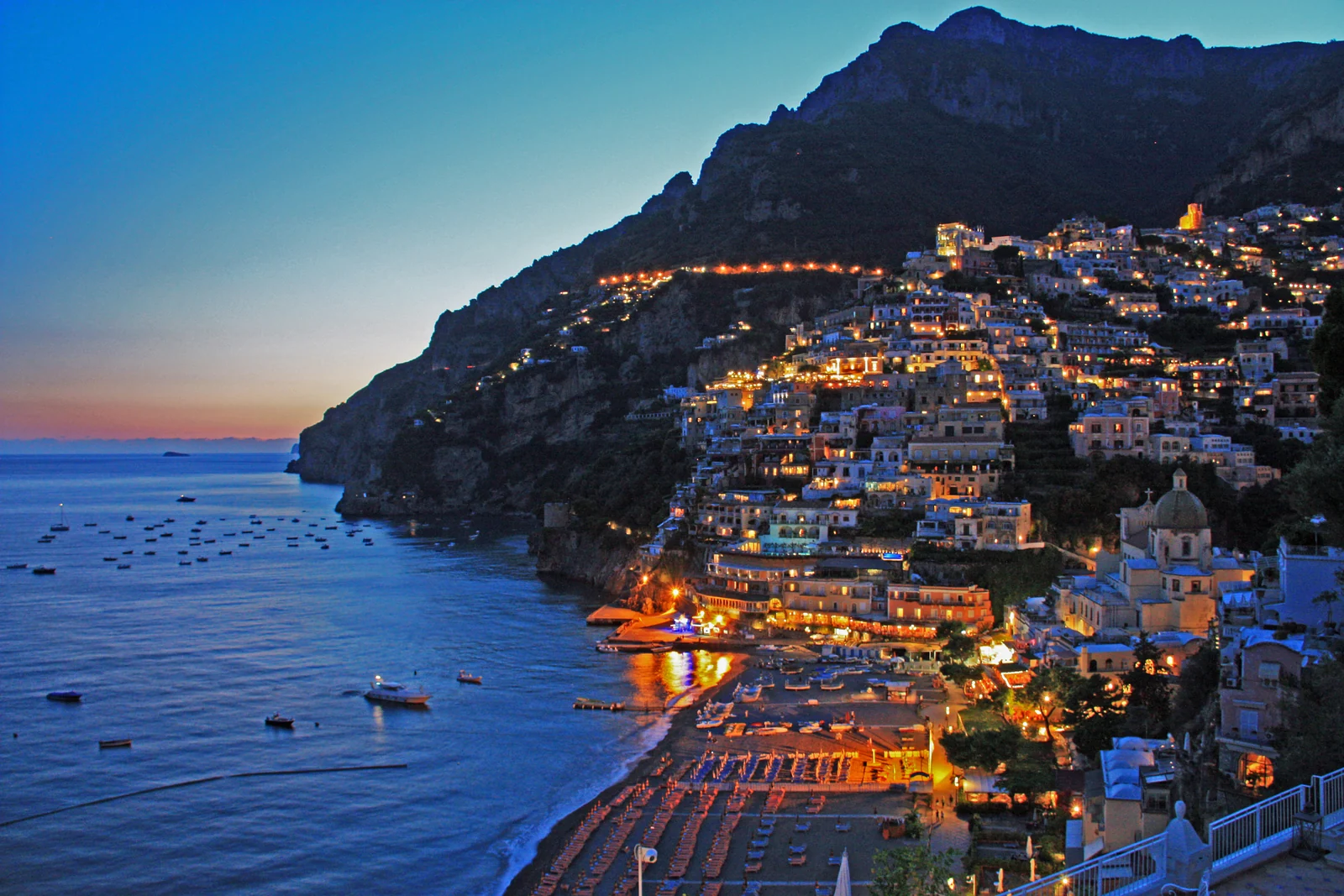
Positano is first of all seen from Spiaggia Grande. The Comune describes it as the heart of the town: in front, the sea with the island of Li Galli on the horizon; behind, the “pyramid” of coloured houses perched one on top of another, crowned by the church of Santa Maria Assunta and its yellow, green and blue majolica dome.
Beneath the church lies the second reason: the MAR, the Roman Archaeological Museum, where visitors see the frescoed dining room of a first-century AD seaside villa buried by the eruption of Vesuvius in 79. It is one of the Roman villas that the Italian National Commission for UNESCO lists among the treasures of the Amalfi Coast, a World Heritage site of twelve municipalities.
Then there are the mountains. Above the town lie the villages of Montepertuso and Nocelle, and from Nocelle starts the Path of the Gods, the hiking trail that reaches Agerola with a view over the whole coast. The rest comes from the smaller beaches, the made-to-measure sandals and Moda Positano, the Amalfi Coast lemon and the summer feasts on the beach, from the Ferragosto fireworks for the Assumption to the dance prize named after Léonide Massine.
Sources: Comune di Positano — Le spiagge di Positano (8 agosto 2023) · Comune di Positano — Le chiese di Positano (7 agosto 2023) · Comune di Positano — Museo Archeologico Romano di Positano (aggiornato il 29 maggio 2025) · Commissione Nazionale Italiana per l’UNESCO — Costiera Amalfitana, sito Patrimonio Mondiale · Comune di Positano — Le frazioni di Positano, Montepertuso e Nocelle (11 agosto 2023) · Comune di Positano — Positano e l’artigianato (6 settembre 2023) · Comune di Positano — Ferragosto a Positano · Comune di Positano — Positano Premia la Danza Léonide Massine (aggiornato il 2 settembre 2025)
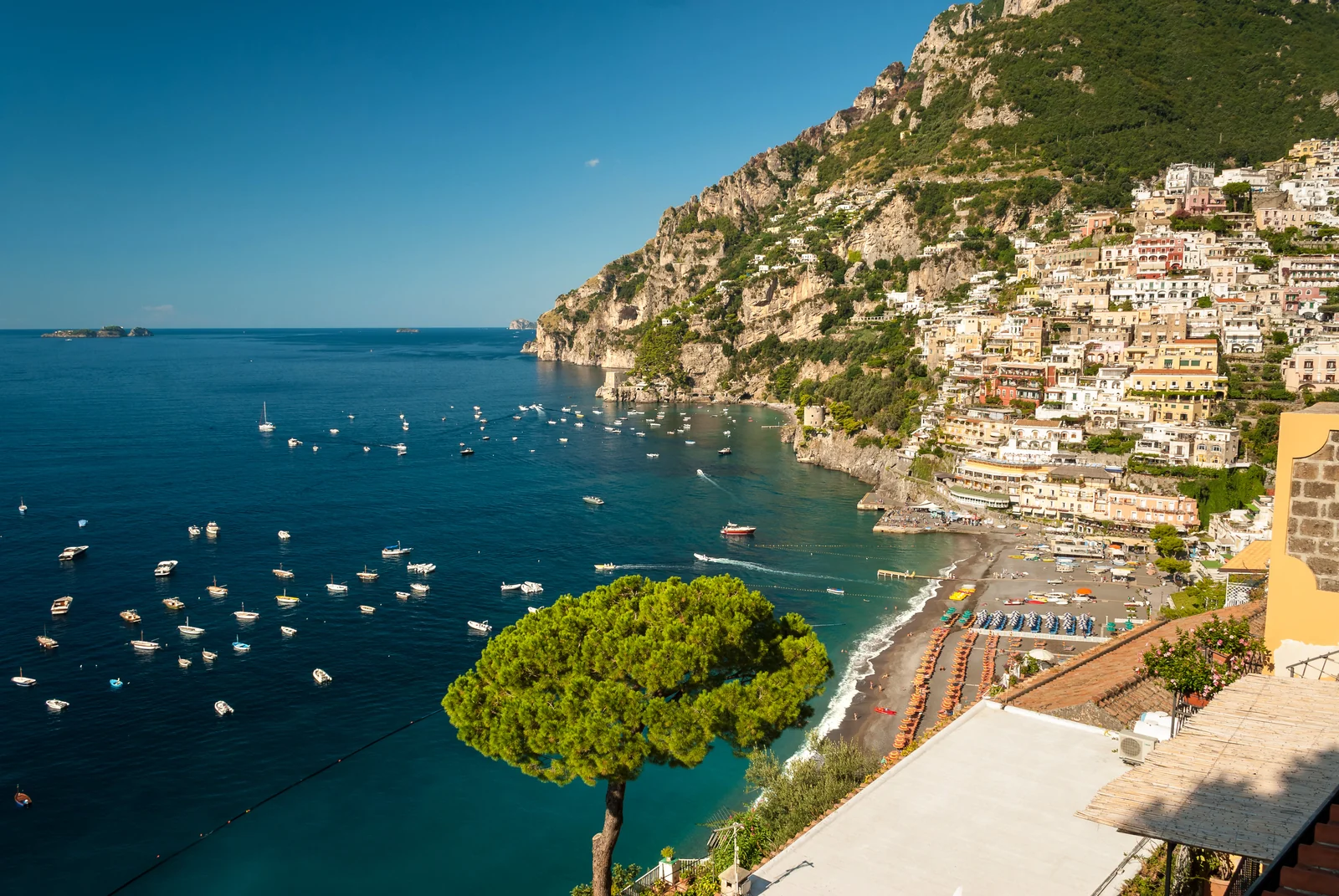
Photo: Mihael Grmek / Wikimedia Commons — CC BY-SA 4.0 · Resized and converted to WebP.
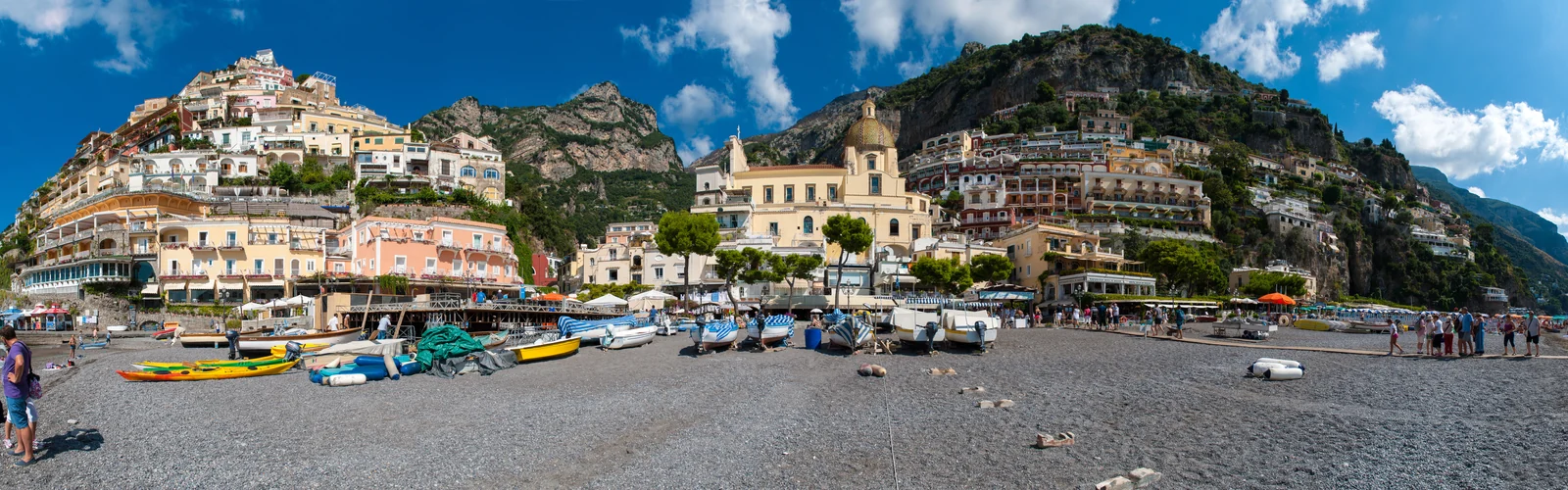
Photo: Mihael Grmek / Wikimedia Commons — CC BY-SA 4.0 · Resized and converted to WebP.
The municipality at a glance
Positano is a municipality in the province of Salerno, in Campania. Its ISTAT code is 065100. On 1 January 2025 it had 3,677 residents. The municipal territory covers 8.70 km² and ranges from -13 to 1,392 metres above sea level; the town hall stands at about 145 metres.
Above the town lie two villages: Montepertuso, the most populous, named after the pierced mountain above it, and Nocelle, the highest and oldest, whose name according to the Comune comes from the Latin “nova cella”, new dwelling. Positano is part of the Amalfi Coast, inscribed on the World Heritage List.
Sources: ISTAT, Codici statistici delle unità amministrative territoriali: elenco dei comuni al 21 febbraio 2026 · ISTAT, Popolazione residente per età, sesso e stato civile al 1° gennaio 2025 (POSAS) · ISTAT, Principali statistiche geografiche sui comuni: superficie e altimetria al 31 dicembre 2021 · Comune di Positano — Le frazioni di Positano, Montepertuso e Nocelle (11 agosto 2023) · Commissione Nazionale Italiana per l’UNESCO — Costiera Amalfitana, sito Patrimonio Mondiale
History
At the end of the first century BC, the MAR explains, the Positano ravine, with its beach, its limestone cliffs and its healthy climate, became the seat of a leisure villa: terraces stepping down to the sea, frescoed halls and colonnades overlooking gardens. The villa had long been known: in 1758 Karl Weber, who worked on the Bourbon excavations, described structures with frescoes and mosaics beneath the mother church and its bell tower. The scholar Matteo Della Corte believed it was the villa of Posides, a powerful freedman of the emperor Claudius, from whom the very name of Positano would derive.
In the mid-first century AD the villa was being restored after the earthquake of 62, and its reception rooms were receiving new decoration in the Fourth Pompeian Style. The eruption of Vesuvius in 79 destroyed it: according to the Comune the house was covered first by a film of ash and then by almost two metres of pumice, and mudflows filled its rooms, bringing down roofs and floors. Most of the villa is still buried beneath the old town.
The church rose over the villa. The Comune dates its foundation to the second half of the tenth century and links it to San Vito, patron saint of Positano; the MAR’s page on the crypts recalls the upper church being dedicated to the Virgin in 1159. The church keeps the Byzantine icon of the Black Madonna and Child: an undocumented tradition says Benedictine monks brought it in the twelfth century; popular legend tells instead of a sailing ship stopped by a storm off the town, and of a voice from the image saying “Posa, posa” (“set me down”). The sailors carried it ashore and the people built a temple for it.
In the twentieth century Positano became a refuge for artists. The Comune recalls the exiles who arrived during the Second World War to escape Nazi-Fascism and the racial laws, welcomed and protected by the townspeople: among them the writer Essad Bey, author of “Ali and Nino”, buried in the town cemetery under his turban-shaped headstone, the writer Stefan Andres and the painter Michele Theile. Then came the dancers Léonide Massine and Rudolf Nureyev, who lived on the islands of Li Galli, and Franco Zeffirelli, who bought a group of villas above Arienzo beach. The Comune has catalogued the graves of the artists and historical figures in the cemetery, with a record for each.
At the end of the 1950s, when the coast began to attract the international jet set, local craftspeople answered the demand for clothes for the seaside: from jute-cloth “pezze” to crocheted bikinis and skirts with strips of lace. That, the Comune writes, is how Moda Positano was born, made of linen, lace and worked and embroidered cotton.
Sources: MAR, Museo Archeologico Romano di Positano — Cenni storici: la villa romana di Positano · Comune di Positano — Museo Archeologico Romano di Positano (aggiornato il 29 maggio 2025) · MAR, Museo Archeologico Romano di Positano — Cripte · Comune di Positano — Le chiese di Positano (7 agosto 2023) · Comune di Positano — Personaggi illustri (7 agosto 2023) · Comune di Positano — I personaggi illustri nel cimitero di Positano (aggiornato il 13 agosto 2025) · Comune di Positano — Positano e l’artigianato (6 settembre 2023)
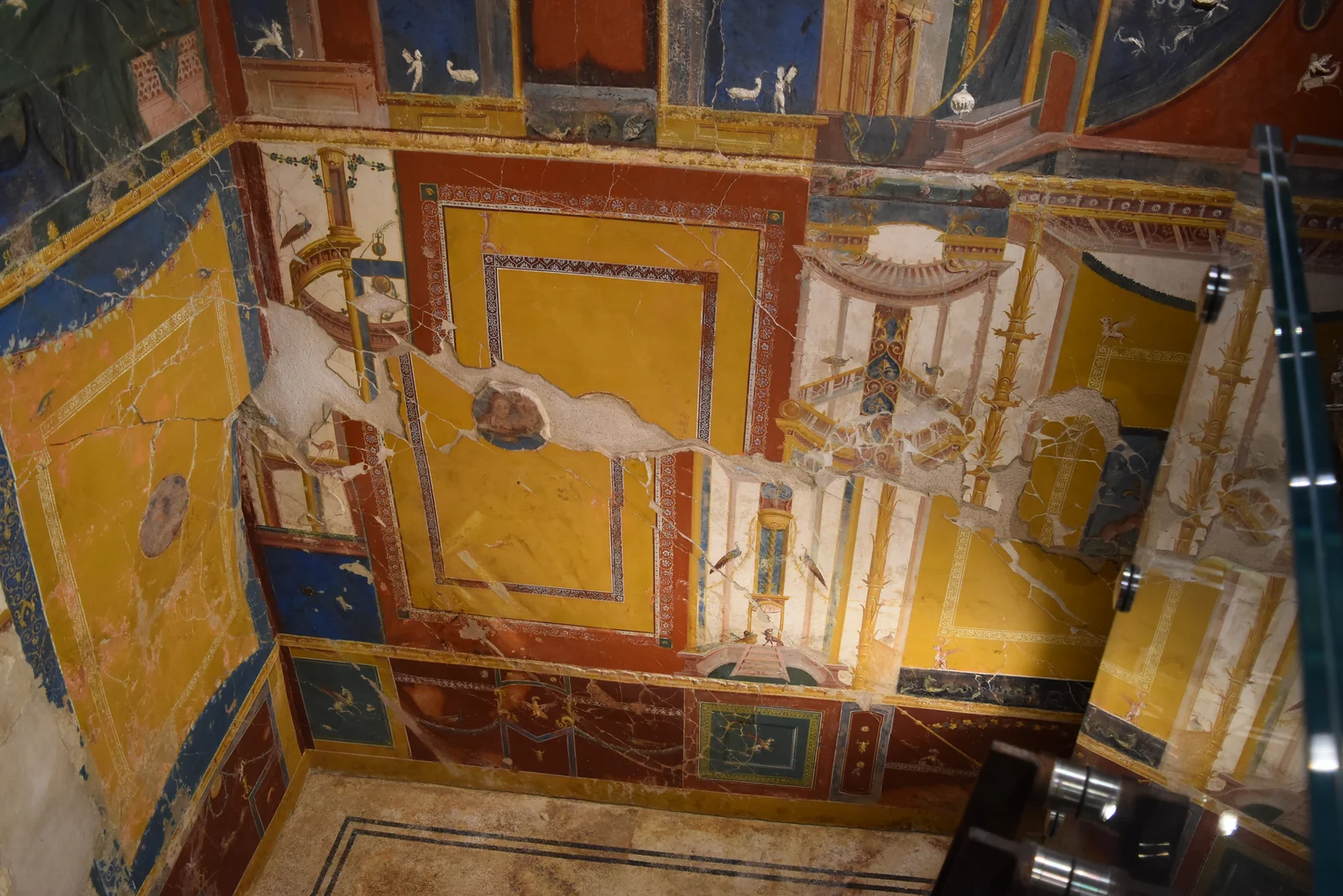
Photo: MaR Positano / Wikimedia Commons — CC BY-SA 4.0 · Resized and converted to WebP.
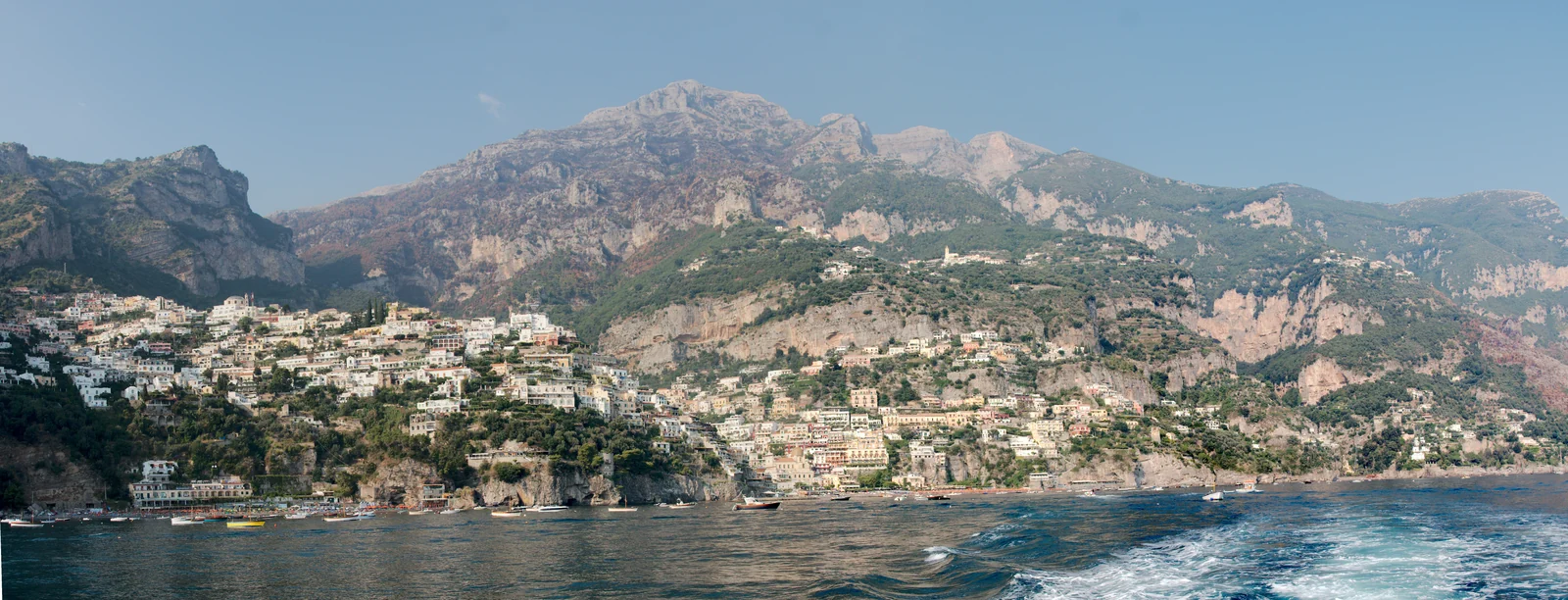
Photo: User:MatthiasKabel / Wikimedia Commons — CC BY-SA 3.0 · Resized and converted to WebP.
What to see
The church of Santa Maria Assunta, the mother church, stands in the centre of the town and can be seen from every corner: the Comune calls it the symbol of Positano for its yellow, blue and green majolica dome. Inside it keeps the Byzantine icon of the Black Madonna.
Beneath the church, at Piazza Flavio Gioia 7, is the MAR, the Roman Archaeological Museum. Visits are guided, in groups of no more than seven people, and pass through the medieval crypt, under the presbytery, with two aisles on marble columns and a plan close to those of the cathedral crypts of Salerno, Amalfi, Ravello and Scala; the upper crypt, with 69 masonry seats for drying the bodies of the dead, decorated with stucco in the early eighteenth century, probably for the Confraternity of the Monte dei Morti; and finally the triclinium of the Roman villa. Its walls, in the Fourth Pompeian Style, show architecture on several levels, a curtain with sea monsters, dolphins and stucco cupids, medallions with mythological scenes such as the centaur Chiron teaching Achilles music, and a seascape with a bay. A crack in the east wall, shifted about forty centimetres downhill, shows the force of the eruption.
Tickets are sold online on the MAR website or at the ticket office, by card only; the Comune advises dressing in layers because the temperature inside is lower, and lists the exemptions, including accompanied children up to 12. The route accessible to visitors with disabilities passes through the church of Santa Maria Assunta during its opening hours: it is best to ask the ticket office before booking.
Every quarter has its church. The Comune lists the Chiesa Nuova, in the upper town, rebuilt in the eighteenth century over the chapel of the Blessed Sacrament, in Baroque style, with a majolica floor by Ignazio Chiaiese; San Giovanni, just past Via Pasitea; San Matteo, along Via Monte, restored in 1878 and 1897; the Rosario, in Piazza dei Mulini; Santa Margherita, on the ramps down to Fornillo, and Santa Caterina, near the Fornillo grotto; San Giacomo, in the Liparlati quarter, founded around 1100; and the small church of San Pietro at Laurito.
The beaches complete the landscape. Besides Spiaggia Grande, the Comune points to Fornillo, quieter; Arienzo, known as the beach of the 300 steps for the stairway down to it; and Laurito, a small bay ringed by Mediterranean scrub. Off the coast lie the islands of Li Galli.
Sources: Comune di Positano — Le chiese di Positano (7 agosto 2023) · Comune di Positano — Museo Archeologico Romano di Positano (aggiornato il 29 maggio 2025) · MAR, Museo Archeologico Romano di Positano — Biglietteria · MAR, Museo Archeologico Romano di Positano — Cripte · MAR, Museo Archeologico Romano di Positano — Cenni storici: la villa romana di Positano · Comune di Positano — Le spiagge di Positano (8 agosto 2023)
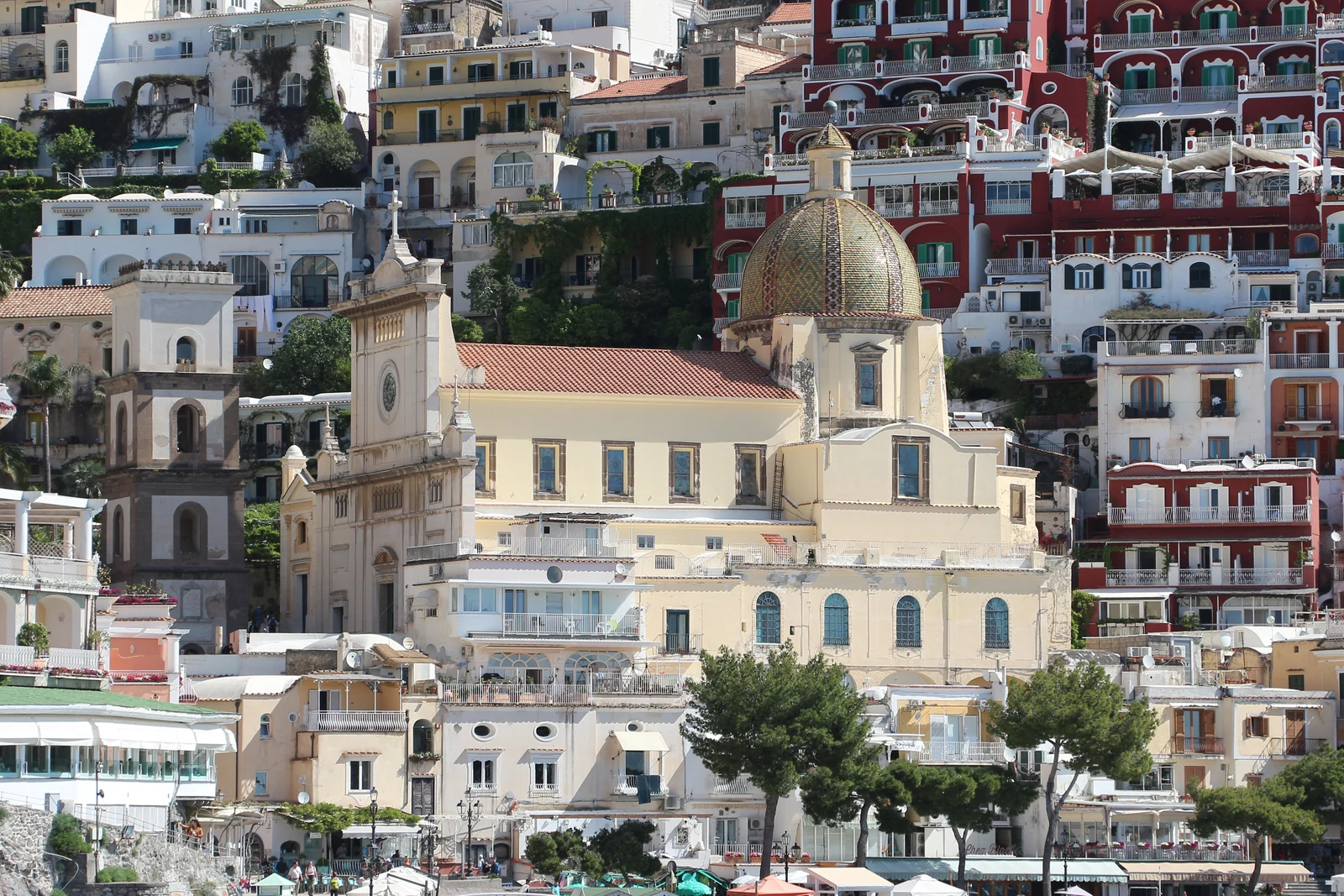
Photo: Bernard Gagnon / Wikimedia Commons — CC BY 4.0 · Resized and converted to WebP.
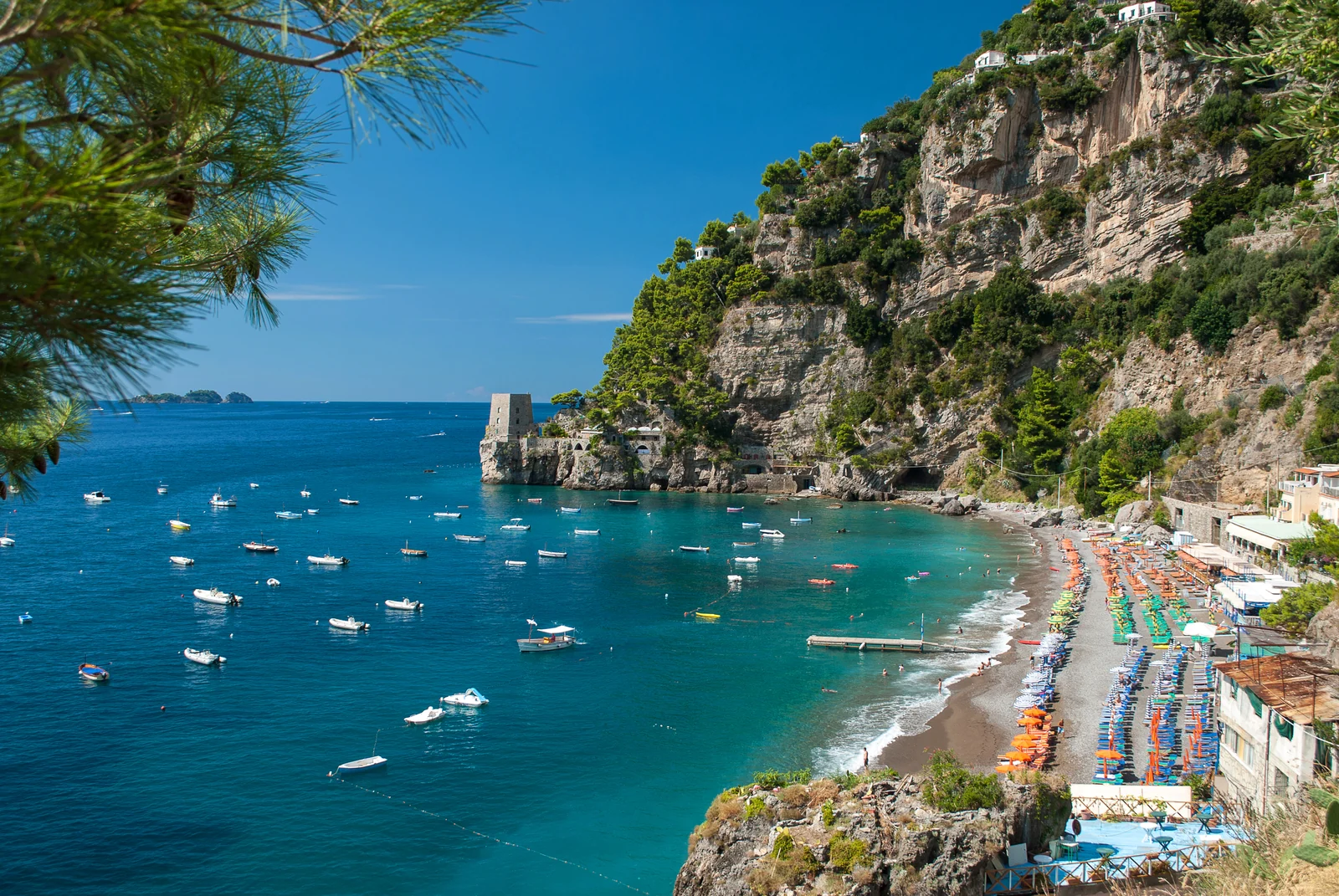
Photo: Mihael Grmek / Wikimedia Commons — CC BY-SA 4.0 · Resized and converted to WebP.
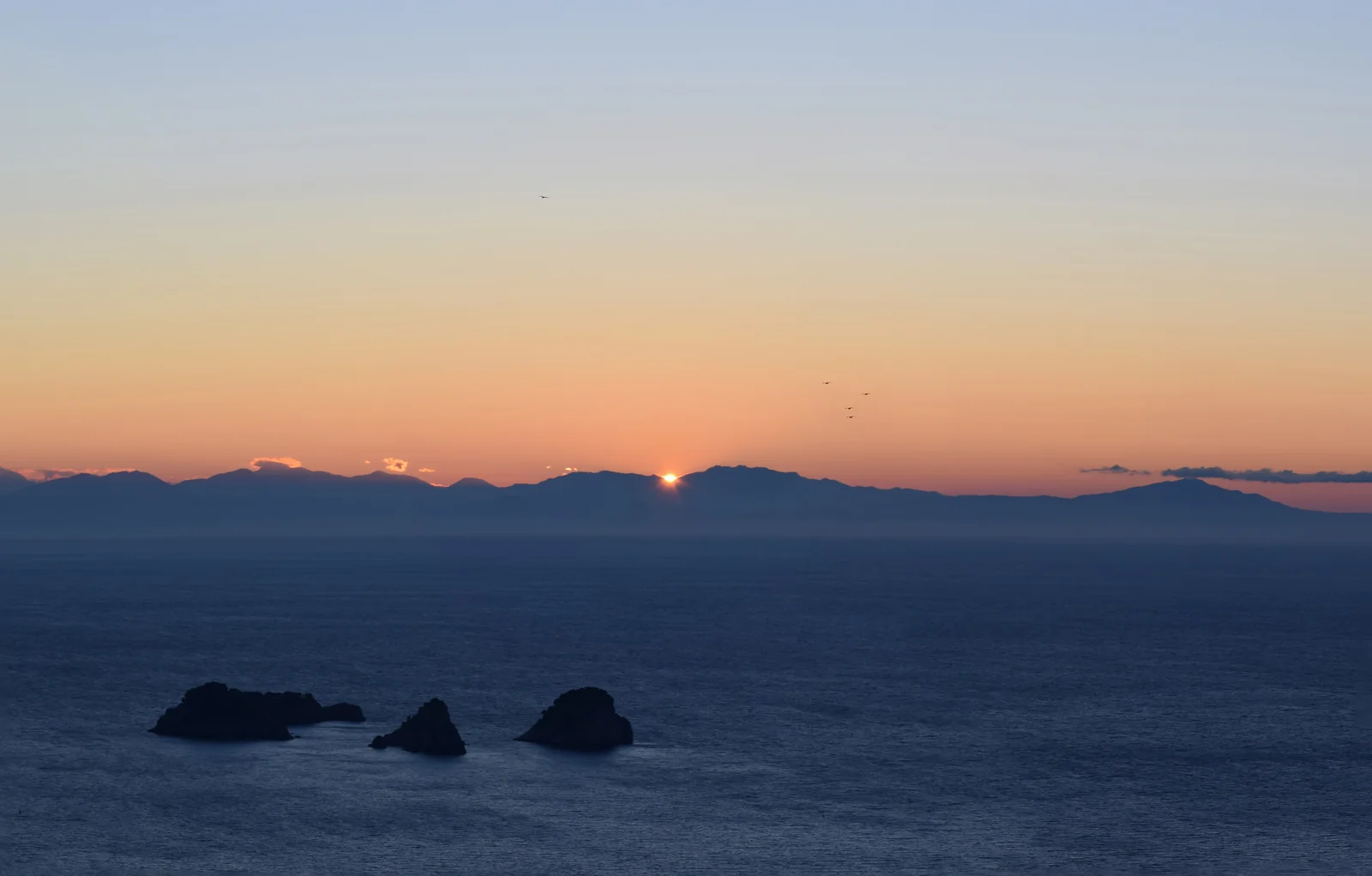
Photo: Carminejoy91 / Wikimedia Commons — CC BY-SA 4.0 · Resized and converted to WebP.
Food and drink
Positano is one of the production municipalities of the Limone Costa d’Amalfi PGI, the Sfusato Amalfitano variety: the Campania Region describes it as tapering, weighing at least 100 grams, with a medium-thick, pale yellow peel rich in essential oils, juicy flesh and few seeds. It grows on the coast’s terraces, once covered with straw “pagliarelle”, today with shade nets; it is picked several times a year, and the best crop comes between March and the end of July.
In the kitchen, the Region writes, the lemon is also served plain, as a salad, goes with fish, seafood starters and first courses, and is the base of limoncello, the infusion of peel in alcohol, and of desserts such as lemon “delizie” and the limoncello babà. Its story comes from the sea: as early as the eleventh century the Republic of Amalfi required ships to carry lemons against scurvy.
The Comune ties Positano’s cooking to its land and recalls the Sagra della zeppola, a tradition born in the 1980s and held over Christmas on Spiaggia Grande, which reached its forty-first edition in 2022.
Sources: Regione Campania, Assessorato Agricoltura — Limone Costa d’Amalfi I.G.P. · Comune di Positano — Positano e l’artigianato (6 settembre 2023) · Comune di Positano — Sagra della zeppola
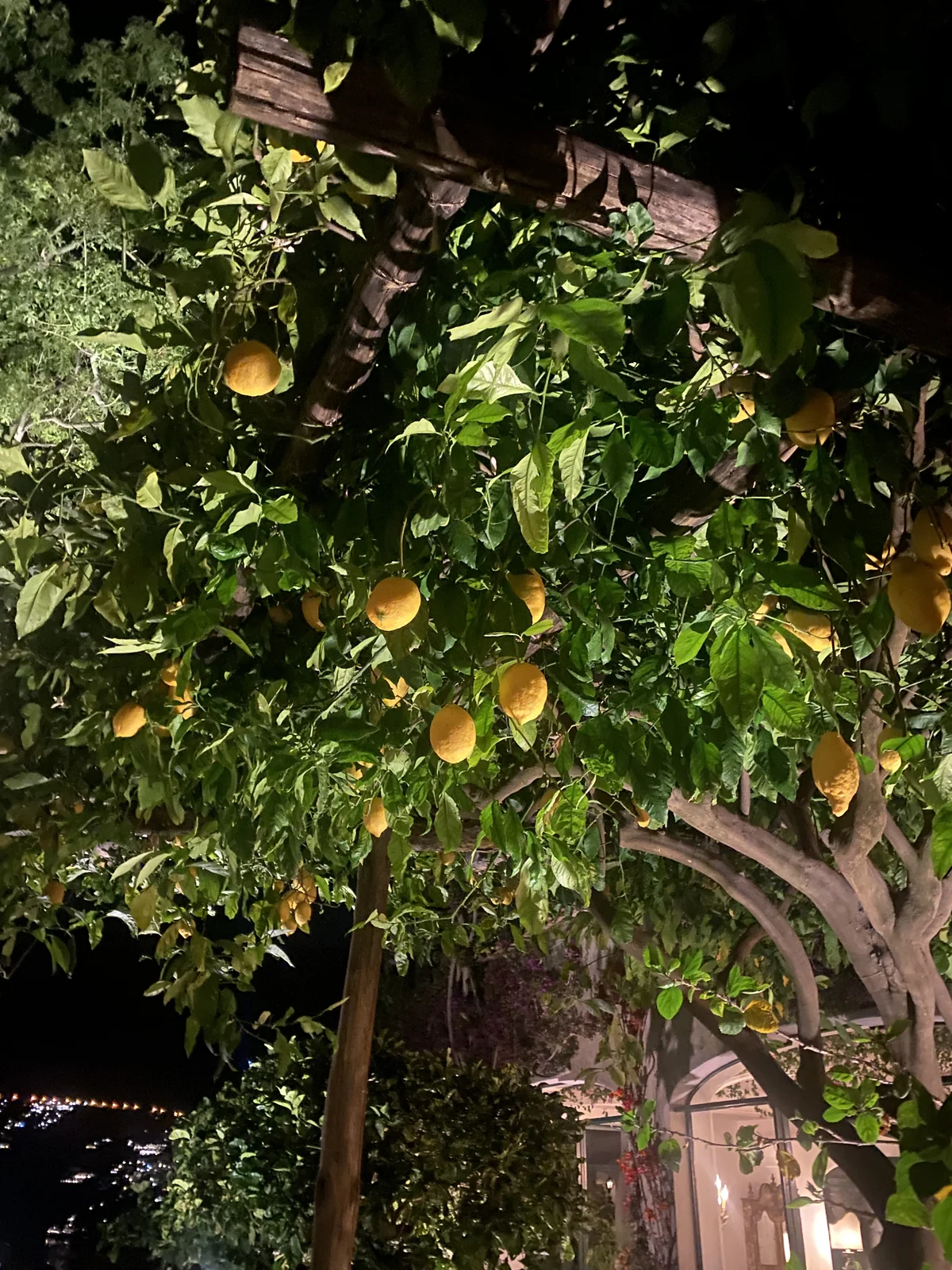
Photo: SullyShave / Wikimedia Commons — CC BY-SA 4.0 · Resized and converted to WebP.
Things to do
The Path of the Gods starts from the upper village of Nocelle and reaches Agerola: the Comune describes it as a walk of about three hours, some 8 kilometres there and back, with views over the Amalfi Coast, Capri and its Faraglioni and Li Galli. It is a hiking trail (grade E) of medium difficulty, waymarked in white and red: walkers need proper footwear, fitness and a sense of direction; there are few water sources, exposed stretches have no protection and it is not advised in rain, wind, fog or snow. From Positano to Nocelle there are 1,700 steps.
On the sea, in 2023 the Comune announced that its Blue Flag had been confirmed: it recognises the quality of the water measured by the regional environmental agencies. The beaches range from Spiaggia Grande, with its services, to Fornillo, Arienzo and Laurito.
Positano is the place to buy sandals made to measure in its workshops, from the simplest with woven leather and coloured threads to those set with pearls, Moda Positano clothes and ceramics, an old tradition in pastel colours. The Comune also recalls the Positano Fashion Day, the fashion show of students from the Accademia della Moda in Naples who work with the town’s ateliers.
In summer the Comune’s programme includes the literary series Positano Mare Sole e Cultura, which turned thirty in 2022, the Positano Teatro Festival Premio Annibale Ruccello, born in 2000, the Vicoli in Arte series, with music and shows in the lanes, and Positano tra Storia e Leggenda, performances in the churches of Santa Maria Assunta, the Madonna delle Grazie at Montepertuso and the Madonna del Carmelo at Nocelle.
Sources: Comune di Positano — Le frazioni di Positano, Montepertuso e Nocelle (11 agosto 2023) · Comune di Positano — Il Sentiero degli Dei (9 agosto 2023) · Comune di Positano — Confermata la Bandiera Blu a Positano (8 agosto 2023) · Comune di Positano — Le spiagge di Positano (8 agosto 2023) · Comune di Positano — Positano e l’artigianato (6 settembre 2023) · Comune di Positano — Eventi e manifestazioni (8 agosto 2023)
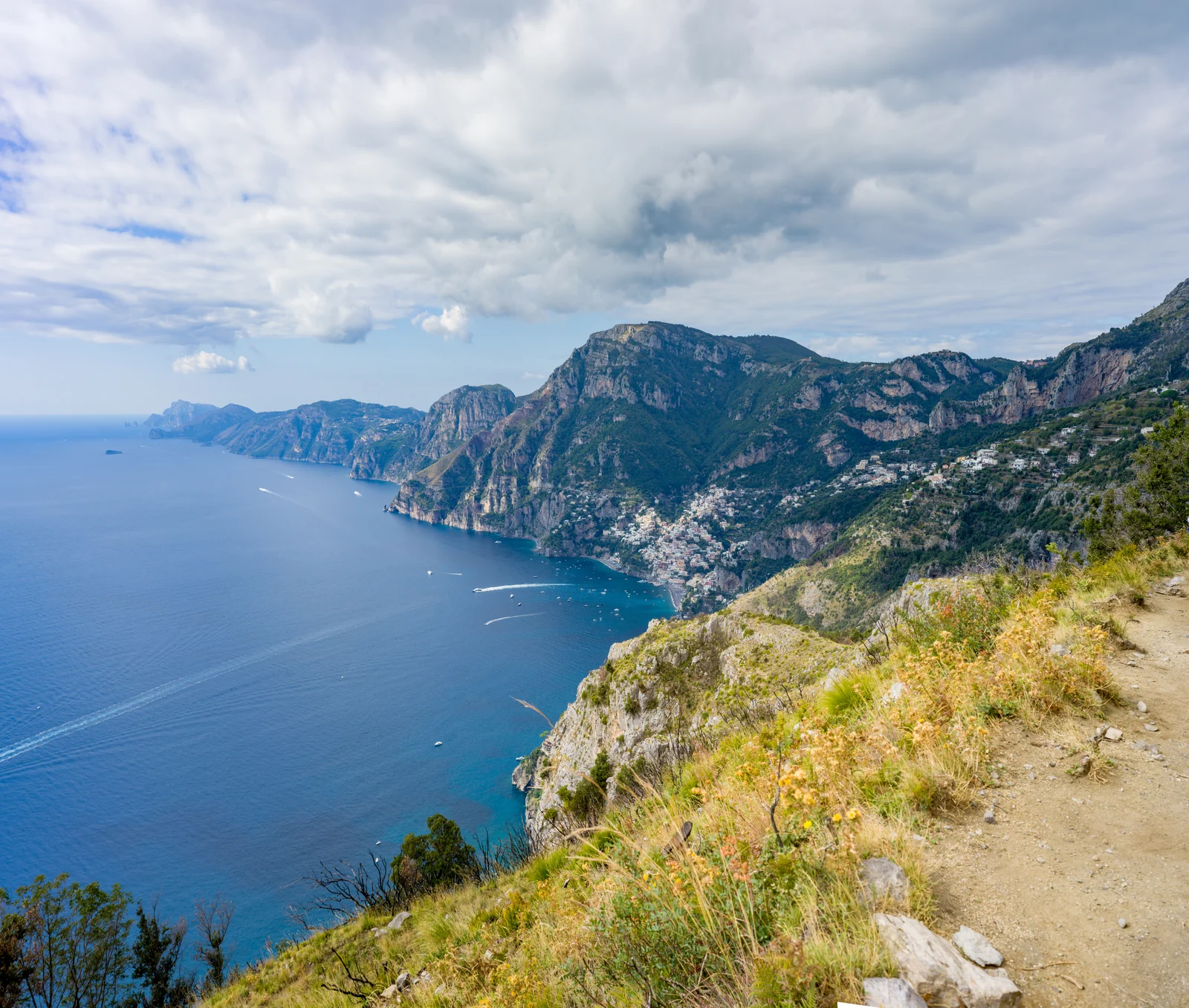
Photo: Wolfgang Moroder / Wikimedia Commons — CC BY-SA 3.0 · Resized and converted to WebP.
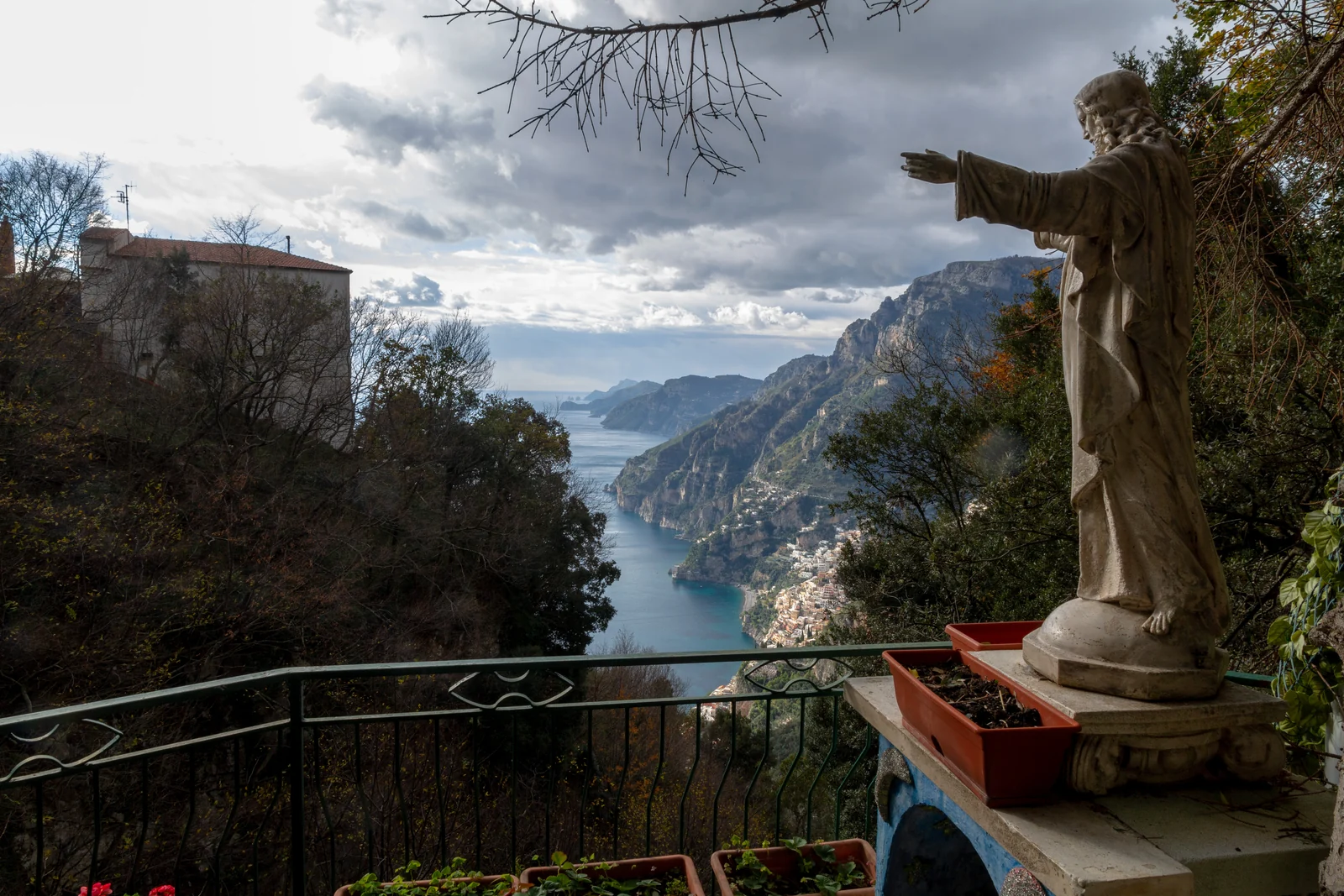
Photo: Ugeorge / Wikimedia Commons — CC BY-SA 3.0 · Resized and converted to WebP.
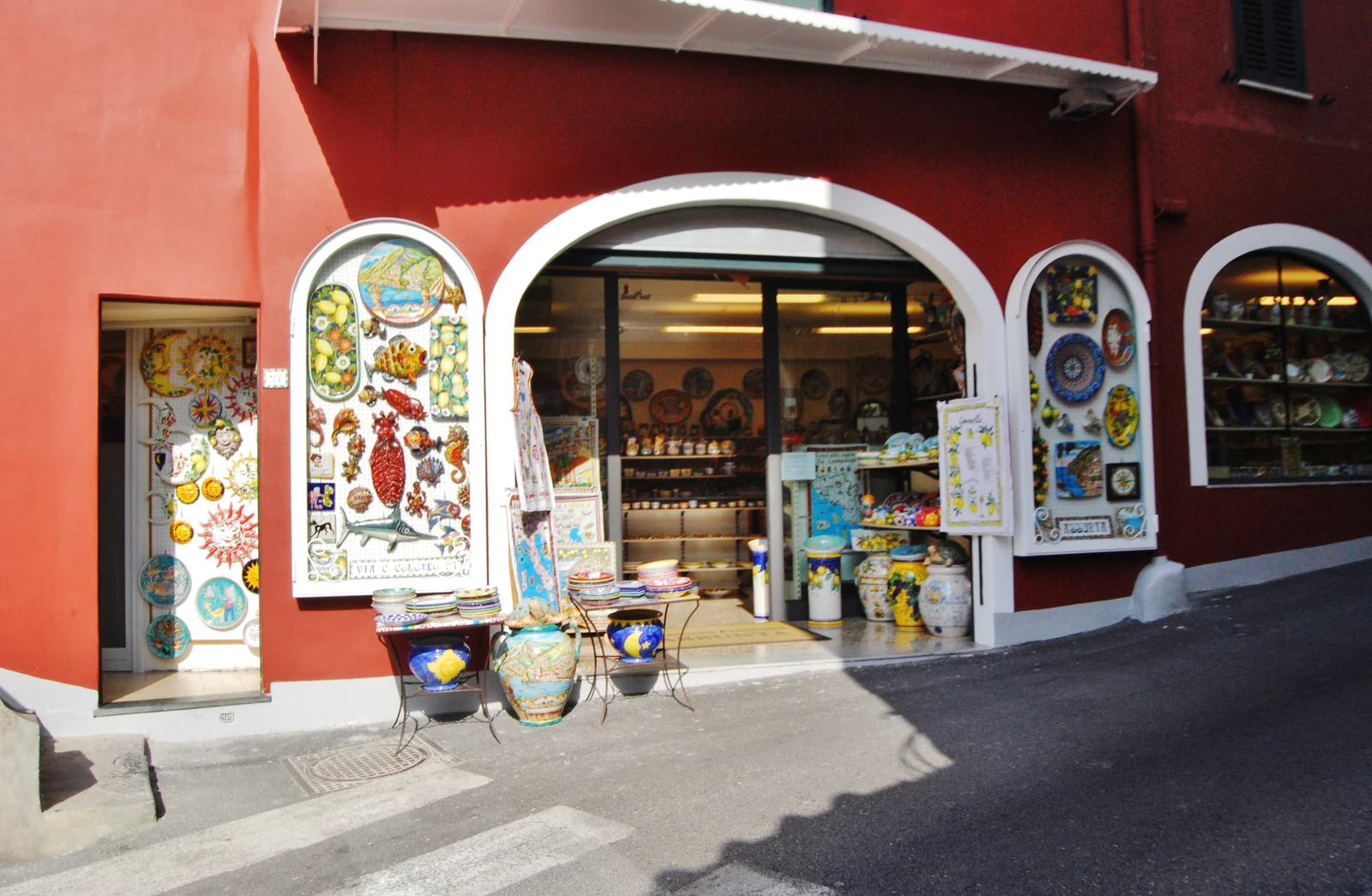
Photo: Mykola Swarnyk / Wikimedia Commons — CC BY-SA 3.0 · Resized and converted to WebP.
When to go
The calendar of feasts follows the villages and the sea. On 2 July Montepertuso celebrates its protector, the Madonna delle Grazie, and re-enacts the legend of the pierced mountain: the devil tried in vain to bore through it, the Virgin crumbled it with the touch of a finger, and the defeated devil’s footprint is still on the rocks. The feast has a religious service and fireworks inside the hole. On 16 July Nocelle celebrates the Madonna del Carmelo in the church on its little square.
On the night of 15 August fireworks are reflected in the sea in front of the town, for Ferragosto and above all for the Assumption of the Virgin; the Comune recalls the boats and yachts that fill the water. In 2024 the Vicoli in Arte series staged “Posa Posa, the landing of the Saracens” on Spiaggia Grande.
At the end of summer Spiaggia Grande hosts Positano Premia la Danza Léonide Massine. The prize was born on 2 August 1969 and ten years later, when Massine died, took his name; the Comune notes that it has never been interrupted, not even during the pandemic, and the fifty-third edition was held on 6 September 2025. Between Christmas and the end of the year Spiaggia Grande fills up again for the Sagra della zeppola.
Sources: Comune di Positano — Le frazioni di Positano, Montepertuso e Nocelle (11 agosto 2023) · Comune di Positano — Ferragosto a Positano · Comune di Positano — Vicoli in Arte 2024: «Posa Posa», lo sbarco dei Saraceni · Comune di Positano — Positano Premia la Danza Léonide Massine (aggiornato il 2 settembre 2025) · Comune di Positano — Sagra della zeppola
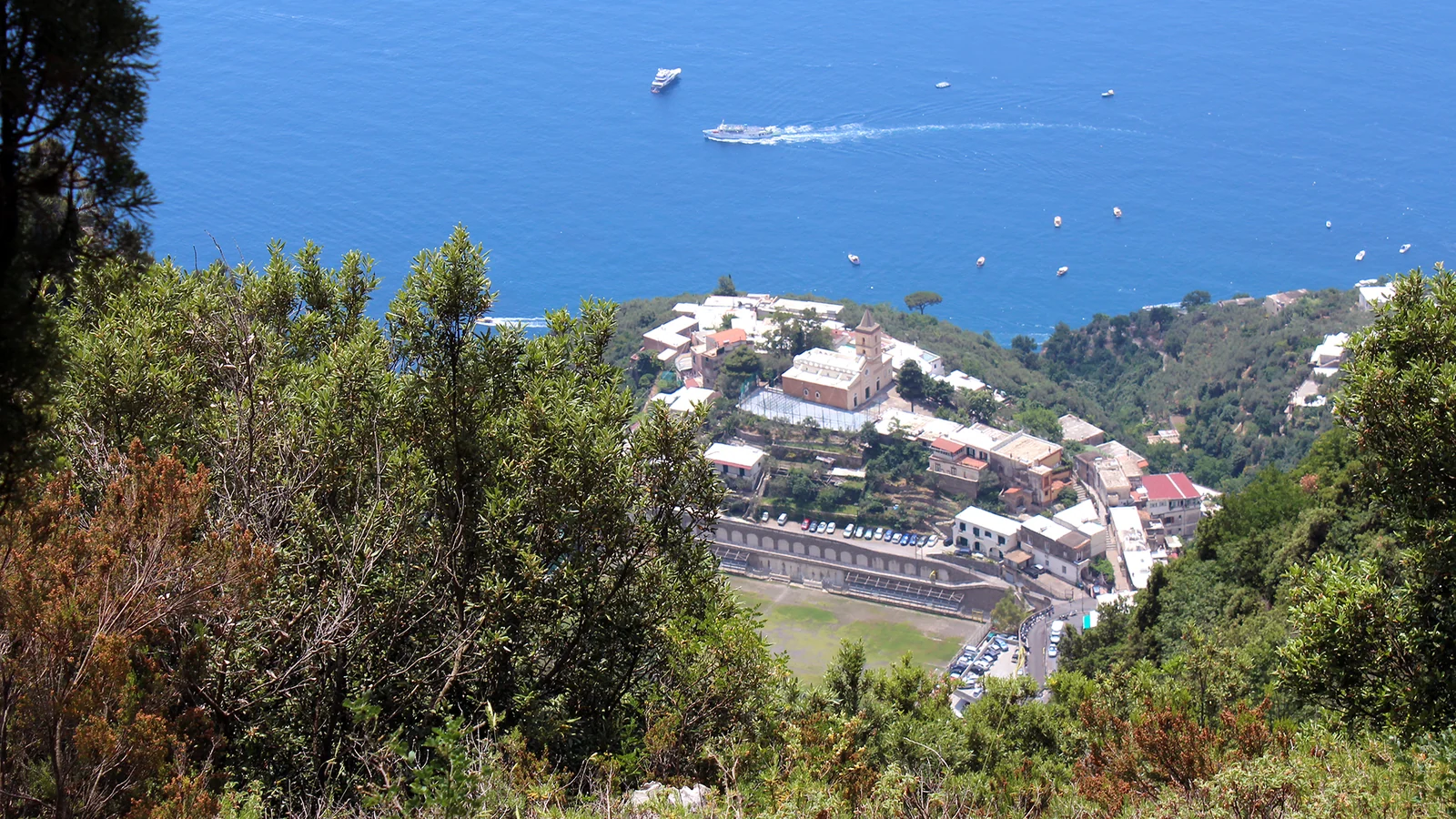
Photo: Mika Auramo / Wikimedia Commons — CC BY 3.0 · Resized and converted to WebP.
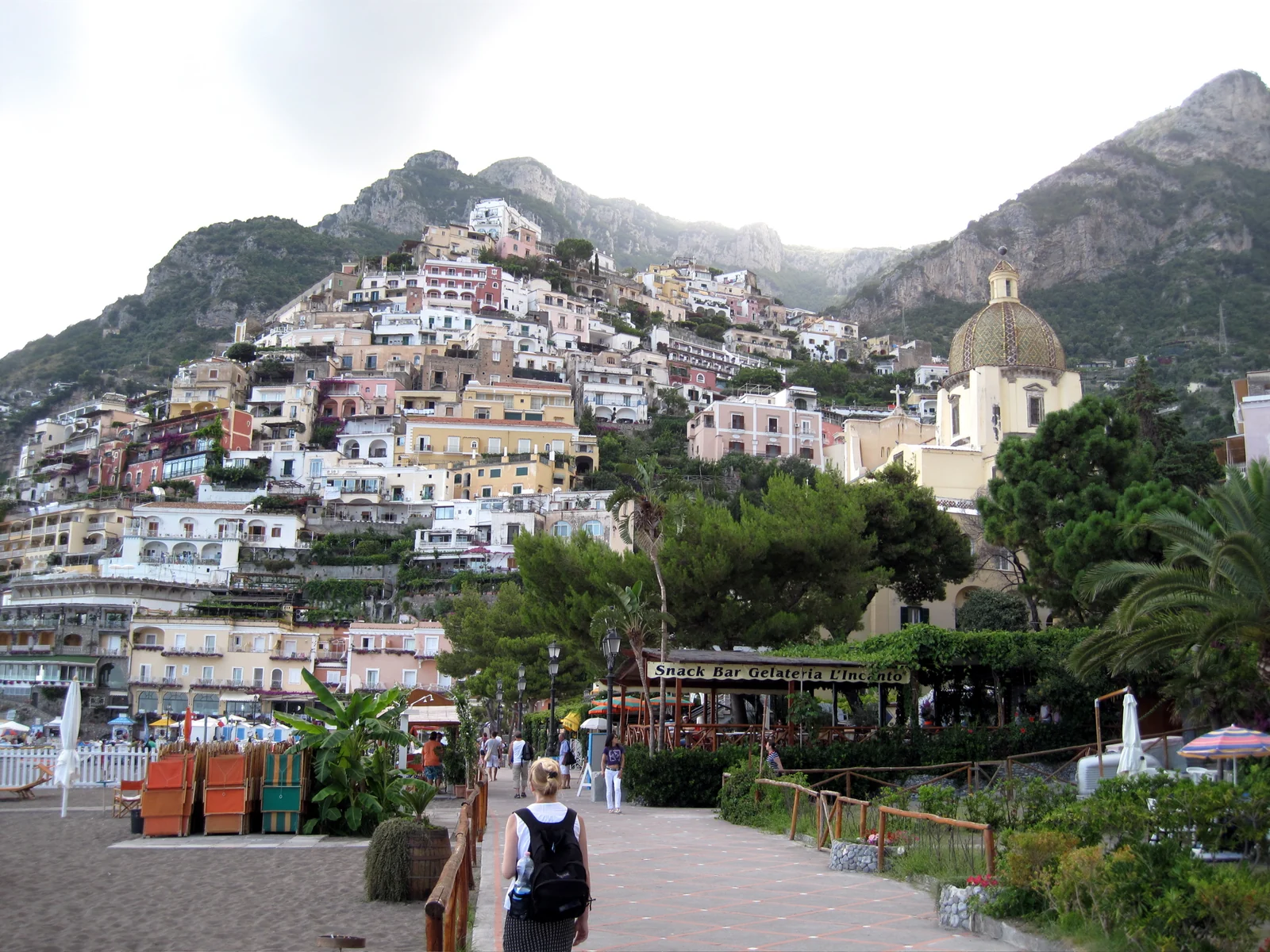
Photo: trukdotcom / Wikimedia Commons — CC BY-SA 3.0 · Resized and converted to WebP.
Getting there
By car, the Comune explains, take the Naples-Salerno motorway, exit at Castellammare di Stabia, follow the signs for the Sorrento Peninsula and, at Meta di Sorrento, those for Positano and the Amalfi Coast.
Positano is served by SITA scheduled buses, and for getting around town the Comune points to the local public bus lines. Hydrofoils and ferries arrive by sea: for timetables and routes the Comune refers, among others, to the Metrò del Mare and to Alilauro. Travelmar, based in Amalfi, runs fast ferries from the coast’s tourist harbours and a tour that calls at Positano and Amalfi. On Spiaggia Grande stands the pier named after Léonide Massine.
Sources: Comune di Positano — Come raggiungerci · Travelmar S.r.l. — Traghetti veloci in Costiera Amalfitana · Comune di Positano — Vicoli in Arte 2024: «Posa Posa», lo sbarco dei Saraceni
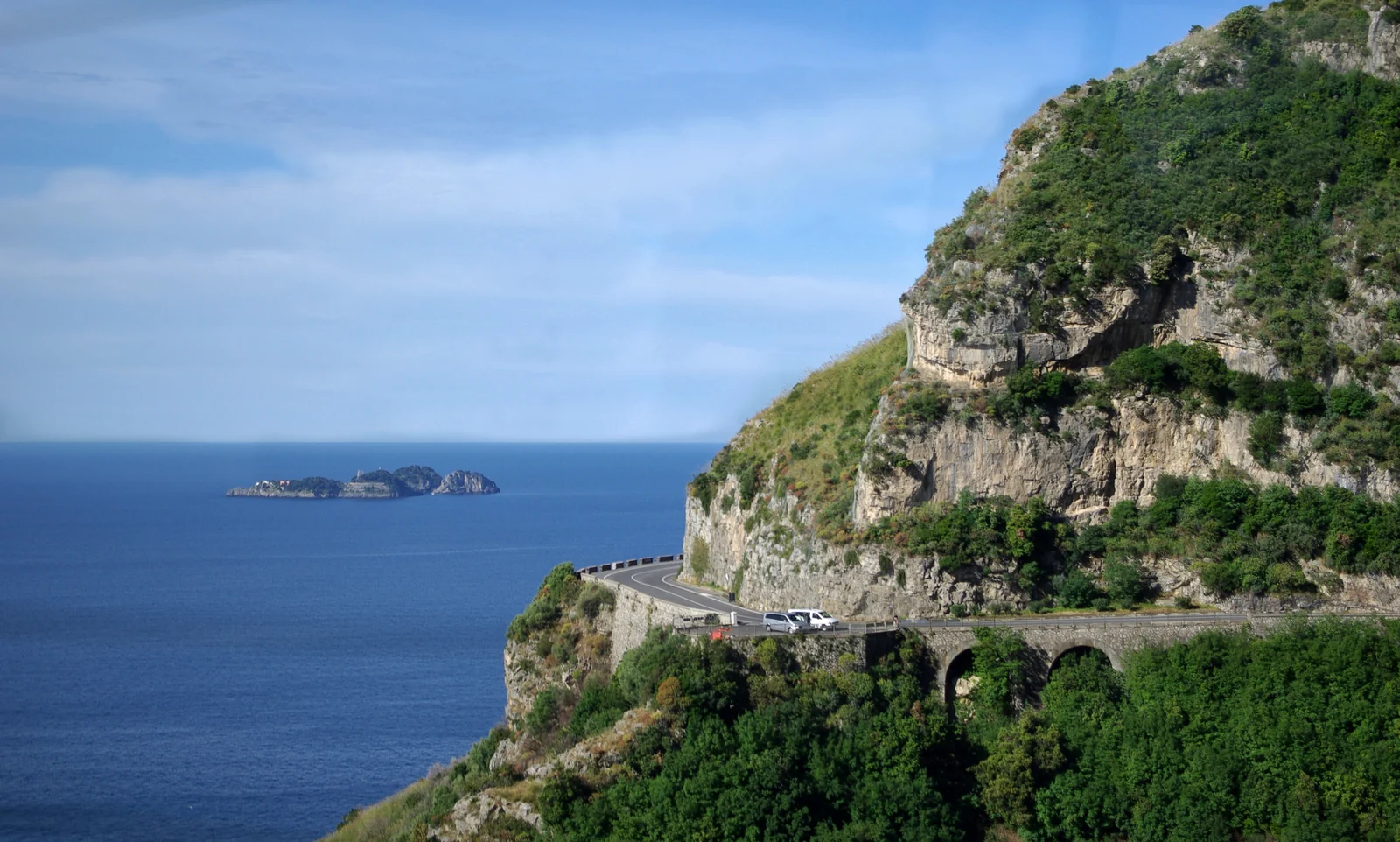
Photo: Berthold Werner / Wikimedia Commons — CC BY-SA 3.0 · Resized and converted to WebP.
Tourism
In the 2026 season, according to the page updated by the council in May, the Tourist Office is open every day from 9 am to 9 pm.
Anyone staying overnight in Positano between 1 April and 31 October, in a hotel, a bed & breakfast, a campsite, a holiday home or a short-term rental, who is not a resident of the town, pays the tourist tax, per person and per night. For 2026 the council’s executive confirmed the rates of previous years: 5 euros in five-star hotels, 4 in four-star hotels, 3 in three-star hotels and 2.50 euros in one- and two-star hotels and all other accommodation. Only children within their tenth year of age are exempt, with documentation to show to the accommodation, and there are no reductions. The tax is paid to the host, who issues a receipt and must inform guests with a notice displayed in the accommodation and in its listings.
The sea off Positano lies within the Punta Campanella marine protected area, whose management consortium includes the town council, and the regulation approved by the Ministry of the Environment in 2010 applies to those who go out by boat or swim. In the A zones there is no swimming, no navigation and no mooring, and near the western shoal of Li Galli only the boats of authorised diving centres may tie up, to the buoys; throughout the area jet skis and water skiing are not allowed, the caves may be entered only in small rowing boats, and near the coast motor boats keep below 5 knots within 300 metres and below 10 knots further out. No anchor is dropped in the A and B zones; in zone C anchoring is allowed from 8 am to 8 pm, but not within 100 metres of beaches or 50 metres of sheer cliffs, nor on posidonia meadows or coralligenous seabeds.
Sources: Comune di Positano — Ufficio del Turismo (aggiornato il 16 maggio 2026) · Comune di Positano — Imposta di soggiorno (Ids): regolamento (Delibere di CC n. 37/2017 e n. 20/2020) e tariffe 2026 (Delibera di GC n. 181 del 19 novembre 2025) · Ministero dell’Ambiente — Decreto 30 luglio 2010, Regolamento di esecuzione e organizzazione dell’area marina protetta «Punta Campanella» (GU n. 195 del 21 agosto 2010)
“Come to Positano as a guest, not as a tourist: that is how these places truly let you know them.”
Accommodation in figures
In the Ministry of Tourism’s national database of accommodation (BDSR), on 12 October 2026, Positano had 755 establishments with a verified national identification code (CIN): 38 hotel-type establishments, 273 non-hotel establishments and 444 other establishments.
Sources: Ministero del Turismo – Banca Dati Strutture Ricettive (dashboard pubblica)
Nearby
Positano is one of the twelve municipalities of the Amalfi Coast, a World Heritage site, which the Italian National Commission for UNESCO describes for its terraces of vines and orchards, its lemon gardens, the Roman villa at Minori, the Valle dei Mulini and the majolica domes of Vietri. The Path of the Gods leads from Nocelle to Agerola; from the sea, the islands of Li Galli lie in front of the town.
Sources: Commissione Nazionale Italiana per l’UNESCO — Costiera Amalfitana, sito Patrimonio Mondiale · Comune di Positano — Le frazioni di Positano, Montepertuso e Nocelle (11 agosto 2023) · Comune di Positano — Le spiagge di Positano (8 agosto 2023)
The town council
The official website of the Comune di Positano, registered in IndicePA, the index of the digital addresses of Italy’s public administrations, is the reference for the town council’s offices, opening hours and news. Its address is listed among the sources of this section.
The council offices and the Mayor’s office are at Via G. Marconi 111; the Comune’s number is 089 8122535. The Tourist Office, which runs the infopoint and the MAR ticket office, is at Viale Regina Giovanna 13 and answers on 335 7328002 and 331 2085821 and at [email protected]. Positano has been twinned with Thurnau, in Bavaria, since 2000; in 2020 the town executive approved the proposal to twin with Sidi Bou Said, in Tunisia.
Sources: Comune di Positano, sito istituzionale · IndicePA (AgID), Indice dei domicili digitali delle pubbliche amministrazioni: dataset Enti · Comune di Positano — Ufficio del Turismo (aggiornato il 16 maggio 2026) · Comune di Positano — I gemellaggi (5 settembre 2023)
Where to stay
In the municipality of Positano the national database of the Ministry of Tourism lists 755 accommodation businesses with a verified CIN code: 38 hotels, 273 other licensed accommodation and 444 other types such as B&Bs and private rentals.
Licensed businesses from the official list of accommodation named as the source in this section. Where the list gives it, the property's official identification code appears next to its name: the national CIN code, or the code assigned by the Region or by the body that keeps the list. Private individuals are not listed. This list is the official census of licensed businesses, not a list of Apulica partners: to stay in Positano you do not have to check one property after another yourself; write to Apulica and we look for the stay that suits your journey, checking availability and conditions before any confirmation.
COVO DEI SARACENI
Hotel · ★★★★★
Regional code (CUSR) 15065100ALB0197
Orsa Maggiore
Campsite · ★
Regional code (CUSR) 15065100EXTMVQU
FATTORIA LA TAGLIATA
Farm stay
Regional code (CUSR) 15065100EXT0763
Affittacamere Malù
Guest rooms
Regional code (CUSR) 15065100EXT0004
BRIKETTE
Hostel
Regional code (CUSR) 15065100EXT0023
Hotel Villa Franca
Hotel · ★★★★★
Regional code (CUSR) 15065100ALB0241
ART PASITEA
Guest rooms
Regional code (CUSR) 15065100EXT0011
Hotel Villa Treville
Hotel · ★★★★★
Regional code (CUSR) 15065100ALB0243
B&B Villa Magia Suite
Guest rooms
Regional code (CUSR) 15065100EXT0014
Il San Pietro di Positano
Hotel · ★★★★★
Regional code (CUSR) 15065100ALB0255
First the places that presented themselves to Apulica, the latest first; then one place of each type in turn, by official category and stars, then by name. No position is paid for.
All 144 entries in alphabetical order
Page 1 of 15
| Name | Type | Identification code |
|---|---|---|
| Affittacamere Malù | Guest rooms | Regional code (CUSR) 15065100EXT0004 |
| ALBERGO BUCA DI BACCO | Hotel | Regional code (CUSR) 15065100ALB0024 |
| ALBERGO CALIFORNIA | Hotel | Regional code (CUSR) 15065100ALB0005 |
| Albergo Pensione Villa Verde | Hotel | Regional code (CUSR) 15065100ALB0006 |
| Albergo Villa delle Palme | Hotel | Regional code (CUSR) 15065100ALB0007 |
| ANTALIA BOUTIQUE HOTEL | Hotel | Regional code (CUSR) 15065100ALB0561 |
| ART PASITEA | Guest rooms | Regional code (CUSR) 15065100EXT0011 |
| B&B Villa Magia Suite | Guest rooms | Regional code (CUSR) 15065100EXT0014 |
| BRIKETTE | Hostel | Regional code (CUSR) 15065100EXT0023 |
| CASA ALBERTINA | Hotel | Regional code (CUSR) 15065100ALB0030 |
Ask Apulica for a stay in Positano We reply shortly, within a few hours at most, with a proposal for you to consider.
Sources: Ministero del Turismo – Banca Dati Strutture Ricettive (dashboard pubblica), 2026-10-12
YOUR JOURNEY
How to shape a journey here
To include Positano in a trip, or to ask for a guide or a transfer, you can write to Apulica with the button below.
Plan your tripKeep exploring
Praiano
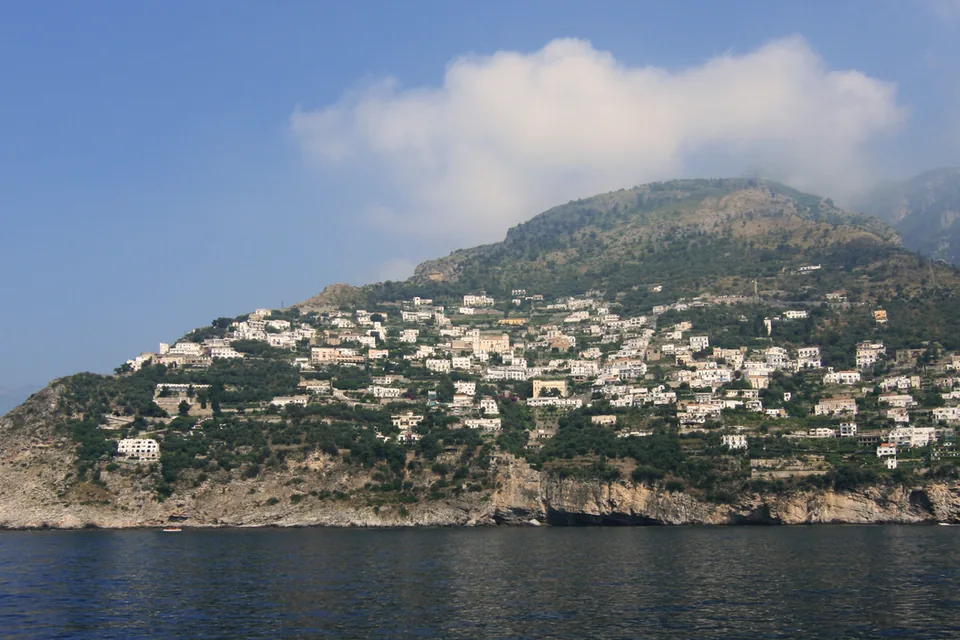
Praiano (SA), Campania: 1,940 residents, 2.74 km². The official facts of the municipality, its town council website and its registered accommodation.
Read the guide →Photo: Jensens / Wikimedia Commons — Public domain · Resized and converted to WebP.

Amalfi
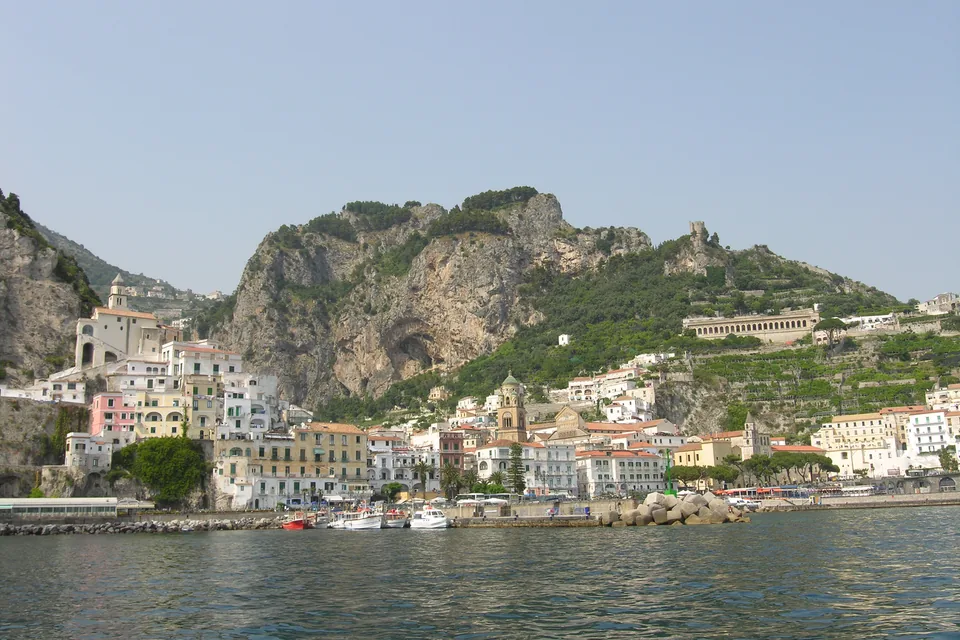
Amalfi (SA), Campania: 4,610 residents, 5.71 km². The official facts of the municipality, its town council website and its registered accommodation. The cathedral of Sant’Andrea and the Cloister of Paradise, the Arsenal of the maritime republic, the handmade paper of the Valle dei Mulini, the lemons of the terraces recognised by the FAO, the feast of the patron saint and the Regatta of the Ancient Maritime Republics.
Read the guide →Photo: Sudodana2048 / Wikimedia Commons — CC BY-SA 3.0 · Resized and converted to WebP.

Amalfi Coast
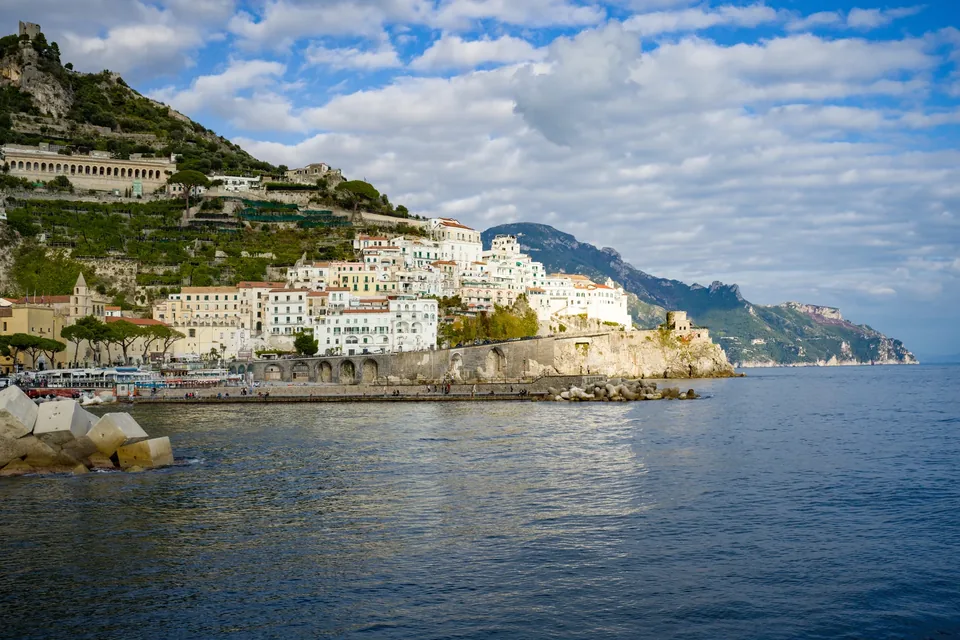
The UNESCO cultural landscape between Positano and Vietri sul Mare: citrus terraces, footpaths, inland valleys and the history of a maritime republic.
Read the guide →Photo: Wolfgang Moroder / Wikimedia Commons — CC BY-SA 3.0 · Resized and converted to WebP.

Agerola
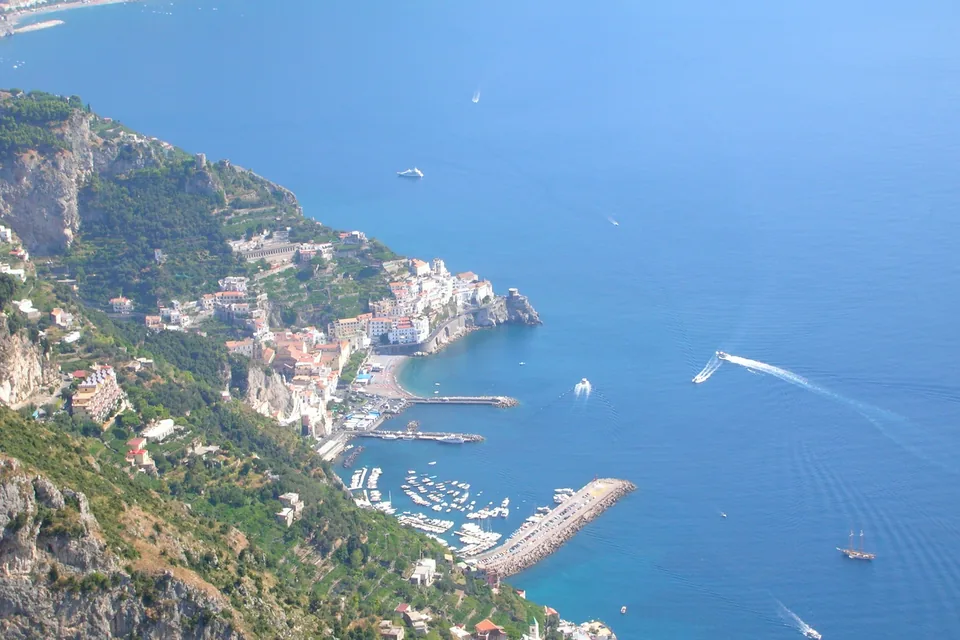
Agerola (NA), Campania: 7,760 residents, 19.83 km². The official facts of the municipality, its town council website and its registered accommodation.
Read the guide →Photo: Numenor / Wikimedia Commons — CC BY-SA 3.0 · Resized and converted to WebP.

Sorrento
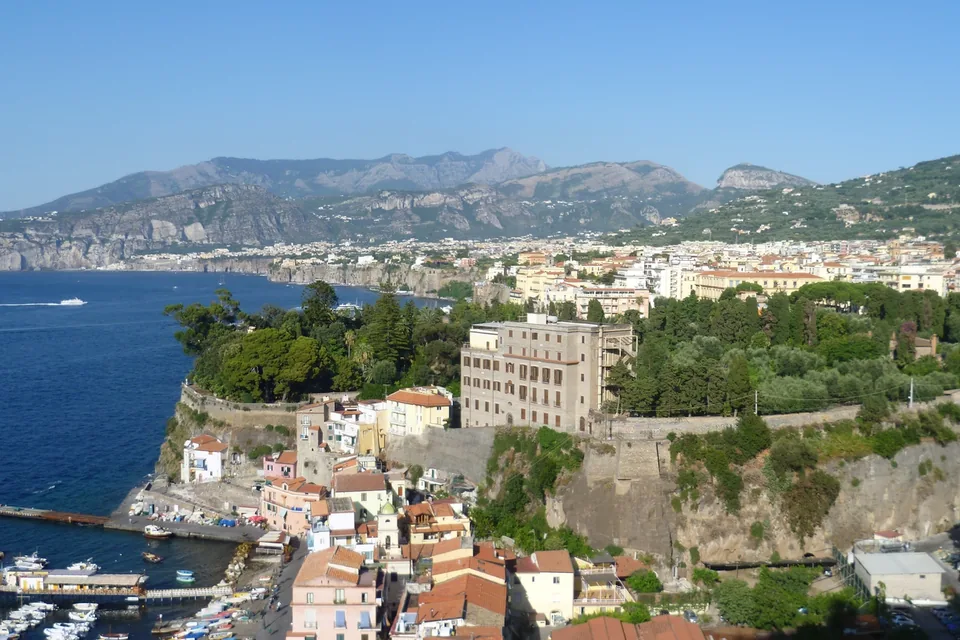
Sorrento (NA), Campania: 15,152 residents, 10.00 km². The official facts of the municipality, its town council website and its registered accommodation. The town on its tuff cliff, the old centre with the basilica of Sant’Antonino and the cloister of San Francesco, the Museo Correale, the Sorrento Lemon PGI, the marinas and the train from Naples.
Read the guide →Photo: Kim Traynor / Wikimedia Commons — CC BY-SA 3.0 · Resized and converted to WebP.

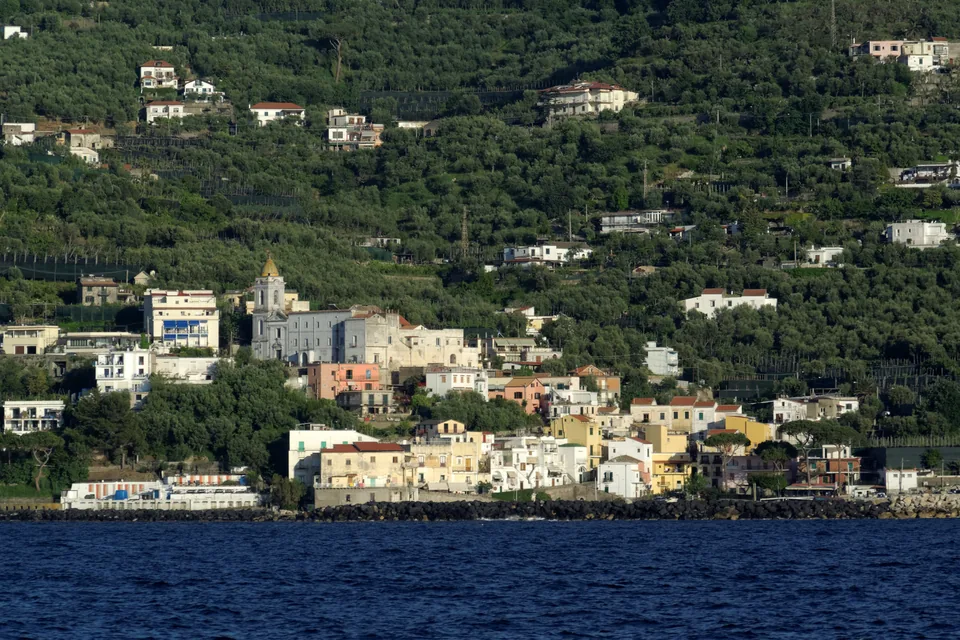
Massa Lubrense
Massa Lubrense (NA), Campania: 14,186 residents, 20.05 km². The official facts of the municipality, its town council website and its registered accommodation.
Read the guide →Photo: Berthold Werner / Wikimedia Commons — CC BY-SA 3.0 · Resized and converted to WebP.

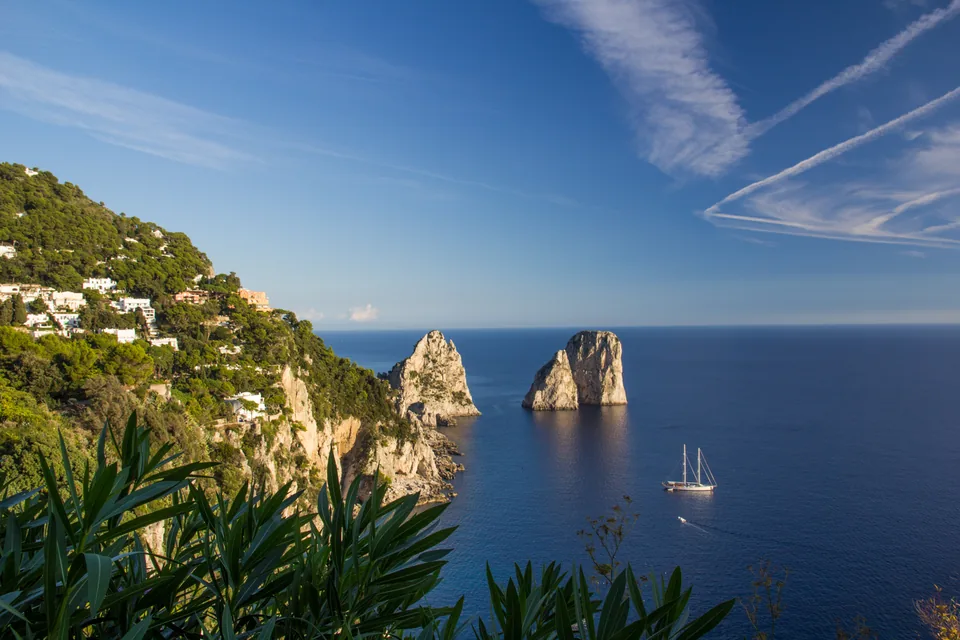
Capri
Capri (NA), Campania: 6,722 residents, 4.06 km². The official facts of the municipality, its town council website and its registered accommodation. The Faraglioni, the Piazzetta, the Gardens of Augustus and Via Krupp, the Certosa di San Giacomo with the Archaeological Museum, Tiberius’s Villa Jovis, Villa Lysis, and the island’s PGI lemon and DOC wine.
Read the guide →Photo: Marlis Börger / Wikimedia Commons — CC BY-SA 2.0 · Resized and converted to WebP.

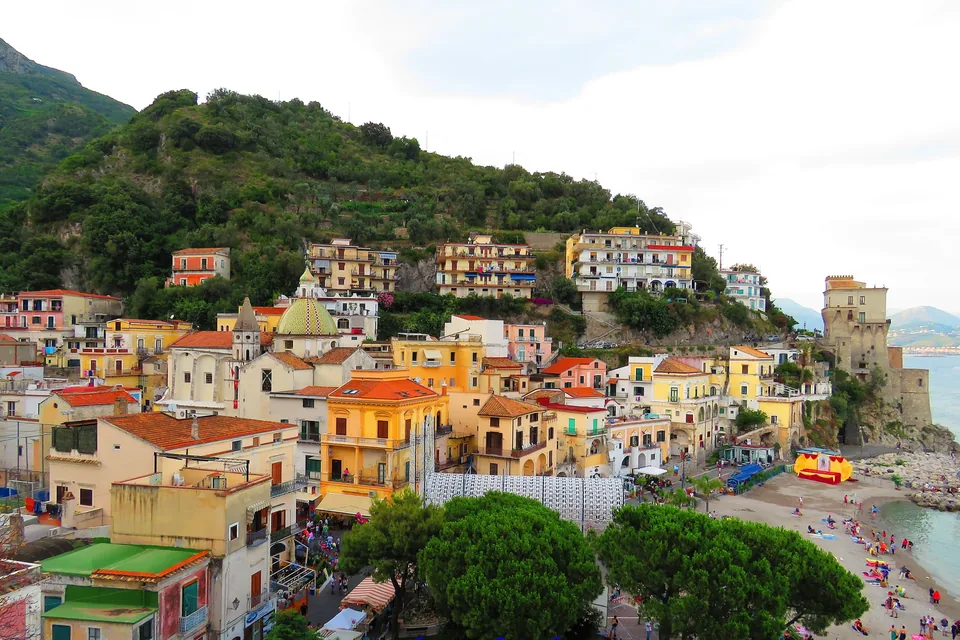
Cetara
Cetara (SA), Campania: 1,928 residents, 5.00 km². The official facts of the municipality, its town council website and its registered accommodation. The Viceregal tower on the Marina, the majolica dome of San Pietro, the Colatura di alici di Cetara PDO, tuna and anchovy fishing, the beaches and the footpaths of the Amalfi Coast.
Read the guide →Photo: Gianfranco Vitolo / Wikimedia Commons — CC BY 2.0 · Resized and converted to WebP.

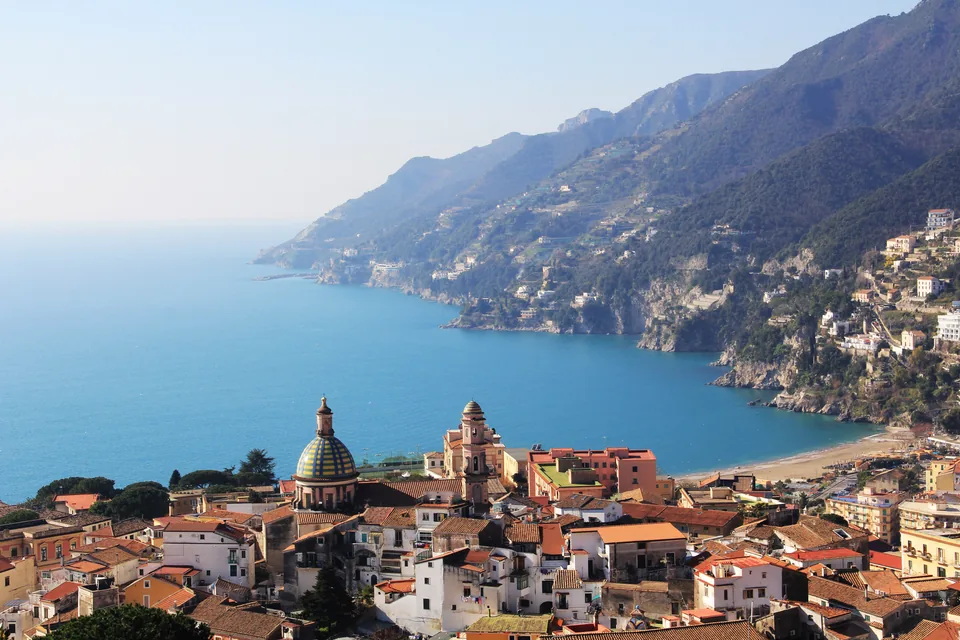
Vietri sul Mare
Vietri sul Mare (SA), Campania: 6,962 residents, 9.53 km². The official facts of the municipality, its town council website and its registered accommodation. Vietri ceramics, from the old faenzere workshops to today’s shops, the cathedral with its majolica dome, the Ceramics Museum at Villa Guariglia, Paolo Soleri’s Solimene factory, the Limone Costa d’Amalfi PGI lemon and the beaches of the Marina.
Read the guide →Photo: Anila amataj / Wikimedia Commons — CC BY-SA 4.0 · Resized and converted to WebP.
