

Why go
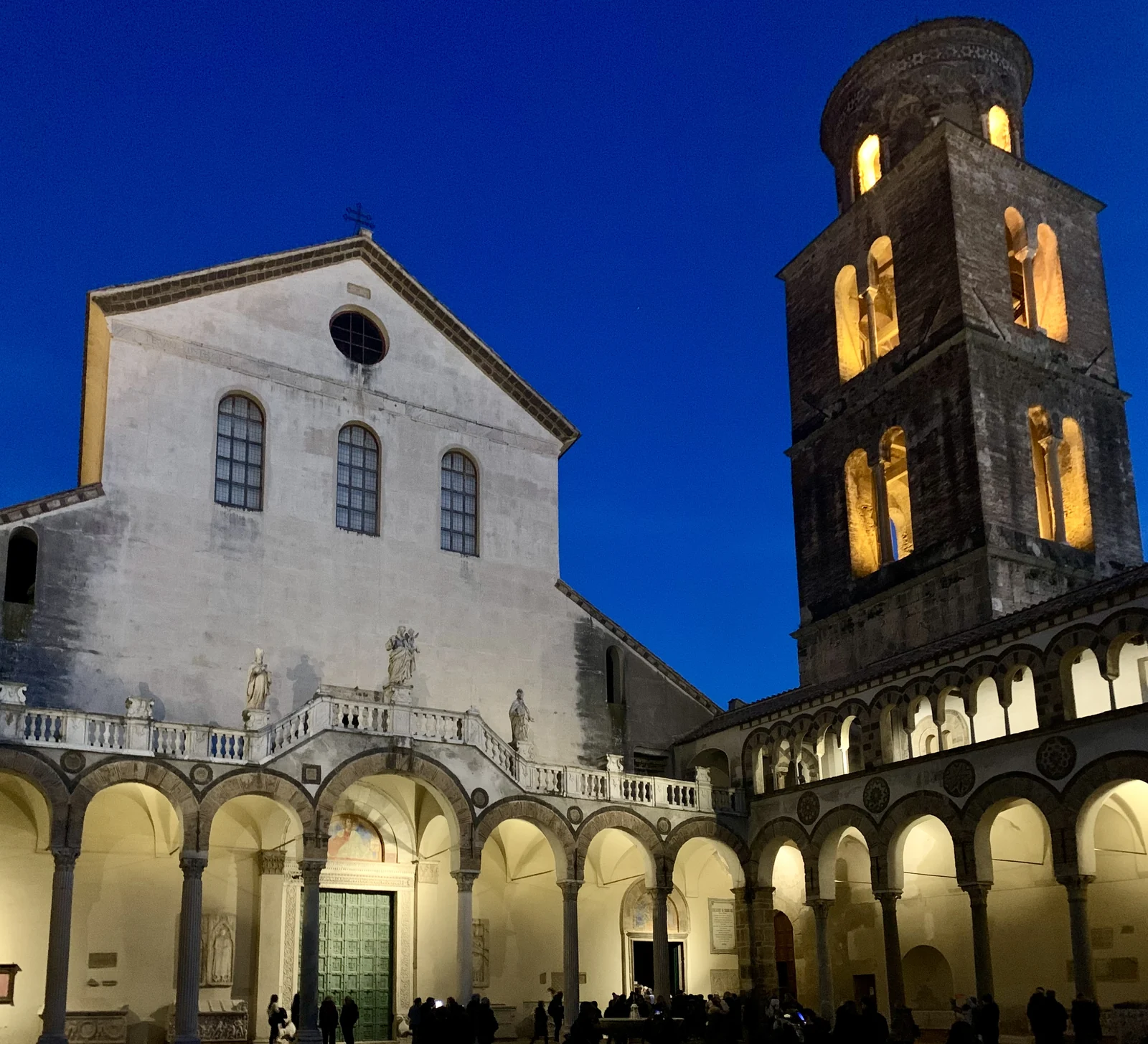
Salerno looks out over its gulf from a long strip of land between the mountains and the sea. High up, on the Bonadies hill, stands the Arechi castle; below it the old town, which keeps its medieval layout and, at its heart, the cathedral of Saint Matthew built by Robert Guiscard; in front, Lungomare Trieste, the seafront promenade from which you can see both shores of the gulf and the Amalfi Coast.
It is a city that has been a capital more than once. It was the court of the Lombard prince Arechi II, the capital of Robert Guiscard's Norman dominion, the seat of the Salerno medical school, which the municipality describes as the oldest institution in western Europe for the teaching of medicine, and in 1944, for five months, the seat of the government and the king. Its old name, "Hippocratica civitas", still appears under the coat of arms on the municipality's website.
Next to the old city there is a new one, grown along the waterfront: Zaha Hadid's maritime station, Piazza della Libertà with Ricardo Bofill's Crescent, the Santa Teresa beach terrace. And every winter, from early November to January, the Luci d'Artista light up streets, squares and gardens: the event which, the municipality writes, carried Salerno's name across Italy and the world.
Salerno is a municipality in the province of Salerno, in Campania. Its ISTAT code is 065116. It is the capital of the province of Salerno. On 1 January 2025 it had 126,000 residents. The municipal territory covers 60.12 km² and ranges from -15 to 947 metres above sea level; the town hall stands at about 10 metres.
Salerno is also a city of books. Horace, in one of his epistles, asks his friend Numonius Vala what the climate is like in Salerno; Boccaccio set three tales of the Decameron here, one of them about a physician, Mazzeo della Montagna, perhaps modelled on Matteo Silvatico; in the fifteenth century Masuccio Salernitano, in his Novellino, described it as a city of merchants and physicians, with the Drapparia that is today’s Via dei Mercanti. The poet Alfonso Gatto, the leading intellectual figure of twentieth-century Salerno, born in the Fornelle quarter, left the city a line that, the Comune writes, every Salernitan knows: «Salerno rima d’inverno», Salerno rhymes with winter.
Sources: Comune di Salerno, Salerno Cultura — Castello di Arechi · Comune di Salerno, Salerno Cultura — Cattedrale di San Matteo, Duomo di Salerno · Comune di Salerno, Salerno Cultura — Lungomare Trieste · Comune di Salerno, Salerno Cultura — Arechi e il suo palazzo · Comune di Salerno, Salerno Cultura — Il Guiscardo e l’assedio di Salerno · Comune di Salerno, Salerno Cultura — La storia della Scuola Medica Salernitana · Comune di Salerno, Salerno Cultura — Salerno capitale d’Italia · Comune di Salerno — Salerno Cultura, portale della cultura e del turismo della città · Comune di Salerno, Salerno Cultura — Stazione marittima · Comune di Salerno, Salerno Cultura — Crescent e Piazza della Libertà · Comune di Salerno, Salerno Cultura — Arenile di Santa Teresa · Comune di Salerno, Salerno Cultura — Luci d’Artista · Italia.it (Ministero del Turismo) — Salerno · Comune di Salerno, sito istituzionale · ISTAT, Codici statistici delle unità amministrative territoriali: elenco dei comuni al 21 febbraio 2026 · ISTAT, Popolazione residente per età, sesso e stato civile al 1° gennaio 2025 (POSAS) · ISTAT, Principali statistiche geografiche sui comuni: superficie e altimetria al 31 dicembre 2021 · Comune di Salerno, Salerno Cultura — Salerno nella letteratura · Comune di Salerno, Salerno Cultura — Masuccio Salernitano · Comune di Salerno, Salerno Cultura — Alfonso Gatto
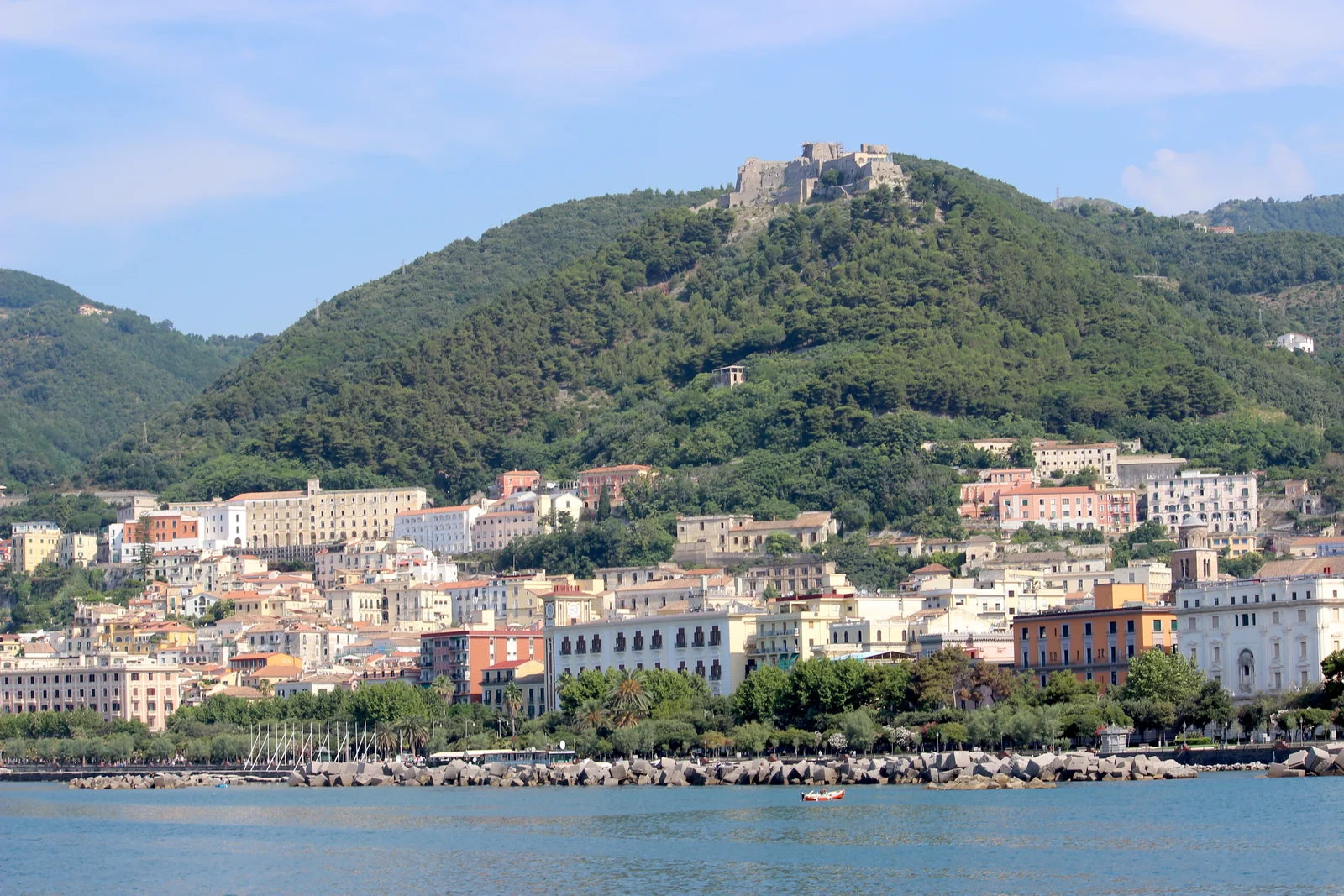
Photo: Miguel Hermoso Cuesta / Wikimedia Commons — CC BY-SA 4.0 · Resized and converted to WebP.
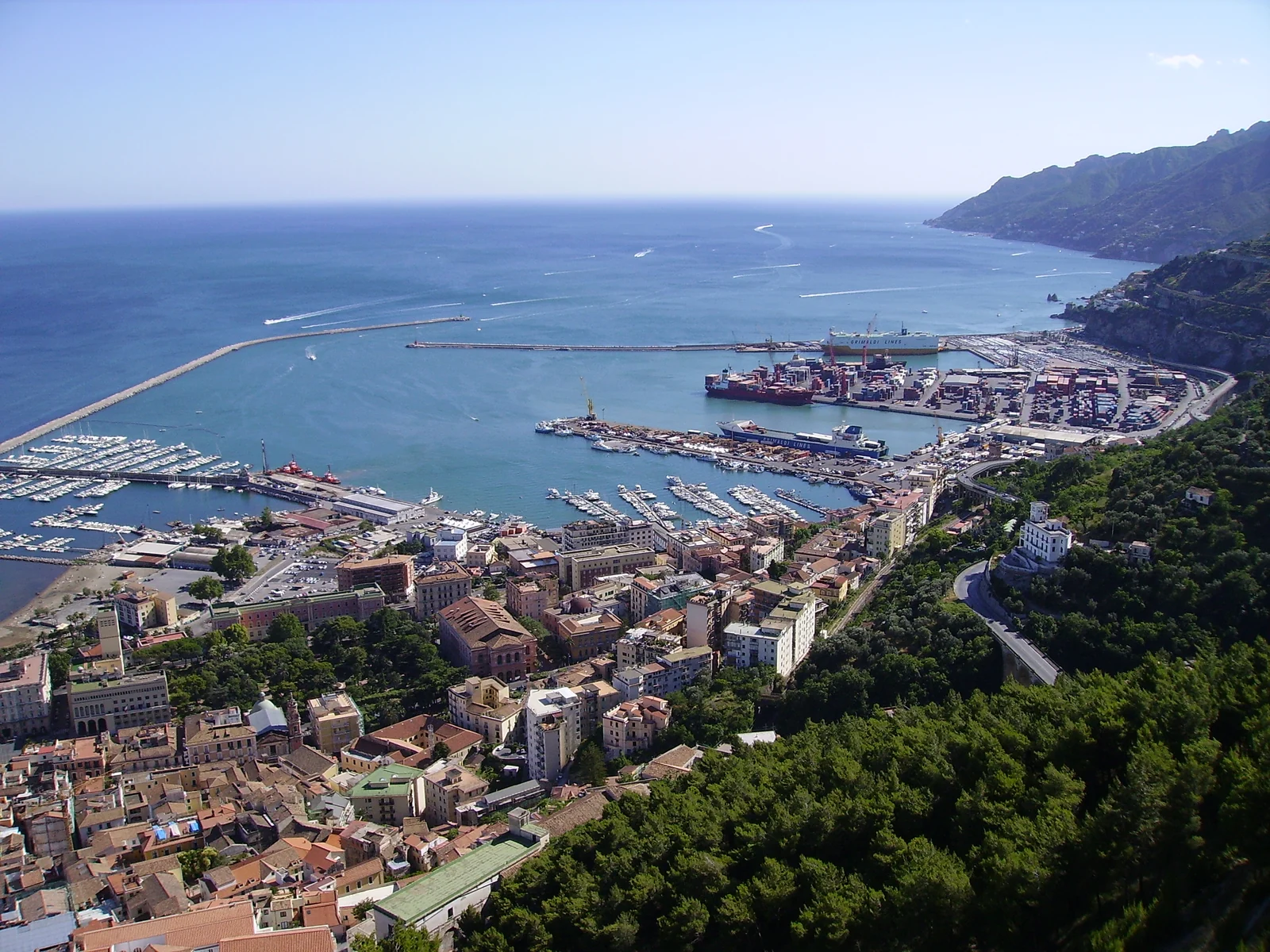
Photo: Mattatoio5 / Wikimedia Commons — Public domain · Resized and converted to WebP.
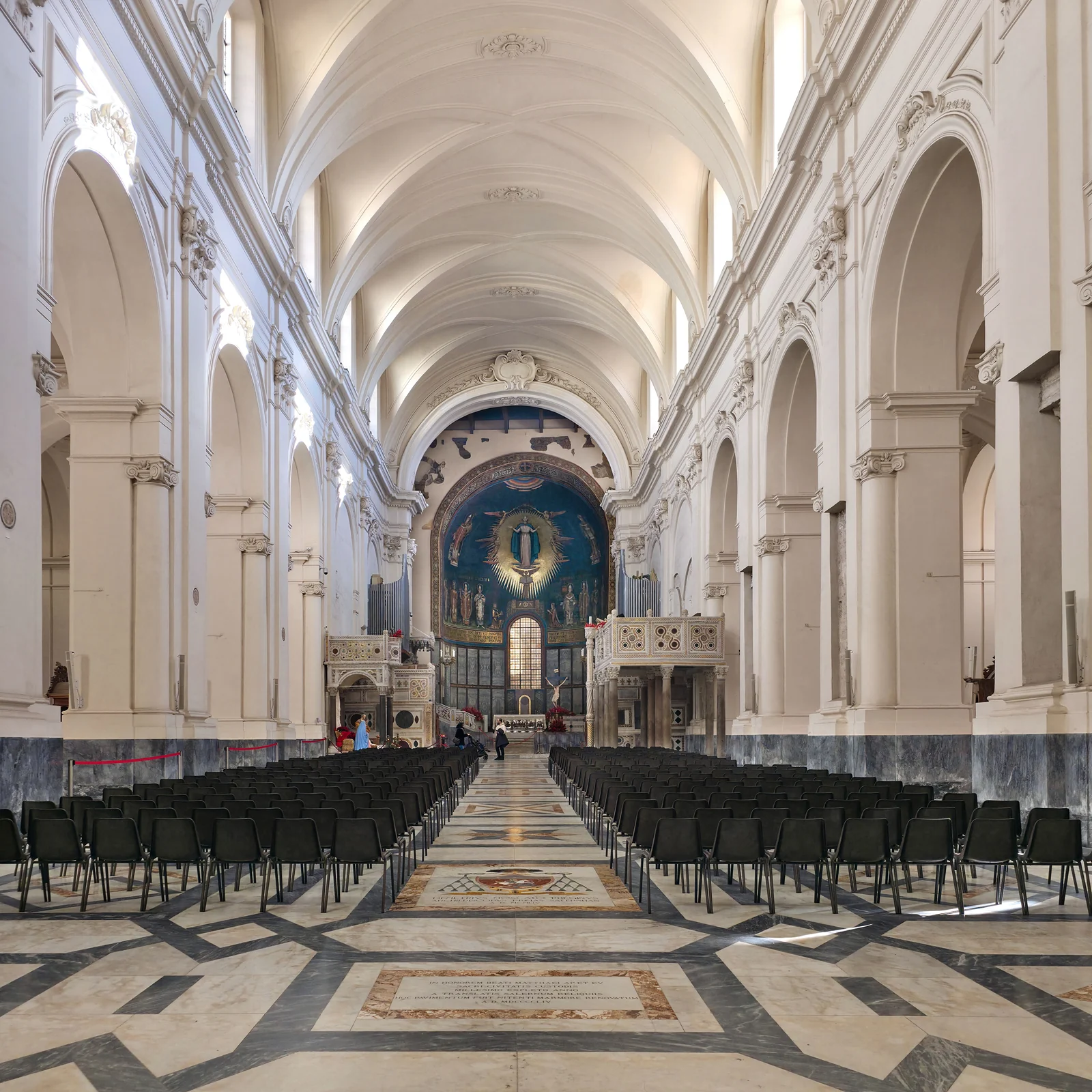
Photo: NateBergin / Wikimedia Commons — CC BY 4.0 · Resized and converted to WebP.
History
The area was settled very early. In the sixth century BC the Etruscans founded a town on the banks of the Irno, in today's Fratte district, which some scholars call Irna; at the end of the fifth century the Samnites arrived and stayed until the second half of the third. Salerno itself was founded as a Roman colony in 197 BC, on the road linking Capua with Reggio. The remains of the Roman town lie beneath the houses of the old centre: baths between Palazzo Fruscione and the Palatine Chapel, the forum probably under Piazza Abate Conforti, the sarcophagi reused in the cathedral atrium, and the bronze head of Apollo fished out of the gulf in 1930.
The first great leap came with the Lombards. In 774, after Pavia fell to Charlemagne, Duke Arechi II moved his court from Benevento to Salerno and proclaimed himself prince; he enlarged the castle on the hill, linked it to the sea with a ring of walls and built a palace with a chapel dedicated to Saints Peter and Paul. There, the municipality recounts, in 787 he received the ambassadors of Charlemagne, his brother-in-law, seated on his throne, asserting the autonomy of his principality.
In 1076 the city was taken by the Normans of Robert Guiscard after a long siege. Salerno became the capital of his dominion: Guiscard built the palace of Castel Terracena and the new cathedral for the relics of Saint Matthew, found in 954 and brought to Salerno by Prince Gisulf I; it was consecrated in 1084 by Pope Gregory VII, who had taken refuge in Salerno, where he died and is buried. In the same years the Salerno medical school lived its golden age: the monk Constantine the African brought Latin translations of Arabic and Greek texts, Frederick II regulated its studies in 1231, and Charles I of Anjou gave it the statute of a Studium generale in medicine in 1280. It closed in 1811, when Joachim Murat reserved the right to confer degrees to the University of Naples.
In the sixteenth century the court of the Sanseverino, princes of Salerno, made the city a centre for men of letters, among them Bernardo Tasso, and painters such as Andrea Sabatini; on 18 November 1535 the emperor Charles V passed through. After Prince Ferrante fled to France, the municipality writes, a long decline began. The nineteenth century brought the municipal theatre, opened in 1872, the Villa Comunale and, from 1920, the new seafront.
On 9 September 1943 the gulf was the scene of the Allied landing, Operation Avalanche, followed by ten days of fighting. From 11 February to 15 July 1944 Salerno was the seat of the government and the royal residence: two Badoglio governments and one led by Bonomi followed one another here, and here came the "Salerno turn", the agreement between the anti-fascist parties announced by Palmiro Togliatti. After the 1980 earthquake the old town was restored, and since the 1990s the city has redesigned its waterfront.
The coins still speak of the Lombard city: the follaro minted in Salerno bears the words «Opulenta Salerno», the city rich in trade. From that age survive the frescoes under Santa Maria de Lama and the church of Sant’Andrea de Lavina, founded in 806, with its frescoed crypt and Arab-style bell tower. Robert Guiscard married Sichelgaita, sister of the last Lombard prince, Gisulf II, and made Salerno the capital of the Duchy of Apulia and Calabria; Palazzo Fruscione, built in those years, is according to the Comune the only surviving example of Norman residential architecture.
The Medical School also had its women, the «mulieres salernitanae». The most famous, Trotula de Ruggiero, who lived in the eleventh century, was a teacher and the author of works on gynaecology and obstetrics, such as De passionibus mulierum, used as handbooks until the sixteenth century, and of a treatise on women’s beauty, De ornatu mulierum. Two centuries later Matteo Silvatico (1245-1342), physician to Robert of Anjou, wrote the Opus Pandectarum Medicinae on medicinal herbs and founded the garden that became the Giardino della Minerva. In the two chapels of Saint Catherine, inside the cathedral, used for teaching in the twelfth and thirteenth centuries, Thomas Aquinas taught theology between 1259 and 1273.
The Salerno physician Giovanni da Procida (1210-1298), who served Frederick II and then Manfred, enlarged the harbour with the pier that still bears that king’s name and created the Fair of Saint Matthew: for centuries merchants from northern Europe and Africa, from Amalfi, Genoa and Venice came to the plain outside the walls between Porta Nova and the slopes of the Carmine, and in the seventeenth century Lo cunto de li cunti mentions it. In 1752 Charles III of Bourbon had a wall and a new quay built on the Molo Manfredi; today the commercial port has three piers.
Sources: Comune di Salerno, Salerno Cultura — Area archeologica etrusco-sannitica di Fratte · Comune di Salerno, Salerno Cultura — La fondazione e i secoli romani · Comune di Salerno, Salerno Cultura — Palazzo Fruscione · Comune di Salerno, Salerno Cultura — Museo archeologico provinciale · Comune di Salerno, Salerno Cultura — Complesso monumentale di San Pietro a Corte · Comune di Salerno, Salerno Cultura — Castello di Arechi · Comune di Salerno, Salerno Cultura — Arechi e il suo palazzo · Comune di Salerno, Salerno Cultura — Il Guiscardo e l’assedio di Salerno · Comune di Salerno, Salerno Cultura — San Matteo: cuore e identità di Salerno · Comune di Salerno, Salerno Cultura — Cattedrale di San Matteo, Duomo di Salerno · Comune di Salerno, Salerno Cultura — Museo virtuale della Scuola medica salernitana · Comune di Salerno, Salerno Cultura — La storia della Scuola Medica Salernitana · Comune di Salerno, Salerno Cultura — Carlo V a Salerno · Comune di Salerno, Salerno Cultura — Teatro Municipale Giuseppe Verdi · Comune di Salerno, Salerno Cultura — Villa Comunale · Comune di Salerno, Salerno Cultura — Lungomare Trieste · Comune di Salerno, Salerno Cultura — Salerno capitale d’Italia · Italia.it (Ministero del Turismo) — Salerno · Comune di Salerno, Salerno Cultura — Crescent e Piazza della Libertà · Comune di Salerno, Salerno Cultura — Itinerario Salerno longobarda · Comune di Salerno, Salerno Cultura — Largo Campo · Comune di Salerno, Salerno Cultura — Itinerario Salerno normanna · Comune di Salerno, Salerno Cultura — Trotula de Ruggiero · Comune di Salerno, Salerno Cultura — Matteo Silvatico · Comune di Salerno, Salerno Cultura — Giovanni da Procida · Comune di Salerno, Salerno Cultura — Piazza Portanova e la Rotonda · Comune di Salerno — Porto commerciale, Molo Manfredi
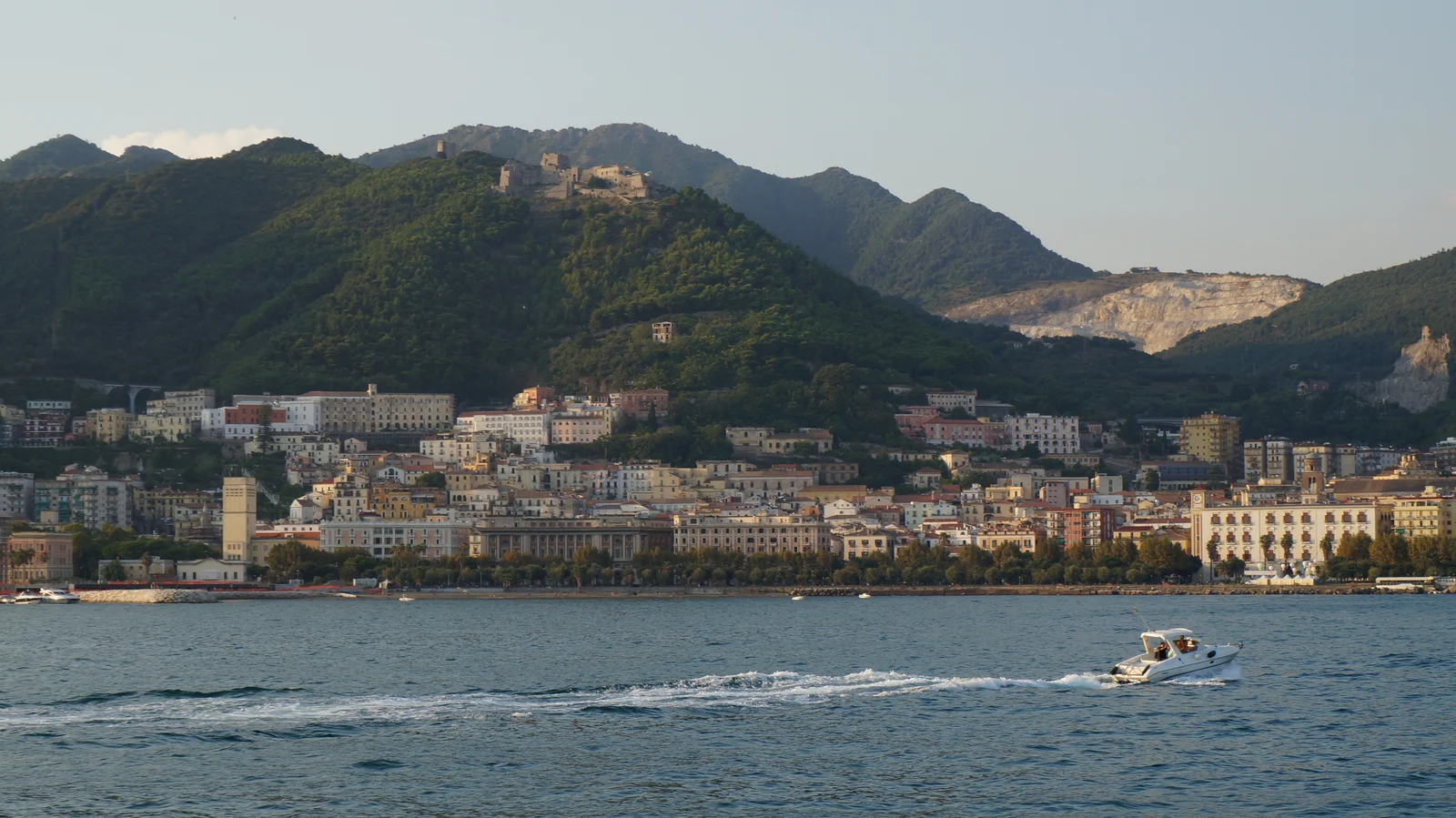
Photo: Leandro Neumann Ciuffo / Wikimedia Commons — CC BY 2.0 · Resized and converted to WebP.
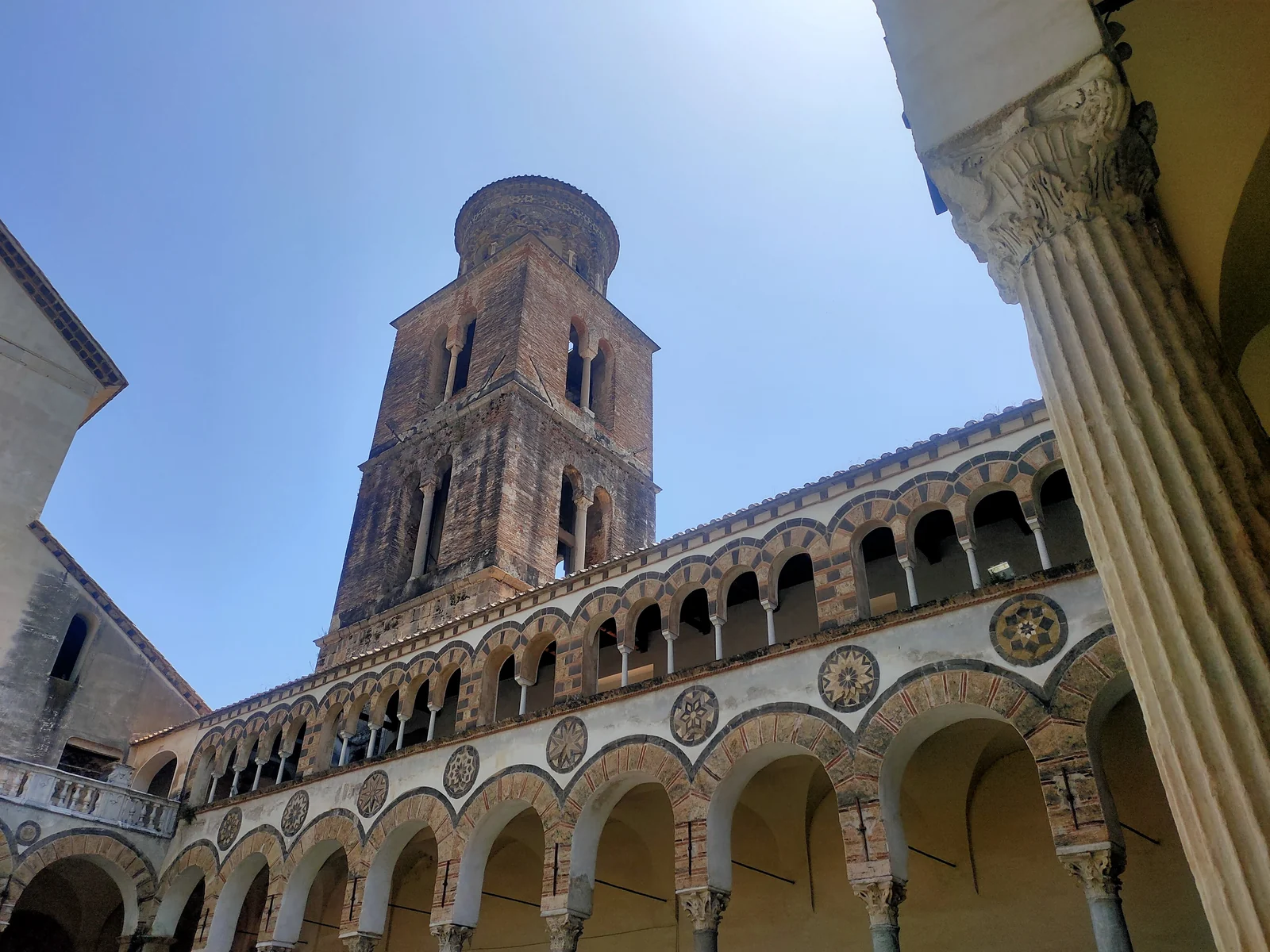
Photo: Whihazel / Wikimedia Commons — CC BY-SA 4.0 · Resized and converted to WebP.
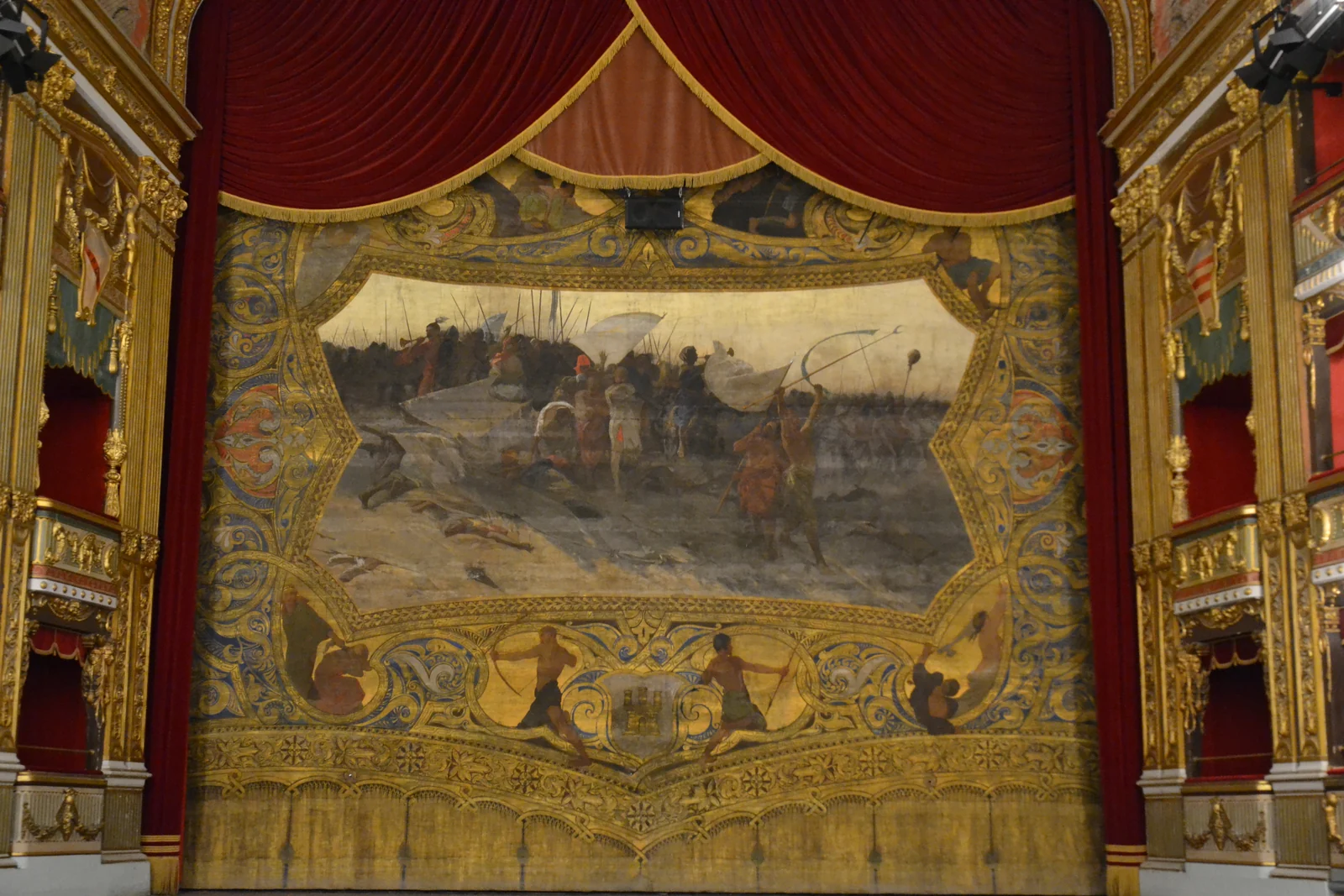
Photo: Jack45 / Wikimedia Commons — CC BY 3.0 · Resized and converted to WebP.
What to see
The first stop is the Duomo, the cathedral of Saint Matthew. You climb a double flight of steps, pass the Lions' Gate and enter the four-sided portico of 28 reused columns, with raised Islamic-style arches, reused Roman sarcophagi and the Norman bell tower commissioned by Archbishop William of Ravenna between 1137 and 1152. Inside are a Byzantine bronze door, the two medieval pulpits of the twelfth and thirteenth centuries and the tomb of Queen Margaret of Durazzo, carved by Antonio Baboccio in the early fifteenth century; below lies the seventeenth-century crypt by the Fontana brothers, with Michelangelo Naccherino's two-faced statue of Saint Matthew (1606) above the saint's tomb. The cathedral, the Diocesan Museum and the church of San Giorgio, on Via Duomo, Salerno's finest Baroque church according to the municipality, with frescoes by the Solimena and a panel by Andrea Sabatini, make up the Salerno Sacra itinerary, with tickets for one or more sites.
In the archbishop's seminary, the last seat of the medical school, the Diocesan Museum holds the Salerno ivories, 64 panels from the late eleventh and early twelfth century, the largest collection of ivories of the Christian Middle Ages according to the municipality, the thirteenth-century Exultet and the crucifix known as Barliario's. In the old centre stands the San Pietro a Corte complex, with Arechi II's palatine chapel above Roman baths; since 4 November 2026 the hypogeum and the chapel of Sant'Anna have been temporarily closed for safety work, while the palatine chapel remains on the Salerno Sacra itinerary. Along Via dei Mercanti, Palazzo Pinto houses the Provincial Picture Gallery, from Sabatini and the Solimena to the foreign painters of the Amalfi Coast; a few steps away, the Provincial Archaeological Museum, in the old San Benedetto complex, shows the bronze head of Apollo. Admission to the picture gallery and the archaeological museum is free. Nearby, the arches of the medieval aqueduct, known as the "Devil's Bridges", are among the city's symbols.
Higher up, the Minerva Garden is what remains of the herb garden of Matteo Silvatico, a master of the medical school, which the municipality presents as the first botanical garden of the western world: terraces with pools and fountains, a seventeenth-century stairway, more than 300 plant species and a viewpoint over the harbour. Higher still, at about 300 metres, the Arechi castle, of Byzantine origin, keeps its tower, the Bastiglia and, since 2009, a museum with the pottery and glass found in excavations.
On the waterfront, the Teatro Verdi, opened in 1872 with Rigoletto, reproduces on a smaller scale the plan of the San Carlo in Naples, with four tiers of boxes, a ceiling with Rossini and the Muses and the curtain of the Expulsion of the Saracens designed by Domenico Morelli. Next to it are the Villa Comunale, with the Aesculapius fountain of 1790, Piazza della Libertà with the Crescent and Zaha Hadid's maritime station on the Manfredi pier, clad in ceramic tiles that light up at night.
In the crypt of the Duomo, renewed in Baroque style after the earthquake of 1688, the vault was frescoed by Belisario Corenzio (1611) with scenes from the life of Jesus, and the central apse was the chapel of the Medical School, whose eighteenth-century altar survives. From the street, to the right of the entrance, you enter the two chapels of Saint Catherine: the lower one, the Sala San Lazzaro, has housed since 1982 Mario Carotenuto’s Museum of the Painted Nativity, 87 life-size figures painted in acrylic on plywood, with the faces of people from the quarter and, among the figures added over the years, that of Alfonso Gatto.
Largo Campo, Piazza Sedile del Campo, where the Romans held the grain market, is the centre of the old town: the seventeenth-century Dolphin Fountain, wrongly attributed to Vanvitelli, Palazzo Bottiglieri with its tufa doorway and the Baroque Palazzo Genovese, now used for exhibitions. Next to it is Vicolo delle Galesse, where Alfonso Gatto was born, and beyond begins the Fornelle quarter, founded in the ninth century and perhaps named after its ceramic kilns: since 2014 the «Muri d’autore» project, dedicated to Gatto, has covered its walls with murals, poems and portraits, from Pino Daniele to Totò and Massimo Troisi. Jorit’s portrait of Trotula de Ruggiero is in Via Vinciprova.
To the east, Piazza Portanova opens the old town between Via dei Mercanti and Corso Vittorio Emanuele, the shopping streets: the gate, rebuilt in 1754 by master Ragozzino, is topped by Francesco Pagano’s statue of Saint Matthew and leads into Piazza Flavio Gioia, known as the Rotonda. Between the Archaeological Museum and the Duomo stand the towers of Castel Terracena, the Norman palace built by Guiscard between 1076 and 1080, decorated with inlays of yellow and grey tufa. The church of the Santissimo Crocifisso, from the tenth or eleventh century, with its Romanesque wall on Via dei Mercanti, stands over a crypt officially discovered in 1950, perhaps from the eighth century, with a Crucifixion fresco of the thirteenth or fourteenth century.
The church takes its name from the legend of the magician Pietro Barliario, a twelfth-century alchemist. He is said to have built the aqueduct of the «Devil’s Bridges» in one night with the help of a thousand devils, and the devils, fleeing at the crow of a surviving cockerel, threw two boulders into the sea, the islets of Li Galli off Positano; repentant, Barliario prayed before a crucifix that bowed its head in forgiveness, and the church was built for that miracle.
Two museums tell other stories of the city. The Roberto Papi Museum of medicine and surgery, opened in 2009 in Palazzo Galdieri on Via Trotula de Ruggiero, shows instruments from the seventeenth to the twentieth century on two floors and fourteen rooms, with a reconstructed sixteenth-century pharmacy and a First World War field hospital. On the hill of Rufoli, in the district of Ogliara, the Città Creativa Museum, founded in 1997 near the old kilns of the De Martino brothers, documents ceramics, with more than a hundred terracotta tiles decorated in 2003, for the Cartoons on the Bay festival, by film-makers and illustrators including Bruno Bozzetto.
Sources: Comune di Salerno, Salerno Cultura — Cattedrale di San Matteo, Duomo di Salerno · Salerno Sacra, itinerario della Cattedrale — Orari visita e regolamento · Salerno Sacra, itinerario della Cattedrale — Tariffe e riduzioni · Comune di Salerno, Salerno Cultura — Chiesa di San Giorgio · Comune di Salerno, Salerno Cultura — Museo diocesano San Matteo · Comune di Salerno, Salerno Cultura — Complesso monumentale di San Pietro a Corte · Comune di Salerno, Salerno Cultura — Pinacoteca provinciale · Comune di Salerno, Salerno Cultura — Museo archeologico provinciale · Comune di Salerno, Salerno Cultura — Acquedotto medievale · Comune di Salerno, Salerno Cultura — Giardino della Minerva · Giardino della Minerva — sito ufficiale (orari e biglietti) · Comune di Salerno, Salerno Cultura — Castello di Arechi · Comune di Salerno, Salerno Cultura — Teatro Municipale Giuseppe Verdi · Comune di Salerno, Salerno Cultura — Villa Comunale · Comune di Salerno, Salerno Cultura — Crescent e Piazza della Libertà · Comune di Salerno, Salerno Cultura — Stazione marittima · Comune di Salerno, Salerno Cultura — Museo del presepe dipinto · Comune di Salerno, Salerno Cultura — Largo Campo · Comune di Salerno, Salerno Cultura — Itinerario Street art alle Fornelle · Comune di Salerno, Salerno Cultura — Trotula de Ruggiero · Comune di Salerno, Salerno Cultura — Piazza Portanova e la Rotonda · Comune di Salerno, Salerno Cultura — Castel Terracena · Comune di Salerno, Salerno Cultura — Chiesa del SS. Crocifisso · Comune di Salerno, Salerno Cultura — Il mago Barliario · Comune di Salerno, Salerno Cultura — Museo Roberto Papi · Comune di Salerno, Salerno Cultura — Museo Città Creativa
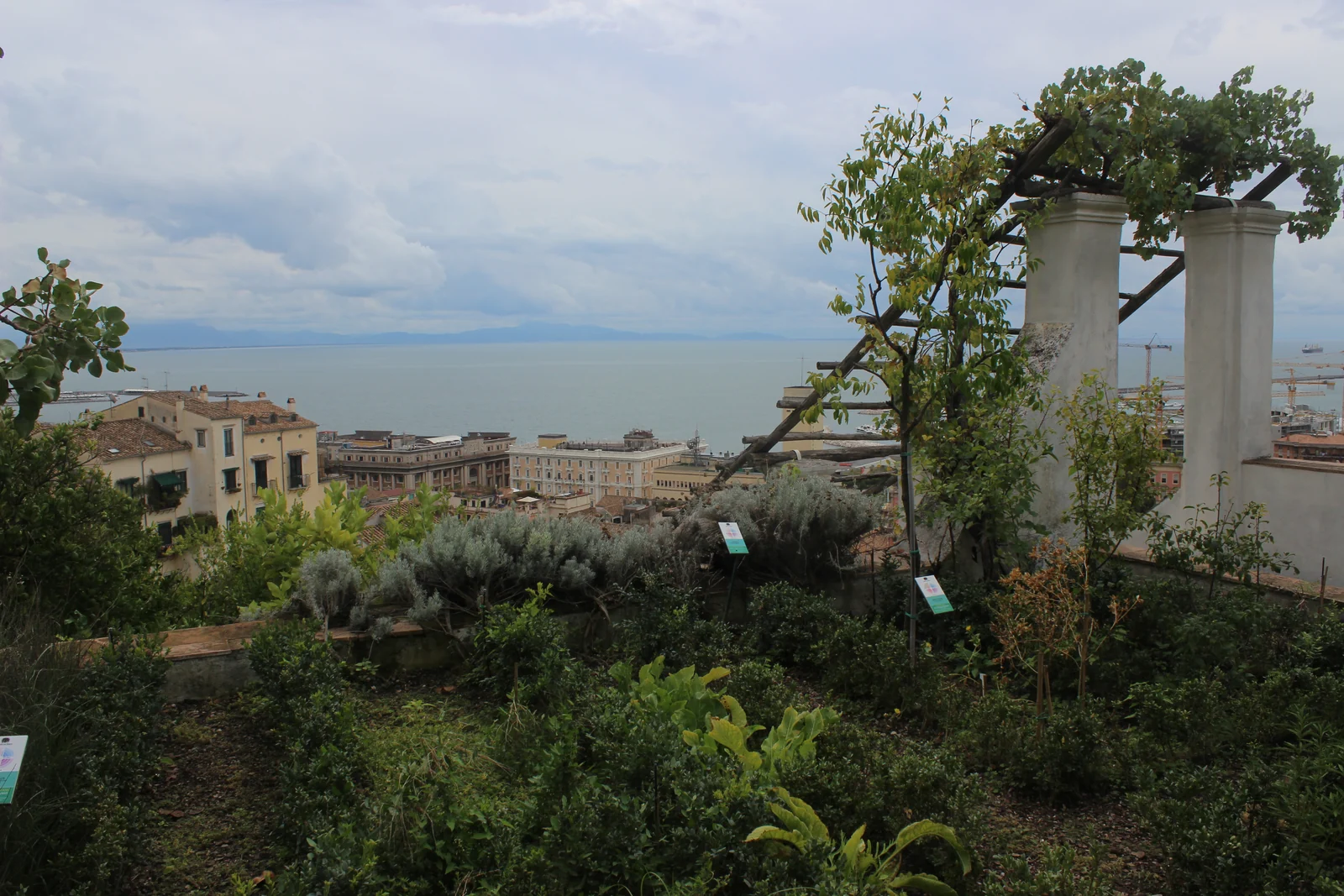
Photo: Miguel Hermoso Cuesta / Wikimedia Commons — CC BY-SA 4.0 · Resized and converted to WebP.
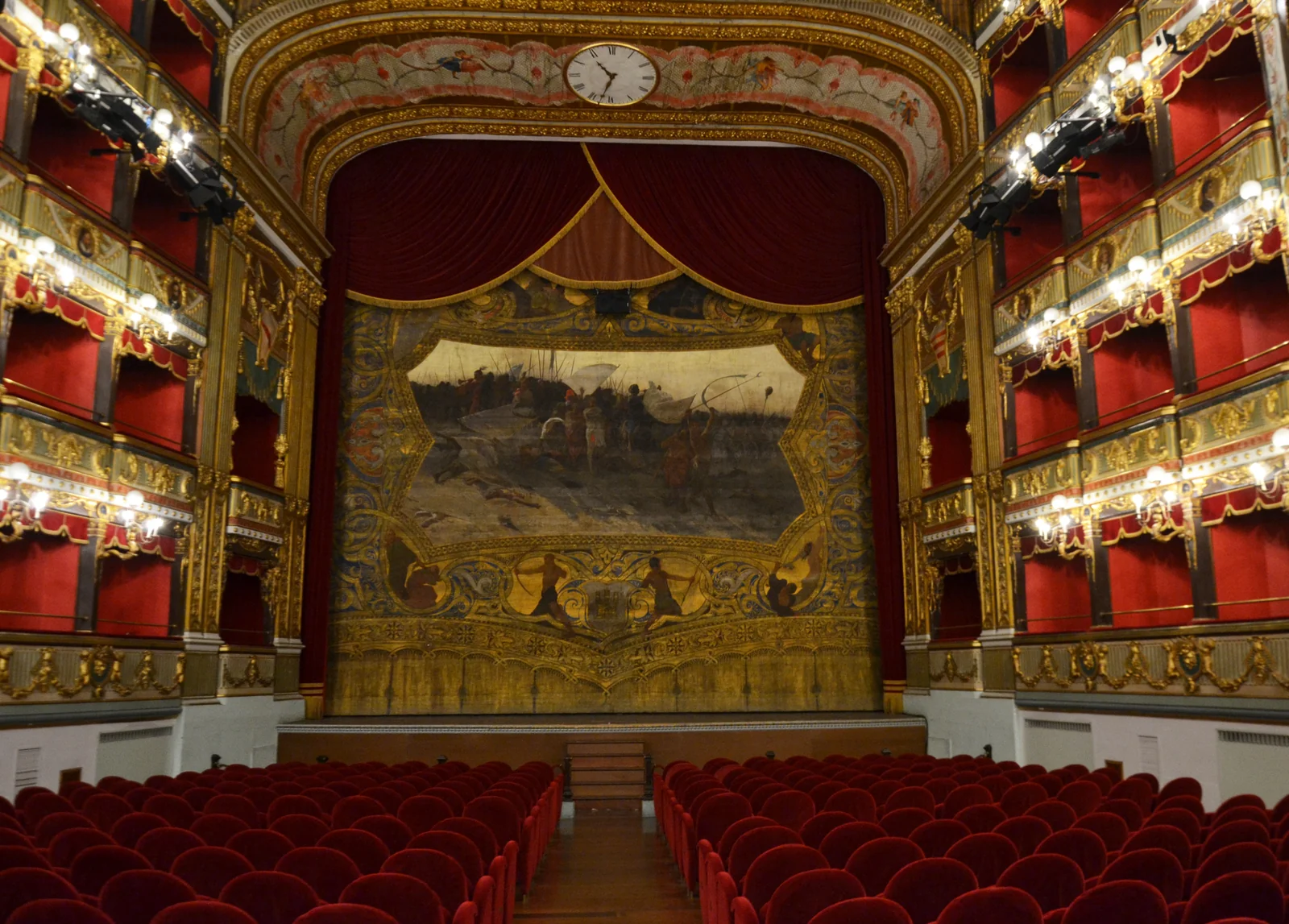
Photo: Jack45 / Wikimedia Commons — CC BY 3.0 · Resized and converted to WebP.
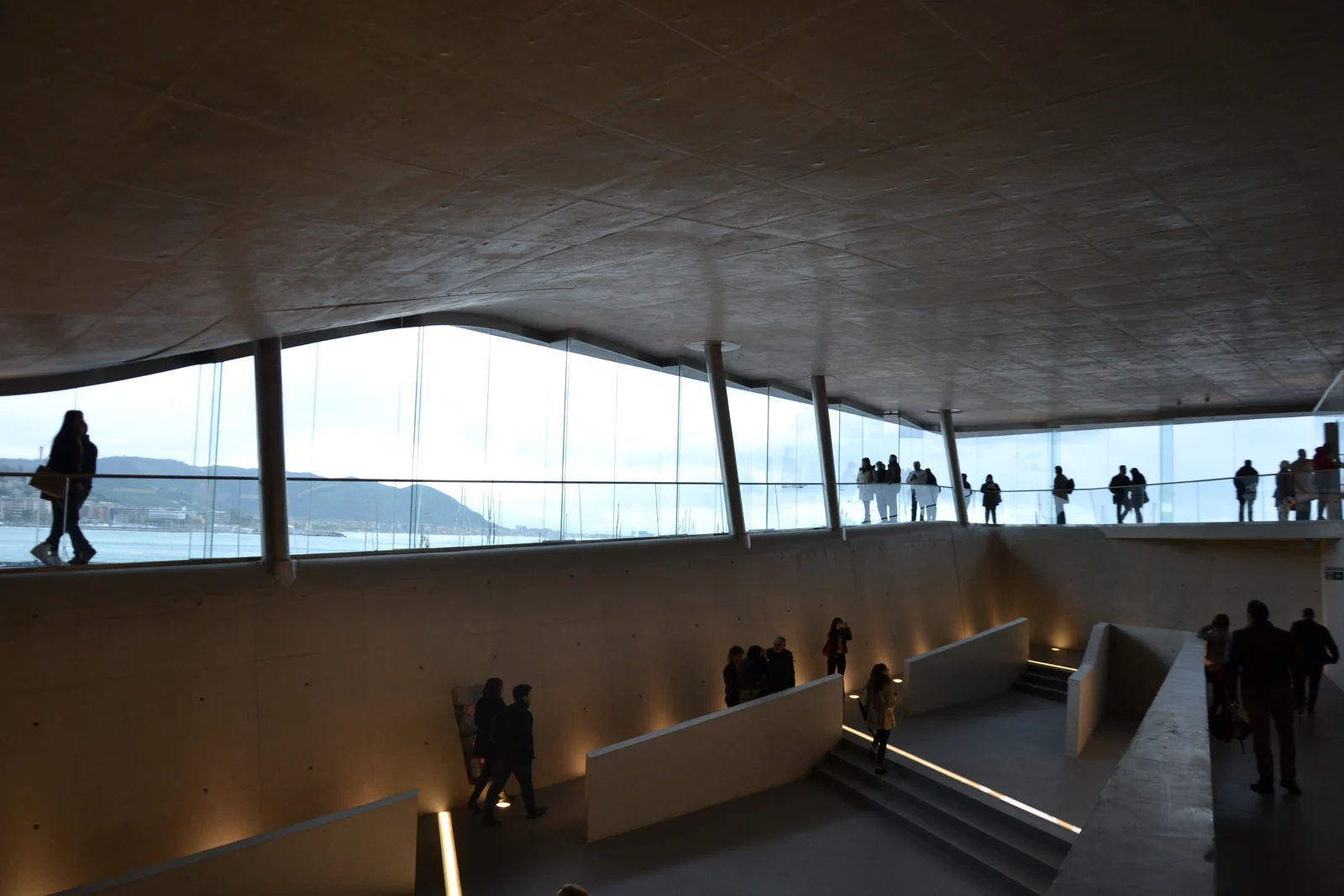
Photo: Jack45 / Wikimedia Commons — CC BY 3.0 · Resized and converted to WebP.
Flavours
Salerno's cooking is of the sea and of feast days. The dish the municipality presents as typically Salernitan is milza imbottita: ox or veal spleen stuffed with parsley, garlic, mint and chilli, cooked in oil and vinegar and served cold, in slices, in bread soaked with its own sauce. You can still find it, the municipality writes, in taverns and at the stalls of popular festivals.
The memory of the Christmas table belongs to salt cod and anchovies, the oily fish that fed generations, alongside colatura, the anchovy sauce. Among the festive sweets are mostaccioli and roccocò, but the one the municipality names as the city's true signature is the raffaiolo, a small glazed cake filled with ricotta.
In its food and wine section the municipality's portal also gathers the products of the province: buffalo mozzarella and ricotta from Campania, Cetara anchovy colatura, Amalfi Coast lemons, the white figs of the Cilento, Giffoni hazelnuts, oil from the Colline Salernitane and the Costa d'Amalfi, Cilento and Castel San Lorenzo wines, together with the Mediterranean diet.
On Saint Matthew's day, 21 September, the feast goes on after the procession among the smells of local dishes, and in May the Crucifix Fair fills the Carmine quarter and the old centre with stalls.
Among the traditional products registered by the Regione Campania is the roccocò, the hard Christmas biscuit of almonds and candied peel, shaped like a flattened ring, whose name recalls an «artificial rock»: it is on Campanian tables from Advent through the holidays and is also eaten dipped in fortified wine. Younger is the delizia al limone, created in the 1970s on the Sorrento and Amalfi coasts: a sponge cake filled and covered with lemon cream and whipped cream, to be eaten very fresh, as it keeps no longer than three hours.
Colatura di alici di Cetara, the anchovy essence, is a PDO product. The anchovies are caught in spring in the sea off the province of Salerno and layered with salt in a small barrel, the terzigno; the liquid that rises is matured in the sun for four or five months until, between late October and early November, it is poured back through the fish. Every stage of production must take place in the municipalities of the province of Salerno; in Cetara it dresses the spaghetti of the Christmas vigils.
Carnival in Salerno begins on 17 January with the bonfires of Sant’Antuono, Saint Anthony the Abbot, and ends at the table on Shrove Tuesday with lasagna layered with meatballs, boiled eggs, salami and pork ragù. In September the Crescent and Piazza della Libertà host Cibo&Dintorni, an international food fair, which reached its fifteenth edition in 2026.
Sources: Comune di Salerno, Salerno Cultura — La milza imbottita · Comune di Salerno, Salerno Cultura — Il Natale nel piatto: tra baccalà e raffaioli · Comune di Salerno, Salerno Cultura — Enogastronomia · Comune di Salerno, Salerno Cultura — San Matteo: cuore e identità di Salerno · Comune di Salerno, Salerno Cultura — La Fiera del Crocifisso: il Medioevo che ritorna · Regione Campania, Assessorato all’Agricoltura — Prodotti tradizionali: roccocò · Regione Campania, Assessorato all’Agricoltura — Prodotti tradizionali: delizia al limone · Regione Campania, Assessorato all’Agricoltura — Colatura di alici di Cetara DOP · Comune di Salerno, Salerno Cultura — Sant’Antuono e il Carnevale: fuoco, farina e lasagna · Comune di Salerno, Salerno Cultura — Cibo&Dintorni, XV edizione
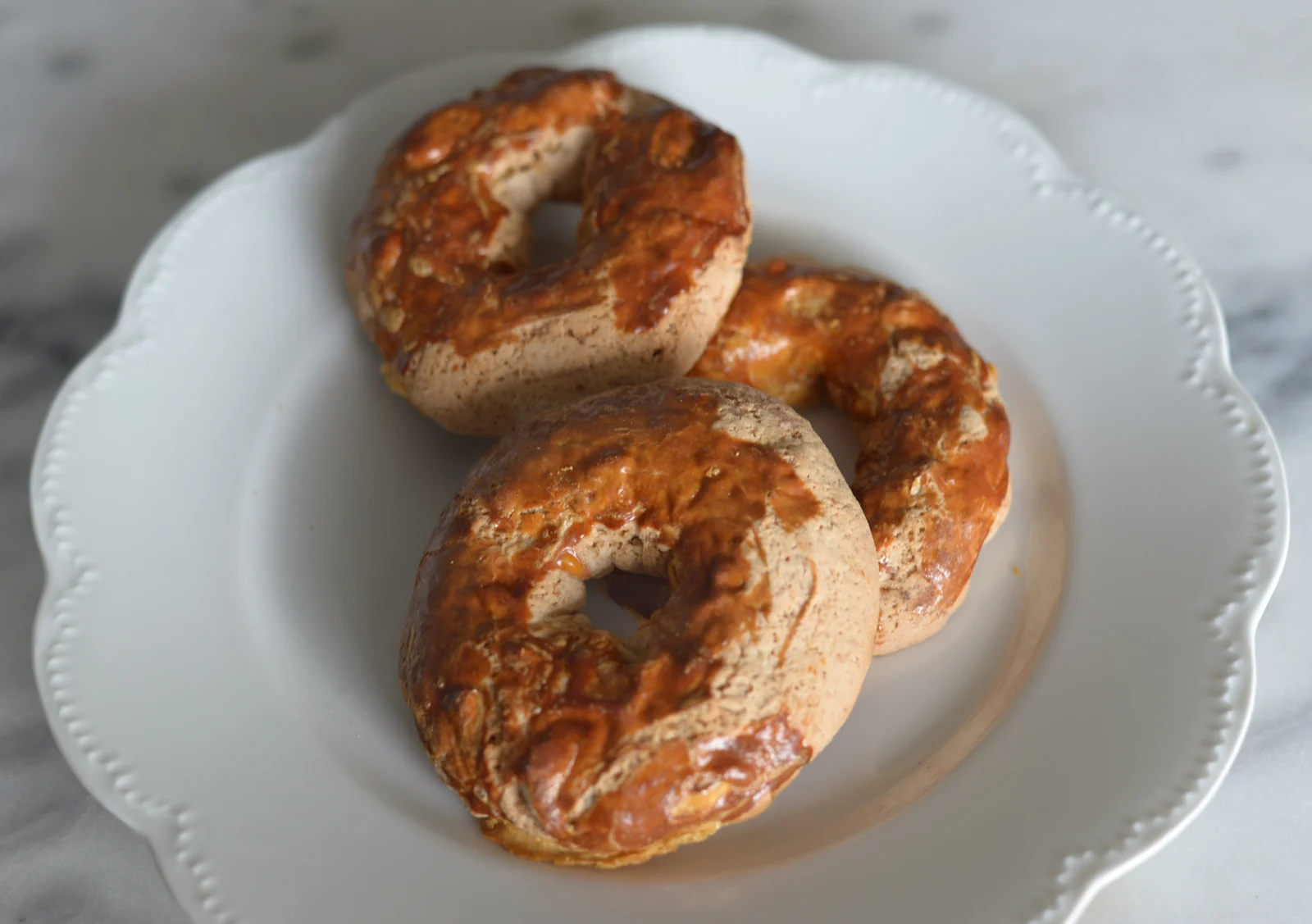
Photo: Ruthven / Wikimedia Commons — CC0 · Resized and converted to WebP.
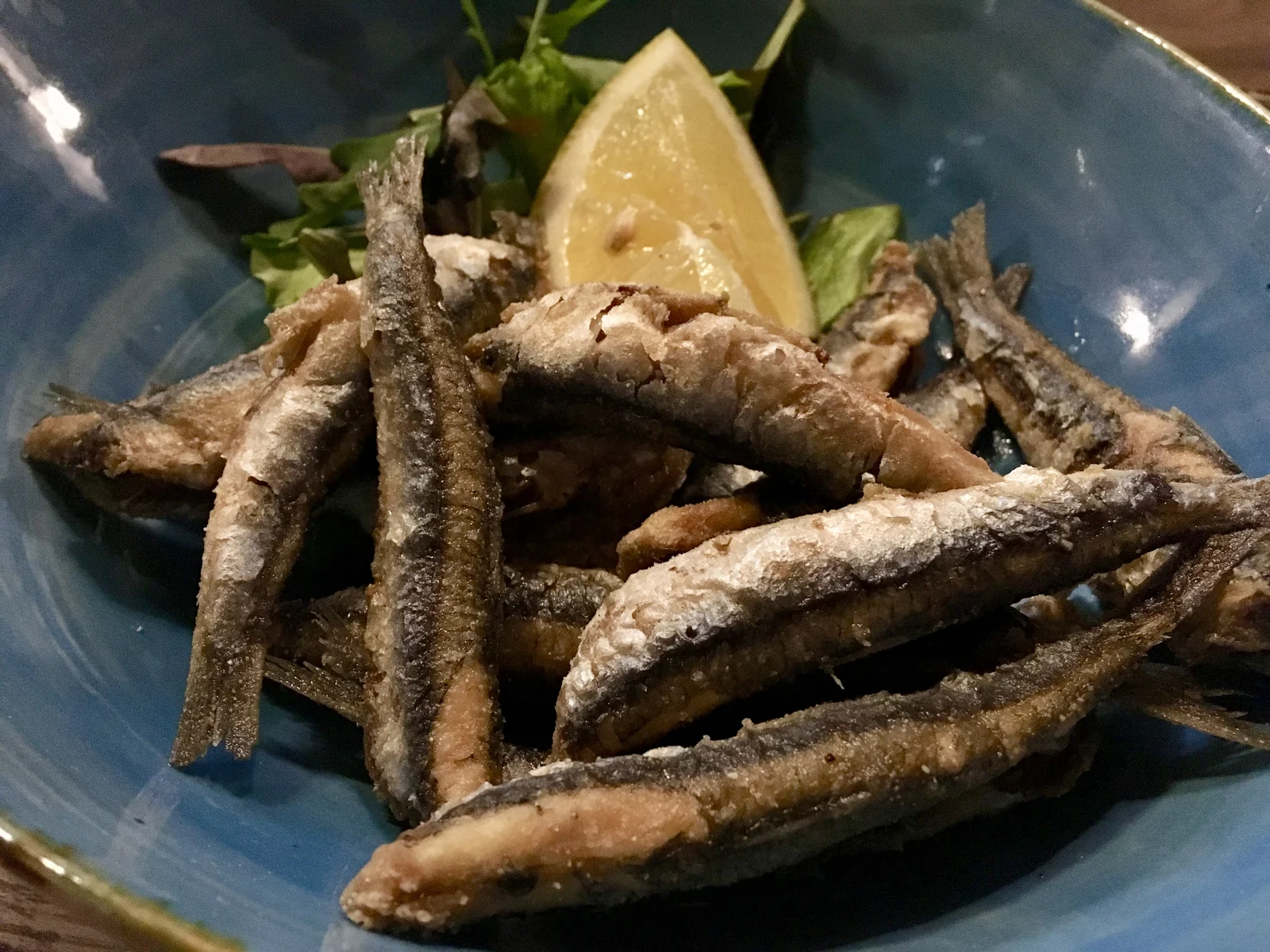
Photo: Enzo Rippa / Wikimedia Commons — CC BY-SA 4.0 · Resized and converted to WebP.
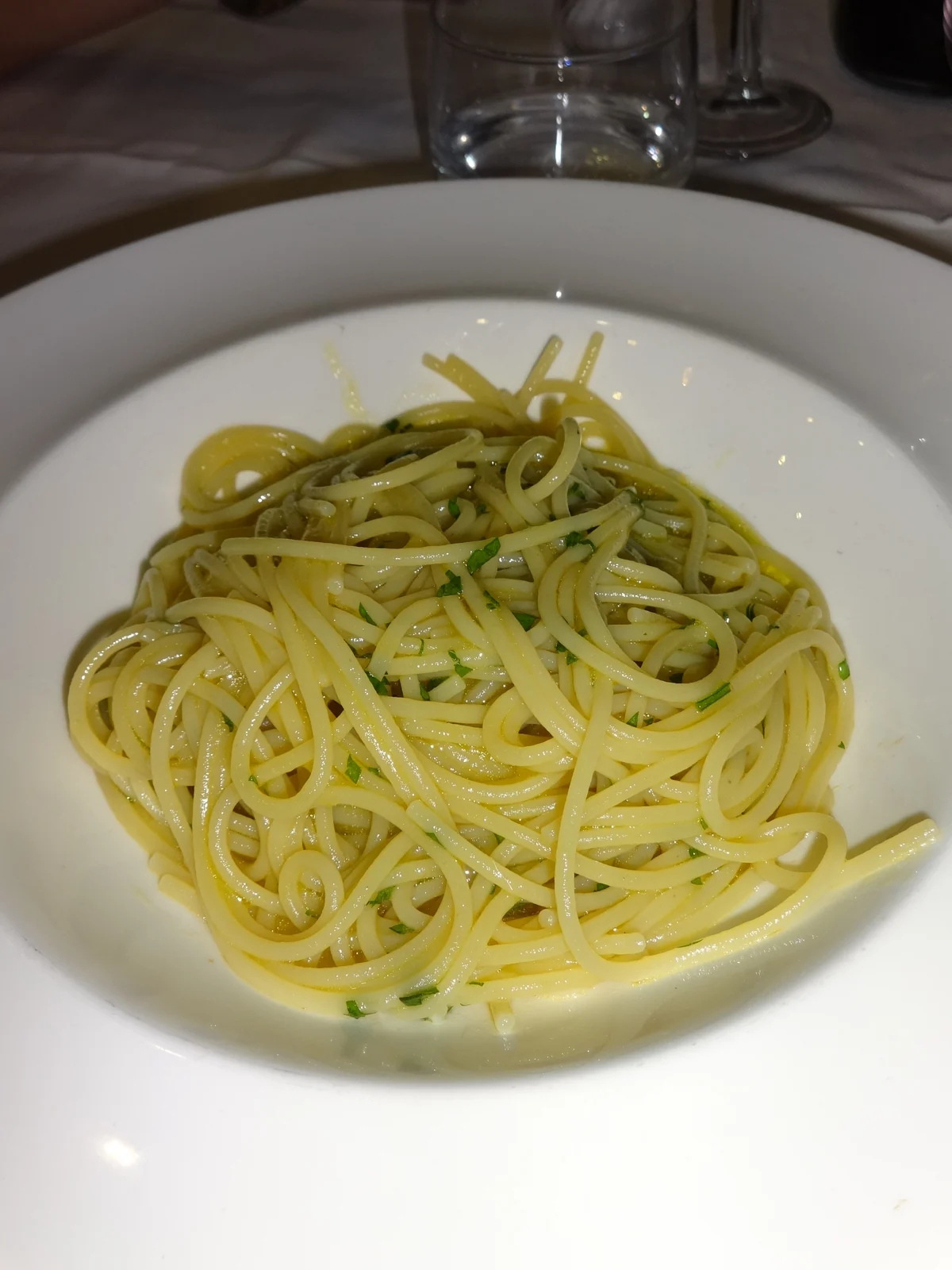
Photo: Derbrauni / Wikimedia Commons — CC BY-SA 4.0 · Resized and converted to WebP.
Things to do
Salerno's walk is Lungomare Trieste, built from 1920 to protect the shore from the sea: kilometres of gardens and palm trees, with bars, beach clubs and free beaches, the Provincial Palace, the Post Office and the Law Courts facing it, and the view of the Amalfi Coast. Towards Piazza della Libertà is the Santa Teresa beach terrace, with a wooden sun deck, a small amphitheatre and a bar on the sea; in the Torrione district, a few hundred metres from the station, the Forte La Carnale, built in the sixteenth century on the headland of a battle against the Saracens, is not open to visitors today according to the municipality's portal.
The city's gardens include the Villa Comunale, open until midnight from April to September, which hosts the Mostra della Minerva rare plant market in April, and the Mercatello Park, ten hectares in the eastern part of town, with a small lake, a citrus orchard, a Mediterranean garden and a greenhouse of succulents.
In the evening you go to the theatre. The Verdi has an opera and ballet season and a drama season, and between October and January the Musica d'Artista series brings pop, jazz, blues, opera and symphonic concerts; guided tours of the theatre are by reservation. Archaeology lovers can head to the northern outskirts, to the Etruscan and Samnite site of Fratte, a park of about 4,500 square metres with chamber tombs, open free of charge from Friday to Sunday.
To discover the medical school there is the Virtual Museum in the church of San Gregorio, on Via dei Mercanti, with multimedia reconstructions, reproduced manuscripts and surgical instruments beneath a glass floor; it also tells the story of Trotula de Ruggiero, whom the museum presents as the first woman doctor in history.
The stadium is the Arechi, home of U.S. Salernitana 1919: built between 1984 and 1990 to replace the old Donato Vestuti ground, it opened in September 1990 with Salernitana against Padova and was renovated in 1998 for the promotion to Serie A. It has a natural grass pitch of 105 by 68 metres and 29,739 seats, also hosts concerts and is reached by the metro, «Arechi» stop. The Comune announces a renovation funded by the Regione Campania, with a single stand per sector and a roof over all sectors. Next to the stadium is the Marina d’Arechi, a marina with about 1,000 berths.
Besides the Verdi, the city has other halls. The Cinema Teatro Augusteo, with seven hundred seats on the ground floor of the Palazzo di Città, is a municipal venue for cinema, theatre and music; the Teatro Ghirelli, in the Parco dell’Irno, occupies a restored old mill, has a hundred and fifty seats and houses the Casa del Contemporaneo, a theatre production centre; the Sala Pasolini, next to Piazza della Libertà, opened in the 1920s as the Teatro Diana, has a hundred and eighty seats and avant-garde programmes; in the eastern part of the city the Teatro Santa Margherita, opened in December 2019, is a neighbourhood theatre with a mostly comic season.
Walkers can follow the Sentiero del Principe, the urban trekking route proposed on the Comune’s portal between the Duomo and the Arechi castle: 2 kilometres, 400 metres of climb (270 to the castle), about two and a half hours, medium difficulty. On 31 October the city takes part in the national urban trekking day with an evening walk through the old town.
Sources: Comune di Salerno, Salerno Cultura — Lungomare Trieste · Comune di Salerno, Salerno Cultura — Arenile di Santa Teresa · Comune di Salerno, Salerno Cultura — Forte La Carnale · Comune di Salerno, Salerno Cultura — Giardino della Minerva · Comune di Salerno, Salerno Cultura — Villa Comunale · Comune di Salerno, Salerno Cultura — Parco del Mercatello · Comune di Salerno, Salerno Cultura — Teatro Municipale Giuseppe Verdi · Comune di Salerno, Salerno Cultura — Area archeologica etrusco-sannitica di Fratte · Comune di Salerno, Salerno Cultura — Museo virtuale della Scuola medica salernitana · Comune di Salerno — Stadio comunale Arechi · Comune di Salerno, Salerno Cultura — Porti · Comune di Salerno, Salerno Cultura — Cinema Teatro Augusteo · Comune di Salerno, Salerno Cultura — Teatro Ghirelli · Comune di Salerno, Salerno Cultura — Sala Pasolini · Comune di Salerno, Salerno Cultura — Teatro Santa Margherita, stagione teatrale 2026/2027 · Comune di Salerno, Salerno Cultura — Salerno outdoor experiences, Sentiero del Principe · Comune di Salerno, Salerno Cultura — Trekking urbano 2026
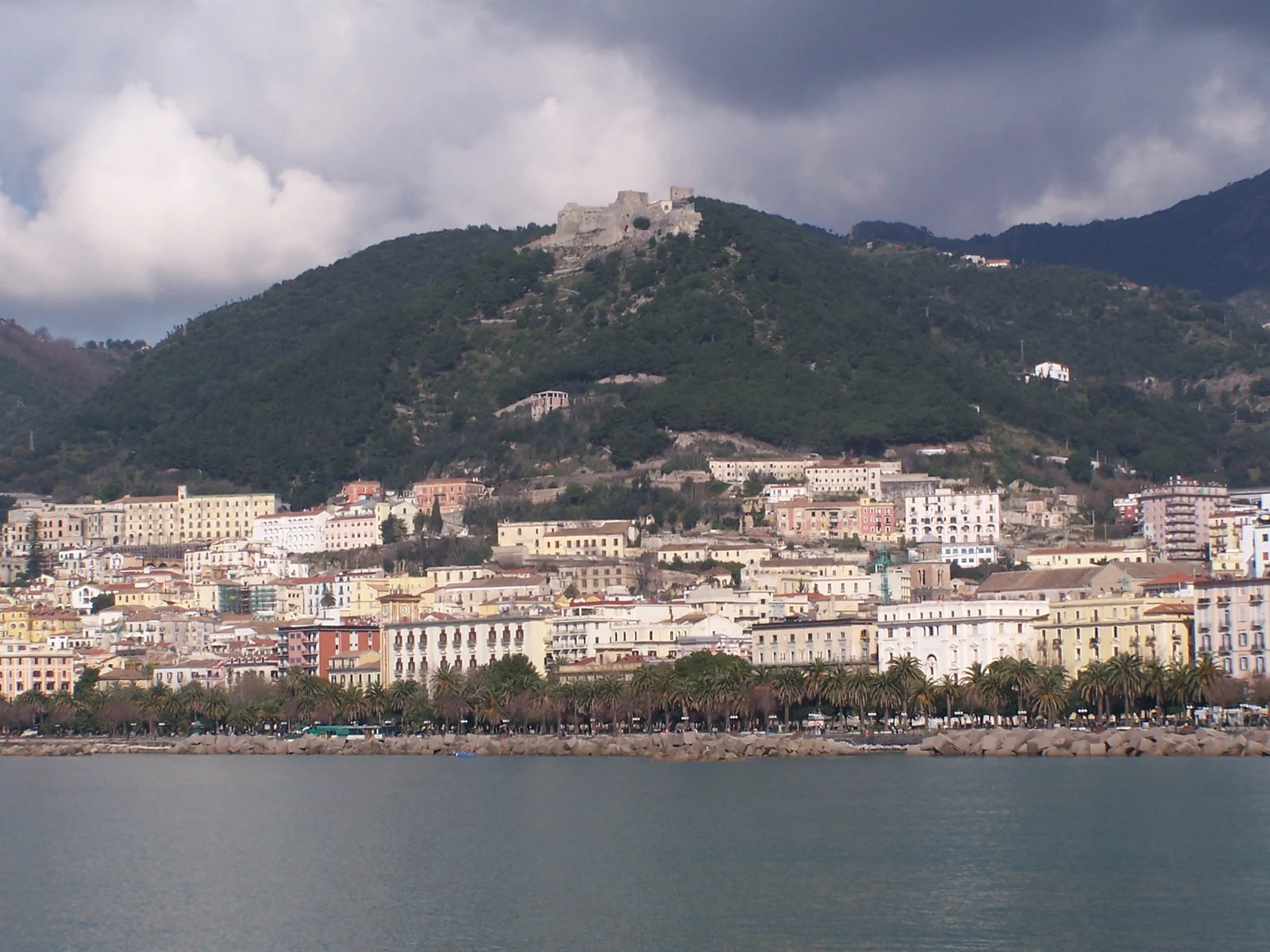
Photo: SOLOXSALERNO at Italian Wikipedia / Wikimedia Commons — Public domain · Resized and converted to WebP.
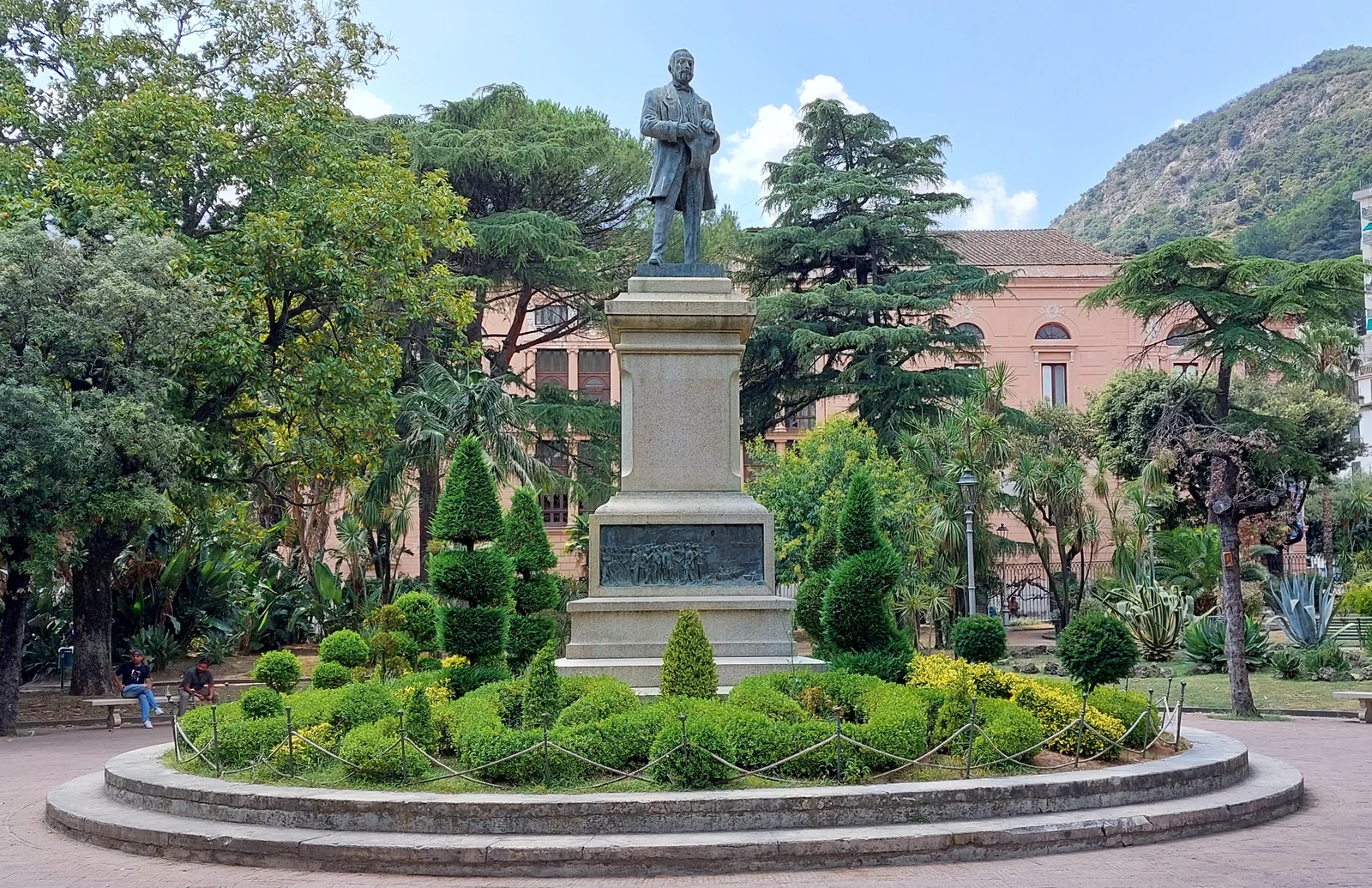
Photo: Giu Pepis / Wikimedia Commons — CC BY-SA 4.0 · Resized and converted to WebP.
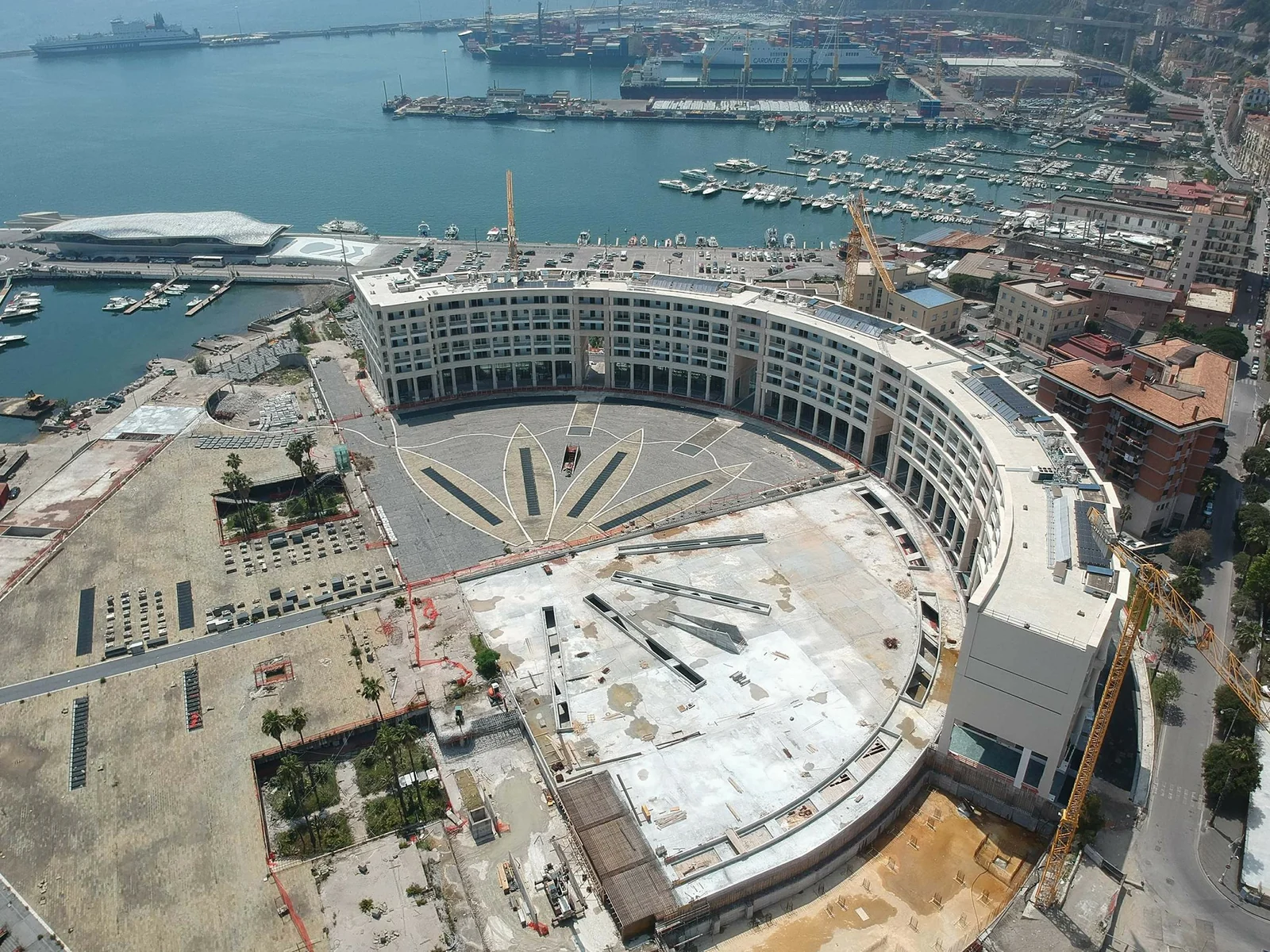
Photo: Jack45 / Wikimedia Commons — CC BY 4.0 · Resized and converted to WebP.
When to go
Winter in Salerno belongs to the Luci d'Artista. The 2026-2027 edition, the twenty-first, opened on 7 November and stays lit until 24 January 2027, free of charge: 31 light works across the centre, the seafront and the eastern districts, four video-mappings on the façades of Palazzo Genovese, Palazzo Sant'Agostino, the Teatro Verdi and the Liceo Tasso, fairy tales in the Villa Comunale, the solar system in Piazza Flavio Gioia and penguins on the seafront rocks. The municipality has prepared six itineraries, twelve audio stories and videos in Italian Sign Language, in Italian and English; the map of the works, transport and parking are on the municipality's portal.
21 September is the feast of Saint Matthew, the city's patron: the procession with the saint's silver statue, carried on the shoulders of the paranze and accompanied by the statues of the Salerno martyr saints, Pope Gregory VII and Saint Joseph, crosses the centre and ends with the run up the cathedral steps and fireworks over the sea. The countdown begins on 21 August with the raising of the banner, the Alzata del Panno, in the cathedral atrium.
In May the Fair of the Rediscovered Crucifix brings the Middle Ages back to the old town, with merchants, craftsmen and costumed performers; in summer the procession of the Madonna che vien dal Mare carries the painting on a boat, escorted by fishing boats, to the church of Sant'Agostino.
On 17 January the bonfires of Sant’Antuono open Carnival. In September, around Saint Matthew’s day, the Museum Festival opens the city’s museums for a week with visits and workshops (in 2026, for the third year, from 20 to 27 September), the Archdiocese’s Giornate Matteane bring talks on the Gospel of Matthew to the church of Sant’Agostino, and the Premio Charlot, a performing-arts festival that reached its thirty-eighth edition in 2026, is held at the Teatro delle Arti, the Augusteo and the Verdi.
November is the month of cinema: Linea d’Ombra, a festival of cinema and audiovisual arts that reached its thirty-first edition in 2026, and the Salerno International Film Festival, which holds its 80th edition from 23 to 28 November 2026 at the Cinema Teatro Augusteo, with the afternoon screenings of the competition films free and open to all.
Sources: Comune di Salerno — A Salerno tornano le Luci d’Artista (notizia) · Comune di Salerno, Salerno Cultura — Luci d’Artista 2026-2027 · Comune di Salerno, Salerno Cultura — San Matteo: cuore e identità di Salerno · Comune di Salerno, Salerno Cultura — La Fiera del Crocifisso: il Medioevo che ritorna · Comune di Salerno, Salerno Cultura — La Madonna che vien dal Mare · Comune di Salerno, Salerno Cultura — Lungomare Trieste · Comune di Salerno, Salerno Cultura — Sant’Antuono e il Carnevale: fuoco, farina e lasagna · Comune di Salerno, Salerno Cultura — Festa dei musei Salerno 2026 · Comune di Salerno, Salerno Cultura — Giornate Matteane, X edizione · Comune di Salerno, Salerno Cultura — Premio Charlot 2026, XXXVIII edizione · Comune di Salerno, Salerno Cultura — Linea d’Ombra Festival 2026, XXXI edizione · Comune di Salerno, Salerno Cultura — Festival Internazionale del Cinema di Salerno 2026
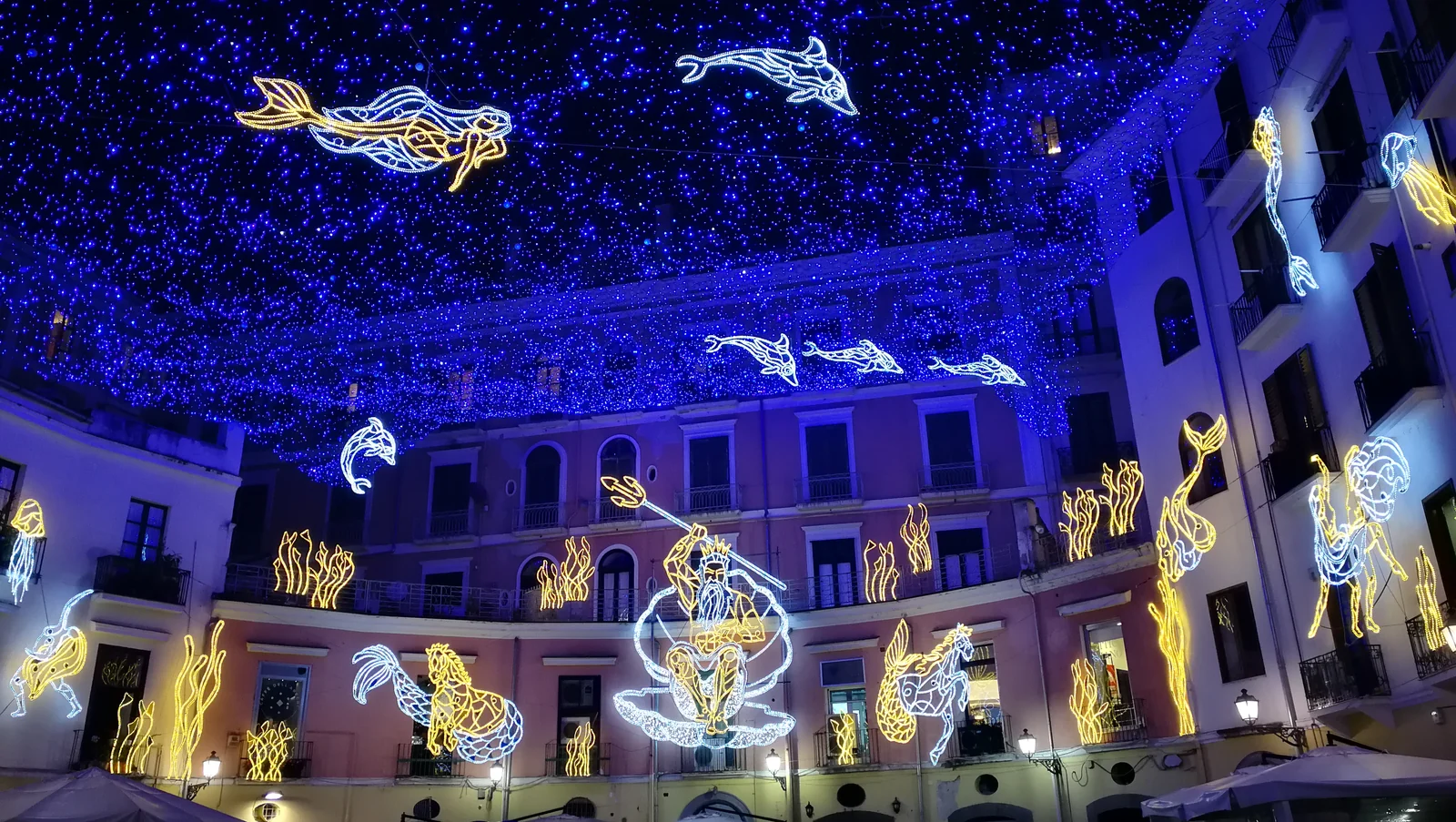
Photo: Marco Ebreo / Wikimedia Commons — CC BY-SA 4.0 · Resized and converted to WebP.
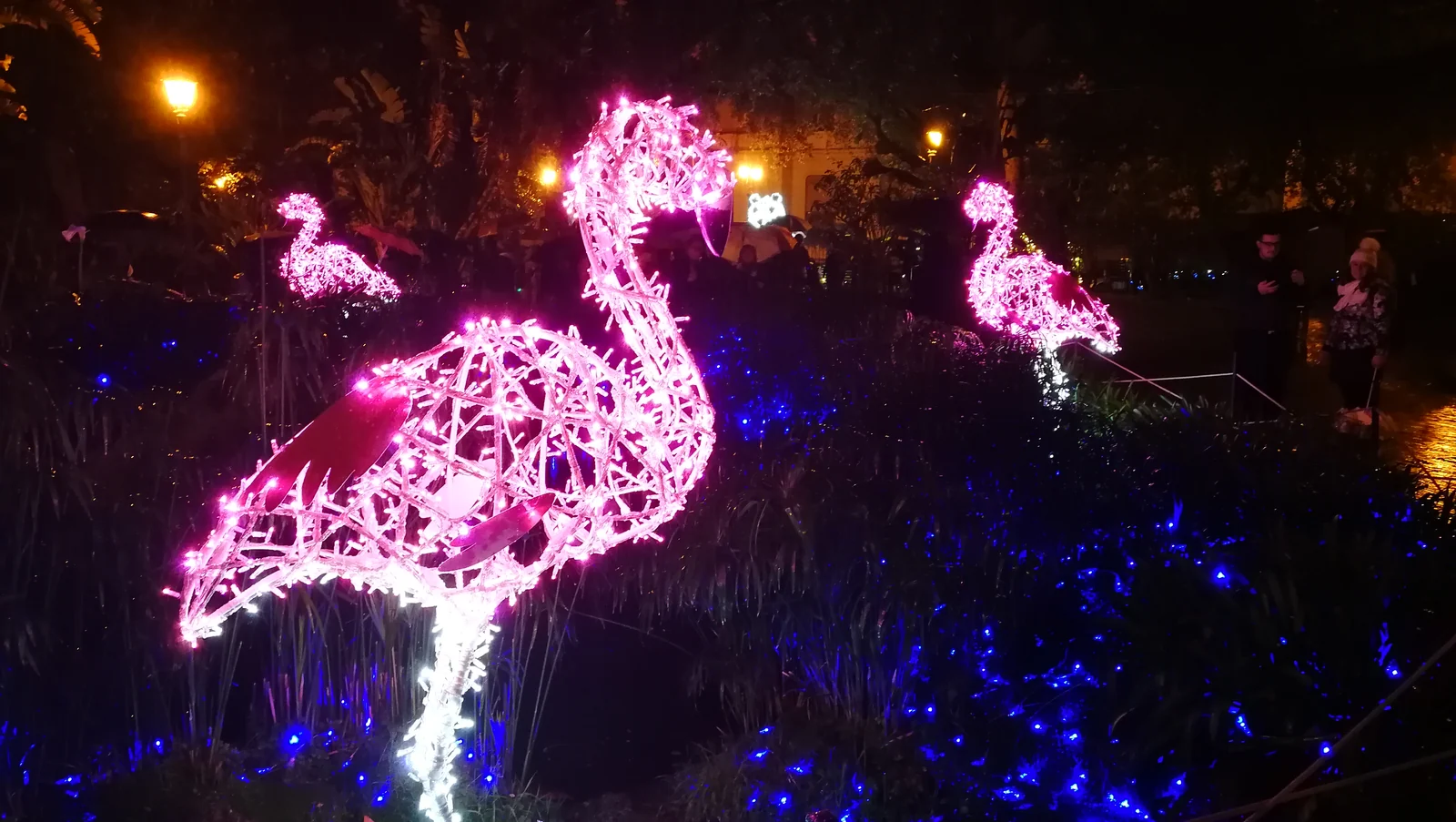
Photo: Marco Ebreo / Wikimedia Commons — CC BY-SA 4.0 · Resized and converted to WebP.
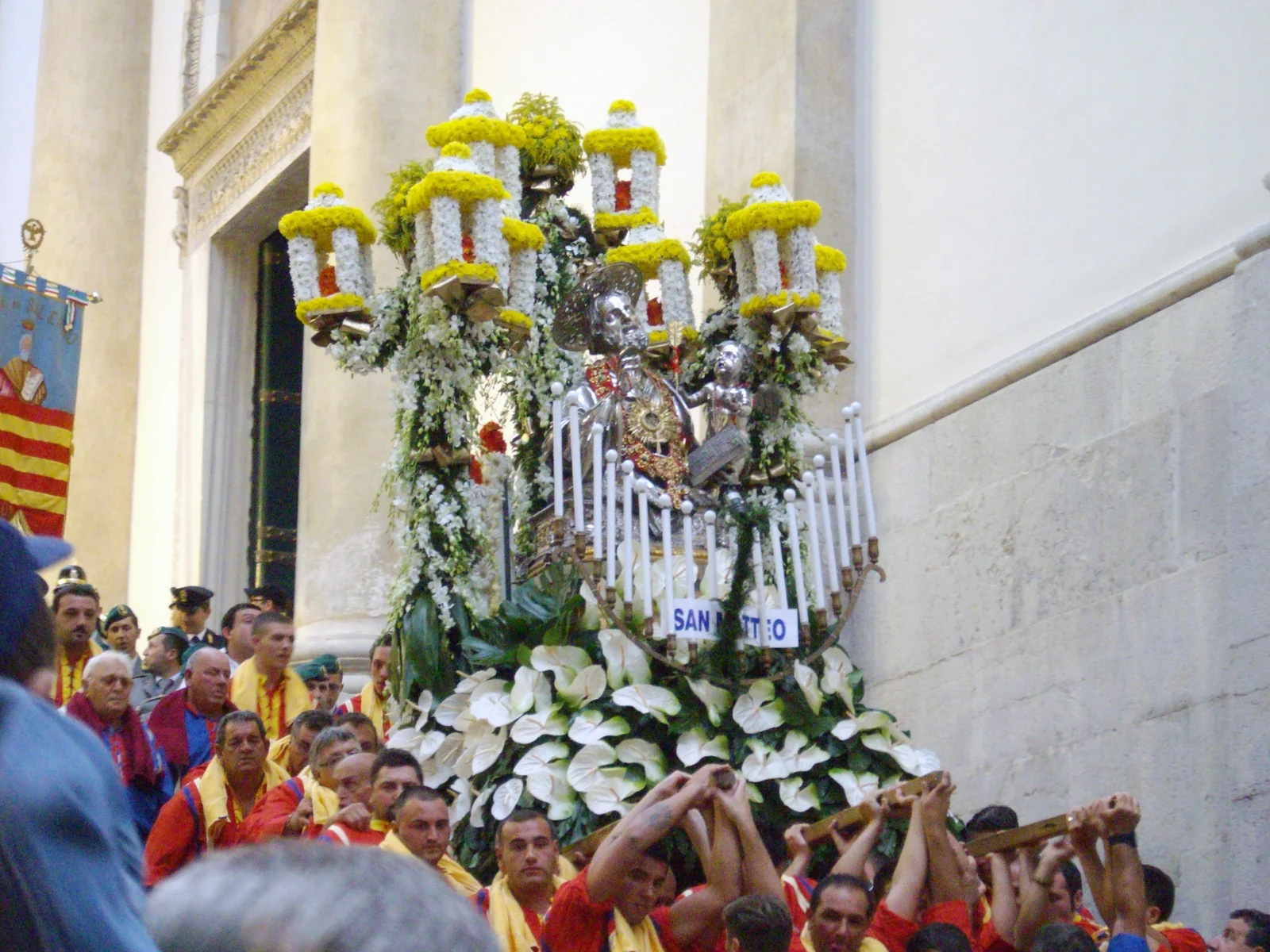
Photo: M2m / Wikimedia Commons — CC BY 3.0 · Resized and converted to WebP.
Getting there and around
Salerno station, in Piazza Vittorio Veneto, has twelve tracks, lifts, step-free and tactile routes and assistance for people with disabilities, booked with the Naples Sala Blu. From the station the Salerno metro runs as far as the Arechi stadium.
The municipality's portal names Naples Capodichino airport and Salerno Costa d'Amalfi e del Cilento airport, at Pontecagnano, 21 kilometres from the city, as the airports of reference. By car you arrive on the motorway; hydrofoils link Salerno with Vietri, Cetara, Maiori, Minori, Amalfi, Positano, Capri and Naples, and the maritime station receives cruise ships.
In town the city buses are run by Busitalia; Salerno Mobilità, the municipal company, manages car parks, camper areas and the public escalators and lifts that climb to the hillside districts. During the Luci d'Artista the municipality publishes a transport plan with car parks, shuttles and extra metro services.
The official website of the Comune di Salerno, registered in IndicePA, the index of the digital addresses of Italy’s public administrations, is the reference for the town council’s offices, opening hours and news. Its address is listed among the sources of this section.
Salerno has two ports, one at each end of the Lungomare Trieste. The commercial port, on the Molo Manfredi, holds the maritime station, with access from Via Porto and Piazza della Libertà; the Masuccio Salernitano port, with about 500 berths and the local section of the Lega Navale Italiana, is where the «sea routes» to the Amalfi Coast, the Cilento and the islands of the gulf depart, with Piazza della Concordia behind it.
From the station Busitalia’s Salerno Airlink bus runs to the airport. SITA SUD buses link the city with the Amalfi Coast and the Sorrento Peninsula, and run lines to Naples Capodichino and to Bari.
The old town is a limited traffic zone watched by cameras at its gates; occasional transit permits, including for vehicles serving people with disabilities, are issued by the ZTL gates office of the Polizia Locale at Via dei Carrari 31. To leave the car, Salerno Mobilità runs car parks open 24 hours a day: Piazza della Concordia (238 spaces) and the underground Sottopiazza (260), Piazza Mazzini (162), the Libertà car park under the Crescent (585), Foce Irno underground (202) and Vinciprova (203). The public lifts of Via Velia and Via Fusandola and the escalators between Via Indipendenza and Via Monti are free, and there is a camper area that is booked in advance.
For medical emergencies the number is 118. The emergency department of the San Giovanni di Dio e Ruggi d’Aragona university hospital, in Largo Città Ippocrate, is on the ground floor of building W; by car it is reached from the ring road, «Ospedale» exit.
Sources: RFI — Stazione di Salerno · Comune di Salerno, Salerno Cultura — Mobilità e trasporti · Salerno Mobilità (società del Comune) — Orari della Metropolitana di Salerno · Salerno Mobilità (società del Comune) — Scale mobili e ascensori · Comune di Salerno, Salerno Cultura — Stazione marittima · Comune di Salerno — A Salerno tornano le Luci d’Artista (notizia) · Comune di Salerno, sito istituzionale · IndicePA (AgID), Indice dei domicili digitali delle pubbliche amministrazioni: dataset Enti · Comune di Salerno — Porto commerciale, Molo Manfredi · Comune di Salerno — Porto Masuccio Salernitano · Comune di Salerno, Salerno Cultura — Porti · Busitalia Campania — Orari urbani di Salerno e Salerno Airlink · SITA SUD — linee e orari · Comune di Salerno, Polizia locale — Ufficio Varchi ZTL · Salerno Mobilità S.p.A. — Tariffe e abbonamenti, aree perimetrate automatizzate · Salerno Mobilità S.p.A. — Scale mobili e ascensori · Salerno Mobilità S.p.A. — Area camper · A.O.U. San Giovanni di Dio e Ruggi d’Aragona — Pronto soccorso
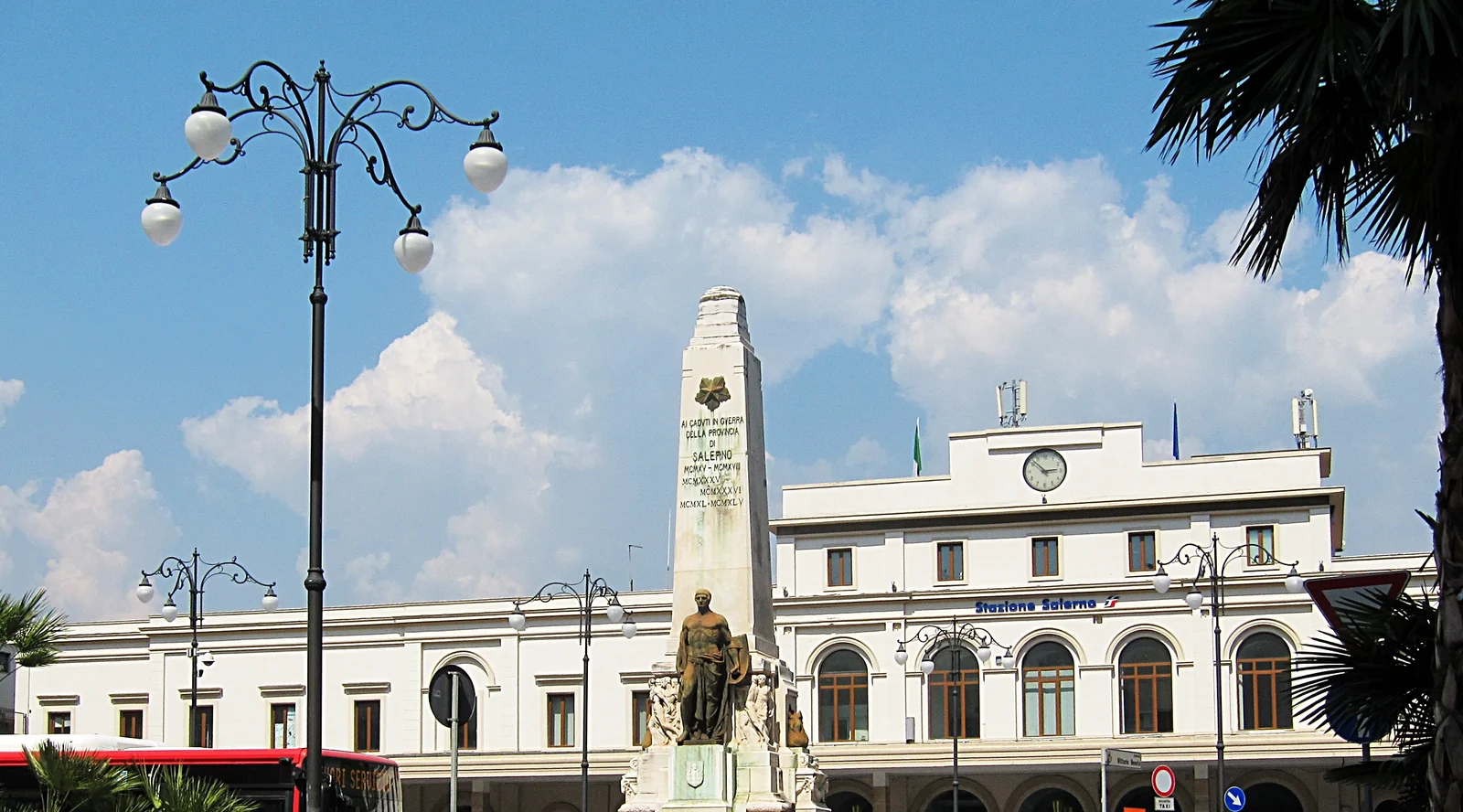
Photo: Velvet / Wikimedia Commons — CC BY-SA 3.0 · Cropped, resized and converted to WebP.
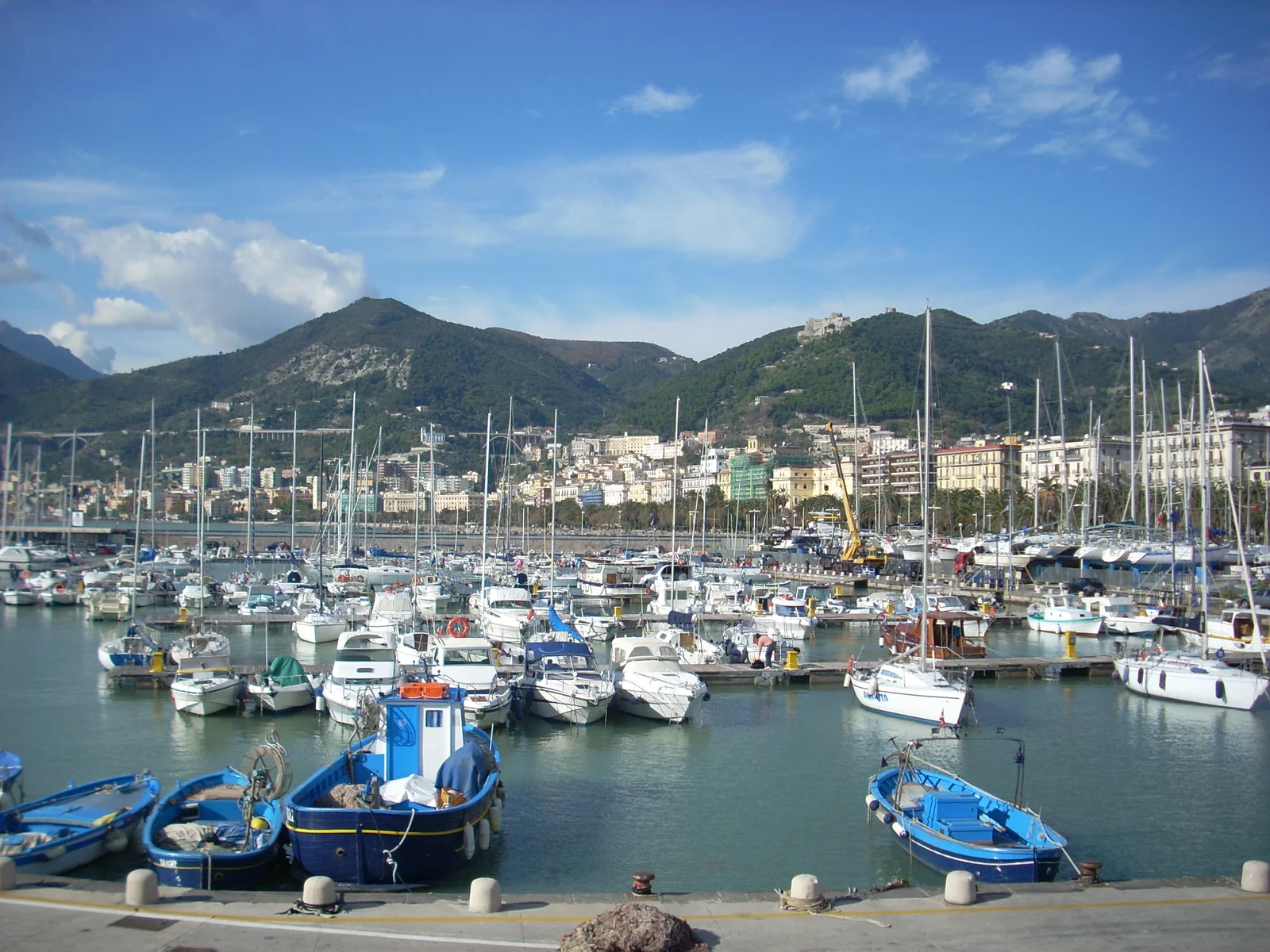
Photo: SOLOXSALERNO at Italian Wikipedia / Wikimedia Commons — CC BY-SA 3.0 · Resized and converted to WebP.
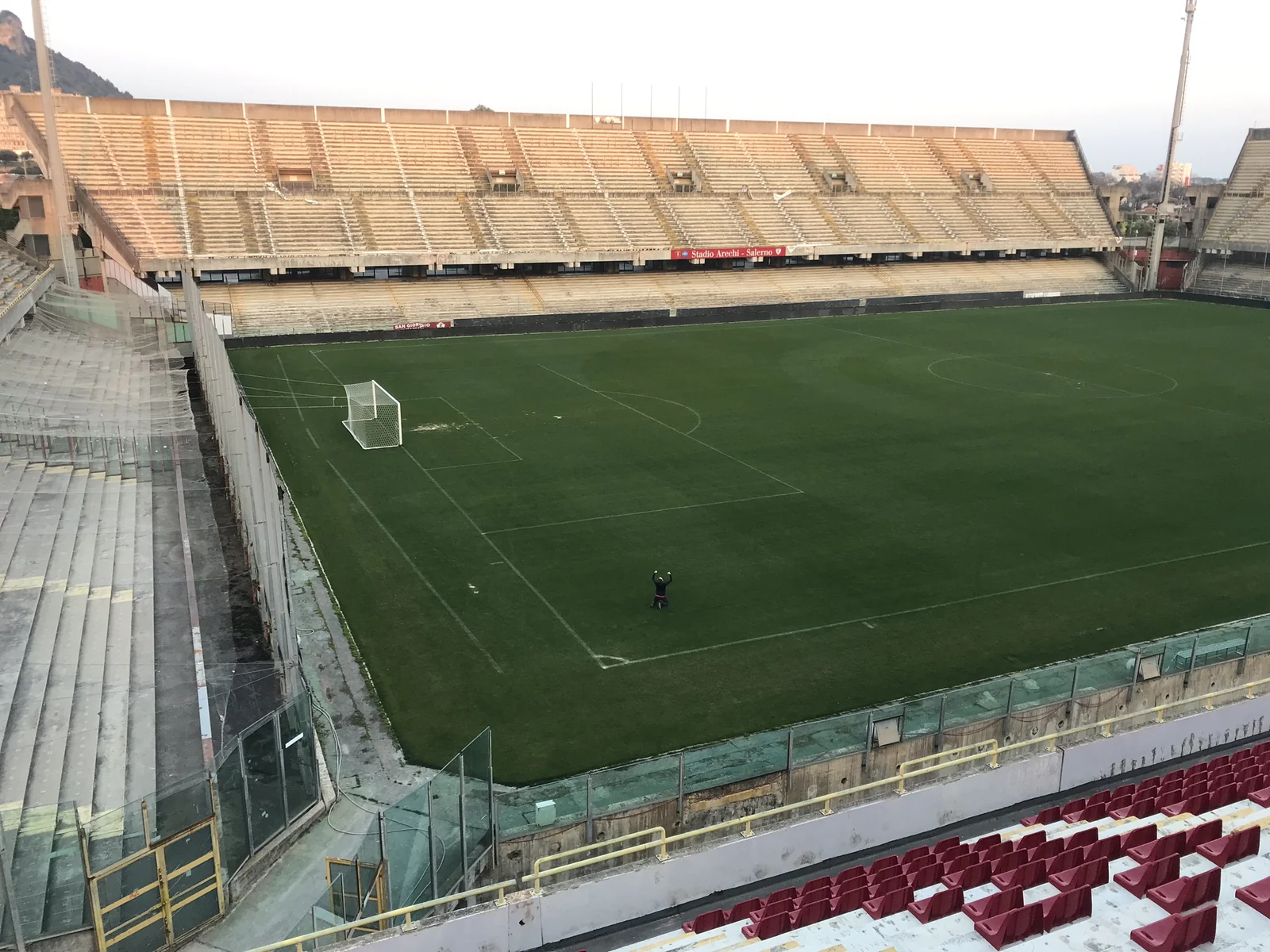
Photo: Vincenzo.togni / Wikimedia Commons — CC BY-SA 4.0 · Resized and converted to WebP.
Where to stay
To stay in Salerno you choose between the old town, close to the cathedral, Via dei Mercanti and the museums, and the nineteenth-century city that extends it along three parallel axes, the seafront, Via Roma and Corso Vittorio Emanuele, from the commercial port to the station: handy for trains and hydrofoils. In the eastern part of town, between Torrione, Pastena and Mercatello, are the Mercatello park and the seafront as it carries on.
In the Ministry of Tourism’s national database of accommodation (BDSR), on 12 October 2026, Salerno had 1,513 establishments with a verified national identification code (CIN): 13 hotel-type establishments, 309 non-hotel establishments and 1,191 other establishments.
During the Luci d'Artista, at weekends between November and January, and around Saint Matthew's day the city fills up: anyone coming on those dates does well to book early and check the municipality's transport plan.
If you arrive by car and stay in the old town, you enter a limited traffic zone: hotels, guesthouses and private garages send their guests’ transits to the ZTL gates office of the Polizia Locale. In the old town, Largo Campo is, the Comune writes, the centre of the historic centre and the Fornelle «the soul of old Salerno», while Via dei Mercanti and Corso Vittorio Emanuele are the shopping streets. Travellers with a camper van can book an area run by Salerno Mobilità, and those arriving by boat find berths at the Masuccio Salernitano port or the Marina d’Arechi.
Overnight guests pay the city tourist tax, per person and per night up to seven consecutive nights, to the accommodation; residents, children up to twelve and guests of youth hostels are exempt. The rate depends on the type of accommodation, and resolution no. 50 of 8 April 2026 raised it from 1 June 2026: the amounts are on the Comune’s website.
Sources: Comune di Salerno, Salerno Cultura — Lungomare Trieste · Comune di Salerno, Salerno Cultura — Mobilità e trasporti · Comune di Salerno, Salerno Cultura — Parco del Mercatello · Ministero del Turismo – Banca Dati Strutture Ricettive (dashboard pubblica) · Comune di Salerno, Salerno Cultura — Luci d’Artista 2026-2027 · Comune di Salerno — A Salerno tornano le Luci d’Artista (notizia) · Comune di Salerno, Salerno Cultura — San Matteo: cuore e identità di Salerno · Comune di Salerno, Polizia locale — Ufficio Varchi ZTL · Comune di Salerno, Salerno Cultura — Largo Campo · Comune di Salerno, Salerno Cultura — Itinerario Street art alle Fornelle · Comune di Salerno, Salerno Cultura — Piazza Portanova e la Rotonda · Salerno Mobilità S.p.A. — Area camper · Comune di Salerno, Salerno Cultura — Porti · Comune di Salerno — Imposta di soggiorno · Comune di Salerno — Delibera n. 50 dell’8 aprile 2026, incremento delle tariffe dell’imposta di soggiorno dal 1° giugno
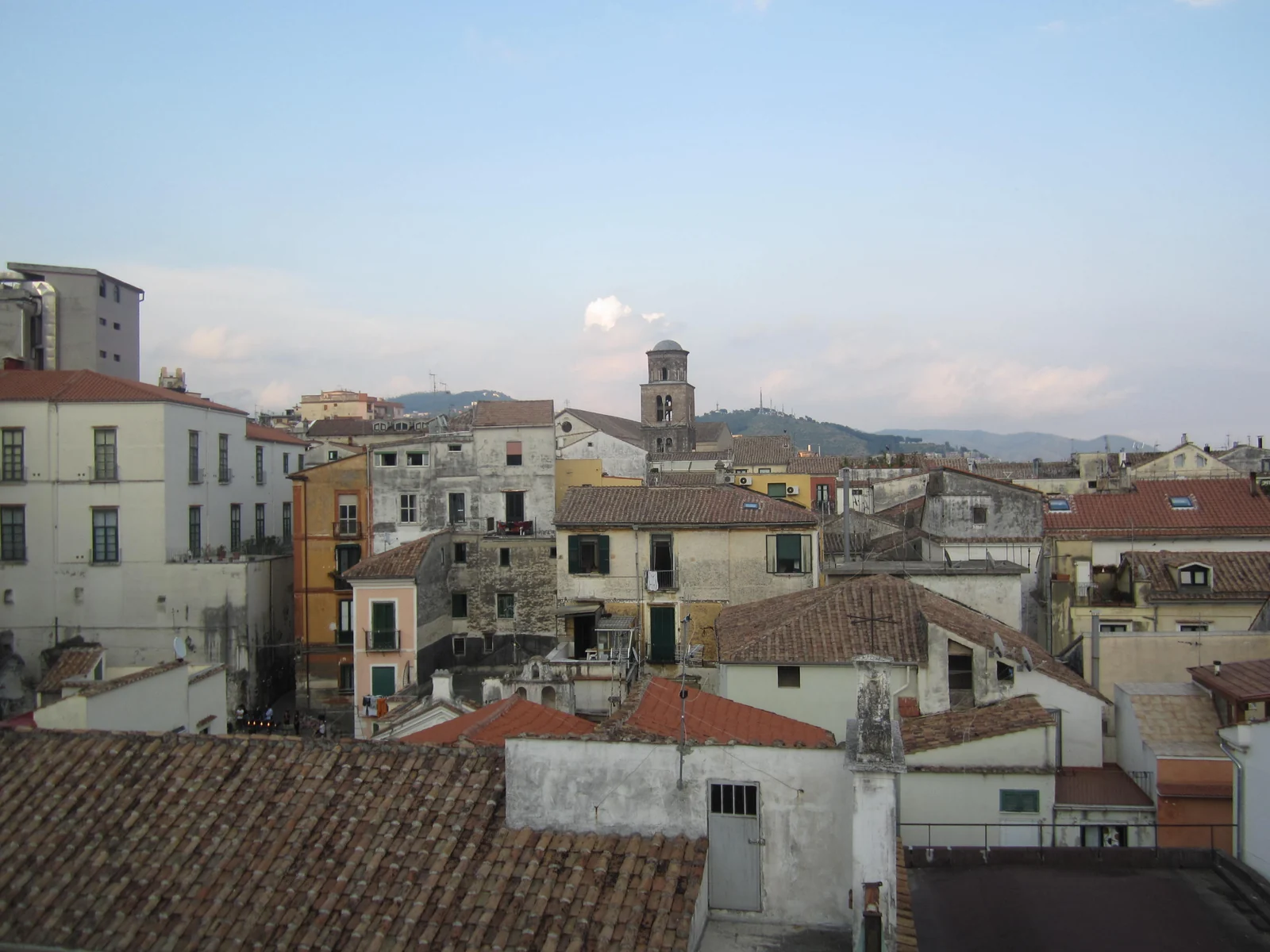
Photo: Luca Aless / Wikimedia Commons — CC BY-SA 3.0 · Resized and converted to WebP.
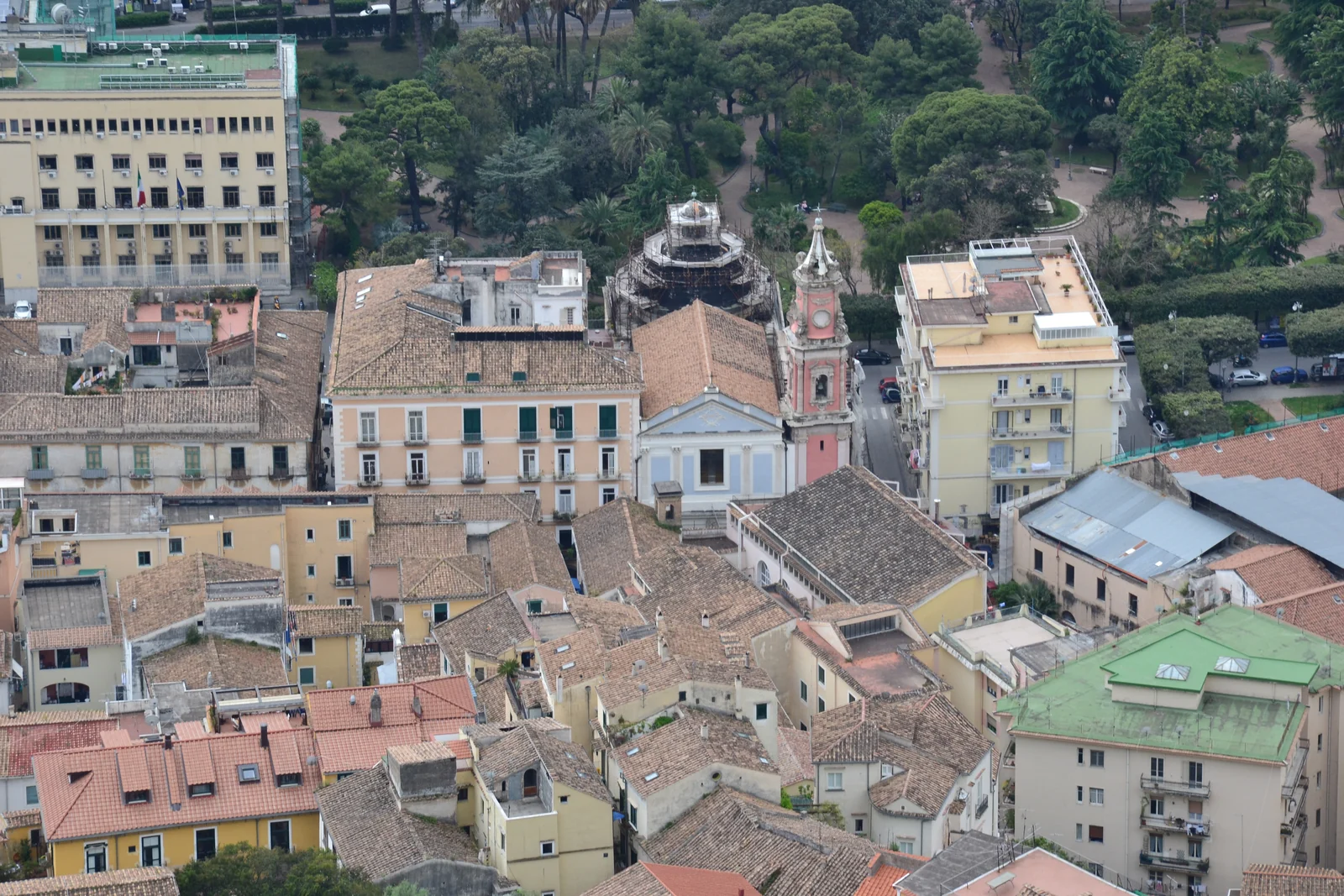
Photo: Jack56 / Wikimedia Commons — Public domain · Resized and converted to WebP.
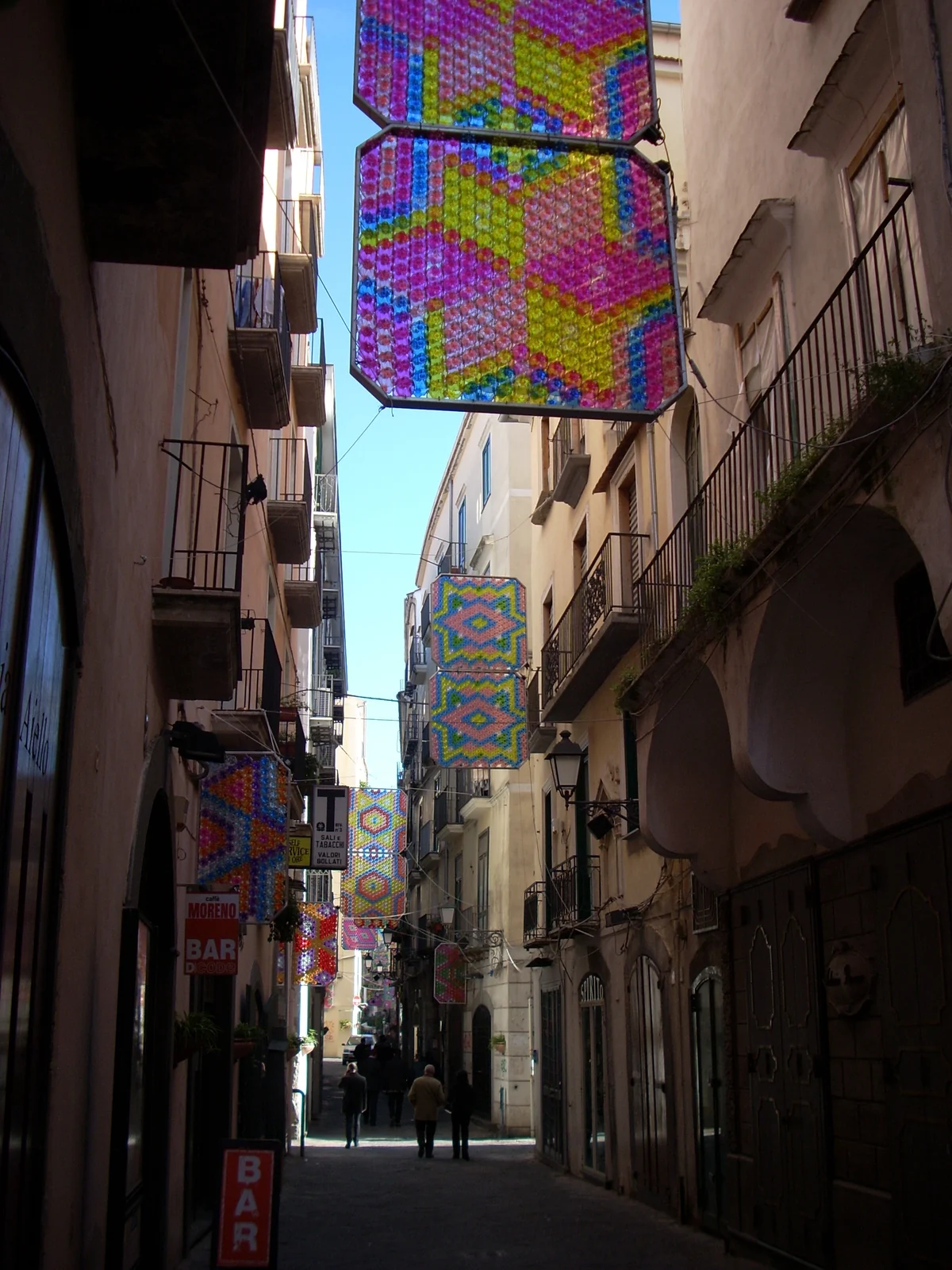
Photo: SOLOXSALERNO at Italian Wikipedia / Wikimedia Commons — CC BY-SA 3.0 · Resized and converted to WebP.
Nearby
Among the places Apulica already covers, the nearest are Montella (about 24 km), Avellino (about 26 km) and Bagnoli Irpino (about 28 km): straight-line distances between the centres of the municipal territories.
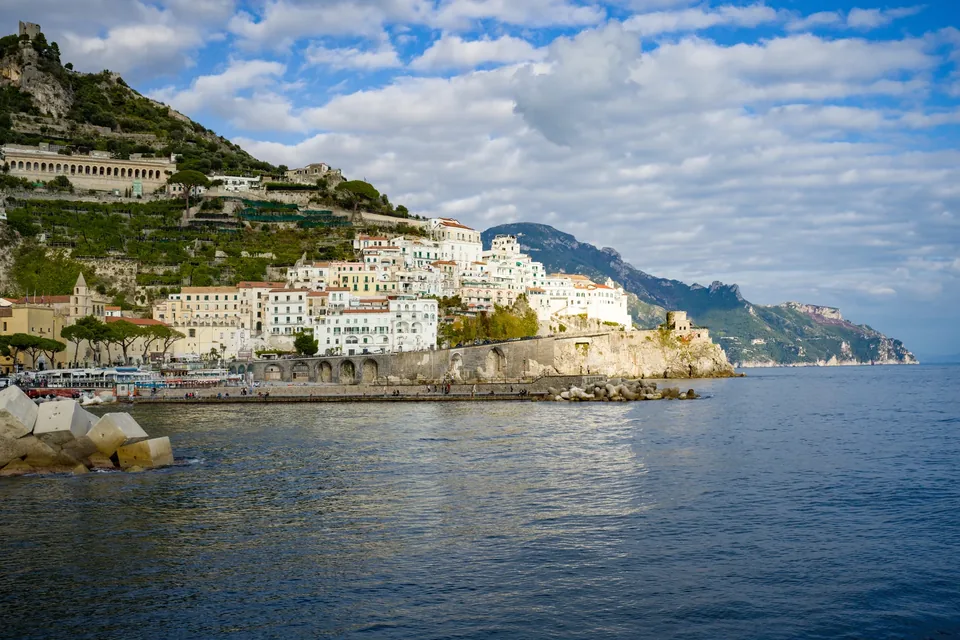
To the west begins the Amalfi Coast, a UNESCO World Heritage site: twelve municipalities among terraces of vines and lemons, the Roman villas of Minori and Positano, the Valle dei Mulini and the majolica domes of Vietri, emblem of a ceramic craft famous worldwide. From Salerno you can also get there by sea on the hydrofoils.
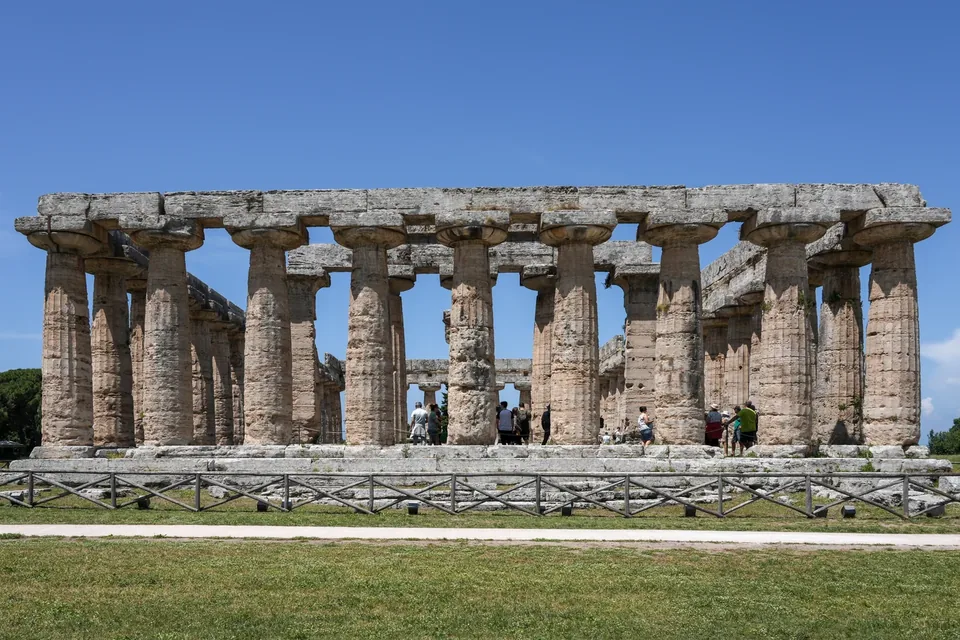
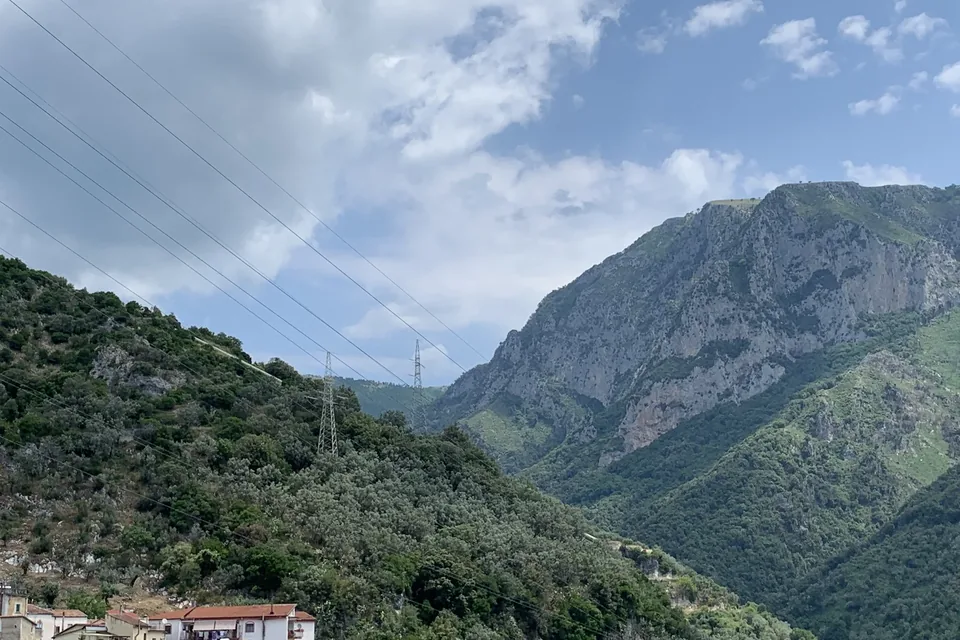
Further away stand the Greek temples of Paestum, which with Velia make up the Ministry of Culture's archaeological parks, on the World Heritage list since 1998; around them lies the Cilento, Vallo di Diano and Alburni National Park. Inland rise the Picentini mountains, and at Pontecagnano the National Archaeological Museum tells the story of the area's other Etruscan outpost, Picentia, Fratte's neighbour.
The «sea routes» leave the Masuccio port for the small harbours of the Amalfi Coast and the Cilento, and SITA SUD buses run along the coast. Vietri sul Mare has an old bond with Salerno: according to the Comune, the potters of Vietri took their clay from the hill of Rufoli, in the Salerno district of Ogliara, and in Vietri Sant’Antuono is still celebrated on 17 January as protector of those who work with kilns and ceramics; Salerno Mobilità also runs the public lift in Vietri. A little further on is Cetara, an old fishing village of the Amalfi Coast and home of the colatura di alici, heir, the Regione writes, to the garum described by Pliny and Horace.
Sources: ISTAT/Openpolis, confini comunali della regione Campania (CC BY 4.0, ISTAT/Openpolis) · Commissione Nazionale Italiana per l’UNESCO — Costiera Amalfitana · Comune di Salerno, Salerno Cultura — Mobilità e trasporti · Ministero della Cultura — Parchi archeologici di Paestum e Velia · Italia.it (Ministero del Turismo) — Salerno · Comune di Salerno, Salerno Cultura — Area archeologica etrusco-sannitica di Fratte · Ente Parco Nazionale del Cilento, Vallo di Diano e Alburni — Il Parco Nazionale · Ente Parco Regionale dei Monti Picentini · Parks.it (Federparchi) — Parco Regionale Monti Picentini, carta d’identità · Comune di Salerno — Porto Masuccio Salernitano · SITA SUD — linee e orari · Comune di Salerno, Salerno Cultura — Museo Città Creativa · Comune di Salerno, Salerno Cultura — Sant’Antuono e il Carnevale: fuoco, farina e lasagna · Salerno Mobilità S.p.A. — Scale mobili e ascensori · Regione Campania, Assessorato all’Agricoltura — Colatura di alici di Cetara DOP
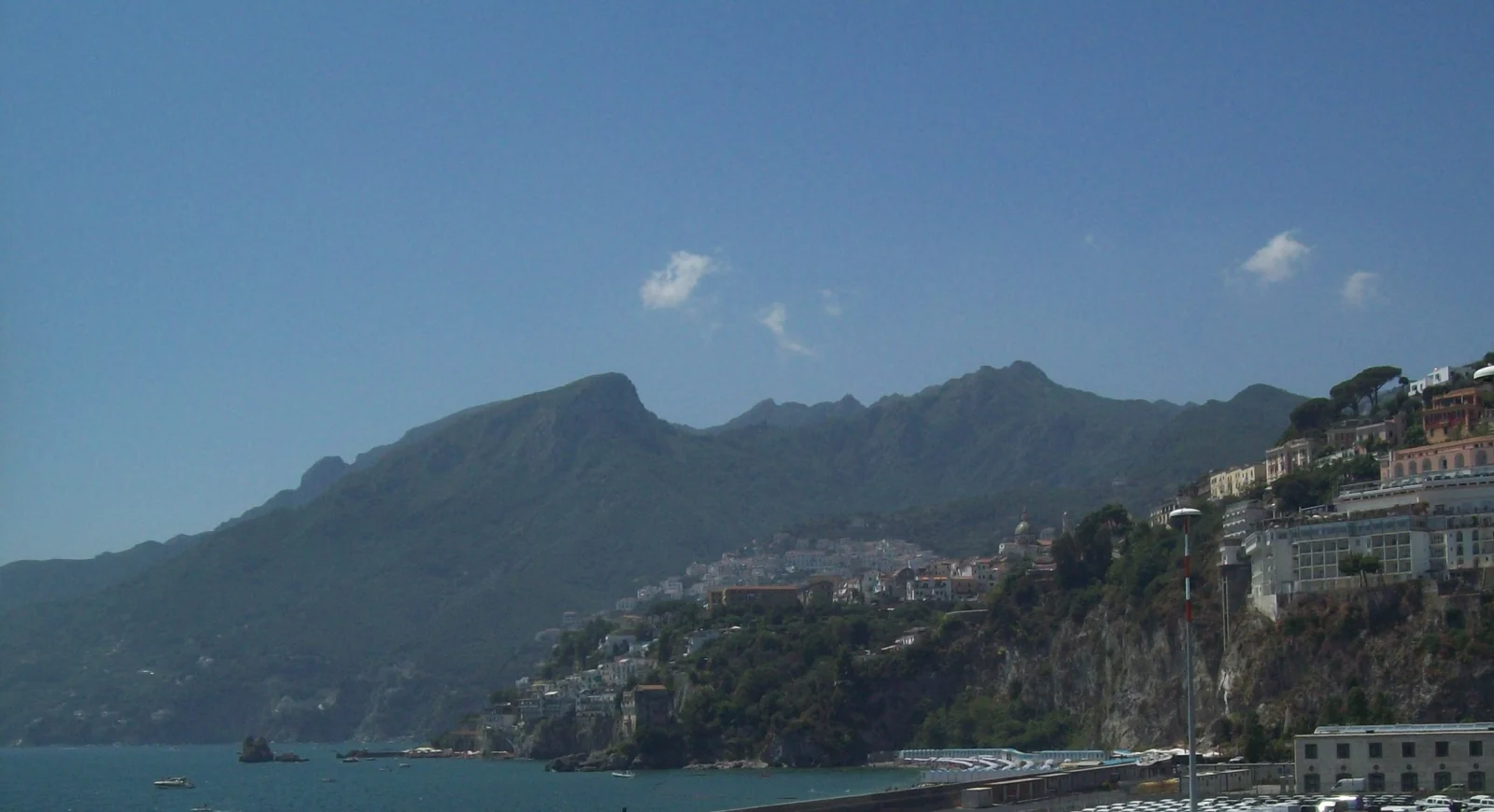
Photo: Francesco Costanza / Wikimedia Commons — CC BY-SA 2.0 · Cropped, resized and converted to WebP.
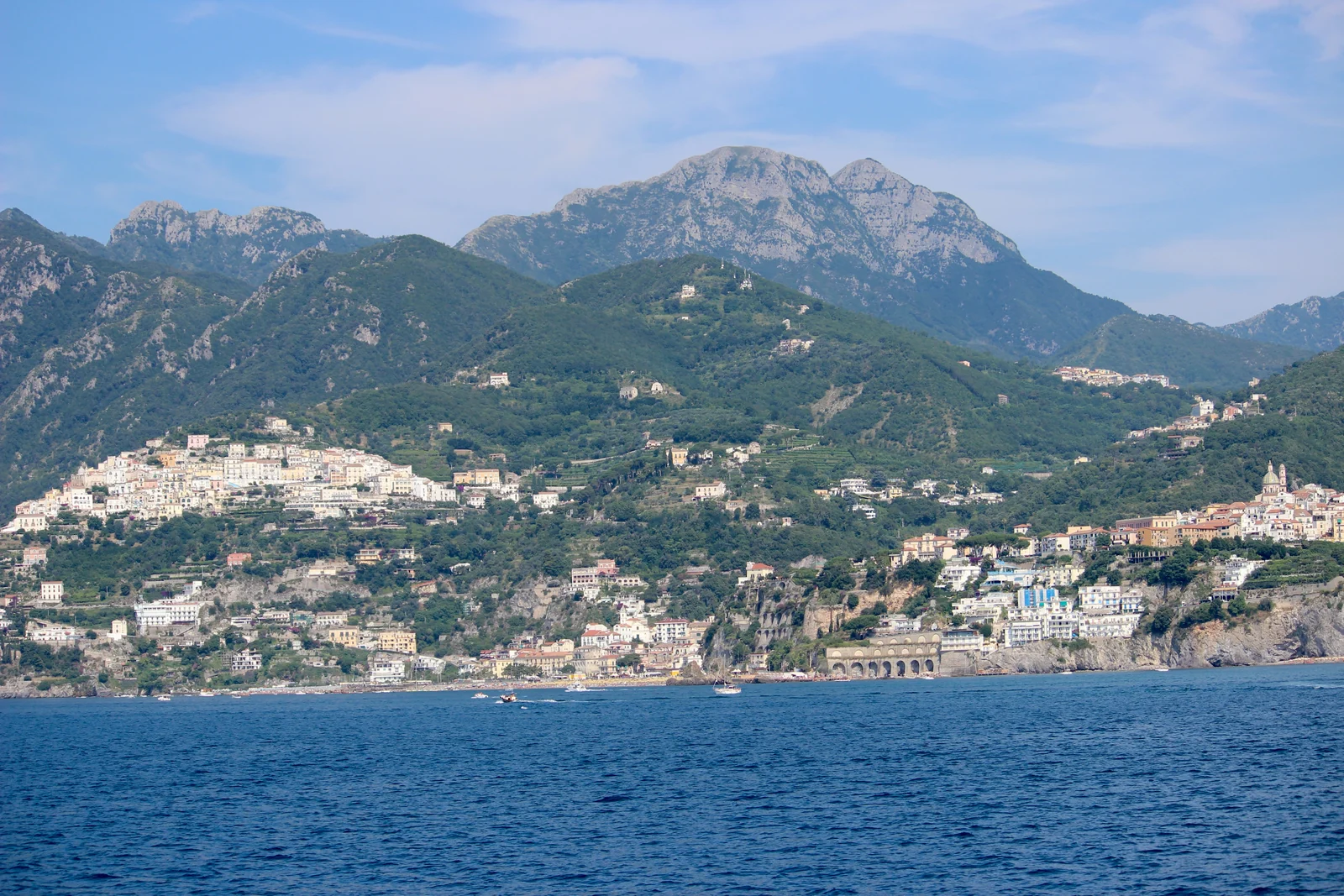
Photo: Miguel Hermoso Cuesta / Wikimedia Commons — CC BY-SA 4.0 · Resized and converted to WebP.
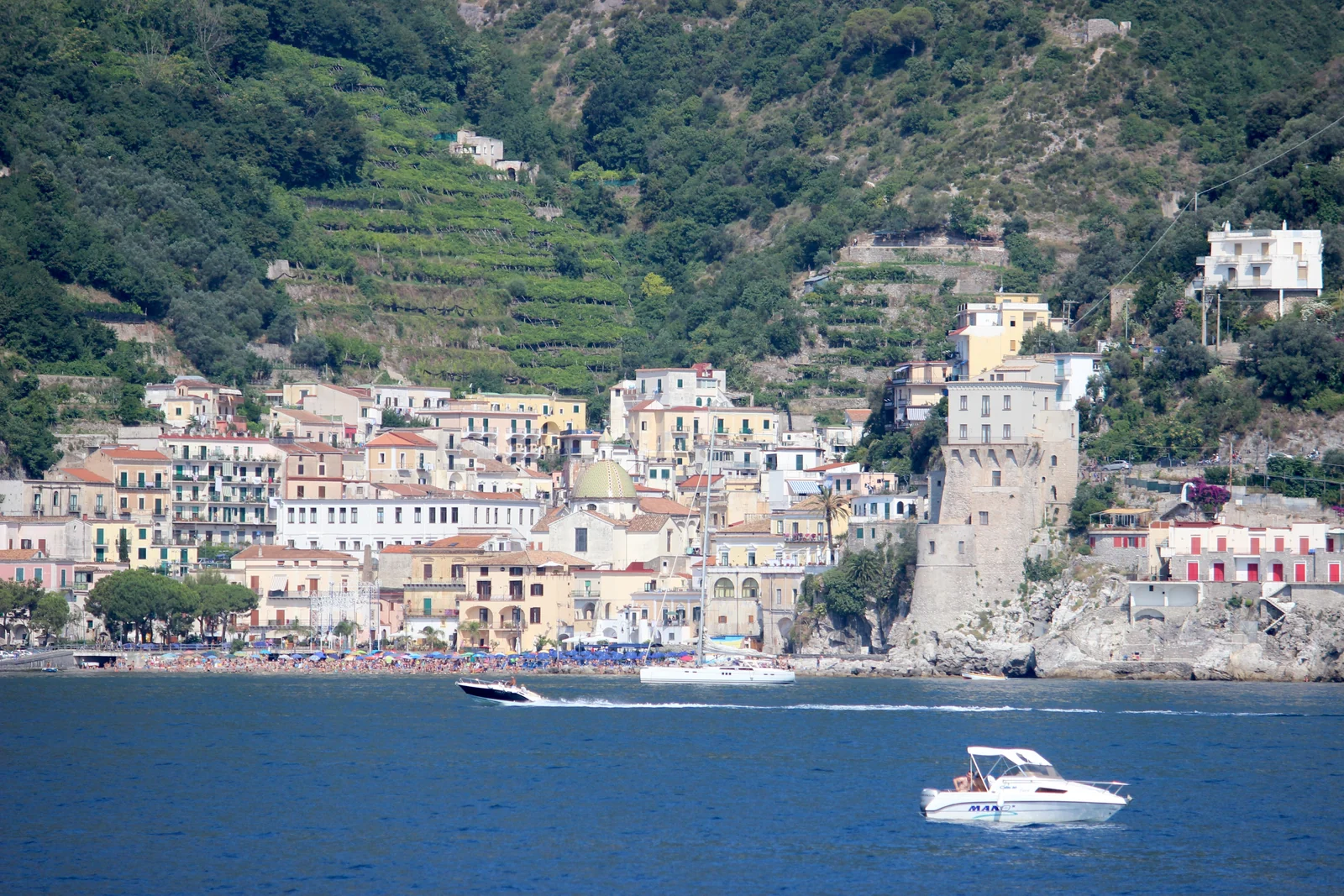
Photo: Miguel Hermoso Cuesta / Wikimedia Commons — CC BY-SA 4.0 · Resized and converted to WebP.
Where to stay
In the municipality of Salerno the national database of the Ministry of Tourism lists 1513 accommodation businesses with a verified CIN code: 13 hotels, 309 other licensed accommodation and 1191 other types such as B&Bs and private rentals.
Licensed businesses from the official list of accommodation named as the source in this section. Where the list gives it, the property's official identification code appears next to its name: the national CIN code, or the code assigned by the Region or by the body that keeps the list. Private individuals are not listed. This list is the official census of licensed businesses, not a list of Apulica partners: to stay in Salerno you do not have to check one property after another yourself; write to Apulica and we look for the stay that suits your journey, checking availability and conditions before any confirmation.
Grand Hotel Salerno
Hotel · ★★★★
Regional code (CUSR) 15065116ALB0357
azienda agrituristica vivinatura di francesco sansone
Farm stay
Regional code (CUSR) 15065116EXT1601
14 Leoni
Guest rooms
Regional code (CUSR) 15065116EXT0006
hostel salerno experience
Hostel
Regional code (CUSR) 15065116EXT1807
Casa di Accoglienza Lions ONLUS
Holiday house
Regional code (CUSR) 15065116EXT0166
Lloyd's Baia Hotel
Hotel · ★★★★
Regional code (CUSR) 15065116ALB0532
Villa Avenia
Farm stay
Regional code (CUSR) 15065116EXT0815
1Passodaltreno
Guest rooms
Regional code (CUSR) 15065116EXTS7YE
Saint Joseph
Holiday house
Regional code (CUSR) 15065116EXT1832
Mediterranea
Hotel · ★★★★
Regional code (CUSR) 15065116ALB0564
First the places that presented themselves to Apulica, the latest first; then one place of each type in turn, by official category and stars, then by name. No position is paid for.
All 154 entries in alphabetical order
Page 1 of 16
| Name | Type | Identification code |
|---|---|---|
| 14 Leoni | Guest rooms | Regional code (CUSR) 15065116EXT0006 |
| 1Passodaltreno | Guest rooms | Regional code (CUSR) 15065116EXTS7YE |
| 4 Rosso | Guest rooms | Regional code (CUSR) 15065116EXT1847 |
| 4Rooms | Guest rooms | Regional code (CUSR) 15065116EXTQGN5 |
| Affittacamere Casa Maria - Express | Guest rooms | Regional code (CUSR) 15065116EXT1766 |
| affittacamere central concordia di petrone filomena | Guest rooms | Regional code (CUSR) 15065116EXT1388 |
| Affittacamere Duca D'Amalfi | Guest rooms | Regional code (CUSR) 15065116EXT1961 |
| AFFITTACAMERE OLD SALERNO | Guest rooms | Regional code (CUSR) 15065116EXT1154 |
| affittacamere piazza vittorio veneto | Guest rooms | Regional code (CUSR) 15065116EXT79AD |
| Affittacamere Re Di Denari | Guest rooms | Regional code (CUSR) 15065116EXTVF02 |
Ask Apulica for a stay in Salerno We reply shortly, within a few hours at most, with a proposal for you to consider.
Sources: Ministero del Turismo – Banca Dati Strutture Ricettive (dashboard pubblica), 2026-10-12
YOUR JOURNEY
How to shape a journey here
We can organise a guided visit of the city, from the cathedral to the Minerva Garden and the castle, or a trip for the Luci d'Artista or Saint Matthew's feast, with transfers from the airports and the station, to the Amalfi Coast, Paestum and the Cilento. For a trip, a guide or a transfer you can write to Apulica with the button below.
Plan your tripKeep exploring
Amalfi Coast
The UNESCO cultural landscape between Positano and Vietri sul Mare: citrus terraces, footpaths, inland valleys and the history of a maritime republic.
Read the guide →Photo: Wolfgang Moroder / Wikimedia Commons — CC BY-SA 3.0 · Resized and converted to WebP.

Cilento
The Cilento, Vallo di Diano and Alburni National Park: coastline, karst mountains, Paestum, Velia and the Padula Charterhouse.
Read the guide →Photo: PaestumPaestum / Wikimedia Commons — CC BY-SA 4.0 · Resized and converted to WebP.

Picentini Mountains
A regional park of beech woods, springs and hill villages, with Giffoni Valle Piana and its film festival for young people.
Read the guide →Photo: Csal1933 / Wikimedia Commons — CC BY-SA 4.0 · Resized and converted to WebP.

Capaccio Paestum
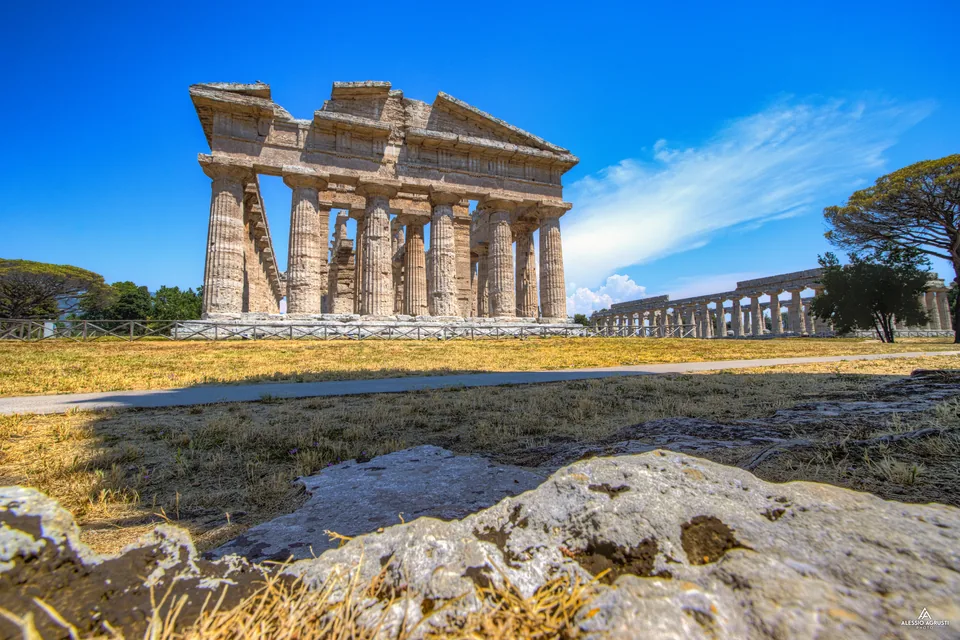
Capaccio Paestum (SA), Campania: 22,410 residents, 113.55 km². The official facts of the municipality, its town council website and its registered accommodation. The Doric temples of Paestum, the National Archaeological Museum with the Tomb of the Diver, the Greek and Lucanian walls, the old village of Capaccio, PDO buffalo mozzarella from Campania and the PGI Paestum artichoke.
Read the guide →Photo: AlessioAg89 / Wikimedia Commons — CC BY-SA 4.0 · Resized and converted to WebP.

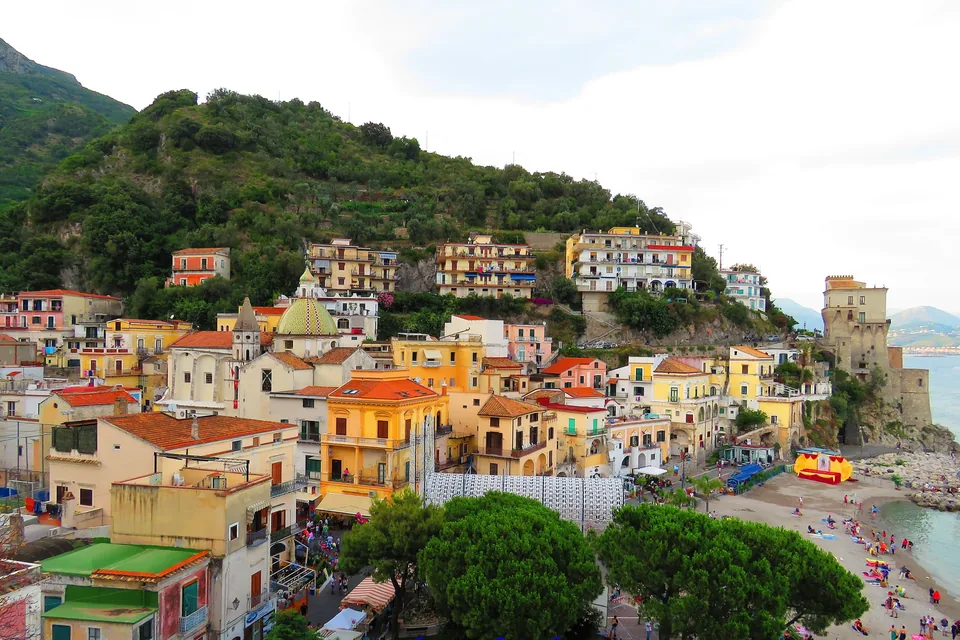
Cetara
Cetara (SA), Campania: 1,928 residents, 5.00 km². The official facts of the municipality, its town council website and its registered accommodation. The Viceregal tower on the Marina, the majolica dome of San Pietro, the Colatura di alici di Cetara PDO, tuna and anchovy fishing, the beaches and the footpaths of the Amalfi Coast.
Read the guide →Photo: Gianfranco Vitolo / Wikimedia Commons — CC BY 2.0 · Resized and converted to WebP.

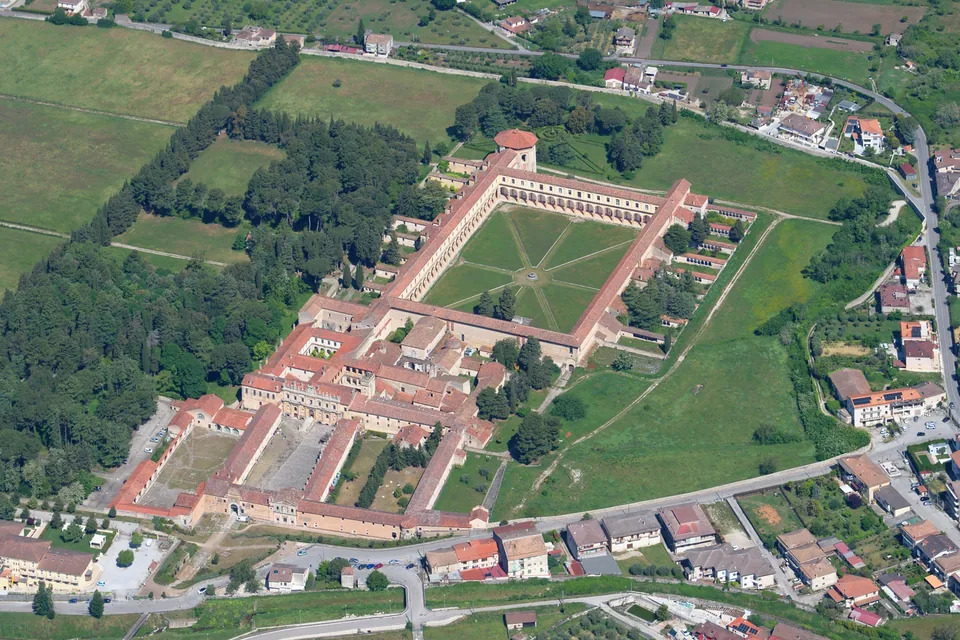
Padula
Padula (SA), Campania: 4,819 residents, 67.11 km². The official facts of the municipality, its town council website and its registered accommodation. The Certosa di San Lorenzo, a UNESCO World Heritage site since 1998, the baptistery of San Giovanni in Fonte, the Joe Petrosino house museum and the re-enactment of Charles V with the thousand-egg omelette.
Read the guide →Photo: Carsten Steger / Wikimedia Commons — CC BY-SA 4.0 · Resized and converted to WebP.

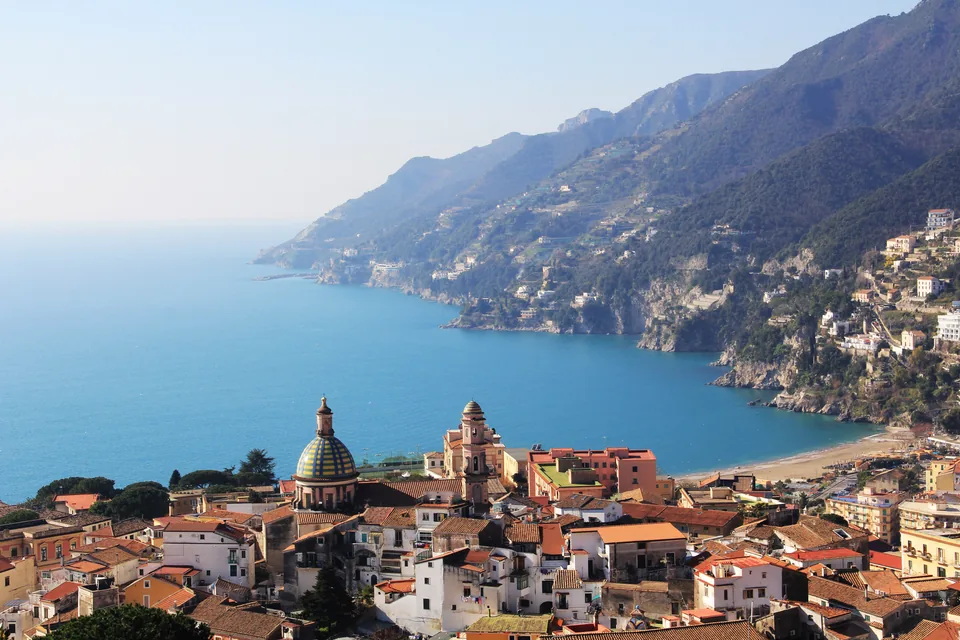
Vietri sul Mare
Vietri sul Mare (SA), Campania: 6,962 residents, 9.53 km². The official facts of the municipality, its town council website and its registered accommodation. Vietri ceramics, from the old faenzere workshops to today’s shops, the cathedral with its majolica dome, the Ceramics Museum at Villa Guariglia, Paolo Soleri’s Solimene factory, the Limone Costa d’Amalfi PGI lemon and the beaches of the Marina.
Read the guide →Photo: Anila amataj / Wikimedia Commons — CC BY-SA 4.0 · Resized and converted to WebP.

“Come to Salerno as a guest, not as a tourist: that is how these places truly let you know them.”