

Why go
Conversano sits on a hill of the Murge, about 8 kilometres from the sea. Its heart is a single square that locals still call “Largo della Corte”: the counts’ castle and the Romanesque cathedral face onto it, with the monastery of San Benedetto a few steps away. These are the three institutions that, the town council writes, dominated the town in the Middle Ages.
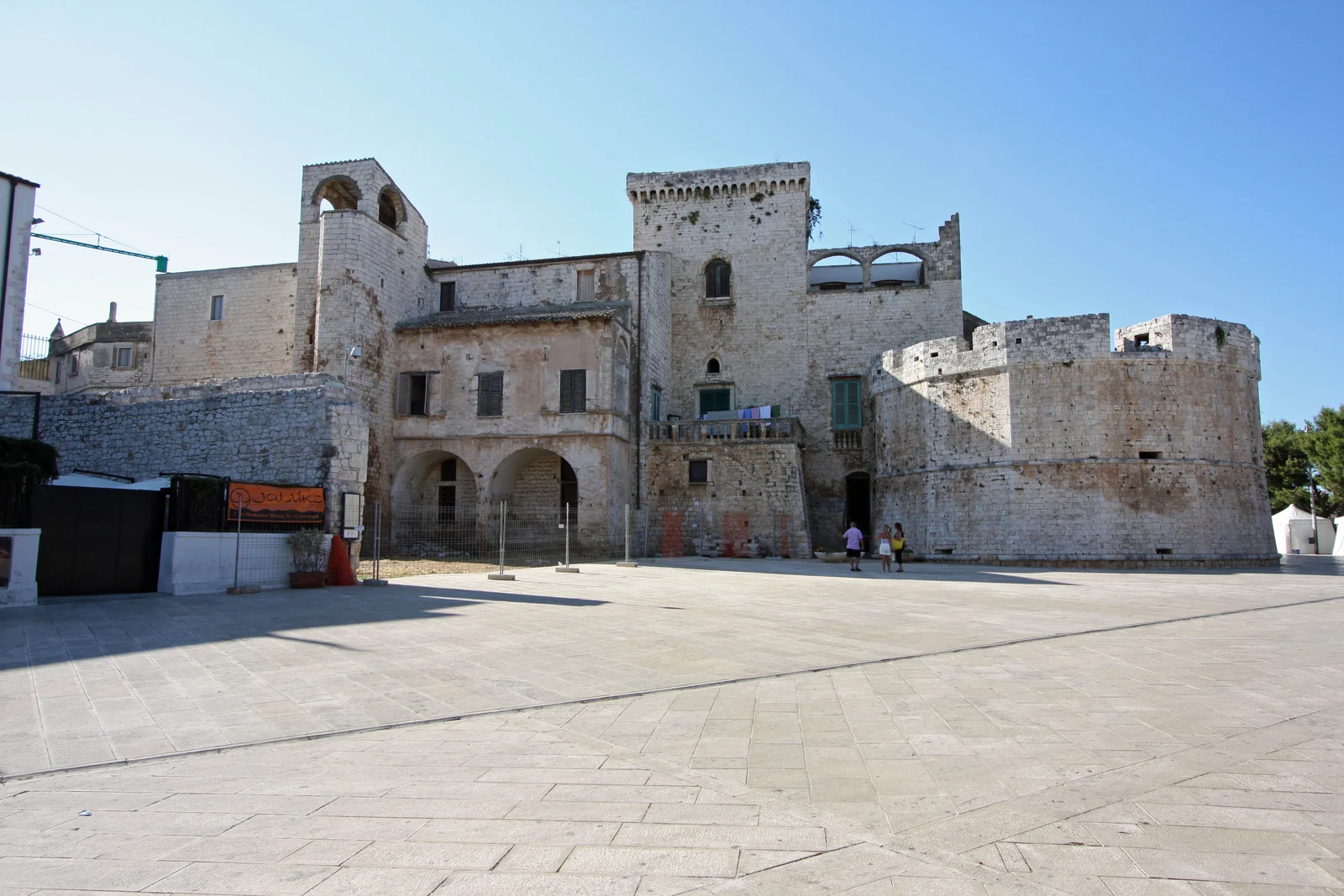
The castle of the Acquaviva d’Aragona, symbol of the town, houses the municipal picture gallery with the ten large canvases of the “Gerusalemme Liberata” painted by Paolo Finoglio for Count Giangirolamo II. The cathedral, a national monument since 1897, keeps the icon of the Madonna della Fonte, the town’s patron. For five centuries the monastery of San Benedetto was the seat of the “mitred abbesses”, who wore the mitre and carried the crozier like bishops: a power the town council calls unique in Western Christendom.
Outside the centre lie the lakes of Conversano, small karst hollows that fill with water when it rains, which give their name to a regional nature reserve. Olive, almond, vine and cherry trees grow in the fields around the town: among the cherries, the council says, the “ferrovia” variety stands out.
Sources: Comune di Conversano — Cenni vari · Comune di Conversano — Storia, arte e cultura · Comune di Conversano — Castello Acquaviva d’Aragona · Comune di Conversano — Basilica Cattedrale Maria SS. Assunta · Comune di Conversano — Monastero di San Benedetto · Comune di Conversano — Natura e verde pubblico · Regione Puglia — Deliberazione della Giunta regionale 21 dicembre 2023, n. 1939: contributi alle aree protette regionali · Comune di Conversano — Economia
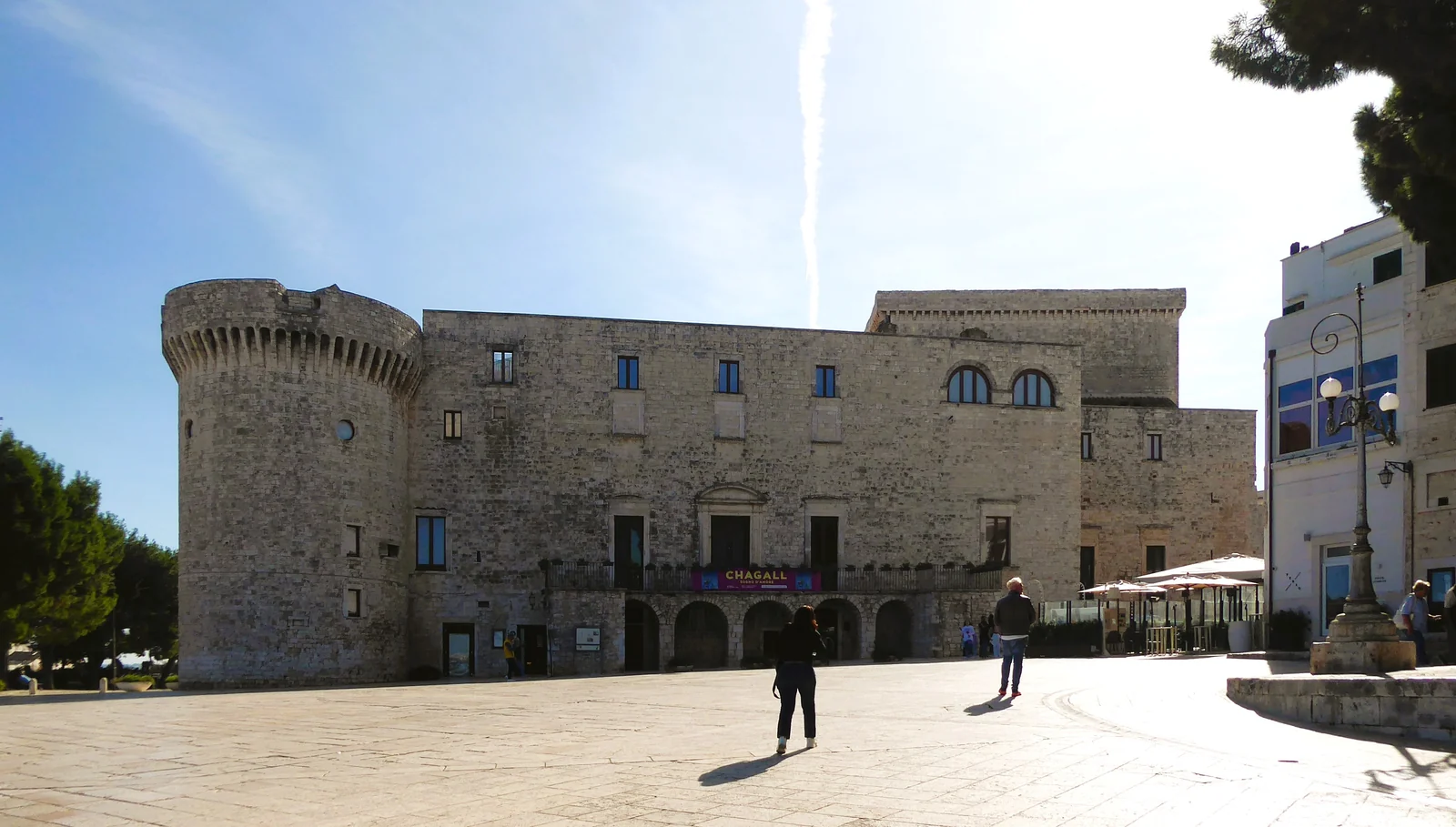
Photo: Chris06 / Wikimedia Commons — CC BY-SA 4.0 · Resized and converted to WebP.
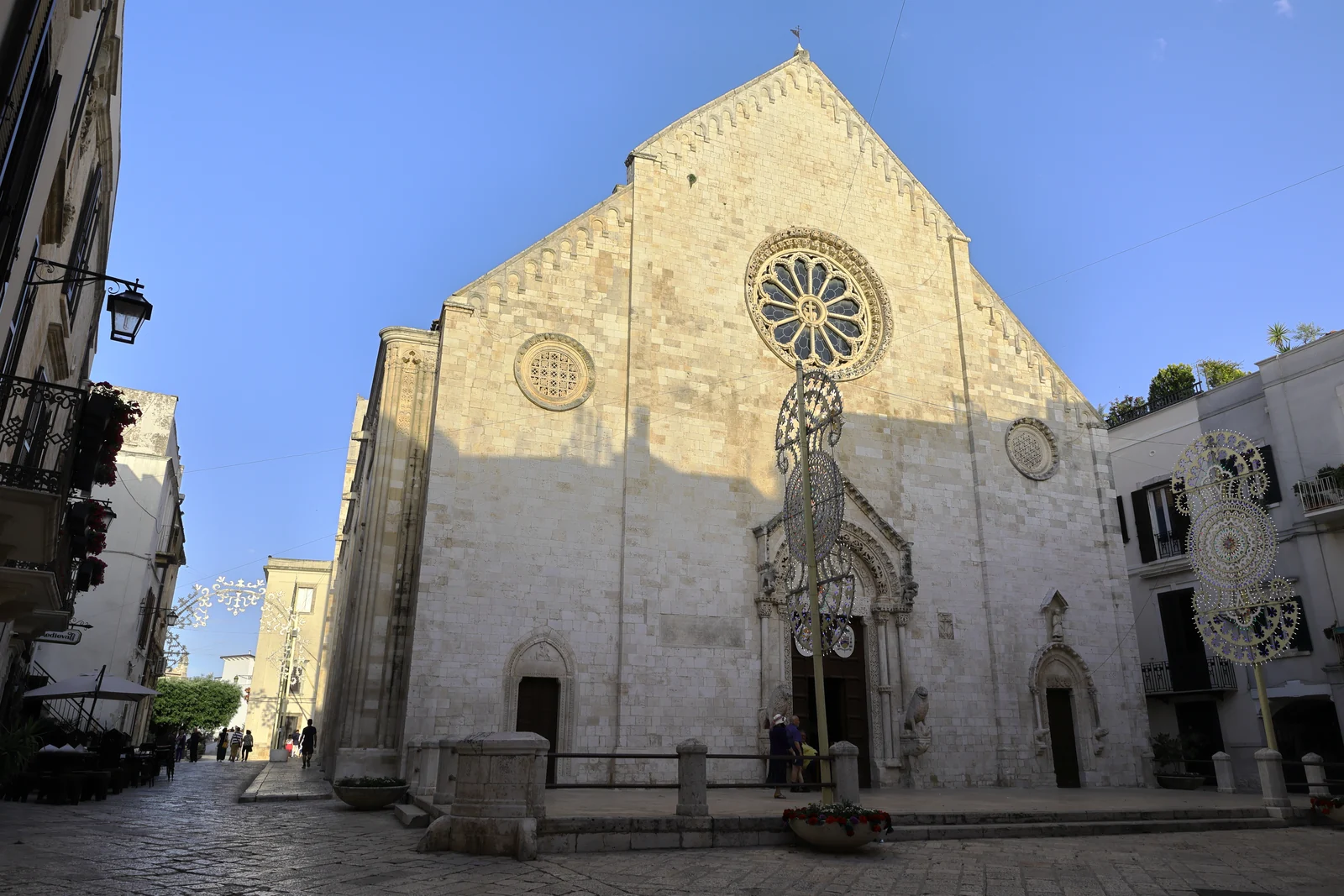
Photo: Eletto Luigi / Wikimedia Commons — CC BY-SA 4.0 · Resized and converted to WebP.
The municipality at a glance
Conversano is a municipality in the Metropolitan City of Bari, in Puglia. Its ISTAT code is 072019. On 1 January 2025 it had 25,938 residents. The municipal territory covers 128.42 km² and ranges from 35 to 346 metres above sea level; the town hall stands at about 217 metres.
According to the town council, the town stands on a hill at 219 metres, about 8 kilometres from the sea. It includes the village of Triggianello, about 8 kilometres from the centre, where the provincial roads to Castellana, Polignano, Monopoli and Conversano meet; the council puts its population at about 1,500.
Sources: ISTAT, Codici statistici delle unità amministrative territoriali: elenco dei comuni al 21 febbraio 2026 · ISTAT, Popolazione residente per età, sesso e stato civile al 1° gennaio 2025 (POSAS) · ISTAT, Principali statistiche geografiche sui comuni: superficie e altimetria al 31 dicembre 2021 · Comune di Conversano — Cenni vari · Comune di Conversano — Nei dintorni: la frazione di Triggianello
History
The town council dates a first village with certainty to the Iron Age, between the eighth and sixth centuries BC, inhabited by Iapygian and Peucetian peoples. Its name was perhaps Norba, “a settlement enclosed in a round hollow”. It was a wealthy centre, protected by walls of which stretches remain: at the foot of the castle’s only surviving Norman tower the blocks of the megalithic walls can still be seen. In 268 BC Norba came into Rome’s orbit; with the invasions that followed the end of the empire it disappeared, and in the fifth century the village of Cupersanem appeared.
Under the Normans the town became the centre of a county: Geoffrey of Hauteville, nephew of Robert Guiscard, took the title “comes Cupersani”, and the council gives 1054 as the year the county’s history began. Over the next four centuries the county passed through many families, from the Hautevilles to the Briennes (Walter IV of Brienne had the “Casal Vecchio” built in 1338) and the Orsini. In 1455 Caterina Orsini del Balzo, daughter of the prince of Taranto, brought it as her dowry to Giulio Antonio Acquaviva, duke of Atri and count of Teramo.
Giulio Antonio died fighting the Turks who had landed at Otranto, on 6 February 1481; King Ferdinand I of Naples then granted him and his descendants the royal name “d’Aragona”. His son Andrea Matteo, a patron and translator of Plutarch, gave the castle a library and one of the first printing presses in the kingdom; Count Adriano built the grid-planned “Casal Nuovo” between the sixteenth and seventeenth centuries. The best known of the counts is Giangirolamo II, the “Guercio delle Puglie” (the one-eyed of Apulia), who held the county from 1626 and died in 1665: around him history blends with legend, but he was also the patron of Paolo Finoglio and of the church of the Santi Medici.
Beside the counts stood the bishops and the abbesses of San Benedetto, who quarrelled for centuries. Feudalism ended on 2 August 1806 with Joseph Bonaparte’s law, and Joachim Murat abolished the abbesses’ power. In the nineteenth century the local architect Sante Simone (1823-1894) redesigned part of the town; on 20 May 1886 a revolt against the “galantuomini”, the local gentry, ended with the burning of the town hall, which destroyed the archive and the municipal library. On 25 September 1921 the Conversano deputy Giuseppe Di Vagno was murdered by fascist squads.
Sources: Comune di Conversano — Storia, arte e cultura · Comune di Conversano — Castello Acquaviva d’Aragona · Comune di Conversano — Archivio storico · Comune di Conversano — Chiesa dei SS. Medici Cosma e Damiano · Comune di Conversano — Monastero di San Benedetto
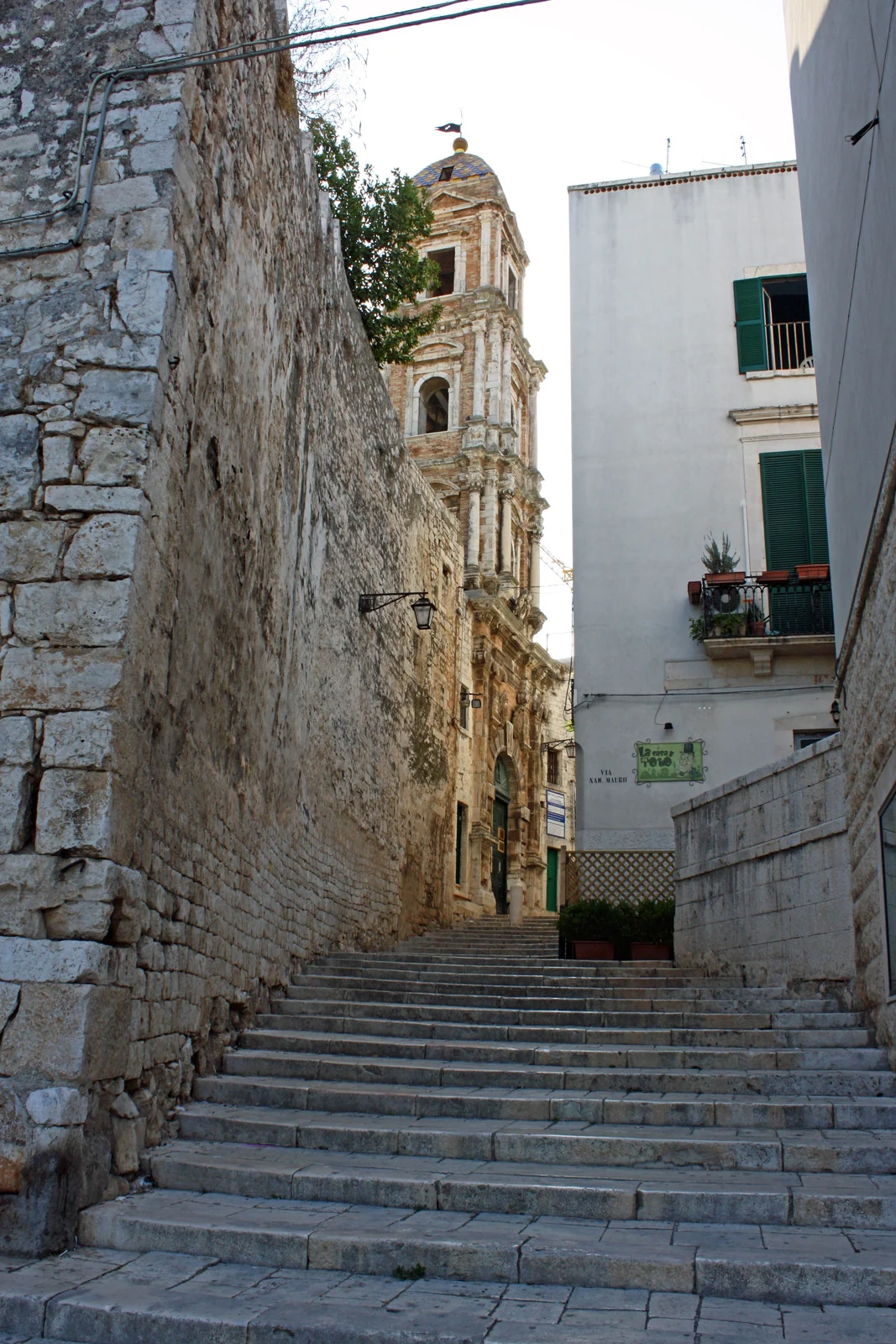
Photo: Carlo Pelagalli / Wikimedia Commons — CC BY-SA 3.0 · Resized and converted to WebP.
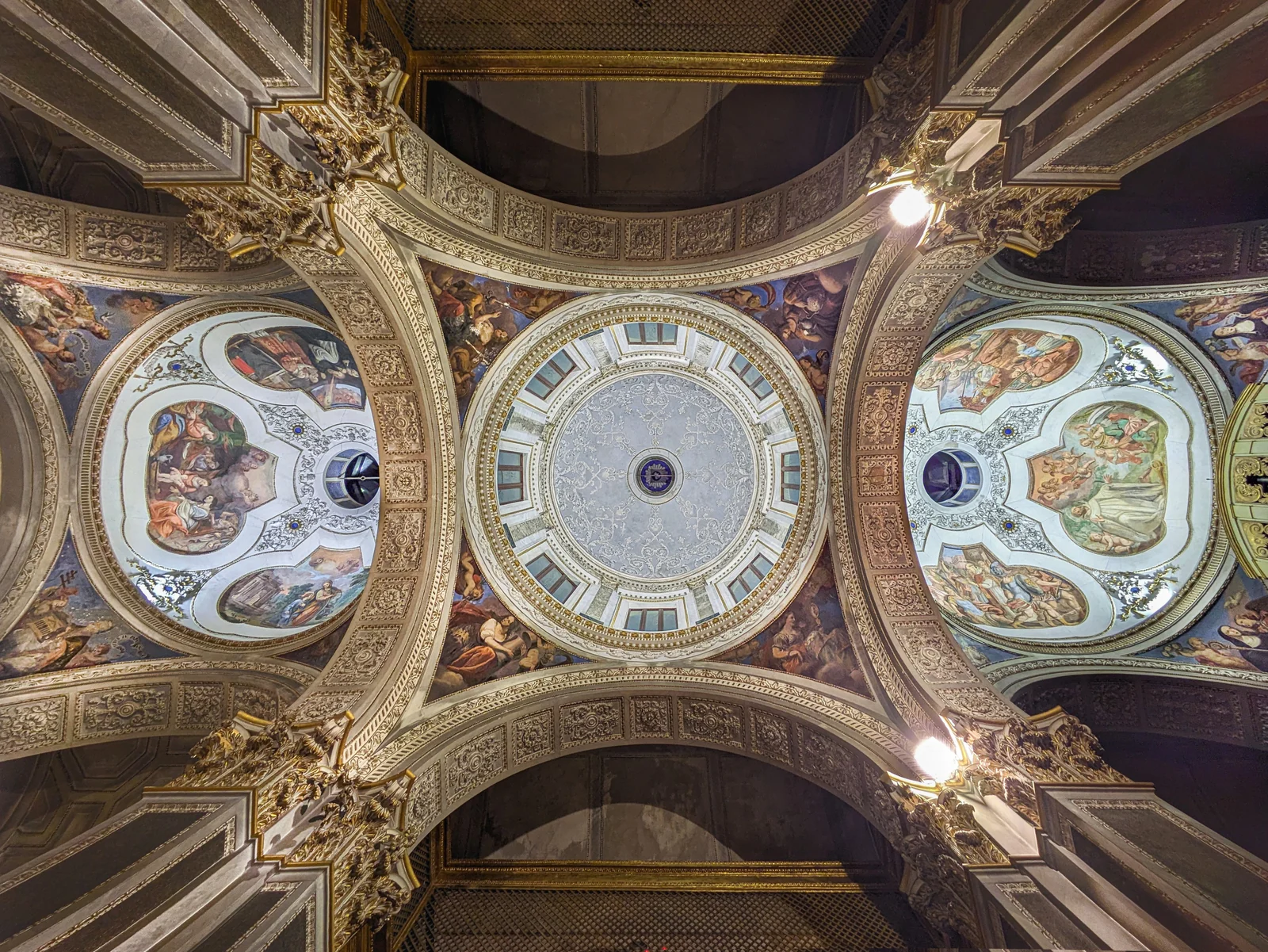
Photo: Abbrey82 / Wikimedia Commons — CC BY-SA 4.0 · Resized and converted to WebP.
What to see
The Acquaviva d’Aragona castle, at Piazza della Conciliazione 8, stands at 220 metres on the remains of Norba’s megalithic walls. It is trapezoidal in plan, with its four corners pointing to the cardinal directions. The oldest core is the “torre maestra”, the 25-metre keep; Giulio Antonio Acquaviva added the round tower on the north side (1480) and turned the fortress into a residence, while the council attributes the sloping twelve-sided tower to his son Andrea Matteo. The entrance portal dates from 1710; on the wall facing the square, the family coat of arms joins the insignia of the count and of Caterina Orsini del Balzo. From the courtyard, with a portico and loggia on two sides, stairs lead to the halls: the inventory of 1666 listed more than five hundred works, among them a Madonna by Artemisia Gentileschi and Lanfranco’s “Allegory of Venice”. The bedchamber was frescoed in 1622 by Paolo Finoglio for Count Giangirolamo’s wedding to Isabella Filomarino.
The castle houses the municipal picture gallery, with Finoglio’s seventeenth-century canvases of the “Gerusalemme Liberata”; on the upper floor are the “Francesco Netti” gallery and the exhibition of historic costumes “Nozze al Castello”. From the top of the tower, the council writes, the view reaches the Adriatic.
The cathedral of Maria Santissima Assunta and San Flaviano, with its apses facing east, has a Latin-cross plan and three naves, like the Apulian churches modelled on the basilica of San Nicola in Bari. Building began at the end of the eleventh century and the church was enlarged in 1359; in the seventeenth century it was covered with Baroque stucco, which Sante Simone began to lighten in 1878. On the night of 10-11 July 1911 a fire destroyed the interior: only the icon of the Madonna della Fonte and the Crucifix, now in the right-hand nave, were saved. The rebuilding returned the church to its Romanesque form, with a trussed roof, a remade rose window and the column-bearing lions of the portal; it was reconsecrated in the 1930s. It holds a fragment of a fourteenth-century fresco of the Virgin and Child and a relic of the arm of San Flaviano. John Paul II raised it to a minor basilica.
The monastery of San Benedetto has a documented history from 889. In 1110 Pope Paschal II exempted it from the bishop’s authority; in the second half of the thirteenth century it passed to Cistercian nuns led by Dameta Paleologo, the first “mitred abbess”. The medieval “chiostrino” (twelfth-thirteenth century) has paired columns and twelve capitals carved with owls and imaginary animals; the large cloister dates from 1605. In the church, above the polychrome marble high altar (1766), hangs Finoglio’s canvas of Saints Blaise and Benedict, and Francesco Antonio Altobello painted the three domes of the nave; the Baroque bell tower dates from 1655. The monastery houses the municipal archaeological museum, at Via San Benedetto 18, and since 2023 the municipal historical archive.
The church of the Santi Medici Cosma e Damiano was originally the Romanesque church of San Matteo: Count Giangirolamo II and his wife Isabella Filomarino had it renewed from around 1630, entrusting the decoration to Paolo Finoglio, who died in 1645 leaving the cycle of the vault and chapels, with the “Martyrdom of San Gennaro”. It was consecrated in 1660; above the high altar hangs the canvas of Saints Cosmas and Damian by Alessandro Turchi, known as l’Orbetto. One chapel is dedicated to Saint Rita: the council calls it the second shrine of the saint in Italy after Cascia. The church of the Carmine, rebuilt with the support of the Acquaviva and finished in 1662, has seventeenth-century wooden altars and, on the high altar, Andrea Malinconico’s fresco of the Madonna del Carmine.
Outside the town, on the provincial road to Rutigliano, the complex of Santa Maria dell’Isola was begun in 1462 at the wish of Count Giulio Antonio Acquaviva and entrusted to the Friars Minor of the Observance. The church holds the tomb monument of a Count Giangirolamo Acquaviva, in painted stone, by Nuzzo Barba, frescoes of the fifteenth and sixteenth centuries and the “Cristo nero”, the black crucifix much venerated by the people of Conversano; the monastery has two cloisters, from about 1462 and from 1481. In town, just outside the walls, Villa Garibaldi is a public garden of 1883 designed by Sante Simone, with an avenue of holm oaks, the medieval Torre Martucci and a view towards the sea.
Sources: Comune di Conversano — Castello Acquaviva d’Aragona · Comune di Conversano — Luoghi: Castello dei Conti Acquaviva d’Aragona · Comune di Conversano — Cenni vari · Comune di Conversano — Basilica Cattedrale Maria SS. Assunta · Comune di Conversano — Monastero di San Benedetto · Comune di Conversano — Archivi Aperti 2026 al Museo archeologico (16-25 ottobre 2026) · Comune di Conversano — Archivio storico · Comune di Conversano — Chiesa dei SS. Medici Cosma e Damiano · Comune di Conversano — Chiesa del Carmine · Comune di Conversano — Santa Maria dell’Isola · Comune di Conversano — Villa Garibaldi
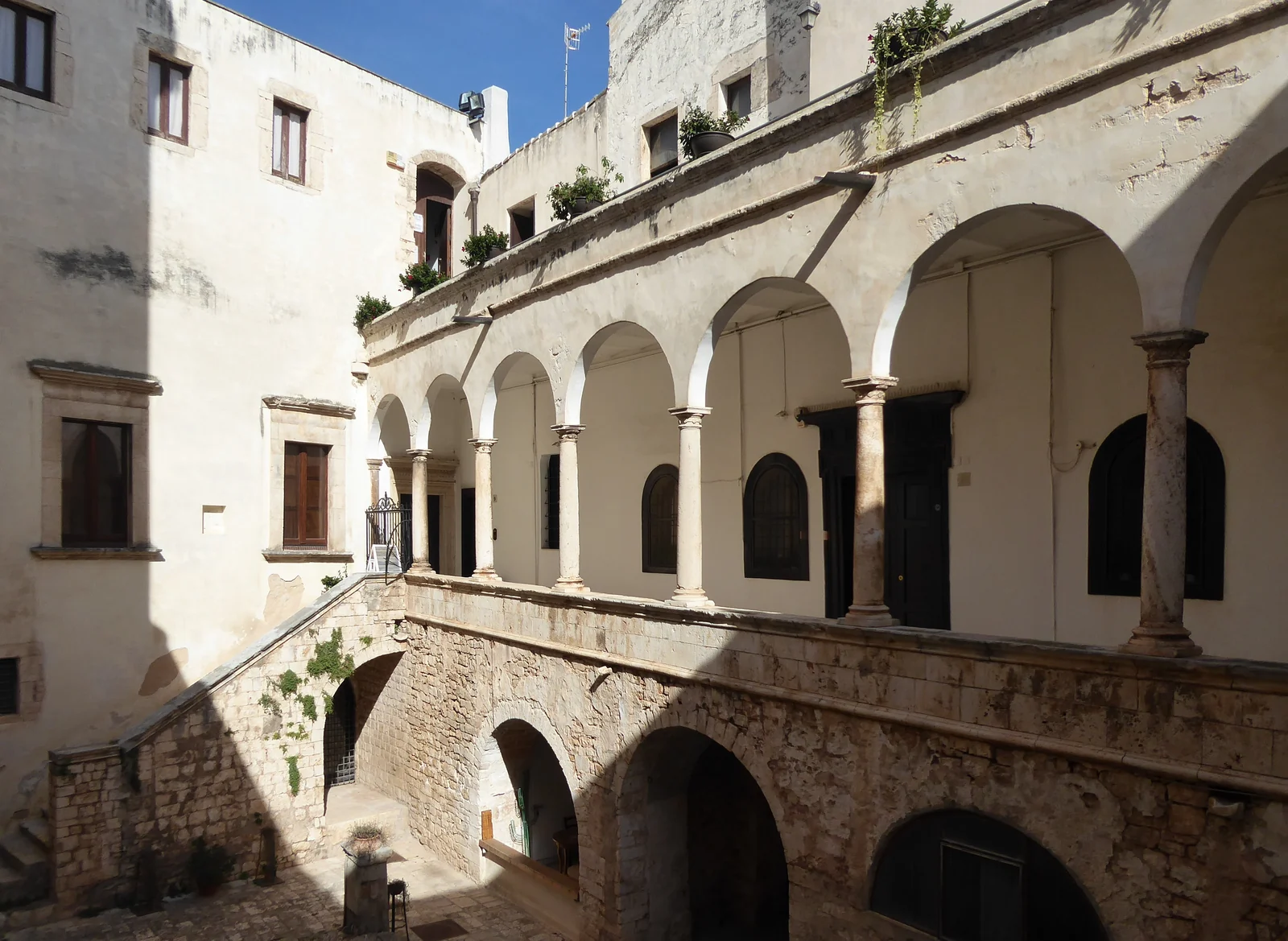
Photo: Chris06 / Wikimedia Commons — CC BY-SA 4.0 · Resized and converted to WebP.
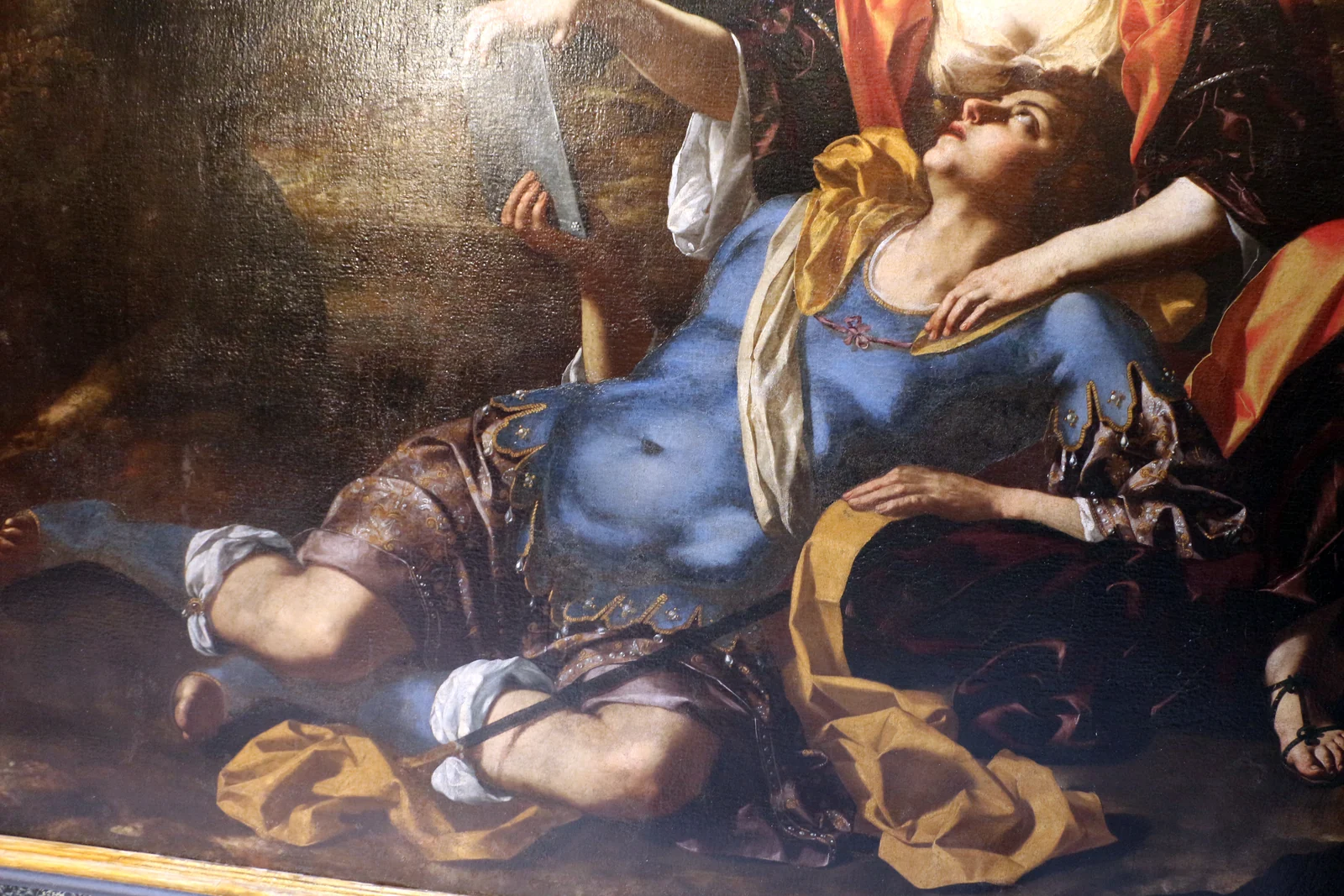
Photo: Sailko / Wikimedia Commons — CC BY 3.0 · Resized and converted to WebP.
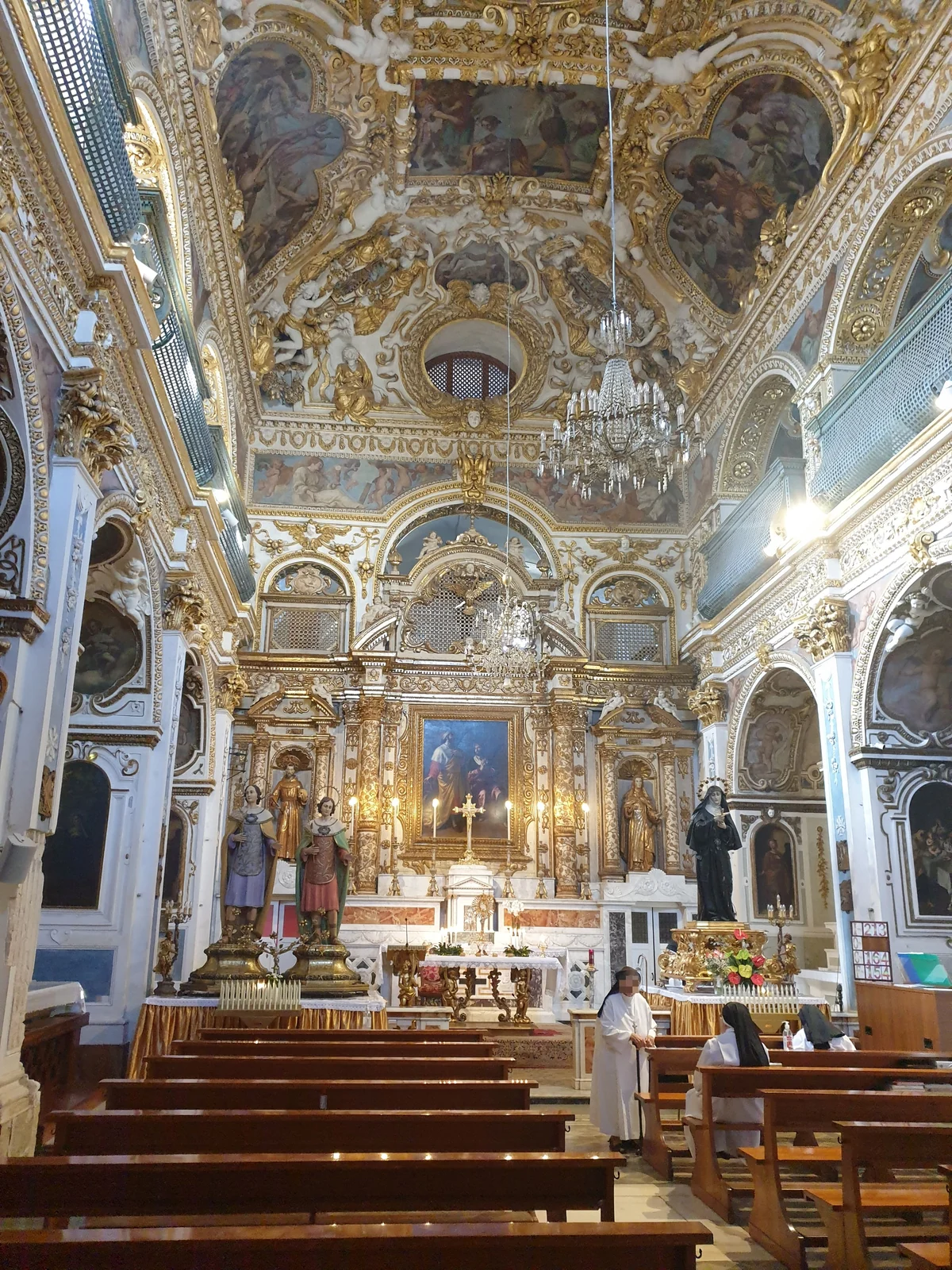
Photo: Chris06 / Wikimedia Commons — CC BY-SA 4.0 · Resized and converted to WebP.
Food and wine
According to the town council, Conversano’s economy is mainly agricultural: olive groves, almond orchards, vineyards, vegetables and fruit, with oil mills, wineries and canning plants. The largest crop is cherries, of many varieties, among which the “ferrovia” stands out; much of the farm produce, the council writes, is exported to northern Europe. Conversano’s cherry has no European quality mark: the eAmbrosia register lists no designation for cherries from this area.
Olive oil, on the other hand, has its own designation: Conversano lies within the area of the “Terra di Bari” PDO with the geographical mention “Murgia dei Trulli e delle Grotte”, together with Alberobello, Noci, Putignano, Castellana, Rutigliano, Turi, Mola, Monopoli, Polignano, Locorotondo and Casamassima. The specification reserves it for extra virgin oil made at least half from the Cima di Mola variety, with olives picked by 30 January. “Terra di Bari” is registered as a PDO in the European eAmbrosia register.
Wine has a designation too: Conversano is among the municipalities of the “Gioia del Colle” DOC, registered as a PDO in the European register. The specification provides for red, rosé and white wines, an Aleatico and the “Gioia del Colle” Primitivo, made from Primitivo grapes only. In Triggianello, a village belonging to Conversano, Saverio De Bellis opened a grape and wine plant in 1880, the first of its kind in the province according to the council, whose products, including the “Villanova” wine, reached Europe and America. Today the council points to the meat cooked “al fornello pronto” in the village.
The council’s calendar of feasts has its food festivals: the cherry festival in June, the bocconotto festival at the feast of Maris Stella on the first Sunday of August, and the festival of the Christmas pettola for the Immaculate Conception on 8 December. In November the old town hosts “Novello sotto il Castello”, which reached its sixteenth edition in 2026.
Sources: Comune di Conversano — Economia · Commissione europea, registro eAmbrosia — «Terra di Bari», DOP, PDO-IT-1542 · MASAF — Disciplinare di produzione dell’olio extravergine di oliva DOP «Terra di Bari» (GU n. 227 del 29 settembre 1998) · MASAF — Disciplinari dei vini DOP dalla E alla N: disciplinare della DOC «Gioia del Colle» (modificato con DM 7 marzo 2014) · Commissione europea, registro eAmbrosia — «Gioia del Colle», DOP (vino), PDO-IT-A0549 · Comune di Conversano — Nei dintorni: la frazione di Triggianello · Comune di Conversano — Feste, tradizioni ed eventi · Comune di Conversano — Ordinanza per «Novello sotto il Castello», XVI edizione, 13-15 novembre 2026
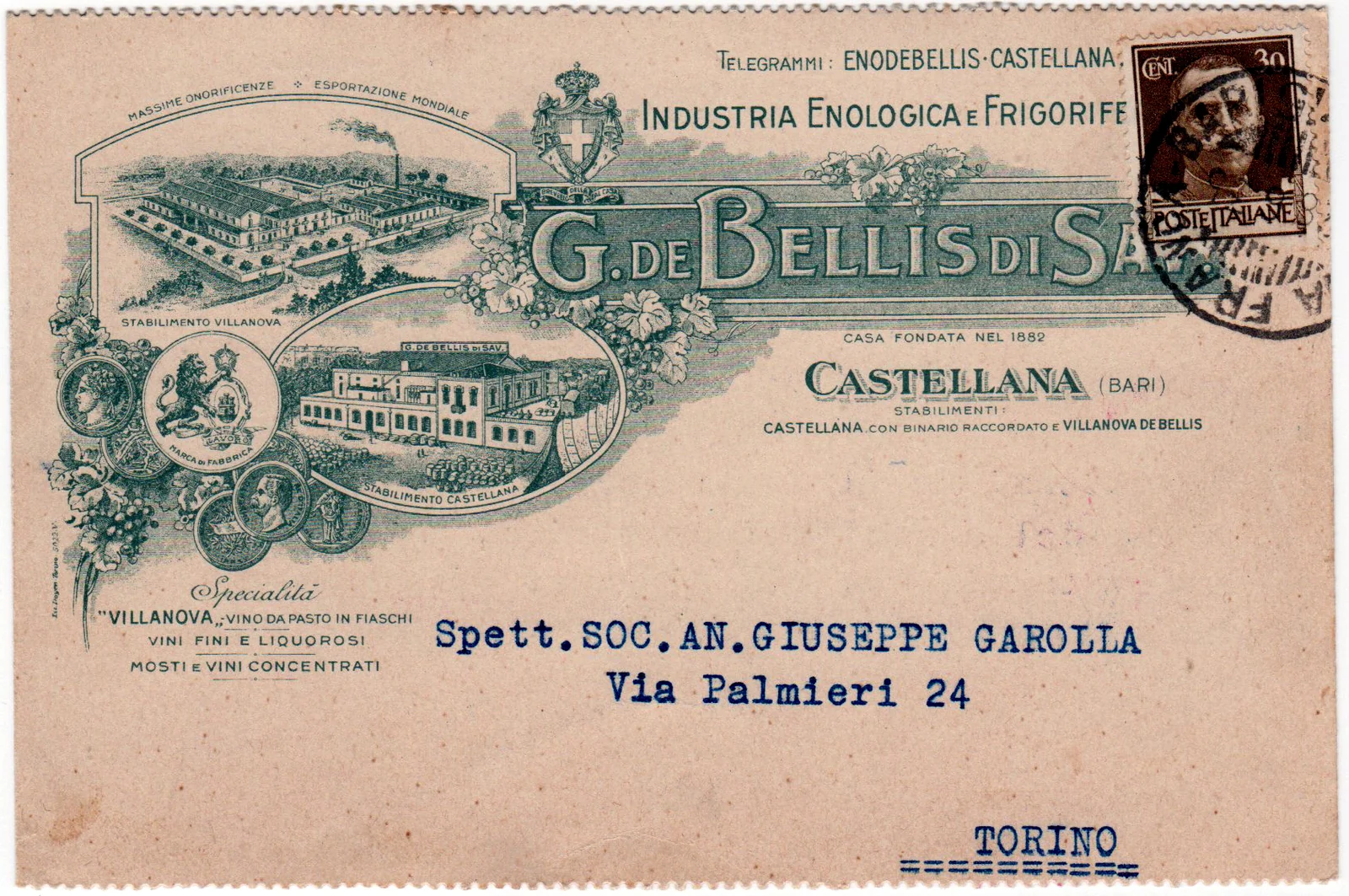
Photo: Giandomobile / Wikimedia Commons — CC BY-SA 4.0 · Resized and converted to WebP.
Experiences
The fullest visit starts in Piazza della Conciliazione: the castle with its picture gallery and Finoglio’s canvases, the cathedral, then the monastery of San Benedetto with its small cloister and the municipal archaeological museum. From 16 to 25 October 2026 the municipal historical archive showed Andrea Marchitelli’s photographs in the museum for Archivi Aperti, in its twelfth edition. The historical archive, in the former monastery, has a reading room: it keeps the council’s records from 1886 to 1985 and archives of institutions and private families.
The lakes of Conversano are karst sinkholes with no outlet, at the foot of the hills, which turn into ponds after rain; beneath the surface lie ancient cisterns built to store water. The council names Sassano, Castiglione, San Vito, Vignola, Chienna and Iavorra as the most striking. They give their name to the “Laghi di Conversano e Gravina di Monsignore” regional nature reserve, established by regional law no. 16 of 13 June 2006.
At Castiglione, 5 kilometres from the centre on the provincial road to Putignano, excavations have found a Bronze Age hut village (fourteenth century BC), graves of the sixth to fourth centuries BC and a walled medieval village abandoned at the end of the fifteenth century: you can still walk its paving, the foundations of its houses and a small church with an apse. A fifteenth-century stone tower overlooks the site; the council describes it as a wide meadow, a favourite outing on holidays.
In the evening the Cinema Teatro Norba, at Piazza della Repubblica 27, shows films and hosts a winter theatre season; the Casa delle Arti, at Via Donato Jaia 14, is a cultural centre opened in 2009 with cinema, music and theatre. The tourist info point in Via San Benedetto, reopened in 2026, runs free activities for visitors and residents.
Sources: Comune di Conversano — Monastero di San Benedetto · Comune di Conversano — Archivi Aperti 2026 al Museo archeologico (16-25 ottobre 2026) · Comune di Conversano — Archivio storico · Comune di Conversano — Natura e verde pubblico · Regione Puglia — Deliberazione della Giunta regionale 21 dicembre 2023, n. 1939: contributi alle aree protette regionali · Comune di Conversano — Contenitori culturali · Comune di Conversano — Feste, tradizioni ed eventi · Comune di Conversano — Riapre l’Info-point turistico comunale di via San Benedetto (2026)
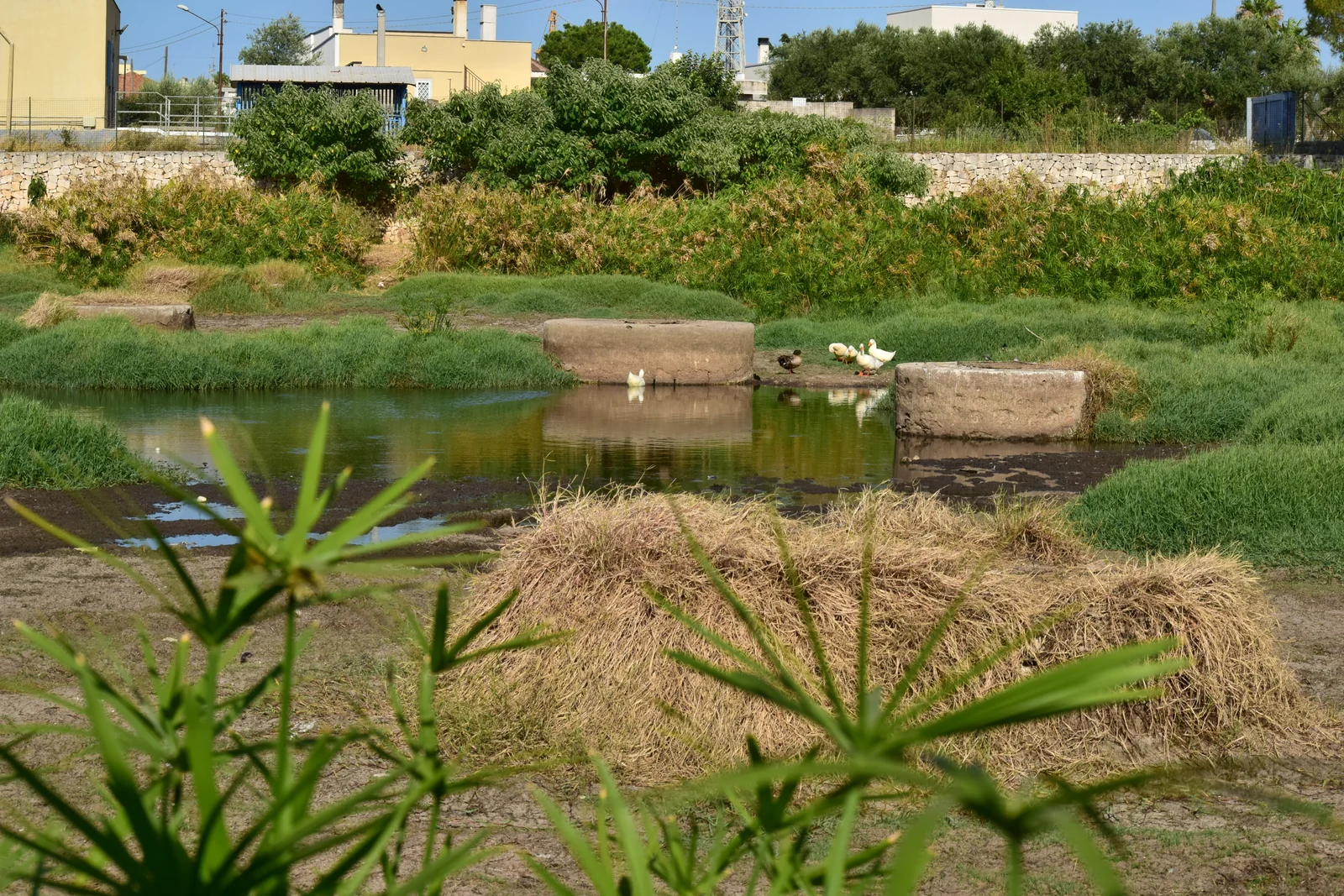
Photo: SantaAngiulli / Wikimedia Commons — CC BY-SA 4.0 · Resized and converted to WebP.
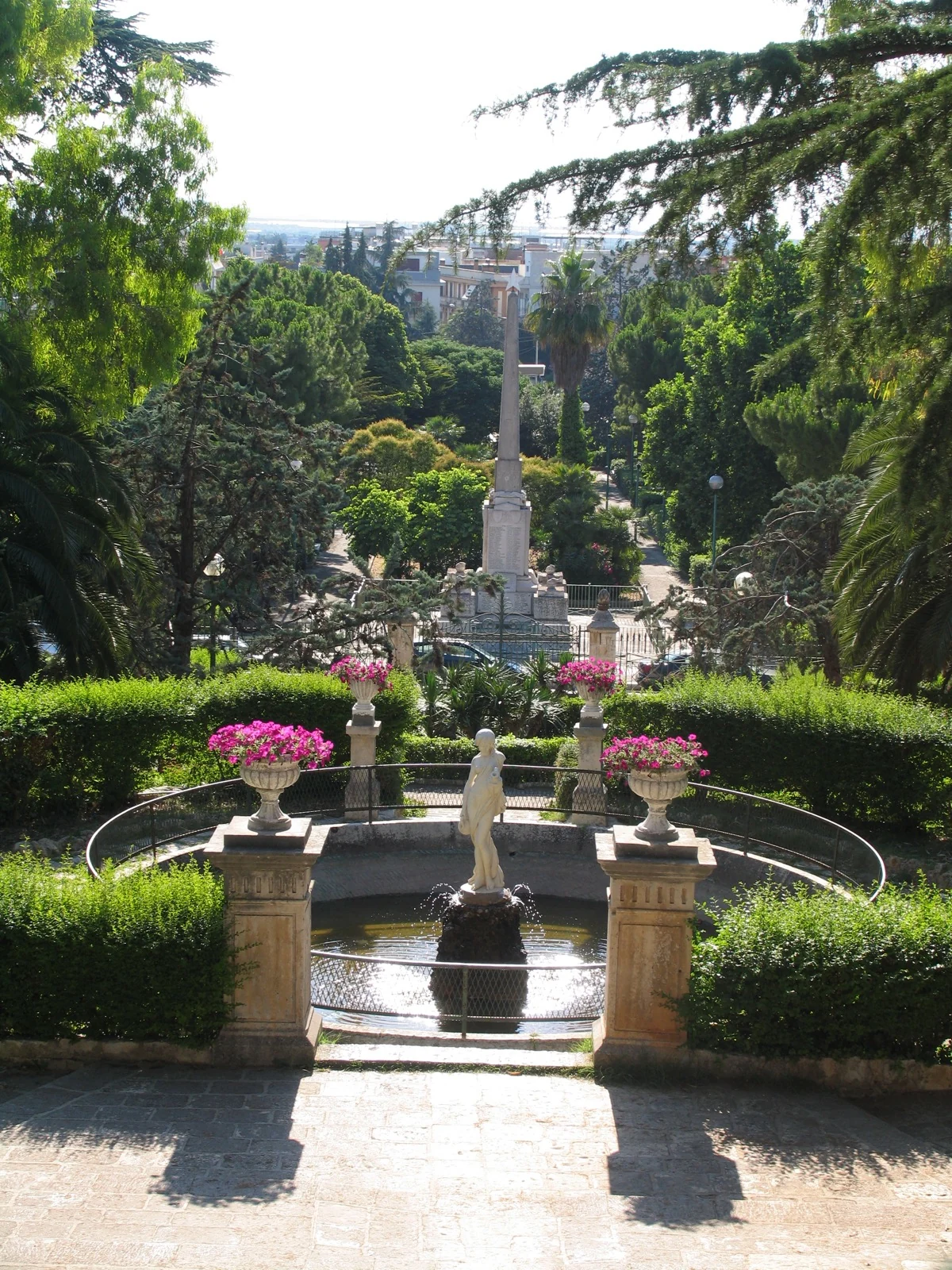
Photo: revolver77 / Wikimedia Commons — CC BY 2.0 · Resized and converted to WebP.
When to go
The calendar of feasts is on the council’s website. The most heartfelt is the feast of the Madonna della Fonte, the town’s patron, in May, with processions, bands, illuminations, fireworks and balloon launches: tradition says the icon was brought to Conversano in 489 by the first bishop, Simplicio, and since 1897 it has been the town’s protector. San Flaviano, the patron saint venerated in the cathedral, is celebrated on 24 November with a procession and a fair; another fair is held on 29 June, for Saints Peter and Paul.
In Holy Week, on Thursday people visit the “Sepolcri” in the churches, ending at Santa Maria dell’Isola, where the black Christ is venerated; at dawn the next day the crucifix is carried in procession to the centre, where it arrives around noon, ahead of the statue of Our Lady of Sorrows. On Friday afternoon the “Misteri” go out, accompanied by the band and by the “Miserere” sung in Latin.
In summer there are the Madonna del Carmine on 16 July, San Rocco on 16 August with the “Cavalcata” of decorated horses and, from June to September, concerts, theatre and cinema in the old town. On the first Sunday of October the town celebrates the Santi Medici and Saint Rita, its second feast; in winter come the bonfire of Sant’Antonio Abate on 17 January, the Immaculate Conception and Santa Lucia, with the parish nativity scenes. The town has a band tradition of more than a century: two bands play today, the “Ligonzo” and the “Piantoni”.
June is cherry time, autumn the season of oil and new wine, with “Novello sotto il Castello” in mid-November: in 2026 from the 13th to the 15th.
Sources: Comune di Conversano — Feste, tradizioni ed eventi · Comune di Conversano — Storia, arte e cultura · Comune di Conversano — Cenni vari · Comune di Conversano — Chiesa del Carmine · Comune di Conversano — Economia · Comune di Conversano — Ordinanza per «Novello sotto il Castello», XVI edizione, 13-15 novembre 2026
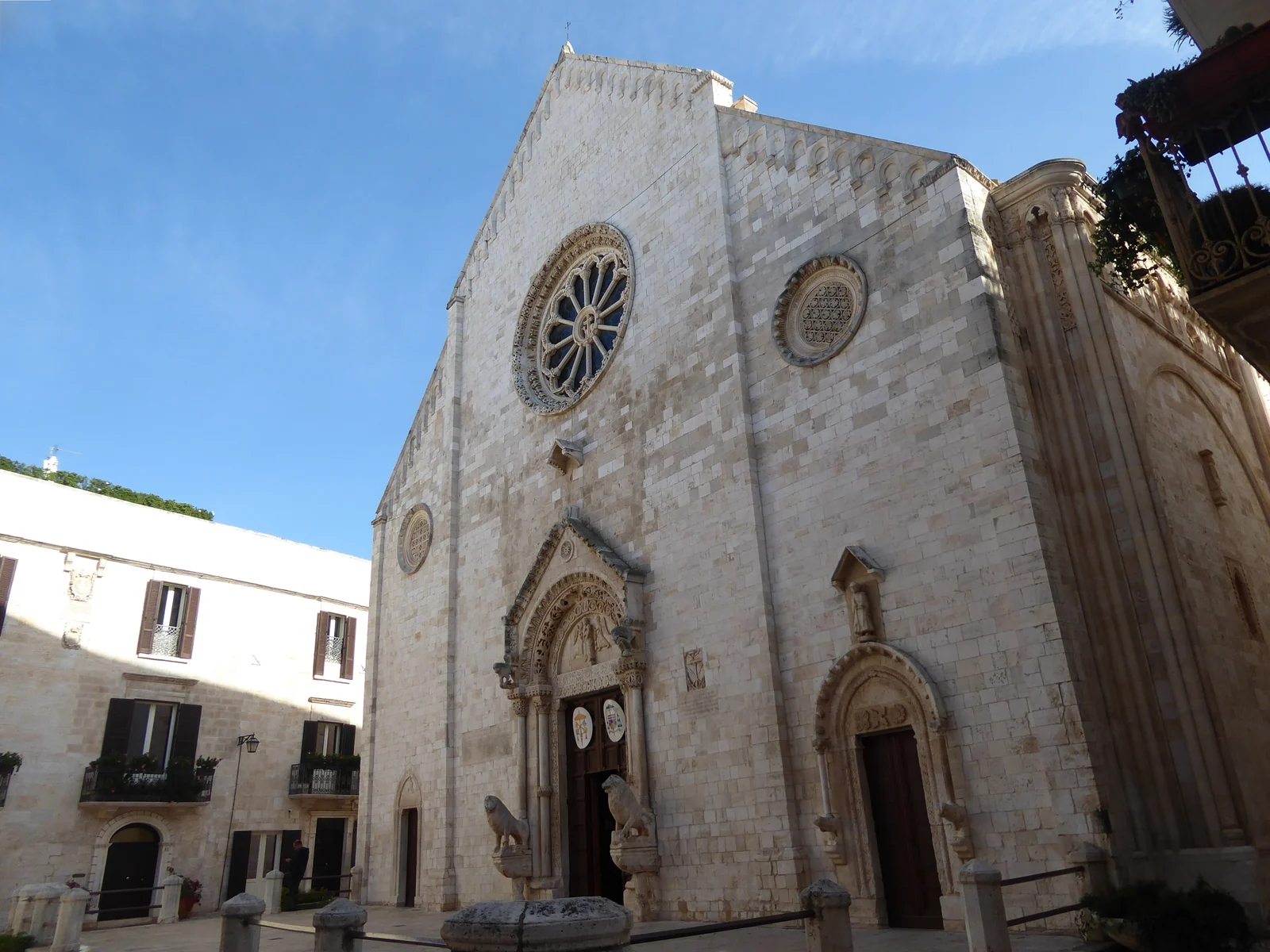
Photo: Chris06 / Wikimedia Commons — CC BY-SA 4.0 · Resized and converted to WebP.
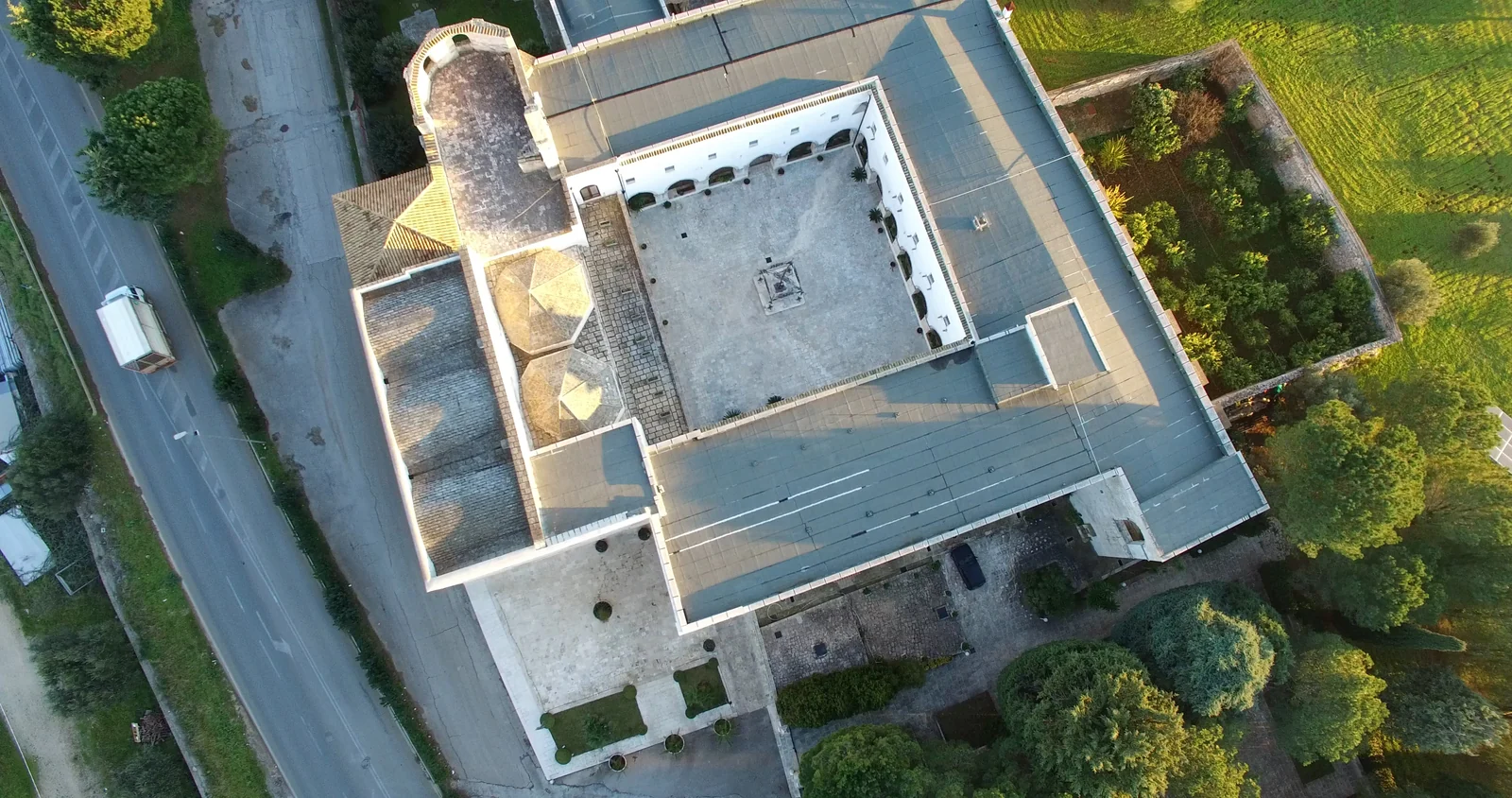
Photo: Giampierobattista / Wikimedia Commons — CC BY-SA 4.0 · Resized and converted to WebP.
Getting there and around
According to the town council, Conversano is about 30 kilometres from Bari, reached along the SS16 trunk road. The town has a station on the FSE railway between Bari and Putignano, which RFI and FSE reopened between Putignano and Rutigliano in June 2024, with stops at Castellana Grotte and Conversano. In FSE’s timetables Conversano is in table 460a, Bari - Conversano - Putignano - Martina Franca - Taranto: some runs are trains to and from Bari Centrale, others are replacement buses, which in Conversano stop in Via Paolotti. Times and the vehicle used on each run should be checked on FSE’s channels before travelling.
In town, paid parking is in the blue bays, with meters that take cards and smartphones and offer several languages; you can also pay with the apps listed by the council. Once a day each vehicle can get a free 10-minute ticket, the “courtesy stop”, by entering its number plate at the meter. The yellow bays of the limited-traffic zones A, B, C and D are for permit holders. Fares, free spaces and traffic restrictions are on the council’s Muvin portal; the service office is at the Local Police headquarters, Via Palmiro Togliatti 26/P.
The weekly market is on Friday: from 13 November 2026 it is back in its usual place in Via Accolti Gil, now that work on the area has finished.
Sources: Comune di Conversano — Cenni vari · RFI e FSE (Gruppo FS) — Linea Putignano-Bari: tornano i treni tra Putignano e Rutigliano (comunicato stampa, 10 giugno 2024) · FSE — Quadri orario ferroviari e automobilistici, indice delle località e quadro 460a (Bari – Conversano – Putignano – Martina Franca – Taranto) · Comune di Conversano — Servizio di gestione della sosta a pagamento: informazioni · Comune di Conversano — Ripristino della sede del mercato settimanale del venerdì (dal 13 novembre 2026)
Accommodation in figures
In the Ministry of Tourism’s national database of accommodation (BDSR), on 12 October 2026, Conversano had 301 establishments with a verified national identification code (CIN): 9 hotel-type establishments, 76 non-hotel establishments and 216 other establishments. Puglia’s regional census of accommodation lists 69 with a verified national CIN, by type: 34 guest rooms, 10 farm stay, 10 B&B, 9 hotel, 5 holiday home and 1 residence.
Sources: Ministero del Turismo – Banca Dati Strutture Ricettive (dashboard pubblica) · Regione Puglia – ARET Pugliapromozione (DMS)
Already on Apulica
Apulica’s events calendar includes «Novello sotto il Castello in Conversano» in Conversano; the latest recorded edition is 2026.
Nearby
Among the places Apulica already covers, the nearest are Polignano a Mare (about 8 km), Castellana Grotte (about 12 km) and Putignano (about 12 km): straight-line distances between the centres of the municipal territories.
On the provincial road to Rutigliano, about a kilometre and a half from the centre, stands the complex of Santa Maria dell’Isola; on the road to Putignano, 5 kilometres out, the site of Castiglione. The FSE railway runs to Castellana Grotte and Putignano. Conversano shares the “Gioia del Colle” DOC wine area with Castellana Grotte, Putignano, Turi and Rutigliano, and the area of the “Terra di Bari” PDO oil with the “Murgia dei Trulli e delle Grotte” mention with Polignano, Monopoli and Alberobello.
Sources: ISTAT/Openpolis, confini comunali della regione Puglia (CC BY 4.0, ISTAT/Openpolis) · Comune di Conversano — Feste, tradizioni ed eventi · Comune di Conversano — Natura e verde pubblico · RFI e FSE (Gruppo FS) — Linea Putignano-Bari: tornano i treni tra Putignano e Rutigliano (comunicato stampa, 10 giugno 2024) · MASAF — Disciplinari dei vini DOP dalla E alla N: disciplinare della DOC «Gioia del Colle» (modificato con DM 7 marzo 2014) · MASAF — Disciplinare di produzione dell’olio extravergine di oliva DOP «Terra di Bari» (GU n. 227 del 29 settembre 1998)
The town council
The official website of the Comune di Conversano, registered in IndicePA, the index of the digital addresses of Italy’s public administrations, is the reference for the town council’s offices, opening hours and news. Its address is listed among the sources of this section.
The town hall is at Piazza XX Settembre 25, in the former convent of San Francesco; the single switchboard answers on 080 4094111. The municipal tourist info point is in Via San Benedetto: for 2026 the council obtained regional funding for the “Conversano Experience Hub” project, with activities from 1 September to 30 November 2026 and longer opening hours. Guests in accommodation pay the tourist tax, under the rules approved by the town council on 21 December 2022.
Sources: Comune di Conversano, sito istituzionale · IndicePA (AgID), Indice dei domicili digitali delle pubbliche amministrazioni: dataset Enti · Comune di Conversano — Luoghi: sede comunale · Comune di Conversano — Archivio storico · Comune di Conversano — Riapre l’Info-point turistico comunale di via San Benedetto (2026) · Comune di Conversano — Turismo, nuove risorse per l’Info-point: «Conversano Experience Hub» (2026) · Comune di Conversano — Imposta di soggiorno
Where to stay
In the municipality of Conversano the national database of the Ministry of Tourism lists 301 accommodation businesses with a verified CIN code: 9 hotels, 76 other licensed accommodation and 216 other types such as B&Bs and private rentals.
Licensed businesses from the official list of accommodation named as the source in this section. Where the list gives it, the property's official identification code appears next to its name: the national CIN code, or the code assigned by the Region or by the body that keeps the list. Private individuals are not listed. This list is the official census of licensed businesses, not a list of Apulica partners: to stay in Conversano you do not have to check one property after another yourself; write to Apulica and we look for the stay that suits your journey, checking availability and conditions before any confirmation.
ALBERGO SANTA CHIARA
Hotel · ★★★★
CIN IT072019A100027092
CIAO HOTEL RESIDENCE
Residence
CIN IT072019B400024989
AGRITURISMO IL FIORE DELLA VITA
Farm stay
CIN IT072019B500128740
B&B DIMORA TOLOSA
B&B
CIN IT072019B400067976
AFFITTACAMERE
Guest rooms
CIN IT072019B400064695
Massaroom
Holiday home
CIN IT072019B400096086
CORTE ALTAVILLA
Hotel · ★★★★
CIN IT072019A100021433
AGRITURISMO MONTEFIENO LE CERASE
Farm stay
CIN IT072019B500033140
b&b Donna Isabella
B&B
CIN IT072019B400129676
Affittacamere Elementa
Guest rooms
CIN IT072019B400078431
First the places that presented themselves to Apulica, the latest first; then one place of each type in turn, by official category and stars, then by name. No position is paid for.
All 69 entries in alphabetical order
Page 1 of 7
| Name | Type | CIN |
|---|---|---|
| AFFITTACAMERE | Guest rooms | IT072019B400064695 |
| Affittacamere Elementa | Guest rooms | IT072019B400078431 |
| AGRITURISMO IL FIORE DELLA VITA | Farm stay | IT072019B500128740 |
| AGRITURISMO MONTEFIENO LE CERASE | Farm stay | IT072019B500033140 |
| ALBERGO SANTA CHIARA | Hotel | IT072019A100027092 |
| ARRINGO | Guest rooms | IT072019B400098438 |
| AVANTGARDE HOTEL RESIDENCE | Hotel | IT072019A100060099 |
| AZIENDA AGRITURISTICA MONTEPAOLO | Farm stay | IT072019B500089463 |
| B&B DIMORA TOLOSA | B&B | IT072019B400067976 |
| b&b Donna Isabella | B&B | IT072019B400129676 |
Ask Apulica for a stay in Conversano We reply shortly, within a few hours at most, with a proposal for you to consider.
Sources: Regione Puglia – ARET Pugliapromozione (DMS), CC BY 4.0, 2026-10-12 · Ministero del Turismo – Banca Dati Strutture Ricettive (dashboard pubblica), 2026-10-12
YOUR JOURNEY
How to shape a journey here
To include Conversano in a trip, or to ask for a guide or a transfer, you can write to Apulica with the button below.
Plan your tripKeep exploring
Polignano a Mare
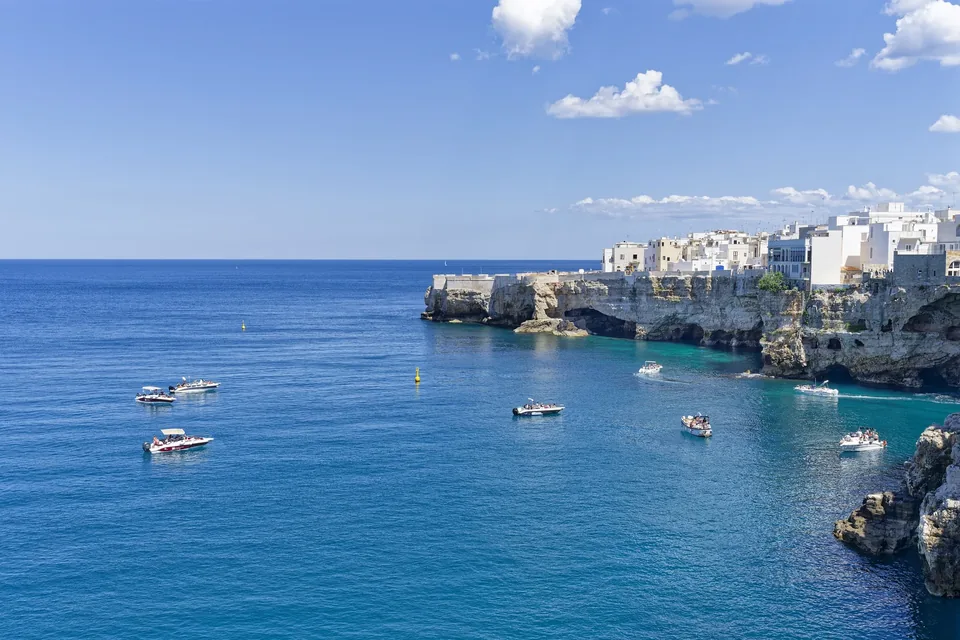
Old town, viewpoints and a coffee as a travel pause. A white town on a cliff, the Arco Marchesale, contemporary art and the multicoloured Polignano carrot. And then the history of the mother church, the Pino Pascali museum, the dives from the houses of the old town, the feast of Saint Vitus and the Costa Ripagnola nature park.
Read the guide →Photo: Maksimsokolov / Wikimedia Commons — CC BY-SA 4.0 · Resized and converted to WebP.

Castellana Grotte
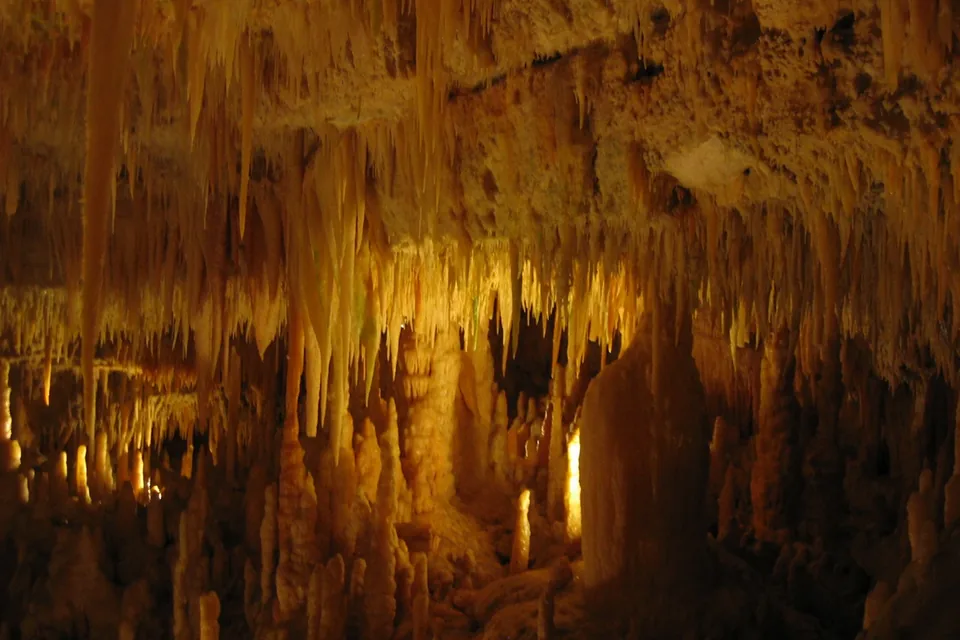
Karst, caves and the town within a journey connected to the Itria Valley.
Read the guide →Photo: ReMagio at Italian Wikipedia / Wikimedia Commons — Public domain · Resized and converted to WebP.

Putignano
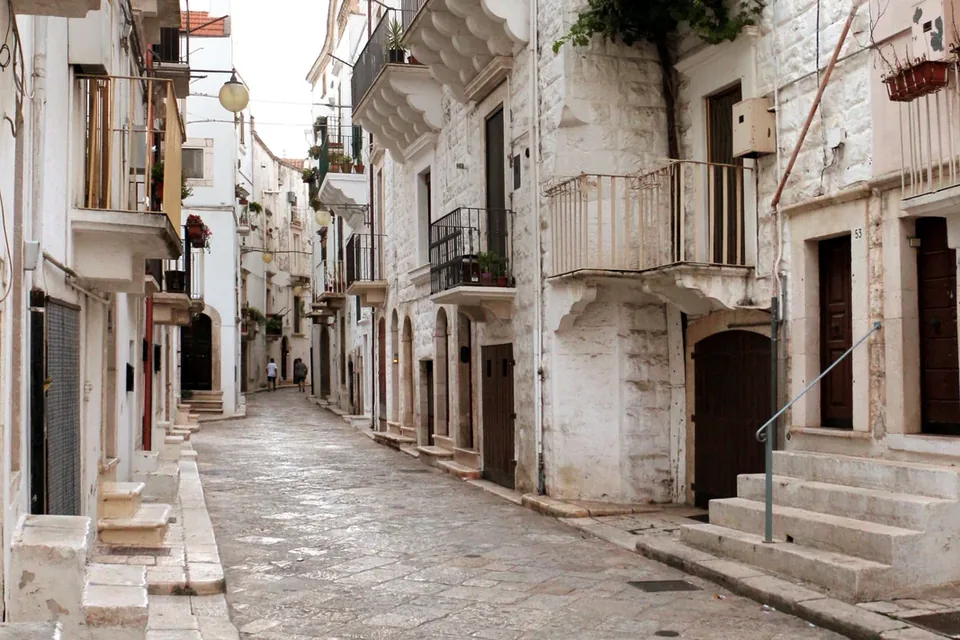
Putignano: papier-mâché and town memory. Europe’s oldest carnival runs from 26 December to Lent with papier-mâché floats, while farinella recalls rural cooking.
Read the guide →Photo: Sailko / Wikimedia Commons — CC BY 3.0 · Resized and converted to WebP.

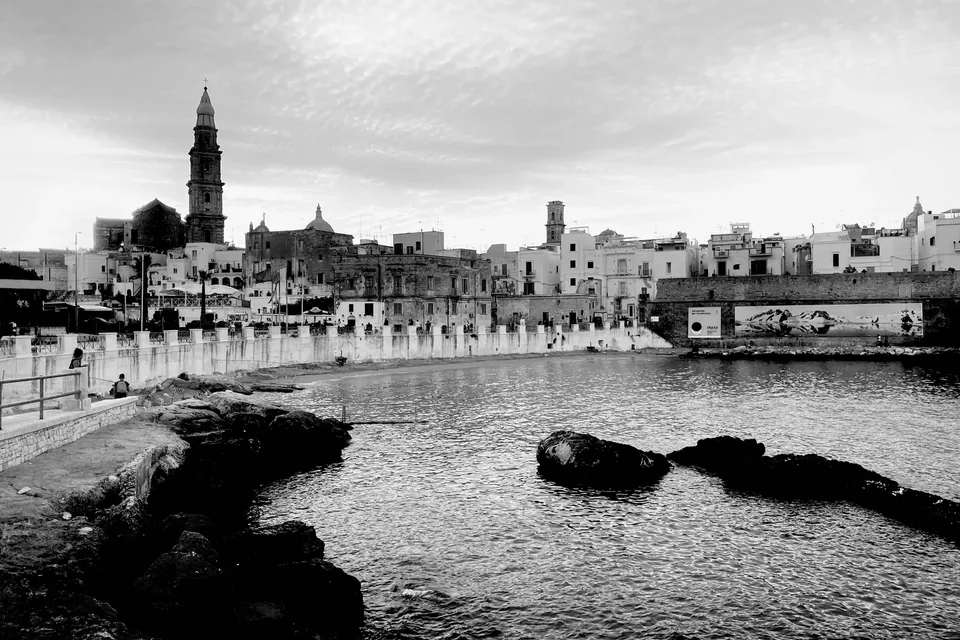
Monopoli
An Adriatic conclusion connected to the rural landscape. A harbour reaching into the old town, the cathedral, rural contrade and ‘mareterra’ cooking.
Read the guide →Photo: RaTio65 / Wikimedia Commons — CC BY-SA 4.0 · Resized and converted to WebP.

Rutigliano
Rutigliano (BA), Puglia: 18,223 residents, 53.85 km². The official facts of the municipality, its town council website and its registered accommodation.
Read the guide →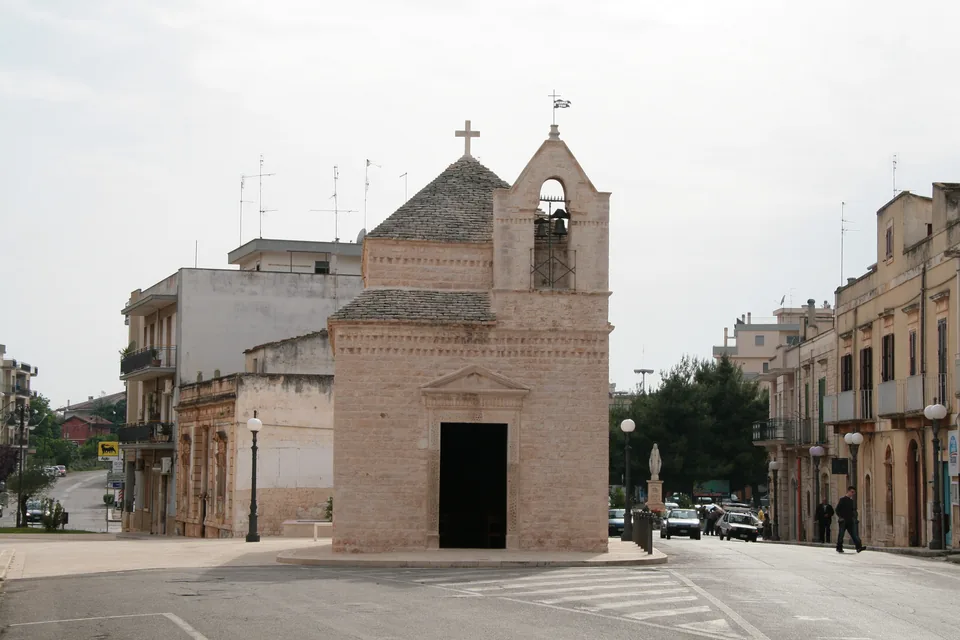
Turi
Turi (BA), Puglia: 12,968 residents, 71.40 km². The official facts of the municipality, its town council website and its registered accommodation.
Read the guide →Photo: C.S. / Wikimedia Commons — CC BY-SA 3.0 · Resized and converted to WebP.

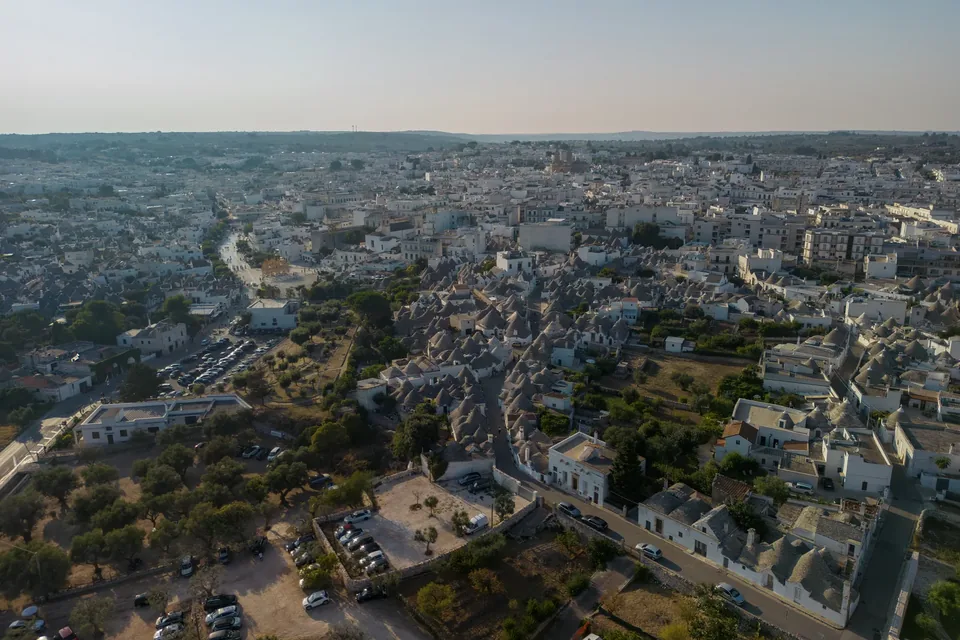
Alberobello
Trulli through their shape, space and everyday use. The Monti and Aia Piccola districts hold more than a thousand trulli, a World Heritage Site since 1996.
Read the guide →Photo: ParisTaras / Wikimedia Commons — CC BY-SA 4.0 · Resized and converted to WebP.

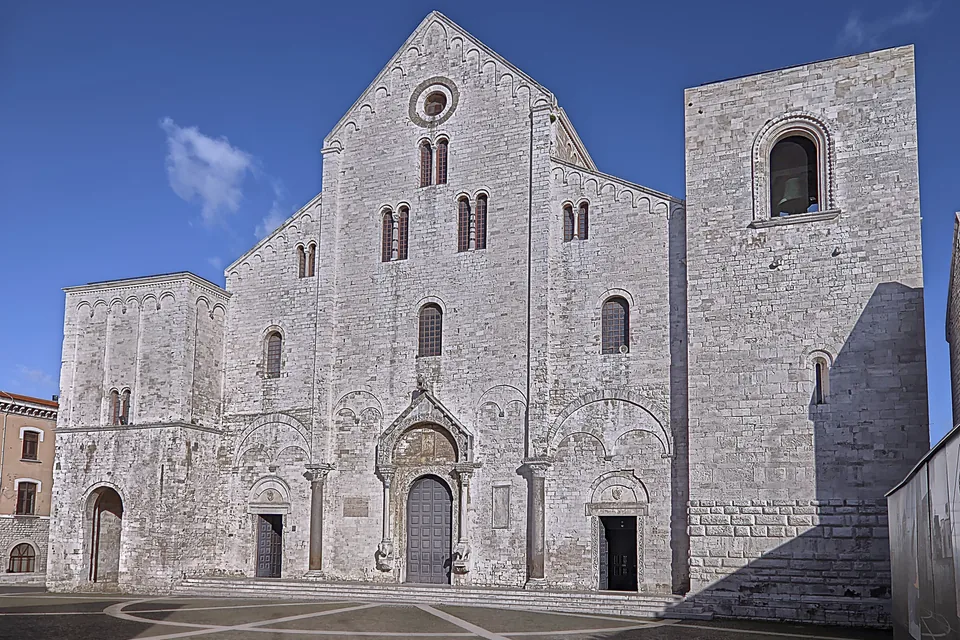
Bari
The old town as a first encounter with Puglia. The Basilica and relics of Saint Nicholas, Bari Vecchia between its two harbours, the Murat district, focaccia and orecchiette with turnip tops.
Read the guide →Photo: Acquario51 / Wikimedia Commons — CC BY-SA 4.0 · Resized and converted to WebP.

“Come to Conversano as a guest, not as a tourist: that is how these places truly let you know them.”