Why go
Manduria lies between three provincial capitals: Puglia's regional cultural heritage map describes it as equidistant from Taranto, Lecce and Brindisi, with a territory of 178 square kilometres running from the town to the Ionian Sea. Within a few hours you move from a Messapian city to a medieval and baroque historic centre, from Primitivo vineyards to a coast the municipality puts at about 15 kilometres.
The first reason is stone. North-east of the modern town stand the three wall circuits built between the 5th and 3rd centuries BC, which the regional map rates as the best preserved in the Salento for extent and condition, together with a necropolis of more than 1,200 tombs and the Fonte Pliniano, the cave and spring described by Pliny the Elder.
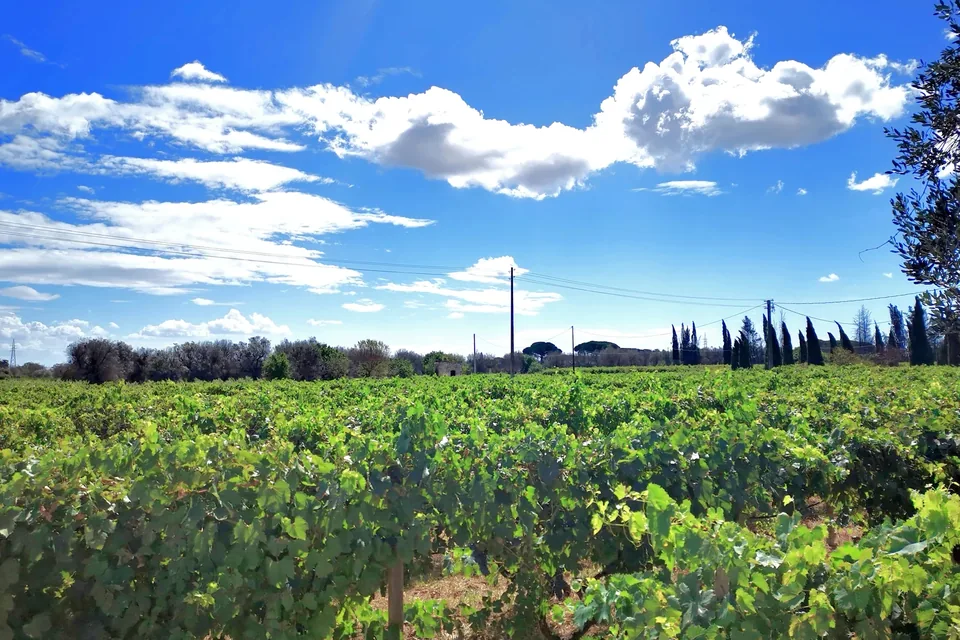
The second is wine: Manduria gives its name to a denomination that the protection consortium spreads across 18 municipalities in the provinces of Taranto and Brindisi, with over 5,000 hectares of vineyards, some still trained as alberello bush vines, according to the consortium the oldest way of training the vine.
The third is the sea, with San Pietro in Bevagna, the mouth of the Chidro, the Salina dei Monaci and Torre Colimena: beaches, a river that begins underground, a wetland and a regional reserve managed by the municipality. One point worth knowing before you leave: as of 7 November 2026 the Archaeological Park can be visited only during special openings.
Sources: CartApulia, Carta dei beni culturali della Regione Puglia — Manduria · Comune di Manduria — la città e il litorale · Italia.it, Ministero del Turismo — Parco Archeologico delle Mura Messapiche · Parco Archeologico di Manduria — Le Mura Messapiche · Parco Archeologico di Manduria — Il Fonte Pliniano · Consorzio di Tutela del Primitivo di Manduria — Terroir e territorio · Bollettino Ufficiale della Regione Puglia n. 16 del 14-2-2023 — Riserve del Litorale Tarantino Orientale · Parco Archeologico di Manduria — Orari e tariffe
History
Ancient Manduria was a city of the Messapians, ringed with ditches and megalithic walls between the 5th and 3rd centuries BC. The Archaeological Park's website recalls the episodes that marked it: Taranto besieged it in vain with the help of Archidamus, king of Sparta, who died beneath its walls in 338 BC; Hannibal took it in 212 BC and in 209 BC the consul Quintus Fabius Maximus conquered it, with rich booty and 3,000 prisoners. Pliny the Elder mentions it in his Natural History for its spring, and the national portal also reports his description of the town as "viticulosa", rich in vines.
The sources disagree about the end of the ancient city. The Ministry of Tourism's portal speaks of destruction by Totila in AD 547, the Treccani Italian Encyclopaedia of a Saracen destruction in the 10th century; the regional map notes that by the early Middle Ages perhaps only the name and part of the walls remained, the inhabitants having scattered to nearby hamlets.
At the end of the 11th century the Normans founded a smaller settlement, today's historic centre, set against the end of the outer Messapian circuit: it was called Casalnuovo for seven centuries. The national portal gives 1090 and Roger I of Hauteville. In 1575 the royal court sold the fief to Davide Imperiali, of a Genoese family; the Imperiali held it until 1782, as new quarters and convents arose. The edict of 14 November 1789 by Ferdinand IV of Bourbon gave the town back the name of Manduria.
The twentieth century left other memories: the Civic Museum, opened in 2018, tells of the American servicemen at the military airfield during the Second World War, and a house museum remembers Elisa Springer, writer and witness of the Shoah.
Sources: Parco Archeologico di Manduria — Le Mura Messapiche · Parco Archeologico di Manduria — Il Fonte Pliniano · Enciclopedia Italiana Treccani — Manduria · Italia.it, Ministero del Turismo — Manduria · CartApulia, Carta dei beni culturali della Regione Puglia — Manduria · Museo Civico di Manduria · Casa Museo Elisa Springer
What to see
The Archaeological Park of the Messapian Walls, in piazza Scegnu, brings together the three circuits, the necropolis, the Fonte Pliniano and the church of San Pietro Mandurino. According to the national portal the inner circuit, from the 5th century BC, forms an irregular pentagon of large polygonal boulders; the middle one, from the 4th, is taller and built of regular blocks; the outer one, from the 3rd and the most imposing, has two faces filled with earth and rubble. The more than 1,200 trench tombs were excavated by Nevio Degrassi between 1955 and 1960. The Fonte Pliniano is a cave about 18 metres across, with a flight of steps and a skylight at the top of the vault. The church of San Pietro Mandurino joins a room perhaps from the 13th century to an 8th-century crypt with frescoes of hermit saints; the Park's website lists it as temporarily closed for works.
Grave goods from the tombs are displayed at the Archaeological Museum "Manduria, Terra di Messapi", in the former Augustinian convent.
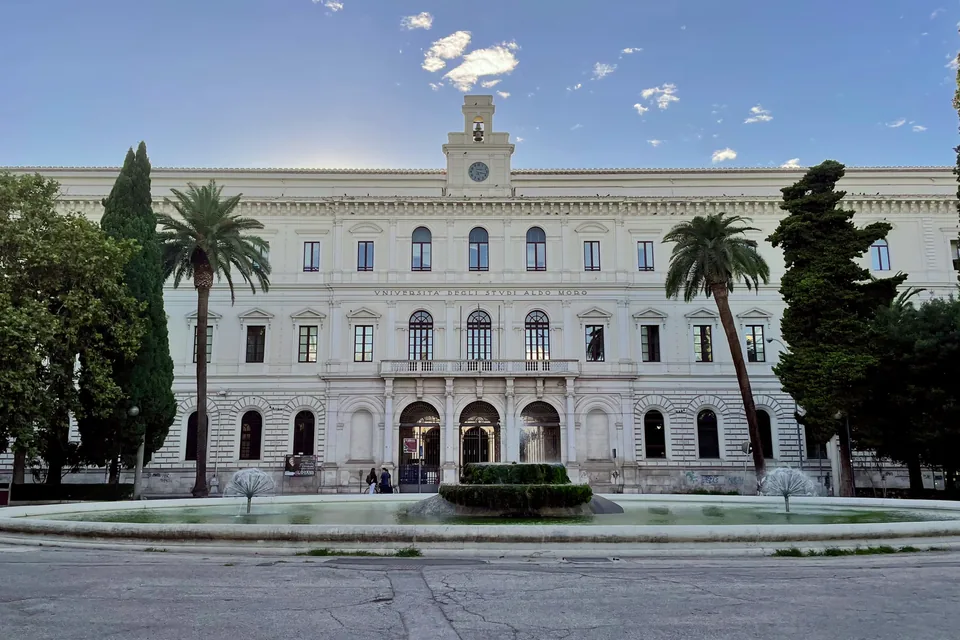
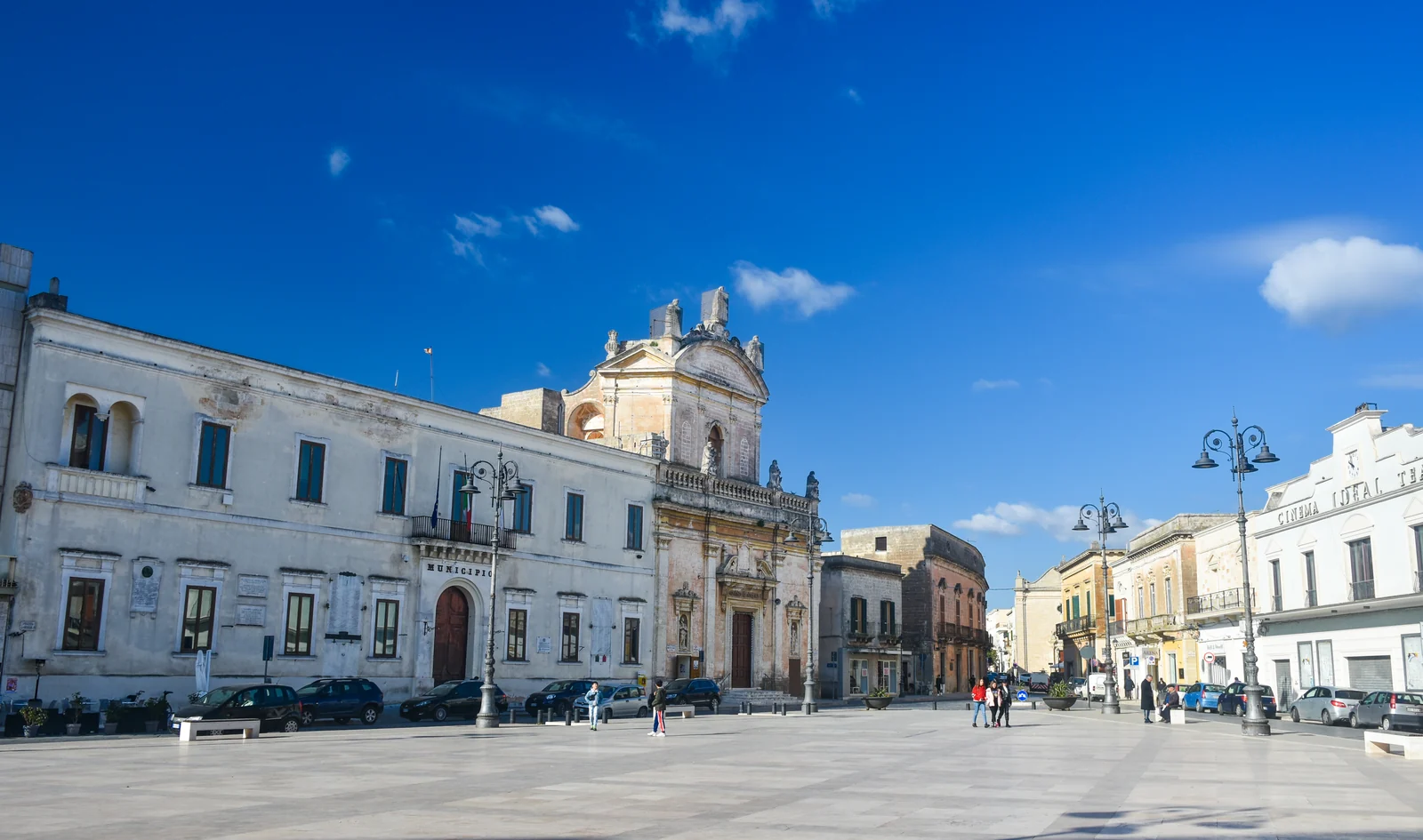
In the historic centre, a tangle of lanes and small squares, the mother church of the Santissima Trinità combines Romanesque and Gothic elements, and opposite it an arch leads into the old Jewish ghetto. Palazzo Imperiali, built over the remains of the Norman castle for Michele Imperiali, who entrusted the work to Mauro Manieri of Lecce, is dated 1719 by the regional record and 1717-1722 by the General Catalogue of Cultural Heritage, which lists it as private property; the regional record gives the ground floor and courtyard as open to visitors. Also worth seeing are the Calvary, decorated with shells and coloured ceramics, and the Civic Museum.
By the sea, at San Pietro in Bevagna the church leans against a tower, and Torre Colimena keeps one of the towers of the defensive system ordered by Charles V.
Sources: Italia.it, Ministero del Turismo — Parco Archeologico delle Mura Messapiche · Parco Archeologico di Manduria — Le Mura Messapiche · Parco Archeologico di Manduria — Il Fonte Pliniano · Parco Archeologico di Manduria — Chiesa di San Pietro Mandurino · Museo Archeologico «Manduria, Terra di Messapi» · Italia.it, Ministero del Turismo — Da Taranto a Manduria · Regione Puglia, AI Smart — Palazzo Imperiali · Catalogo generale dei beni culturali, Ministero della Cultura — Palazzo Imperiali · CartApulia, Carta dei beni culturali della Regione Puglia — Manduria · Museo Civico di Manduria · Comune di Manduria — la città e il litorale
Food and wine
Primitivo owes its name to the early ripening of its grapes. The protection consortium describes a landscape running from iron-rich red earth with limestone outcrops to the sand of the districts near the sea, and a variety also grown as bush vines, the oldest training system, no more than a metre and a half tall. The denomination covers Manduria and 14 other municipalities in the province of Taranto, plus Oria, Erchie and Torre Santa Susanna in the province of Brindisi. It has two levels: Primitivo di Manduria DOC, whose stages since 1974 are told in Apulica's product page, and the Dolce Naturale DOCG, from 2011. The history and techniques can be followed at the Museum of the Civilisation of Primitivo Wine, in the nineteenth-century cisterns of the Produttori di Manduria winery: the museum recommends booking the guided visit and tastings.
The table is not only wine. The pomodorino di Manduria, a Slow Food Presidium, is a small oval tomato, often with a point at its base, grown by hand and without irrigation: it is picked from mid-June to the end of July and eaten fresh with carosello, a local cucumber, or in jatedda, the summer salad with garlic, capers and oregano that dresses friselle; the passata is available all year.
The colombino di Manduria, also a Presidium, is a more recent story: a small pastry of puff pastry, orange almond paste and custard under a meringue glaze, which testimonies place in the 1950s, linked by legend to a pastry chef who stopped in town in 1953. The full pages for these products and the guide to Primitivo are at the bottom of this page.
Sources: Consorzio di Tutela del Primitivo di Manduria — Terroir e territorio · Consorzio di Tutela del Primitivo di Manduria — Evoluzioni · Italia.it, Ministero del Turismo — Museo della Civiltà del Vino Primitivo · Museo della Civiltà del Vino Primitivo · Fondazione Slow Food — Pomodorino di Manduria · Fondazione Slow Food — Colombino di Manduria
Things to do
The Regional Oriented Nature Reserves of the Eastern Taranto Coast, created by regional law 24 of 23 December 2002 and managed by the municipality of Manduria, cover 1,081.34 hectares along the coast and just inland. The regional bulletin lists four areas: Salina dei Monaci, Palude del Conte, the Cuturi and Rosa Marina woods, and the mouth of the river Chidro.
The Salina dei Monaci is a wetland linked to the sea by a channel, surrounded by dunes and Mediterranean scrub: regional pages point to it for birdwatching and pink flamingos. The Chidro is a short and unusual river: it runs for about 10 kilometres underground to the spring called the "cratere", then for about 500 metres on the surface, forming three small lakes, before reaching the sea near San Pietro in Bevagna. The regional record gives a water temperature of 18 to 20 degrees.
Off that same beach, about 70 metres from the shore and 3 to 6 metres deep, lies the cargo of a Roman ship: unfinished white marble sarcophagi, twenty according to the study published by the University of Salento, twenty-three according to the municipality, which also mentions frequent covering by sand. Analyses point to marble from the island of Thasos; the wreck is dated to the 3rd century AD. They are not always visible, so they should not be the only purpose of the day. The municipality also mentions the sandy beaches of Specchiarica and the rocky ones of Marchese.
Walkers can follow the Via Jonica of the Cammino Materano: its first section, Manduria to Torre Colimena, measures 18.8 kilometres. The official site states that waymarking and GPX tracks are available, but the accommodation network is still being built. San Pietro in Bevagna appears on the 2026 Blue Flag list.
Sources: Bollettino Ufficiale della Regione Puglia n. 16 del 14-2-2023 — Riserve del Litorale Tarantino Orientale · Regione Puglia, Press — area protetta del fiume Chidro · Italia.it, Ministero del Turismo — Da Taranto a Manduria · Regione Puglia, AI Smart — Saline dei Monaci · Regione Puglia, AI Smart — San Pietro in Bevagna · Regione Puglia, AI Smart — Riserva naturale della foce del fiume Chidro · Comune di Manduria — I sarcofagi sommersi di San Pietro in Bevagna · Università del Salento — Provenance of the Roman marble sarcophagi of the San Pietro in Bevagna Wreck · CNR — naves lapidariae della costa ionica del Salento · Comune di Manduria — la città e il litorale · Cammino Materano — Via Jonica · FEE Italia — Elenco spiagge Bandiera Blu 2026
When to go
Manduria's calendar changes with the countryside. The Slow Food record has the pomodorino sown from late February near the coast and in March inland, at the time of the Pessima fair, held for two centuries in the second week of the month. The harvest runs from mid-June to the end of July, the right moment to eat it fresh.
Summer is the season of the sea and the coastal villages; if you arrive by car, bear in mind that the municipality has set rules for a limited traffic zone at San Pietro in Bevagna and Torre Colimena. September brings two events: the patronal feast of San Gregorio Magno, which the regional record gives as 2 to 4 September and for which the municipality gave the same days in a 2026 notice, and the Festa delle Giuggiole, a jujube festival whose 8th edition took place in the Archaeological Park on 12 September 2026. Both 2026 editions have ended: the dates of the next ones should be checked once published.
Spring and autumn are the best periods for the Via Jonica, for which the Cammino Materano site gives the season as autumn to spring, and for walks in the reserves.
For archaeology, the date needs checking first of all. Verified on 7 November 2026: the Park's website states that from 21 September it can be visited only during special openings, because of a reorganisation of its management, and that the church of San Pietro Mandurino is closed for works. Anyone planning a trip for the walls should ask the Park which openings are scheduled; the Archaeological Museum, Civic Museum and House Museum have their own channels.
Sources: Fondazione Slow Food — Pomodorino di Manduria · Comune di Manduria — Delibera di Giunta 111 del 5-5-2021, ZTL San Pietro in Bevagna e Torre Colimena · Regione Puglia, AI Smart — Festa patronale di San Gregorio · Comune di Manduria — Festa di San Gregorio Magno, avviso 2026 · Parco Archeologico di Manduria — Festa delle Giuggiole 2026 · Cammino Materano — Via Jonica · Parco Archeologico di Manduria — Orari e tariffe · Parco Archeologico di Manduria — Chiesa di San Pietro Mandurino · Museo Archeologico «Manduria, Terra di Messapi» · Museo Civico di Manduria · Casa Museo Elisa Springer
Getting there and around
The airports to consider are Brindisi and Bari, run by Aeroporti di Puglia. Manduria lies inland, about 36 kilometres from Taranto according to the Italian Encyclopaedia and just over ten from the sea, and equidistant from Taranto, Lecce and Brindisi according to the regional map: a car is the simplest way to combine the town, the wineries and the coast.
Manduria station lies on the railway now run by FS Sud Est, between Francavilla Fontana and Lecce. Parts of this network have had replacement buses in the past: before relying on the train, check timetables and the state of the service with the company. CTP links Taranto with the towns of the province; here too, timetables should be checked with the company at the time of travel.
For the coastal villages you need your own transport or a transfer: the regional record gives 12 kilometres from Manduria to San Pietro in Bevagna, and the walking stage of the Via Jonica to Torre Colimena measures 18.8. The municipality has approved rules for transit permits in the limited traffic zone of San Pietro in Bevagna and Torre Colimena, with forms for residents and accommodation: if you are staying there, ask your host how to reach it.
The historic centre and the Archaeological Park are explored on foot. Punta Prosciutto, just past Torre Colimena, lies across the provincial boundary, in the municipality of Porto Cesareo, province of Lecce.
Sources: Aeroporti di Puglia — Brindisi · Aeroporti di Puglia — Bari · Enciclopedia Italiana Treccani — Manduria · CartApulia, Carta dei beni culturali della Regione Puglia — Manduria · FS Sud Est — sito ufficiale · CTP Taranto — sito ufficiale · Regione Puglia, AI Smart — San Pietro in Bevagna · Cammino Materano — Via Jonica · Comune di Manduria — Delibera di Giunta 111 del 5-5-2021, ZTL San Pietro in Bevagna e Torre Colimena · Regione Puglia, AI Smart — Punta Prosciutto
Where to stay
The territory offers three different ways to stay, and the choice depends on what you want to do each day.
In town you sleep close to the historic centre, the museums and the Archaeological Park, and in the evening you stay among the lanes and small squares described by the national portal. It is the most logical base for those coming for archaeology or wineries, and for setting out towards Taranto, Lecce or Brindisi, which the regional map places at equal distance.
Along the coast, at San Pietro in Bevagna, Specchiarica and Torre Colimena, you are a few steps from the beach and the reserves. These are seaside places with a marked season and a limited traffic zone set by the municipality: check the opening period and, with your host, car access.
In the countryside, among vineyards and olive groves, there are masserie and farm stays. They offer space and quiet but require a car for every trip, including to the beach.
In this section we do not recommend specific properties. Further down you will find first the properties that introduced themselves to Apulica, then the official census of the municipality's accommodation: this is public data and not a selection of Apulica partners. If you prefer, we can handle the stay request for you.
Sources: Italia.it, Ministero del Turismo — Da Taranto a Manduria · CartApulia, Carta dei beni culturali della Regione Puglia — Manduria · Comune di Manduria — la città e il litorale · Comune di Manduria — Delibera di Giunta 111 del 5-5-2021, ZTL San Pietro in Bevagna e Torre Colimena
Nearby
The Via Jonica links Manduria with Taranto through Torre Colimena, Maruggio, Lizzano and Pulsano; the Ministry of Tourism proposes a similar itinerary along the Ionian coast. Taranto offers MArTA, the National Archaeological Museum, where the Messapian city can be compared with the great Magna Graecia polis that was its adversary, and the old town between two seas.
Inland, the national portal points to Avetrana, with its courtyard houses, old oil mills and the remains of a 14th-century castle. The Primitivo denomination also leads to Oria, Erchie and Torre Santa Susanna in the Brindisi area, and to Sava and Maruggio in the Taranto area.
Along the coast towards Lecce, past Torre Colimena, you enter another territory. Punta Prosciutto, on the boundary between the provinces of Taranto and Lecce, belongs to the municipality of Porto Cesareo: the regional record describes its shore between Torre Colimena and Torre Lapillo, with pale sand and Mediterranean scrub. Punta Prosciutto is also where, according to the Ministry of the Environment, the Porto Cesareo Marine Protected Area begins, reaching as far as Torre Inserraglio.
Lecce and Brindisi can be reached in a day: the regional map notes that Manduria is equidistant from those two capitals and Taranto. From a base here you can alternate walls, vineyards, museums and the sea on different days.
Sources: Cammino Materano — Via Jonica · Italia.it, Ministero del Turismo — Da Taranto a Manduria · Italia.it, Ministero del Turismo — Manduria · Consorzio di Tutela del Primitivo di Manduria — Terroir e territorio · Regione Puglia, AI Smart — Punta Prosciutto · Ministero dell’Ambiente e della Sicurezza energetica — AMP Porto Cesareo · CartApulia, Carta dei beni culturali della Regione Puglia — Manduria
Where to stay
In the municipality of Manduria the national database of the Ministry of Tourism lists 1030 accommodation businesses with a verified CIN code: 11 hotels, 166 other licensed accommodation and 853 other types such as B&Bs and private rentals.
Licensed businesses from the official list of Regione Puglia, each with a checked national CIN code: matching municipality and category. Private individuals are not listed. This list is the official census of licensed businesses, not a list of Apulica partners: to stay in Manduria you do not have to check one property after another yourself; write to Apulica and we look for the stay that suits your journey, checking availability and conditions before any confirmation.
We open the list with those who have introduced themselves to Apulica, most recent first, each with a description we wrote from the information they sent or published. Those who introduced themselves are part of the census too, with their official category; neither their position in the list nor the description indicates any commercial relationship.
MASSERIA SCALEDDA
Holiday home
A fortified masseria with a view of the sea, in the countryside of Manduria. Its history, as the masseria itself tells it, begins in 1172 with the defence tower built by the Benedictines of Aversa; Raffaele Schiavoni restored and enlarged it in 1856. Around it lie 125 hectares of Mediterranean scrub and centuries-old olive trees. Dogs are welcome on prior request.
CIN IT073012B400117604
AL CIVICO 2
Guest rooms
CIN IT073012B400022956
CASA IONIO
Guest rooms
CIN IT073012B400125801
ERPI VACANZE DI PALMATE' CINZIA
Guest rooms
CIN IT073012B400032264
IL RIFUGIO DEL TURISTA
Guest rooms
CIN IT073012B400102362
Kalyvia
Guest rooms
CIN IT073012B400126151
LA GIARA
Guest rooms
CIN IT073012B400026087
La Criansa
Guest rooms
CIN IT073012B400089975
Messapico
Guest rooms
CIN IT073012B400060857
NATURALMENTE A SUD
Guest rooms
CIN IT073012B400032025
OFFICINE IL VOLO - FATTORIA IL NOCE
Guest rooms
CIN IT073012B400026158
Oasi Cleopatra Luxury Suite
Guest rooms
CIN IT073012B400109972
PALEAT
Guest rooms
CIN IT073012B400046336
SANTA CHIARA
Guest rooms
CIN IT073012B400023472
SCUDELLA SRL
Guest rooms
CIN IT073012B400032485
buona creanza
Guest rooms
CIN IT073012B400090692
AGRITURISMO MASSERIA POTENTI
Farm stay
CIN IT073012B500021827
AZIENDA AGRICOLA MALORGIO - AGRITURISMO
Farm stay
CIN IT073012B500091027
AZIENDA AGRICOLA TORREBIANCA
Farm stay
CIN IT073012B500024530
FINO GIANFRANCO
Farm stay
CIN IT073012B500066900
LE FRASCHE
Farm stay
CIN IT073012B500129410
MASSERIA CUTURI 1881
Farm stay
CIN IT073012B500054660
MASSERIA FELLICCHIE
Farm stay
CIN IT073012B500026945
MASSERIA LI RENI
Farm stay
CIN IT073012B500027258
MASSERIA PRISUTI
Farm stay
CIN IT073012B500026306
QUI MEDITERRANEO
Farm stay
CIN IT073012B500118378
geanide
Farm stay
CIN IT073012B500127768
ACQUADAMARE B&B
B&B
CIN IT073012B400056929
ARCHIDAMO
B&B
CIN IT073012B400021407
Almarè B&B di Gioia Vittorio
B&B
CIN IT073012B400064563
Appartamento dei Pittori
B&B
CIN IT073012B400089139
B&B L'ATELIER
B&B
CIN IT073012B400042871
B&B LA COLIMENA
B&B
CIN IT073012B400056924
B&B MACCHIA MEDITERRANEA
B&B
CIN IT073012B400027653
B&B MASSERIA SCALEDDA
B&B
CIN IT073012B400126142
B&B Saint Matthew
B&B
CIN IT073012B400059084
B&B Vento del Mare
B&B
CIN IT073012B400075365
B&b Petra Solis
B&B
CIN IT073012B400090881
CASA AOOM B&B
B&B
CIN IT073012B400091278
CHILL GARDEN B&B
B&B
CIN IT073012B400111848
D.F. BED & BREAKFAST
B&B
CIN IT073012B400021826
IL GIRASOLE
B&B
CIN IT073012B400028123
MASSERIA SPECULA
B&B
CIN IT073012B400083041
MAZZARA
B&B
CIN IT073012B400021828
MIRAMARE
B&B
CIN IT073012B400036021
MORGAN S.R.L.S.
B&B
CIN IT073012B400094763
Palazzo Donna Elisabetta
B&B
CIN IT073012B400057571
TENUTA CARDINALE
B&B
CIN IT073012B400125445
VILLA MIMINA
B&B
CIN IT073012B400112121
AURORA
Campsite · ★★
CIN IT073012B100021465
LA SALINA - MINI AREA DI SOSTA
Campsite · ★
CIN IT073012B100020424
SOSTA CAMPER TORRE BORRACO
Campsite · ★
CIN IT073012B100128110
Sosta Camper La Specchia
Campsite · ★★★★
CIN IT073012B100078584
Villaggio Camping Tiziana
Campsite · ★★★★
CIN IT073012B100108663
LOCAZIONI BREVI SAINT MATTHEW
Holiday house
CIN IT073012B700115847
Borgo Bevagna Relais
Holiday home
CIN IT073012B400079457
CASA DEL PRIMITIVO
Holiday home
CIN IT073012B400095244
Casa degli Ulivi
Holiday home
CIN IT073012B400122749
Casa dei Francesi
Holiday home
CIN IT073012B400099609
Casa del Mandorlo
Holiday home
CIN IT073012B400095806
Casa del Mirto
Holiday home
CIN IT073012B400095707
Casa sul Mare
Holiday home
CIN IT073012B400095838
GINEPRI DEL SALENTO
Holiday home
CIN IT073012B400126050
LA SCOGLIERA
Holiday home
CIN IT073012B400020363
LE TRE TORRI
Holiday home
CIN IT073012B400125497
La Corte della Salina
Holiday home
CIN IT073012B400095950
RESIDENCE LUCILLA
Holiday home
CIN IT073012B400058085
SALENTIN_HOME
Holiday home
CIN IT073012B400073151
VILLA ODETTA
Holiday home
CIN IT073012B400054631
il cappero
Holiday home
CIN IT073012B400090693
villa salina monaci
Holiday home
CIN IT073012B400088688
AURORA ALBERGO
Hotel · ★★★★
CIN IT073012A100024376
BHB HOTEL
Hotel · ★★★★
CIN IT073012A100025124
Boomerang Village
Hotel · ★★★★
CIN IT073012A100120865
CORTE BORROMEO
Hotel · ★★★★
CIN IT073012A100022709
HOTEL CARAIBISIACO
Hotel · ★★★
CIN IT073012A100026481
REGGIA DOMIZIA
Hotel · ★★★★
CIN IT073012A100021772
S.PAOLO
Hotel · ★★★★
CIN IT073012A100028866
VINILIA WINE RESORT
Hotel · ★★★★
CIN IT073012A100024548
MALIBUU'
Holiday village · ★★★
CIN IT073012B200020404
Ask Apulica for a stay in Manduria We reply shortly, within a few hours at most, with a proposal for you to consider.
Sources: Regione Puglia – ARET Pugliapromozione (DMS), CC BY 4.0, 2026-10-12 · Ministero del Turismo – Banca Dati Strutture Ricettive (dashboard pubblica), 2026-10-12
YOUR JOURNEY
How to shape a journey here
We can organise Manduria around the walls, museums and wineries, checking current openings, or combine Primitivo and the coastal reserves in a stay between countryside and sea.
Plan your trip